Every minute of unplanned downtime costs manufacturers an estimated $260,000 in lost output, emergency repairs, and missed delivery windows. Yet most factories still run on fixed maintenance schedules and manual inspections that catch problems only after they have already disrupted production. Predictive analytics and machine learning are rewriting this equation—turning raw sensor data into forward-looking intelligence that lets manufacturing teams anticipate failures, optimize throughput, and make every operational decision with data-backed confidence. With the global predictive analytics market projected to surpass $91 billion by 2032, manufacturers who invest in data-driven operations today are building a competitive moat that reactive competitors simply cannot match. Schedule a free consultation to discover how your plant can shift from reactive firefighting to predictive precision.
How Predictive Analytics Prevents Unplanned Downtime in Manufacturing
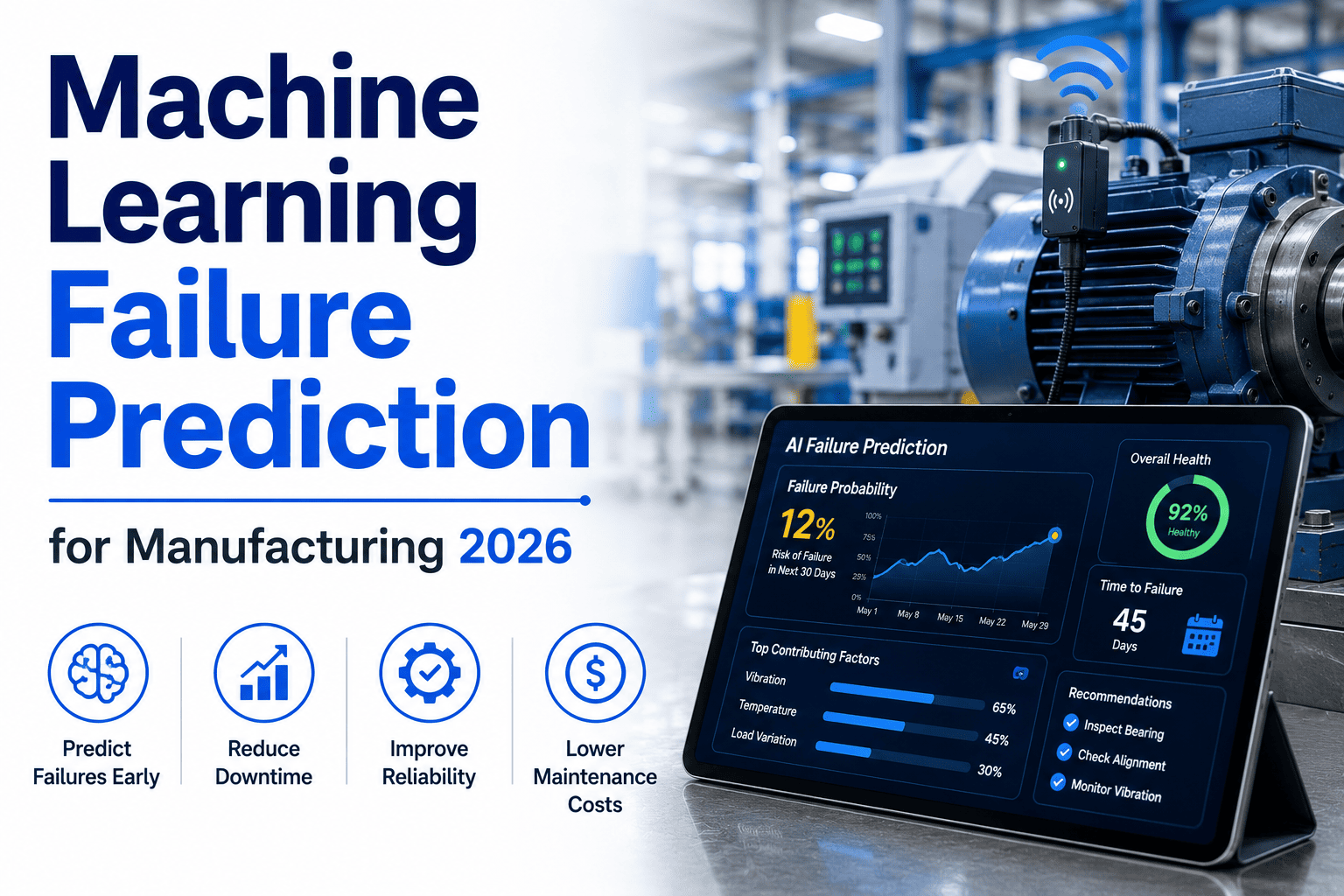
Unplanned downtime remains the single most expensive problem in manufacturing. According to industry research, predictive maintenance strategies have reduced unplanned stoppages by 30–50% across automotive, food processing, aerospace, and heavy industry. The difference lies in how data is used: instead of replacing parts on a calendar schedule or waiting for catastrophic failure, machine learning models analyze real-time equipment health signals to predict exactly when intervention is needed—often weeks before a human inspector would notice the early warning signs.
$50B+
Estimated annual cost of unplanned downtime across industrial manufacturing
70–75%
Reduction in downtime reported by manufacturers deploying predictive maintenance
87%
Fewer equipment defects with predictive over preventive maintenance (NIST)
The shift from reactive to predictive maintenance is not just a technology upgrade—it is an operational philosophy change. When your CMMS integrates real-time condition monitoring with automated work order generation, maintenance teams stop firefighting and start strategically managing asset health across the entire facility. Sign up for Oxmaint to digitize your maintenance workflows today.
What sensors capture
Vibration signatures from bearings, gearboxes, and rotating assemblies
Thermal profiles indicating overheating or friction anomalies
Acoustic emissions revealing micro-cracks and structural stress
Power consumption patterns flagging motor degradation
Fluid quality measurements detecting contamination or wear particles
What ML models predict
Remaining useful life (RUL) for each critical component
Probability of failure within specific time windows
Root cause classification for detected anomalies
Optimal maintenance scheduling based on production load
Cost-risk trade-off analysis for repair vs. replace decisions
Stop losing revenue to preventable breakdowns. Oxmaint centralizes asset data, automates condition-based work orders, and gives your team the real-time visibility to act before failures happen.
Sign Up Free
Book a Demo
Machine Learning Use Cases That Deliver Measurable Factory ROI
Predictive maintenance is the most widely adopted ML application in manufacturing—but it is only the beginning. Leading factories are applying machine learning across quality control, demand forecasting, supply chain management, production scheduling, and energy optimization. Each use case compounds savings and creates a factory ecosystem that gets smarter with every production cycle. Here are the six highest-impact applications driving documented returns in 2025 and 2026.
01
Predictive Equipment Maintenance
ML models process vibration, thermal, and power data from IoT sensors to forecast failures days or weeks in advance. Condition-based maintenance replaces fixed-interval schedules, cutting maintenance costs by 18–25% and extending asset life significantly.
300–500% typical ROI
02
AI-Powered Quality Inspection
Computer vision systems inspect every product on the line at production speed—catching surface defects, dimensional errors, and assembly flaws invisible to manual sampling. Manufacturers report achieving 99%+ defect detection rates with 24/7 consistency.
35% reduction in quality defects
03
Intelligent Demand Forecasting
ML algorithms analyze historical sales, market signals, seasonal trends, and external factors to predict demand with 85–95% accuracy. Accurate forecasts eliminate overproduction waste and prevent costly stockout events across your supply chain.
20–30% better forecast accuracy
04
Supply Chain Risk Prediction
Predictive models correlate supplier performance data, logistics patterns, and global risk indicators to identify disruptions before they cascade into production delays. Early adopters have improved inventory levels by 35% and reduced logistics costs by 15%.
150–250% ROI on supply chain AI
05
Real-Time Production Optimization
AI-driven scheduling balances machine availability, workforce capacity, material flow, and order priority in real time. Changeover times shrink, bottlenecks are eliminated dynamically, and overall equipment effectiveness (OEE) climbs measurably.
53% productivity boost (WEF Lighthouses)
06
Energy Consumption Optimization
Consumption pattern analysis predicts peak usage, recommends load shifting to off-peak windows, and identifies inefficient equipment. Factories achieve measurable energy cost reductions while building toward sustainability and emissions compliance goals.
10–20% energy cost reduction
The key to unlocking these results is having a centralized maintenance management platform that connects predictive insights to actionable workflows. When ML-generated alerts automatically trigger work orders, assign technicians, and update asset health records inside your CMMS, the gap between prediction and action collapses—and savings compound faster. Sign up for Oxmaint to automate your maintenance workflows with predictive intelligence.
From Reactive to Predictive: The Data-Driven Manufacturing Maturity Curve
Most manufacturing operations sit somewhere on a maturity curve between fully reactive maintenance and fully predictive operations. Understanding where your factory stands today—and what it takes to advance—helps you prioritize investments for maximum impact at every stage.
Stage 1
Reactive
Fix it when it breaks. No scheduled maintenance. Emergency repairs dominate. Highest downtime cost per asset.
Stage 2
Preventive
Calendar-based PM schedules. Reduces some failures but replaces parts regardless of actual condition. Over-maintenance waste is common.
Stage 3
Condition-Based
IoT sensors monitor asset health in real time. Maintenance is triggered by actual equipment state rather than schedules. CMMS integration automates work orders.
Stage 4
Predictive & Prescriptive
ML models forecast failures, optimize scheduling, and prescribe specific corrective actions. Digital twins simulate scenarios. The factory learns and improves autonomously.
Wherever you are on the maturity curve, Oxmaint meets you there. Start with digital work orders and preventive scheduling, then scale into condition monitoring and predictive workflows—all within one platform.
Sign Up Free
Book a Demo
What Does It Take to Implement Predictive Analytics on the Factory Floor?
Implementing predictive analytics does not require ripping out your existing infrastructure or hiring a team of data scientists. The most successful deployments follow a phased approach: start small with high-impact pilot assets, prove ROI quickly, and then scale systematically. Here is the practical framework that leading manufacturers follow.
Month 1–2
Identify your top 5–10 critical assets by downtime cost and failure frequency
Audit existing data sources: PLCs, SCADA, historian systems, CMMS history
Define success KPIs: unplanned downtime reduction, MTTR improvement, cost savings
Select and deploy a cloud-connected CMMS that supports condition-based triggers
Month 3–5
Install IoT sensors (vibration, thermal, power) on pilot machines
Establish data pipelines from edge devices to cloud analytics platform
Train baseline ML models using 60–90 days of historical data
Validate predictions against actual maintenance events and refine thresholds
Month 6–12+
Expand monitoring to additional production lines and asset classes
Integrate predictive alerts with automated work order generation in your CMMS
Add quality analytics, demand forecasting, and energy optimization modules
Continuously retrain models as operations evolve and new data accumulates
Most manufacturers see initial ROI within 6–12 months from predictive maintenance pilots alone. As models mature and expand across more assets and use cases, the returns compound—with leading factories reporting 300–500% ROI on their predictive analytics investments within 18 months. Schedule a free demo to see how Oxmaint can accelerate your predictive maintenance ROI.
Why Your CMMS Is the Missing Link in Predictive Manufacturing
Predictive analytics generates insights. But insights without action are just dashboards. The real value is realized when predictive alerts automatically flow into your maintenance management system—creating work orders, assigning technicians, reserving spare parts, and logging compliance data without manual intervention. This is where your CMMS becomes the operational backbone of predictive manufacturing.
Automated Work Orders
Predictive alerts trigger work orders with failure context, repair instructions, and priority ranking—eliminating manual ticket creation and reducing response time.
Asset Health Dashboards
Centralized view of every asset's condition score, predicted failure window, and maintenance history—giving maintenance managers instant decision-making visibility.
Real-Time Tracking
Track work order status, technician assignments, parts availability, and completion metrics in real time—ensuring no predicted issue falls through the cracks.
Compliance & Reporting
Automatic documentation of every maintenance action, inspection result, and asset intervention—building an audit-ready compliance trail without extra administrative effort.
Turn Predictive Insights into Maintenance Action
Oxmaint gives your maintenance team the complete platform to capture asset data, automate condition-based work orders, track equipment health in real time, and build the data foundation for predictive analytics—all from a single mobile-friendly dashboard. Stop managing maintenance in spreadsheets and start making data-driven decisions that protect your uptime and bottom line.
Frequently Asked Questions
What is predictive analytics in manufacturing?
Predictive analytics uses statistical algorithms, machine learning models, and real-time sensor data to forecast future events on the factory floor—such as equipment failures, quality drifts, demand shifts, and production bottlenecks—before they disrupt operations. It transforms manufacturing from a reactive model to a proactive, data-driven one.
How much does predictive maintenance save manufacturers?
Industry benchmarks show predictive maintenance typically delivers 18–25% reduction in maintenance costs, 30–50% less unplanned downtime, and 25–30% fewer breakdown events. Most manufacturers achieve positive ROI within 12–18 months, with predictive maintenance on high-downtime equipment often paying back within 6–9 months.
Schedule a demo to calculate your plant's projected maintenance savings.
Do we need data scientists to implement machine learning in our factory?
Not necessarily. Modern CMMS platforms and predictive maintenance tools are designed for operations and maintenance teams—not data scientists. Pre-built models, automated threshold calibration, and intuitive dashboards let your existing team start benefiting from ML insights without specialized expertise.
Sign up free and experience how easy data-driven maintenance can be.
What is the difference between predictive and preventive maintenance?
Preventive maintenance follows fixed schedules—replacing parts or servicing equipment at set intervals regardless of actual condition. Predictive maintenance uses real-time sensor data and ML analysis to determine when maintenance is actually needed, based on equipment health. This eliminates unnecessary maintenance while catching problems that fixed schedules would miss.
What equipment or sensors do we need to get started?
You can begin with existing SCADA/PLC data or basic condition monitoring tools like handheld vibration analyzers. As you scale, adding IoT vibration sensors, thermal imagers, and power monitors on critical assets unlocks deeper predictions. A phased sensor rollout—starting with your 5–10 most failure-prone machines—is the most cost-effective approach.