Manufacturing plants running AI on distant cloud servers are losing the one thing predictive maintenance demands most: real-time response at the machine level. Edge AI brings the intelligence directly to the factory floor—processing sensor data locally, flagging failures before they happen, and operating securely even on air-gapped networks. For plants handling sensitive production data or operating in regulated industries, on-premise deployment is not just a preference—it is a competitive and compliance necessity. This guide breaks down exactly how to implement edge AI for predictive maintenance, what the architecture looks like, and what ROI you can realistically expect.
$260B
Global cost of unplanned manufacturing downtime annually
10ms
Edge AI response latency vs 200–500ms on cloud-based analytics
40%
Average reduction in unplanned downtime with edge predictive maintenance
What Is Edge AI in Manufacturing?
Edge AI refers to running machine learning models directly on hardware located at or near the production equipment—inside the factory, on a local server, or embedded in a gateway device. Instead of sending raw sensor data to a remote cloud server for analysis, edge AI processes that data locally and generates actionable insights in real time. For predictive maintenance, this means vibration anomalies, temperature spikes, and pressure deviations are detected and flagged in milliseconds—not seconds or minutes later when cloud round-trips are involved.
On-Premise
Edge AI Model
Runs locally on factory hardware. Processes sensor streams from PLCs, SCADA systems, and IoT sensors without sending data outside the facility. Operates independently even when network connectivity is disrupted.
Latency: <10ms
→
Inference Layer
Real-Time Analysis
The AI model compares live equipment behavior against learned baseline patterns. Deviations trigger alerts, generate maintenance work orders, and log failure probability scores continuously.
Always On
→
Output Layer
Maintenance Actions
Findings sync to your CMMS platform, alerting technicians with specific asset IDs, failure type predictions, and recommended interventions before breakdowns occur.
Auto Work Orders
Why On-Premise Deployment Is the Right Choice for Manufacturing
Cloud-based AI works well for many industries, but manufacturing has four unique requirements that make on-premise edge deployment the superior technical and business choice. Plants dealing with air-gapped networks, strict data sovereignty regulations, intermittent connectivity, and ultra-low-latency requirements cannot afford the limitations of cloud-dependent architectures.
01
Data Sovereignty and Compliance
Automotive, aerospace, defense, and pharmaceutical manufacturers operate under strict data governance frameworks—including ITAR, ISO 27001, and GDPR. Sending raw production data to third-party cloud infrastructure creates compliance exposure. Edge AI keeps all operational data within your own network perimeter. Your sensor readings, production rates, and machine health data never leave your facility.
Zero Data Egress
02
Air-Gapped Network Compatibility
Many critical manufacturing environments deliberately isolate OT networks from the internet as a cybersecurity measure. Cloud AI is simply unusable in these environments. Edge AI models are trained externally and then deployed locally, running inference entirely offline. The AI continues detecting anomalies and generating alerts whether or not your facility has internet access.
Offline Operation
03
Sub-10ms Latency for Safety-Critical Responses
When a bearing temperature spikes toward critical threshold on a press running 400 cycles per minute, a 300ms cloud round-trip is not just slow—it is dangerous. Edge AI detects the anomaly and initiates a shutdown signal in under 10 milliseconds. For high-speed production lines, this latency gap between edge and cloud is the difference between a prevented failure and a catastrophic breakdown.
<10ms Response
04
Bandwidth and Infrastructure Cost Control
A single CNC machine with 20 sensors generates gigabytes of raw data daily. A plant floor with 200 machines produces terabytes. Streaming all of it to the cloud for analysis creates crushing bandwidth requirements and significant ongoing cloud compute costs. Edge AI filters, analyzes, and condenses this data locally—sending only meaningful alerts and aggregated summaries upstream, reducing bandwidth consumption by up to 95%.
95% Less Bandwidth
See How Edge AI Works With Your Existing Maintenance Workflow
Oxmaint integrates predictive maintenance alerts from edge AI systems directly into automated work orders, asset history, and KPI dashboards—giving your team actionable intelligence without switching tools.
Edge AI vs Cloud AI: The Real Comparison for Factory Environments
The cloud vs edge debate in manufacturing is not about which technology is better in general—it is about which architecture fits the operational realities of your plant. This comparison covers the dimensions that matter most to maintenance engineers and plant managers.
| Capability |
Edge AI (On-Premise) |
Cloud AI (Remote) |
| Response Latency |
<10 milliseconds |
200–500 milliseconds |
| Internet Dependency |
Fully offline capable |
Requires constant connectivity |
| Air-Gapped Networks |
Native support |
Not compatible |
| Data Sovereignty |
100% on-site data control |
Data leaves facility perimeter |
| Bandwidth Usage |
Minimal (processed locally) |
High (raw data streaming) |
| Compliance Fit (ITAR, ISO) |
Fully compliant |
Requires contractual review |
| Ongoing Cloud Compute Cost |
None after deployment |
Scales with data volume |
| Model Customization |
Retrained on your equipment |
Generic or semi-custom |
| Failure During Outage |
Continues operating |
Analysis stops completely |
Top 6 Edge AI Use Cases in Predictive Maintenance
Edge AI does not replace your maintenance team—it gives them foresight. These are the six highest-impact use cases where on-premise AI is being deployed across discrete and process manufacturing environments today.
01
Rotating Equipment Health Monitoring
AI models analyze vibration signatures from motors, pumps, fans, and compressors in real time. Bearing defects, imbalance, and misalignment are detected weeks before audible symptoms appear, allowing scheduled replacement during planned downtime rather than emergency shutdowns.
Average warning lead time: 2–6 weeks
02
Thermal Anomaly Detection
Edge AI processes thermal imaging and temperature sensor streams to identify hotspots in electrical panels, motor windings, and heat exchangers. Abnormal thermal patterns trigger alerts before insulation breakdown or arc flash events occur, protecting both equipment and personnel.
Electrical failure prevention: up to 70% of cases
03
CNC and Tooling Wear Prediction
Spindle load, acoustic emission, and cutting force data feed local AI models that predict tool wear curves for end mills, inserts, and drills. The system recommends tool changes at the optimal point—before quality defects appear but not prematurely, maximizing tool utilization and reducing scrap rates.
Scrap reduction: 20–35% in machining operations
04
Hydraulic System Degradation
Pressure waveform analysis by edge AI detects pump cavitation, valve leakage, and seal degradation in hydraulic presses and injection molding machines. Early-stage hydraulic issues that take months to manifest as visible failures are identified within days of first appearance.
Hydraulic failure prevention: 3x faster detection vs manual
05
Power Quality and Energy Anomalies
Motor current signature analysis reveals degradation in stator windings, rotor bars, and capacitor banks that would be invisible to conventional monitoring. Edge AI correlates power consumption patterns with equipment health scores, detecting efficiency losses that signal impending failure while also driving energy cost reduction.
Energy cost identification: 8–15% hidden waste detected
06
Conveyor and Material Handling Systems
Belt tension sensors, roller vibration, and drive current data are analyzed by edge AI to predict belt slippage, roller seizure, and drive motor failures on conveyor networks. In continuous production environments, conveyor failures create cascading line stoppages—edge AI prevents the chain reaction before it starts.
Conveyor uptime improvement: 15–25% on high-volume lines
On-Premise Edge AI Deployment Architecture
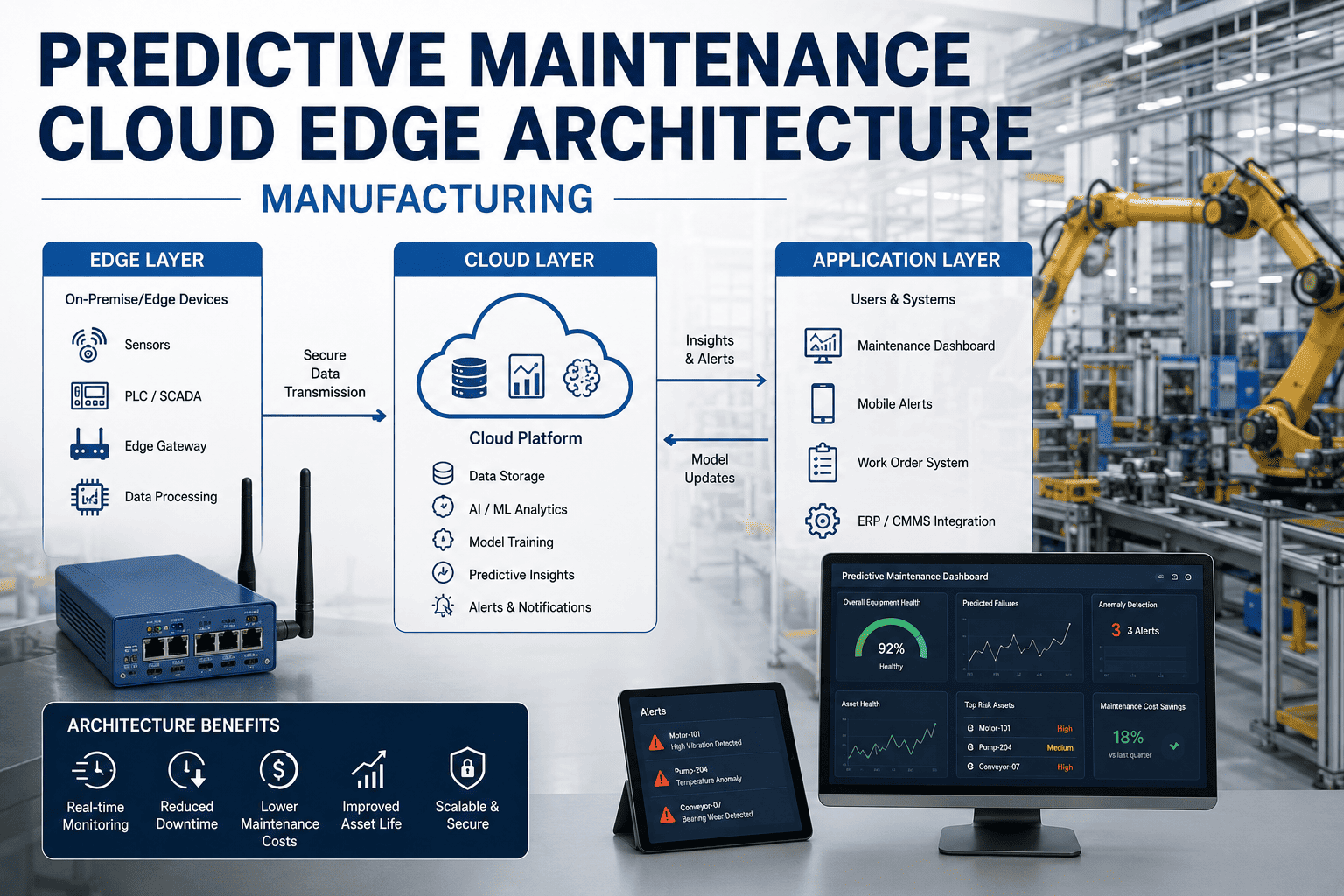
A successful edge AI deployment follows a layered architecture that connects plant-floor sensors to maintenance management systems without routing data through external networks. Understanding this architecture helps maintenance managers and IT teams collaborate on a deployment that is both technically sound and operationally sustainable.
Layer 1 — Sensing
Equipment & Sensors
Vibration Sensors
Thermal Cameras
Current Transducers
Pressure Transmitters
Acoustic Emission
PLC/SCADA Data
↓ Raw Sensor Streams (OT Network)
Layer 2 — Edge Processing
On-Premise AI Gateway / Server
Data Preprocessing
Feature Extraction
ML Inference Engine
Anomaly Scoring
Alert Generation
Local Data Storage
↓ Processed Insights Only (IT Network / LAN)
Layer 3 — Action
CMMS / Maintenance Platform
Auto Work Orders
Asset Health Scores
Technician Alerts
KPI Dashboards
Historical Trending
Parts Procurement
All data processing occurs within the factory perimeter. No raw sensor data leaves the facility.
Implementation Roadmap: From Zero to Full Deployment
Most manufacturing plants can reach a functional edge AI predictive maintenance system within 90 days when following a structured deployment approach. The key is starting with the highest-failure-risk assets and expanding methodically once the initial models prove their value.
Days 1–14
Asset Risk Assessment and Sensor Audit
Rank your assets by criticality—production impact, failure frequency, and replacement cost. Identify which machines already have sensors and which require new instrumentation. Define 5–10 pilot assets that represent your highest downtime risk. Map existing PLC and SCADA data outputs to understand available signals without adding hardware where possible.
Days 15–30
Infrastructure Setup and Data Collection
Deploy edge gateway hardware in the local OT network. Install any additional sensors on pilot assets. Begin collecting baseline data during normal operating conditions—this baseline is what the AI model will learn as healthy behavior. Establish network segmentation between OT sensor network and IT infrastructure per IEC 62443 standards.
Days 31–60
Model Training and Threshold Calibration
AI models are trained on your collected baseline data—building equipment-specific health signatures rather than generic industry averages. Anomaly detection thresholds are calibrated to balance sensitivity against false alarm rate. The goal is catching 90%+ of real failures while keeping nuisance alerts below 5% of total alerts generated.
Days 61–90
Live Deployment and CMMS Integration
Edge AI models go live on pilot assets. Alerts and health scores feed directly into your CMMS to auto-generate work orders. Technicians begin acting on AI recommendations and providing feedback on alert accuracy. This feedback loop continuously improves model precision. At 90 days, review pilot KPIs and build the expansion plan for remaining plant assets.
Month 4 Onward
Plant-Wide Rollout and Continuous Learning
Scale deployment to full asset fleet using the validated model architecture from the pilot. Models continue improving as they accumulate more failure event data. Introduce condition-based maintenance schedules driven by AI health scores—replacing fixed-interval PM tasks with dynamic, need-based maintenance that reduces both over-maintenance and breakdown risk simultaneously.
Ready to Move From Reactive Breakdowns to Predicted Interventions?
Oxmaint connects edge AI health alerts directly to work order management, spare parts tracking, and maintenance KPI dashboards. Schedule a 30-minute demo to see exactly how the integration works for your plant environment.
KPIs That Prove Edge AI Predictive Maintenance Is Working
Without measurement, AI investment cannot be justified to leadership or refined by maintenance engineers. These are the metrics that directly reflect the impact of edge AI predictive maintenance in a manufacturing environment.
MTBF
Mean Time Between Failures
Target improvement: +30–60% in 12 months
The single most important indicator of whether edge AI is preventing failures. Rising MTBF confirms the AI is catching degradation before it becomes failure. Track per asset class, not just fleet-wide average.
Alert Precision
True Positive Alert Rate
World-class target: above 90%
Measures what percentage of AI-generated alerts led to a confirmed finding when investigated. High precision means technicians trust the alerts. Low precision means alert fatigue, where the team starts ignoring notifications—destroying the value of AI investment.
OEE
Overall Equipment Effectiveness
Benchmark: from 65% to 80–85%
OEE captures the availability, performance, and quality impact of your maintenance strategy in one number. Edge AI primarily drives the availability component by reducing unplanned downtime. A 10-point OEE improvement on a high-throughput line typically represents millions in recovered production value.
Planned vs React.
Planned Maintenance Ratio
Target: 85%+ planned work orders
Tracks how much of your total maintenance work is scheduled vs emergency. As edge AI catches failures earlier, your planned ratio rises. Plants below 70% planned ratio are in reactive culture. Edge AI is typically what breaks that cycle at scale.
MTTR
Mean Time to Repair
Target reduction: 25–40%
When edge AI identifies the specific failure mode before a breakdown, technicians arrive with the right parts, the right procedure, and a diagnosis already done. This reduces repair duration dramatically compared to emergency troubleshooting. Lower MTTR means less production time lost per event.
$/Unit
Maintenance Cost Per Unit Produced
Expected reduction: 20–45%
The ultimate financial KPI for maintenance leadership. It normalizes maintenance spend against production output, accounting for both cost efficiency and volume effects. Edge AI reduces emergency repair premiums, overtime labor, and rush parts procurement—all of which compress this cost per unit figure significantly.
Frequently Asked Questions
Do we need to replace our existing PLC and SCADA infrastructure to deploy edge AI?
In most cases, no. Edge AI platforms are designed to read data from existing OT infrastructure through standard industrial protocols like OPC-UA, Modbus, and MQTT. Your PLCs and SCADA systems continue operating exactly as they are—the edge AI gateway subscribes to their data streams passively without interfering with control logic. Additional sensors may be needed on older equipment that lacks adequate monitoring outputs, but a full infrastructure replacement is rarely required.
Book a consultation to assess what your current setup needs.
How long does it take for edge AI models to learn our equipment's normal behavior?
The initial baseline learning period typically spans 2–4 weeks of normal operations. During this window, the AI model profiles each asset's healthy operating signature across different production modes, load conditions, and shift patterns. Model accuracy improves significantly over the first 3–6 months as it observes more operating cycles and incorporates technician feedback on alert quality. Factories with historical sensor data available can accelerate this timeline considerably.
Start logging your asset data today to build the baseline faster.
What cybersecurity risks does edge AI deployment introduce into an OT network?
When properly architected, edge AI reduces rather than increases OT cybersecurity risk by keeping data within the facility and eliminating the external cloud connections that represent common attack vectors. Best practice deployment follows IEC 62443 OT security standards, uses a DMZ between OT and IT networks, and restricts the edge gateway to read-only data access from PLCs. The gateway itself receives security patches through a controlled update process, not live internet connections.
Discuss your specific network security requirements in a free technical demo.
How is edge AI different from the condition monitoring systems we already have?
Traditional condition monitoring systems use fixed threshold alerts—they alarm when a value crosses a set limit. Edge AI learns the dynamic, multivariate relationship between dozens of parameters simultaneously, detecting subtle pattern changes that threshold-based systems miss entirely. A motor might show vibration within acceptable limits while running 3°C hotter and drawing 4% more current than its baseline—edge AI identifies that combined signature as early degradation long before any single parameter crosses a threshold. This is the fundamental difference between rule-based monitoring and learned intelligence.
Sign up to see how AI-driven alerts integrate with your work order workflow.
What hardware is required for on-premise edge AI deployment?
Hardware requirements scale with the number of assets and sensor data volumes involved. Small deployments (10–30 assets) typically run on industrial mini-PCs or ruggedized edge servers with GPU-accelerated inference chips. Larger plants (100+ assets) use rack-mounted edge servers positioned in the electrical room or server closet near the production floor. Many facilities leverage existing industrial PCs already installed for other OT applications. The exact specification depends on sensor sampling rates, number of concurrent AI models, and data retention requirements.
Request a sizing consultation for your specific plant scale.
Your Factory Floor Deserves AI That Works on Your Terms
Edge AI predictive maintenance on-premise means full data control, zero cloud dependency, and real-time alerts that reach your technicians before failures reach your production line. Oxmaint ties it all together with automated work orders, asset tracking, and maintenance KPIs in one platform built for manufacturing teams like yours.