Manufacturing 6.0 is not a roadmap item — it is already running in leading automotive, semiconductor, and pharmaceutical plants. The shift from cloud-dependent Industry 4.0 to edge-native AI inference changes everything about how predictive maintenance, quality inspection, and plant optimization actually work on the production floor. Connect OxMaint to your edge AI layer — free to start, no infrastructure lock-in.
Trending · Manufacturing 6.0 · Edge AI · OxMaint
Manufacturing 6.0: Edge AI for Predictive Maintenance & Plant Operations
Sub-10ms inference latency. No cloud dependency. AI decisions made at the machine, in real time — driving predictive maintenance, quality inspection, and plant optimization without the round-trip delay that makes cloud AI unsuitable for production-floor use cases.
<10ms
Edge AI inference latency vs 200–800ms cloud round-trip
99.9%
Uptime for edge-native AI — no internet dependency on the floor
40%
Further reduction in unplanned downtime vs standard Industry 4.0
2026
Year edge AI deployments in manufacturing exceed cloud AI deployments
What Is Manufacturing 6.0
From Industry 4.0 to Manufacturing 6.0: What Changed and Why It Matters
Industry 4.0 connected machines to the cloud. Manufacturing 6.0 moves intelligence back to the edge — where data is generated, where decisions must be made, and where latency, bandwidth, and data sovereignty constraints make cloud-dependent AI architectures operationally fragile.
Industry 3.0
1970s–2000s
Automation
PLCs, CNC machines, and robotic automation replace manual processes. Equipment operates autonomously but generates no usable data about its own condition.
Limitation: Automation without visibility
→
Industry 4.0
2010s–2020s
Cloud Connectivity
Sensors, IIoT platforms, and cloud analytics connect equipment data to centralised AI models. Predictive maintenance becomes theoretically possible — but latency, bandwidth costs, and cloud dependency create production-floor barriers.
Limitation: Intelligence is off-site when decisions are on-site
→
Manufacturing 6.0
2024 onwards
Edge-Native AI
AI inference runs directly on edge hardware at the machine — sub-10ms decisions, no cloud dependency, full data sovereignty. Predictive maintenance, quality inspection, and process optimization happen in real time at the source.
Now: Intelligence lives where production happens
Edge AI Architecture
The Manufacturing 6.0 Stack: 4 Layers From Sensor to Action
Edge AI in manufacturing is not a single product — it is a four-layer architecture. Each layer must be specified correctly, or latency and reliability targets collapse in production.
L1
Sensor & Data Acquisition Layer
Vibration accelerometers (MEMS, piezoelectric), thermal cameras, acoustic emission sensors, current transformers, and vision cameras capture raw equipment state data at sampling rates from 1Hz to 50kHz depending on failure mode detection requirements. Data is never sent to the cloud at this layer — it passes directly to the edge processing unit.
Sampling: 1Hz–50kHz · Protocols: OPC-UA, MQTT, Modbus · Local only
L2
Edge Compute Layer
Ruggedised edge servers or embedded AI accelerator modules (NVIDIA Jetson, Intel Neural Compute Stick, custom ASICs) run inference workloads locally. The edge compute unit processes sensor streams in real time, executes trained ML models, and outputs anomaly scores and action signals — all without leaving the production facility. DIN-rail mount industrial form factors operate at -20°C to +70°C without active cooling.
Latency: <10ms · Operating temp: -20 to +70°C · No internet required
L3
AI Model Layer
Quantised and pruned deep learning models — anomaly detection autoencoders, time-series classifiers, and convolutional neural networks for vision — are optimised for edge inference using TensorRT, ONNX Runtime, or TensorFlow Lite. A model that requires 4GB VRAM in cloud training runs in under 200MB on edge hardware after quantisation. Models are updated via encrypted over-the-air (OTA) packages without production interruption.
Model size: 50–500MB post-quantisation · OTA update · Offline-capable
L4
Action & Integration Layer
Edge AI outputs trigger physical and digital actions in under 10ms: PLC signals stop a line before a detected defect passes the inspection gate, OxMaint work orders are created with full sensor context attached, operator mobile alerts fire at the exact machine location, and aggregated anonymised health scores are optionally synced to cloud dashboards for fleet-level trend analysis — without sending raw production data off-site.
PLC signal · CMMS work order · Mobile alert · Optional cloud aggregation
3 Core Use Cases
Where Edge AI Delivers the Highest ROI in Manufacturing
Edge AI is not a general-purpose platform — it produces exceptional ROI in three specific manufacturing use cases where latency, reliability, and data volume make cloud AI architecturally unsuitable.
Use Case 1
Predictive Maintenance at Machine Speed
Edge AI monitors motor current signatures, vibration FFT spectra, and thermal profiles in real time — detecting bearing degradation, gearbox wear, and lubrication failure weeks before breakdown. Unlike cloud-based predictive maintenance that samples data every 15–60 minutes, edge AI processes continuous high-frequency streams at millisecond resolution, catching fast-developing failures that cloud systems miss entirely.
6 weeks
Average advance warning before bearing failure
94%
Failure prediction accuracy in production deployments
OxMaint integration: Edge anomaly detection triggers OxMaint work orders automatically — with the sensor waveform, anomaly score, and estimated remaining useful life attached. Maintenance acts on data, not hunches.
Use Case 2
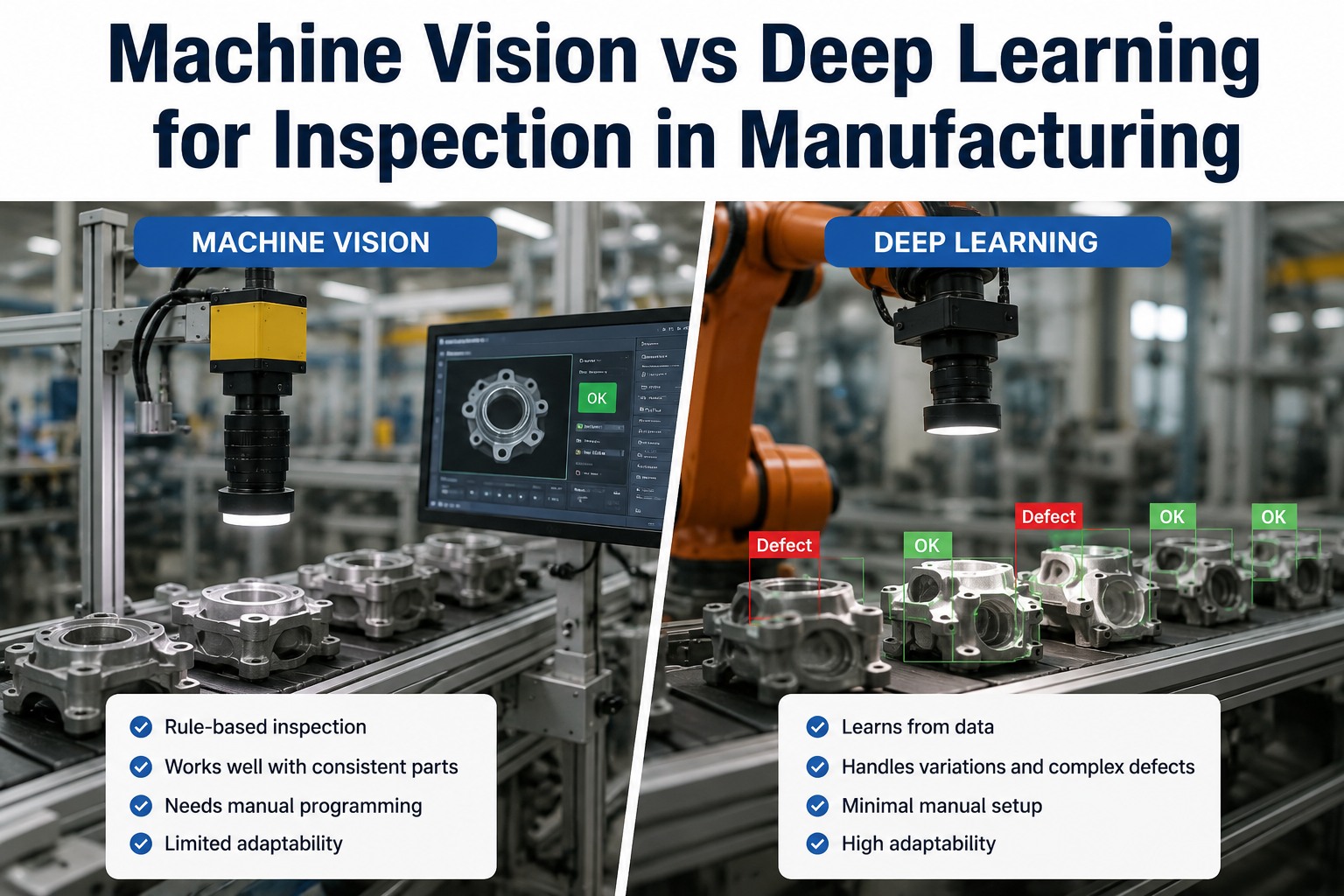
Real-Time Quality Inspection
Vision AI models running on edge hardware inspect parts at full line speed — 200–800 parts per minute — with sub-10ms classification latency. The reject gate opens before the defective part has moved 50mm past the inspection point. Cloud-dependent vision systems cannot achieve this: a 200ms cloud round-trip at 800 parts/minute means 2.7 parts pass the gate between detection and rejection signal.
99.9%
Detection accuracy at full line speed
<10ms
Reject gate signal latency
OxMaint integration: Every reject event generates a quality work order with the defect image and classification attached — creating a closed loop between detection and root-cause maintenance action.
Use Case 3
Process Parameter Optimisation
Edge AI continuously adjusts process parameters — spindle speed, feed rate, temperature setpoints, pressure — based on real-time sensor feedback, without operator intervention. Reinforcement learning agents running on edge hardware learn optimal settings for each material batch, tool condition, and environmental state. This closes the loop that Industry 4.0 monitoring only opened: from detect-and-report to detect-and-correct, in milliseconds.
8–15%
Energy reduction from real-time process optimisation
12%
Yield improvement from closed-loop parameter control
OxMaint integration: Parameter optimisation events and process deviation alerts are logged as observation records — building the asset health history that feeds future AI model improvement.
OxMaint connects edge AI detection to maintenance execution — automatically.
Every anomaly, every quality event, every process deviation becomes a traceable work order. Edge intelligence meets maintenance action in a single platform.
Edge vs Cloud AI
Edge AI vs Cloud AI in Manufacturing: The Decisive Comparison
Cloud AI is not wrong for manufacturing — it is wrong for production-floor, real-time use cases. This comparison defines where each architecture belongs and why the latency gap is not a minor technical detail but an operational constraint.
Decision latency
200–800ms (cloud round-trip)
<10ms (local inference)
Internet dependency
Full dependency — outage stops AI function
Zero dependency — operates fully offline
Data sovereignty
Raw production data leaves the facility
All raw data stays on-premise
Bandwidth cost
High — continuous high-frequency data upload
Near-zero — only aggregated scores synced
Vision inspection at line speed
Not viable above ~200 parts/min
Viable at 800+ parts/min
Model training
Superior — cloud GPU resources
Edge runs inference; training in cloud then deployed
Fleet-level analytics
Superior — aggregates across all sites
Aggregated scores synced; raw data stays local
The correct architecture for Manufacturing 6.0 is hybrid: edge AI for real-time production-floor inference; cloud for model training, fleet analytics, and long-range trend analysis. Neither alone is sufficient.
Deployment Roadmap
Deploying Edge AI in Your Plant: 4-Phase Implementation
Edge AI deployment fails most often at phase 2 — when teams attempt to deploy models trained in lab conditions directly to the production environment without a shadow mode validation period. This four-phase approach prevents that failure.
Sensor Deployment & Data Collection
Install sensors at failure-critical points. Collect baseline data under normal operating conditions for 2–3 weeks — capturing vibration, current, thermal, and acoustic signatures across the full operating cycle including startup, steady-state, and shutdown. This dataset is the training foundation; shortcuts here produce models that fail in production.
Output: Labelled baseline dataset · Sensor installation validated · OPC-UA / MQTT integration tested
Model Training & Edge Deployment
Train anomaly detection and classification models on cloud GPU infrastructure using the collected dataset. Quantise and optimise models for edge hardware targets. Deploy to edge compute units in shadow mode — generating anomaly scores and alerts without triggering physical actions. Compare against actual maintenance outcomes to validate model accuracy before live deployment.
Output: Trained model deployed · Shadow mode active · Accuracy validated against known events
Live Deployment & CMMS Integration
Switch from shadow mode to live action mode. Edge AI anomaly scores above threshold trigger OxMaint work orders automatically via webhook — with sensor data, anomaly classification, and estimated time-to-failure attached. Maintenance team responds to AI-generated work orders rather than operator-reported breakdown calls. Configure PLC output signals for vision inspection reject gates.
Output: Edge AI live · OxMaint work orders generated automatically · PLC integration active
Continuous Model Improvement
Review OxMaint work order outcomes against edge AI predictions monthly. True positives (AI predicted failure, maintenance found it), false positives (AI alerted, no fault found), and false negatives (breakdown occurred without AI warning) each provide labelled training data. Retrain the model quarterly using production outcomes as ground truth. Accuracy improves continuously — and the model becomes specific to your equipment, not a generic off-the-shelf predictor.
Output: Continuously improving model · Fewer false positives · Longer advance warning windows
Questions & Answers
Edge AI in Manufacturing: What Teams Ask
What is the difference between Manufacturing 6.0 and Industry 4.0?
Industry 4.0 is characterised by connectivity — sensors, IIoT platforms, and cloud analytics connecting equipment data to centralised processing. Manufacturing 6.0 is characterised by intelligence at the edge — AI inference running locally on production-floor hardware, producing decisions in milliseconds without cloud dependency. The practical distinction is latency and reliability: Industry 4.0 systems detect a bearing anomaly and send an alert to a cloud dashboard, where a maintenance analyst reviews it hours later. A Manufacturing 6.0 edge AI system detects the same anomaly and automatically generates a maintenance work order in OxMaint in under a second — without internet connectivity, without human routing, and without the data leaving the facility.
How much data does edge AI require to train an effective predictive maintenance model?
For anomaly detection using autoencoder or isolation forest approaches — the most common edge PM architecture — 2–4 weeks of normal operating data is sufficient to train a baseline model. This does not require historical failure data, which is frequently unavailable. The model learns "normal" and flags deviations. For classification models that predict specific failure modes (bearing vs gearbox vs lubrication), 200–500 labelled examples per failure class are required — typically collected over 3–6 months of live operation as the system encounters real events. Transfer learning from pre-trained industrial models reduces this requirement significantly.
Book a demo to discuss your specific data situation with OxMaint.
How does OxMaint integrate with edge AI systems?
OxMaint connects to edge AI systems through its webhook and REST API integration layer. When an edge AI platform generates an anomaly event — from a vibration monitoring system, vision inspection unit, or process parameter monitoring agent — it sends a structured payload to OxMaint's work order API. OxMaint automatically creates a work order with the asset linked, the anomaly details attached (sensor readings, anomaly score, estimated severity), and the work order assigned to the appropriate maintenance technician based on the asset type and location. No custom development is required; OxMaint provides pre-built webhook templates for the most common edge AI platform output formats. The integration closes the loop between AI detection and maintenance execution — the gap that most IIoT platforms leave open.
Manufacturing 6.0 · Edge AI · OxMaint
Edge AI Detects. OxMaint Acts. Downtime Eliminated Before It Starts.
Connect your edge AI layer to OxMaint's work order platform — every anomaly becomes a maintenance task, every quality event becomes a root-cause investigation, every prediction becomes a scheduled repair before failure occurs.