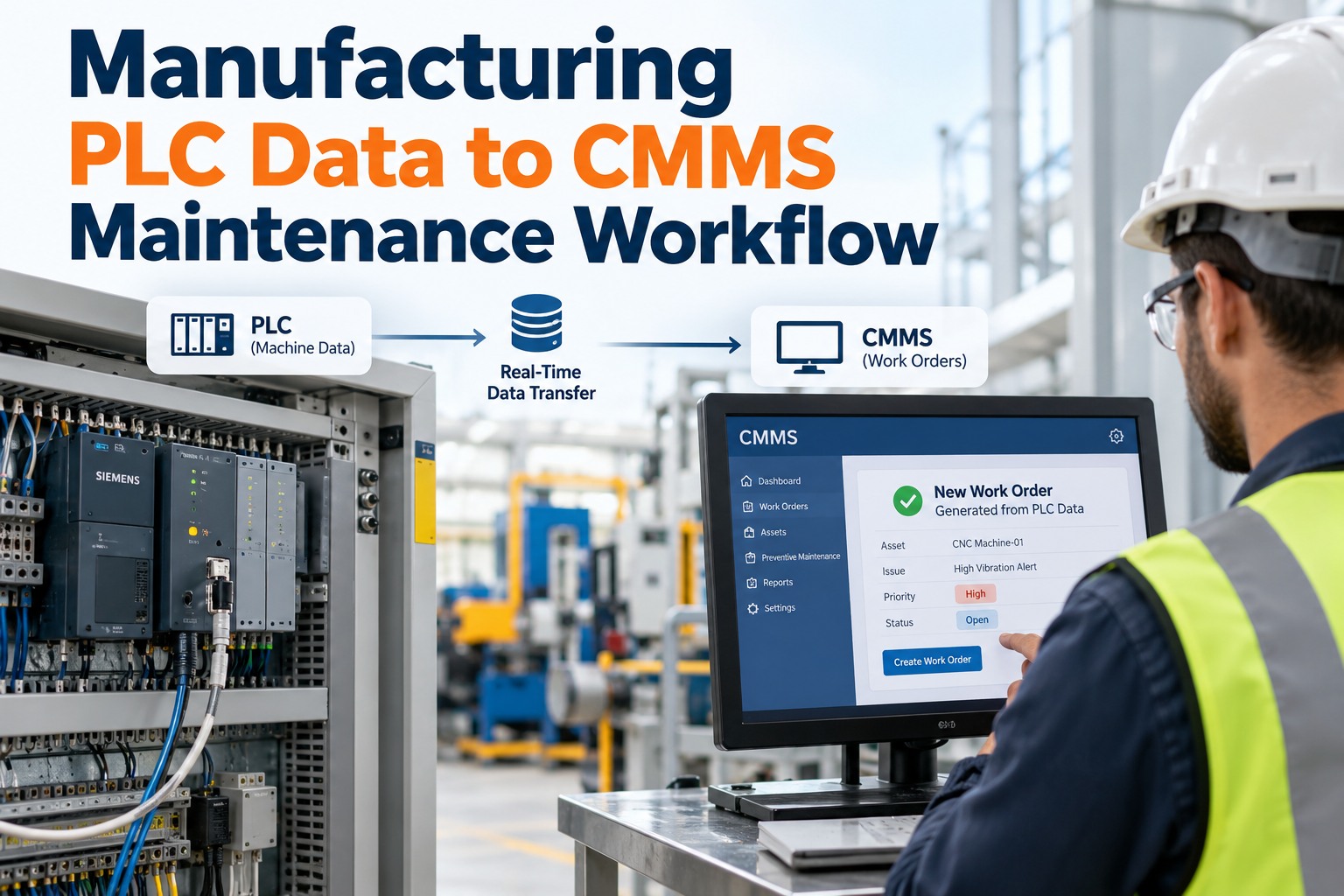
Your team finds the failing bearing when it's already screaming — the alarm was buzzing on an HMI three shifts ago, but nothing turned it into a work order, so the line went down anyway. That's the gap on most floors: the condition data exists, but it never reaches maintenance as an action. OxMaint AI is an AI-powered CMMS that closes it — running one connected workflow from inspection or sensor reading, to a logged issue or defect, to a ranked work order, into your preventive and predictive maintenance loop. The connectivity architecture in this guide is what feeds that workflow: your machines' live signals arriving as maintenance action, not just numbers on a dashboard.
Manufacturing · Industrial IoT · Asset Connectivity Architecture · 2026
Manufacturing IoT Asset Connectivity Architecture Guide
Stop learning about a failure from the breakdown instead of the data that saw it coming. OxMaint's AI-powered CMMS turns a sensor reading or inspection into a logged issue, a ranked work order, and a scheduled PM or predictive alert — one workflow, one platform. This guide shows the connectivity layer that makes it possible: how your existing PLCs, SCADA, and sensors connect, so a condition breach becomes a work order in a technician's hands, automatically.
1Inspection / sensor reading
→
2Issue or defect logged
→
3Ranked work order
→
4PM / predictive loop
$291B
industrial IoT market in 2026, on a steep multi-year climb
62%
of manufacturers now use IoT for predictive maintenance
4 layers
move data from machine to work order in milliseconds
Port 4840
the OPC UA endpoint most SCADA and historians expose
Why Connectivity — Not Sensors — Is the Real Bottleneck
Most plants already generate the data they'd need for condition-based maintenance. The manufacturing IoT market sits at roughly USD 291 billion in 2026 and is climbing fast, yet the money mostly buys more sensors — not the plumbing that turns their readings into action. Surveys put predictive maintenance adoption at about 62% of manufacturers, while cybersecurity and integration difficulty remain the two barriers deployments hit most. In other words, the hard part is the architecture between the sensor and the decision. Start free and close that gap in OxMaint AI.
The 4-Layer Connectivity Stack
Data moves from the factory floor to your maintenance platform through four distinct layers, each with one job. The stack doesn't replace your control systems — it reads from them. Here's what sits at each level and what it does.
LAYER 1
Field — Sensors, PLCs & Machines
Where condition is created: vibration, temperature, pressure, and current sensors, plus the PLCs already running each line. This is the source of every reading — Allen-Bradley, Siemens, Schneider, Mitsubishi, and 15–25 year-old legacy controllers included.
↓
LAYER 2
Edge — The Gateway
Where protocol translation happens. The gateway polls Modbus devices over RS-485, reads Modbus TCP PLCs over Ethernet, subscribes to OPC UA on the SCADA, filters noise, applies engineering-unit conversions, and republishes clean data upward — all at once, no PLC firmware change required.
↓
LAYER 3
Transport — Broker & Protocol
Where clean data moves north. An MQTT broker or OPC UA server exposes the tags to external systems: MQTT for sub-second alarm events, OPC UA for semantically rich condition data that carries context, not just a number.
↓
LAYER 4
CMMS — Where Data Becomes Action
Where a reading becomes a work order. OxMaint maps each PLC tag and SCADA identifier to an asset record, scores condition, and raises a ranked, condition-based work order the moment a threshold is breached — the only layer that turns data into a maintenance decision.
The lower layers stay exactly as they are — the CMMS reads from them, it doesn't rip them out. Book a demo to see the full stack running on your assets.
The Protocols That Carry Your Data
Four protocols cover almost every controller and sensor on a modern floor — including the old ones. Each has a job, and a good gateway speaks all of them at once. Start free and connect over the protocol you already run.
OPC UA
Rich condition data
The dominant industrial standard (IEC 62541). Platform-independent and semantically rich — carries what a value means, not just the number. Supported by Siemens, Rockwell, ABB, and Schneider; OxMaint connects natively on port 4840.
MQTT
Sub-second alarms
A lightweight publish/subscribe protocol (ISO/IEC 20922). Relays telemetry to a cloud or on-prem CMMS at sub-second latency with minimal bandwidth — the default layer for IIoT gateways feeding a CMMS.
Modbus
Legacy PLCs
Modbus RTU over RS-485 and Modbus TCP over Ethernet let a modern gateway read register-level data from 15–25 year-old PLCs that have no native OPC UA or MQTT — no middleware, no firmware change.
REST API
Cloud sensors & systems
Direct API endpoints connect cloud-native sensors and enterprise systems, and expose OxMaint asset data outward — the bridge to ERP, MES, and analytics tools already in your stack.
Where Each Layer Lives: Secure OT/IT Segmentation
Connectivity can't mean opening the plant floor to the internet. A secure design keeps controllers in the OT zone and the CMMS in IT, with data flowing one direction only. The PLC network never accepts an inbound connection from the CMMS. Book a demo of the secure network design.
OT ZONE
Layer 1 — PLCs, sensors, machines
Layer 2 — Edge gateway (protocol translation)
Controllers never exposed directly. OPC UA uses X.509 certificate authentication.
FIREWALL
northbound
MQTT / REST only →
IT ZONE
Layer 3 — Broker / OPC UA server (in the OT DMZ)
Layer 4 — OxMaint CMMS
OxMaint connects to the gateway or OPC UA server in the DMZ — never to Layer 1 controllers.
A Dashboard Full of Data Isn't Maintenance. A Work Order Is.
The most common failure in IoT deployments isn't bad sensors — it's alert fatigue. Readings pile up on a dashboard nobody acts on, and the team tunes out the noise. Connectivity only pays off when a threshold breach becomes a ranked work order in a technician's queue. That's the layer OxMaint owns.
Signal to Work Order: The Full Path
Here's what actually happens when a sensor crosses a limit — the sequence that turns a number into a fixed asset. Start free and run this flow on your highest-downtime assets.
1
Sensor reads condition
Vibration, temp, pressure, or current is captured at the asset.
2
Gateway cleans & forwards
Noise filtered, units converted, published north over MQTT or OPC UA.
3
Tag maps to an asset
The PLC tag or SCADA identifier resolves to the OxMaint asset record.
4
Threshold logic fires
A two-level rule — warning then critical — evaluates the value against limits.
5
Work order is raised
A ranked, condition-based work order lands in the technician's queue.
Beating Alert Fatigue: Thresholds That Hold
The single most common reason IoT deployments stall is thresholds set too sensitive — every momentary spike triggers an alert, the team stops trusting them, and the program dies. Two design choices fix it. Book a demo to set thresholds that stay trusted.
Two-Level Thresholds
A warning band (amber) prompts an inspection; a critical band (red) triggers immediate repair. One breach doesn't mean one response — the severity sets the action.
Time-Hold Before Alerting
A 60–120 second hold means a value must stay past the limit before an alert fires — killing false positives from momentary spikes without missing a sustained breach.
What OxMaint Connects To, Out of the Box
Integration shouldn't be a six-figure IT project. OxMaint connects to the control systems already on your floor over standard protocols — modern and legacy, single-site or multi-facility. Start free and see what connects in your environment.
| You have | Connect via | What OxMaint does with it |
|---|
| Modern PLC (OPC UA) | OPC UA, port 4840 | Reads tag data with full semantic context for condition scoring |
| Legacy PLC (15–25 yr) | Modbus RTU / TCP | Register-level reads, no firmware change, via edge gateway |
| SCADA / historian | Direct OPC UA subscription | Subscribes to alarms and tags — no agent on the SCADA server |
| IoT sensor gateway | MQTT broker | Sub-second telemetry into automatic work-order rules |
| Cloud sensors / ERP / MES | REST API | Bidirectional data exchange with enterprise systems |
Native connectors cover Wonderware/AVEVA, Ignition, FactoryTalk, WinCC, OSIsoft PI, Kepware, AWS IoT Core, Azure IoT Hub, and any OPC UA-compliant server. Book a demo to map your specific systems.
A Low-Risk Way to Start
You don't need to wire the whole plant on day one. Start with vibration monitoring on the three to five assets that drive the most unplanned downtime — a few wireless sensors and one gateway, feeding OxMaint over MQTT. Stand it up fast, then expand as it proves out. Start free and connect your first five assets.
Protocol-Native Connectivity
OPC UA, MQTT, Modbus, and REST out of the box — modern and legacy controllers, no custom middleware.
Tag-to-Asset Mapping
Each PLC tag and SCADA identifier resolves to an OxMaint asset record, so data lands on the right equipment.
Condition-Based Work Orders
A threshold breach becomes a ranked work order automatically — data drives the schedule, not the calendar.
Two-Level Alert Logic
Warning and critical bands with a time-hold filter keep alerts meaningful and the team trusting them.
Secure OT/IT Separation
Sits in the IT layer, connects to the gateway in the OT DMZ — never inbound to your controllers.
Unified Multi-Site View
One real-time asset-condition picture across every facility, however many controllers feed it.
Frequently Asked Questions
Do I have to change my PLC or SCADA to connect it?
No. An edge gateway reads Modbus, OPC UA, and MQTT from your existing controllers with no PLC firmware change and no SCADA reconfiguration — it sits between your control systems and the CMMS.
Start free and connect what you already run.
Which protocols does OxMaint support?
OPC UA, MQTT, Modbus RTU/TCP, EtherNet/IP, and REST API — covering all major control-system vendors and both modern and legacy equipment out of the box.
Can I connect PLCs that are 20 years old?
Yes. Modbus RTU over RS-485 and Modbus TCP let a modern gateway read register-level data from legacy controllers that have no native OPC UA or MQTT — no equipment replacement needed.
How do you stop the maintenance team drowning in alerts?
Two-level thresholds — warning for inspection, critical for repair — plus a 60–120 second time-hold that filters out momentary spikes before any alert fires. Only meaningful, sustained breaches reach the team.
Is the integration secure across the OT/IT boundary?
Yes. OxMaint sits in the IT layer and connects to an edge gateway or OPC UA server in the OT DMZ, never directly to Layer 1 controllers; data flows northbound only and OPC UA uses certificate authentication.
Turn the Data You Already Have Into Maintenance Action.
Your machines are already talking. The architecture is what lets your maintenance team hear them — and act before a reading becomes a failure. OxMaint connects your controllers and sensors over the protocols you already run, and turns a threshold breach into a ranked work order, automatically.