Every 15 seconds, somewhere in the world, a worker dies from a work-related accident or disease — and for every fatality, there are roughly 1,000 non-fatal injuries costing manufacturers billions in lost productivity, workers' compensation, regulatory fines, and reputational damage. ISO 45001 — the world's first international occupational health and safety management system standard — is how leading manufacturers finally move from reactive incident response to a structured, auditable, board-level safety system that demonstrably prevents injuries before they happen. Sign in to OxMaint to start digitising your ISO 45001 documentation, hazard registers, and audit trails on a single CMMS platform, or book a demo to see how manufacturers are cutting Lost Time Injury rates by 32% within 24 months of certification.
Safety & Compliance / ISO 45001
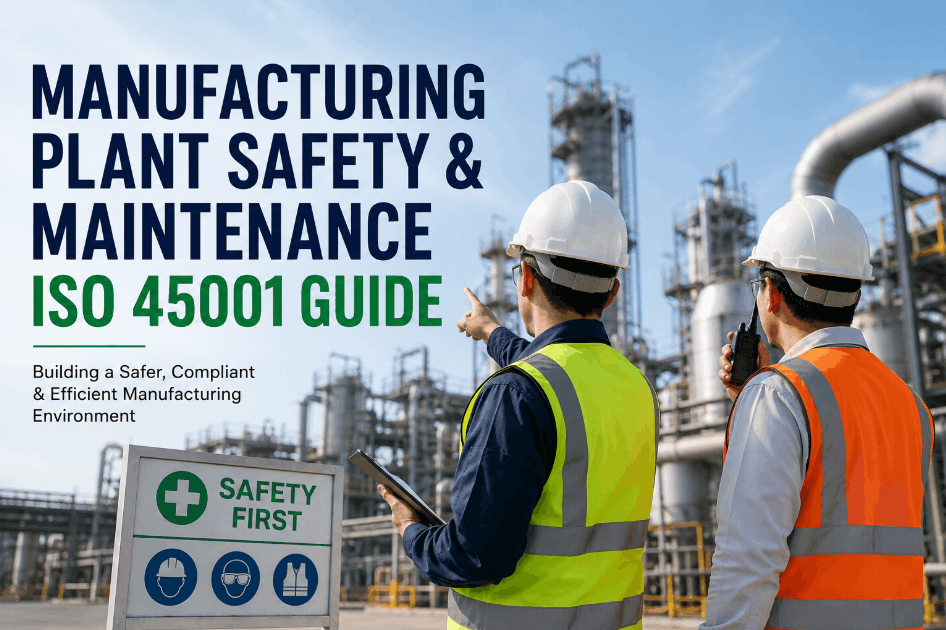
ISO 45001 Occupational Health & Safety for Manufacturing — The Complete Implementation Guide
From gap analysis to certification — how manufacturing plants implement the ISO 45001:2018 standard, build a functioning OH&S management system across all 10 clauses, pass Stage 1 and Stage 2 audits, and turn safety documentation into measurable injury reduction on the plant floor.
What ISO 45001 Actually Is — and Why It Matters for Manufacturing
ISO 45001:2018 is the international standard that replaced OHSAS 18001 in March 2018. It specifies the requirements for an occupational health and safety management system (OH&S MS) and applies to any organisation, of any size, in any sector — but it delivers disproportionate value in higher-risk industries like manufacturing, where hazards are complex, incident rates are elevated, and regulatory scrutiny is constant.
01
A Management System — Not a Safety Binder
ISO 45001 does not prescribe PPE rules or machine guarding standards. It prescribes the structure around them — how your plant identifies hazards, consults workers, assigns accountability, measures performance, and continually improves. It is a framework for safety governance, not a safety rulebook.
02
Built on Plan-Do-Check-Act
The standard uses the PDCA cycle — Plan risks and controls, Do the work with documented procedures, Check performance through monitoring and audits, Act by closing nonconformities and continually improving. Every clause maps into this loop.
03
Leadership Cannot Be Delegated
The single biggest change from OHSAS 18001 is that top management — the plant manager, the operations VP, the board — must be demonstrably and visibly involved in the OH&S system. Safety is no longer the safety officer's problem to own alone.
04
Worker Participation Is Mandatory
Non-managerial employees must be actively consulted on hazard identification, risk assessment, incident investigation, and control selection. A safety committee that meets quarterly without documented worker input does not meet the standard.
The 10 Clauses of ISO 45001 — What Each One Requires
Clauses 1–3 are scope, normative references, and definitions — not auditable. Clauses 4–10 are where the management system lives. This is the structure every manufacturer must build, document, and operate.
The Plan-Do-Check-Act Cycle — How ISO 45001 Actually Works
Every clause of ISO 45001 plugs into one of the four PDCA phases. Understanding this loop is the difference between building a system that passes audit and building a binder of procedures that auditors reject at Stage 2.
PLAN
Clauses 4, 5, 6
Establish the System
Define context and interested parties
Secure leadership commitment and publish policy
Identify hazards, assess risks, identify legal requirements
Set measurable OH&S objectives with resource plans
DO
Clauses 7, 8
Operate the System
Train workers to required competence levels
Apply hierarchy of controls on the plant floor
Manage change, procurement, and contractor onboarding
Prepare and drill emergency response procedures
CHECK
Clause 9
Evaluate Performance
Monitor leading and lagging OH&S indicators
Evaluate legal and other compliance obligations
Run full-cycle internal audits across all clauses
Conduct documented management reviews with decisions
ACT
Clause 10
Improve Continually
Investigate incidents to root cause, not just immediate cause
Issue and close corrective actions with effectiveness checks
Address audit nonconformities within agreed timelines
Feed lessons back into planning to strengthen the system
Centralise Your ISO 45001 Evidence on One Platform
OxMaint CMMS digitises your hazard register, risk assessments, training records, PM history, permit-to-work, contractor management, incident investigations, and audit trails — giving your OH&S team a single source of truth that auditors can verify in hours, not weeks.
The 6-Phase Implementation Roadmap for Manufacturing Plants
Manufacturers typically take 6–18 months from decision to certificate. Plants with existing ISO 9001 or ISO 14001 systems move faster because Annex SL structure is shared. Plants starting from scratch should plan for the longer end of the range. The following roadmap reflects what actually happens in real manufacturing implementations — not the sanitised version in the standard.
1
Phase 1 — Months 1–2
Gap Analysis Against All 10 Clauses
Compare current practices to ISO 45001 requirements clause by clause. Expect 20–30 nonconformities and 70+ opportunities for improvement on a first pass — even at plants with strong safety records. The gap is in the management system structure, not necessarily the safety practices themselves. Output: a detailed roadmap mapping every finding to a specific clause.
2
Phase 2 — Months 2–5
System Development & Documentation
Draft the OH&S policy, define context and interested parties, build the hazard register, complete risk assessments for every process and task, establish operational controls, write procedures for permit-to-work, contractor management, change management, and emergency preparedness. Keep documents lean — auditors do not reward volume.
3
Phase 3 — Months 4–9
Implementation on the Plant Floor
The critical phase — the system must actually function, not just exist on paper. Train supervisors and workers, deploy documented procedures, start collecting evidence of worker consultation, run hazard identification workshops, activate the incident reporting and investigation workflow. Auditors test implementation through site observation and worker interviews — not by reading manuals.
4
Phase 4 — Months 8–11
Internal Audit & Management Review
Prerequisites before any certification body will engage — no exceptions. Run a full-cycle internal audit covering every clause with independent, competent auditors. Hold a documented management review with top management where actual decisions are recorded — resource allocations, objectives, corrective actions. Close out all major findings before Stage 1.
5
Phase 5 — Months 10–12
Stage 1 Audit — Documentation Review
The certification body reviews the documented system for adequacy against ISO 45001 requirements. They identify areas needing attention before Stage 2. This is not a pass-fail audit — it is a readiness assessment. Expect observations and findings; address them before Stage 2 begins.
6
Phase 6 — Months 12–18
Stage 2 Audit & Certification
The certification body conducts on-site implementation audit — reviewing records, observing operations, interviewing workers at every level. Nonconformities must be closed within agreed timelines. On successful completion, the ISO 45001 certificate is issued, valid for three years, with annual surveillance audits at 12 and 24 months, and recertification at 36 months.
The Hierarchy of Controls — Clause 8's Non-Negotiable Requirement
Clause 8.1.2 mandates that operational controls must follow the hierarchy of controls — in order of effectiveness. Auditors will ask why a hazard is controlled with PPE when it could have been eliminated or substituted. Manufacturing plants that default to PPE for every hazard will fail this clause.
1
Elimination
Most Effective
Physically remove the hazard — redesign the process so the hazard no longer exists. Example: replace solvent-based cleaning with mechanical scrubbing.
2
Substitution
Highly Effective
Replace the hazard with a safer alternative. Example: swap a hazardous chemical for a less toxic one; replace a manual lift with a pneumatic tool.
3
Engineering Controls
Effective
Isolate workers from the hazard through physical controls. Example: machine guards, ventilation systems, interlocks, sound enclosures.
4
Administrative Controls
Moderate
Change how people work through procedures and training. Example: permit-to-work systems, job rotation, signage, safe operating procedures.
5
Personal Protective Equipment
Least Effective
The last line of defence — protect the worker directly with PPE. Example: hard hats, gloves, respirators, hearing protection.
The Real Financial Case — What ISO 45001 Delivers for Manufacturing
Certification costs money. So does implementation consulting, system development, training, and internal auditing. The return, however, is measurable and well-documented across the manufacturing sector.
32%
Lost Time Injury Rate Reduction
Average LTI reduction documented across European manufacturing firms within 24 months of ISO 45001 certification — a direct result of systematic hazard identification, hierarchy-of-controls application, and worker participation.
5–20%
Insurance Premium Reductions
Many insurers offer workers' compensation and liability premium reductions to ISO 45001-certified manufacturers, recognising the reduced risk profile and lower claims frequency documented in certified operations.
540K+
Global Procurement Access
Over half a million organisations are certified. Large buyers, government procurement frameworks, and tier-one OEMs increasingly require ISO 45001 as a tender prerequisite. Uncertified plants are progressively excluded from high-value contracts.
3 yrs
Certificate Validity
Certification is valid for three years with annual surveillance audits (smaller in scope than Stage 2) and a full recertification audit at 36 months — a predictable compliance cycle that fits neatly into manufacturing capex planning.
Integrated
Annex SL Alignment
ISO 45001 uses the same high-level structure as ISO 9001 (quality) and ISO 14001 (environment). Plants with existing ISO certifications share documentation, audits, and management reviews — reducing integration cost and duplicated effort.
Board-level
Regulatory Defensibility
Clause 6.1.3 requires a maintained register of legal requirements and documented compliance verification. Certified plants demonstrate due diligence in regulatory defence — reducing penalty exposure and prosecution risk after incidents.
Turn ISO 45001 Paperwork into a Running System
OxMaint replaces the spreadsheets, shared drives, and paper logs that sink ISO 45001 implementations. Hazard registers, risk assessments, permit-to-work, contractor inductions, training competence, incident investigations, corrective actions, and audit trails — all live in one platform, accessible to workers, supervisors, auditors, and top management on any device.
Where Manufacturers Actually Fail the Audit — The Top 5 Stage 2 Failure Patterns
The single most common reason manufacturers fail Stage 2 audits is not a weakness in safety practices — it is the gap between documented procedures and operational implementation. Auditors verify implementation through site walks and worker interviews. Here is what they find.
01
Beautiful procedures that workers have never seen
Documented safe operating procedures exist in the QMS, but operators on the line have never been trained on them or cannot locate them. Auditors confirm this in 30-second worker interviews.
02
Risk assessments without worker participation
Risk assessments completed by the safety manager in an office, without documented input from the workers performing the tasks. Clause 5.4 explicitly requires non-managerial worker involvement.
03
Management reviews where no decisions are recorded
Meeting minutes show attendance and agenda items but no resource allocations, objective changes, or corrective actions. A management review must produce documented decisions — otherwise it did not happen.
04
Incident investigations that stop at operator error
Investigation reports conclude "operator failed to follow procedure" without systemic root cause analysis — missing questions about training adequacy, supervision, workload, equipment design, or procedural clarity.
05
Contractor management that ends at the induction video
Contractors sign an induction attendance sheet and are released to work. No competence verification, no task-specific risk assessment integration, no supervision structure. Clause 8.1.4 requires this to be managed across the contractor lifecycle.
Frequently Asked Questions
How long does ISO 45001 certification take for a manufacturing plant?
Most manufacturing plants take 6–18 months from decision to certificate. Plants with existing ISO 9001 or ISO 14001 move faster because Annex SL structure is shared.
Book a demo to see a typical timeline.
Do we need a consultant or can we implement ISO 45001 internally?
Plants with mature QMS teams and ISO 9001/14001 experience can implement internally. First-time implementers typically benefit from a consultant during gap analysis and Stage 1 preparation to avoid costly rework cycles.
How does a CMMS like OxMaint support ISO 45001 compliance?
OxMaint centralises hazard registers, risk assessments, permit-to-work, training competence records, incident investigations, corrective actions, and audit trails — the documented information Clause 7.5 requires.
Sign in to OxMaint to start.
What is the single most common reason manufacturers fail the Stage 2 audit?
The gap between documented procedures and operational implementation. Auditors verify through worker interviews and site observation — not by reading manuals. Procedures that workers have never seen will fail the audit every time.
Is ISO 45001 certification mandatory in manufacturing?
It is voluntary, not legally required. However, large buyers, government procurement, and tier-one OEMs increasingly mandate it as a tender prerequisite — making it commercially essential even when not legally required.
How long is an ISO 45001 certificate valid and what happens after?
Certificates are valid for three years with annual surveillance audits at 12 and 24 months and a full recertification audit at 36 months. Surveillance audits are shorter in scope than Stage 2 but still cover critical clauses.
From Gap Analysis to Certificate — All Your Evidence in One Place
OxMaint gives manufacturing safety teams the digital backbone for ISO 45001 implementation. Hazard identification, risk assessment, operational controls, training records, incident management, corrective actions, internal audits, and management reviews — one platform, auditor-ready on demand.

![monthly-manufacturing-plant-safety-audit-checklist-[osha---iso-45001]](./manage-post-2k26/uploads/monthly-manufacturing-plant-safety-audit-checklist-[osha---iso-45001].png)