Most manufacturing plants measure dozens of metrics but act on none of them consistently. Daily production counts tallied in spreadsheets. Downtime logged on paper shift reports. Quality defects tracked in one system while maintenance costs live in another. The result is predictable — metrics that exist but do not drive decisions because they arrive too late, contradict each other, or require three departments to interpret. PwC's 2024 manufacturing operations study found that plants tracking 8-12 core KPIs with automated calculation and role-based dashboards outperform those tracking 40+ manually-compiled metrics by 32% in operational efficiency. The difference is not the metrics themselves but whether those metrics update in real time, connect to the work that influences them, and reach the people who can act on the insight before the shift ends. OxMaint calculates and displays your plant's critical KPIs automatically from work orders, production data, and quality records — no manual entry, no end-of-month compilation delays, no contradictory numbers across departments.
Manufacturing Metrics · 2025
Top KPIs Every Manufacturing Plant Should Track in 2025
The Essential Metrics That Drive Performance — Production, Maintenance, Quality, and Safety
The 4 KPI Categories Every Plant Needs
Production Metrics
Throughput, OEE, cycle time, and capacity utilisation — the KPIs that measure how effectively your plant converts inputs into finished product.
Maintenance Metrics
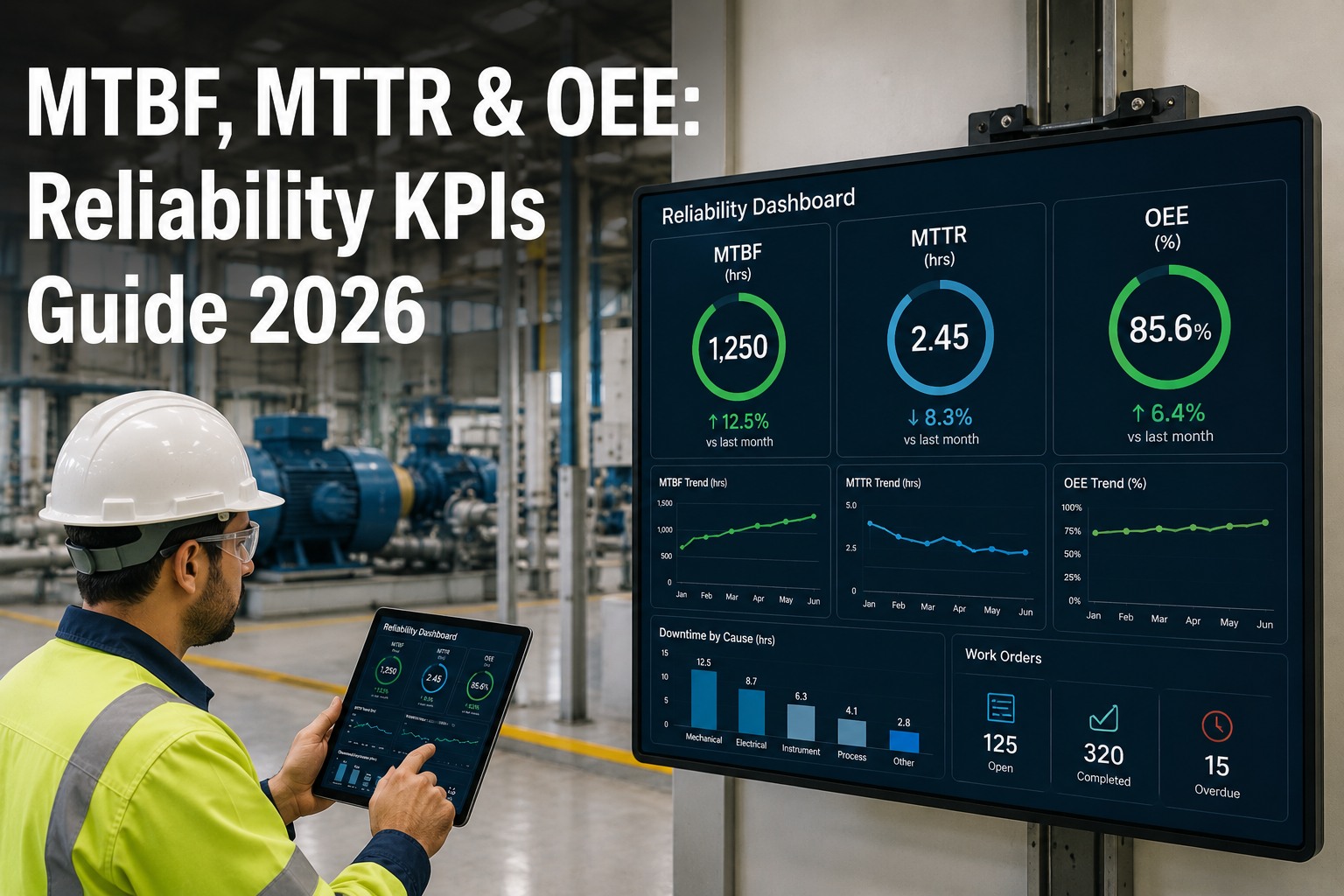
MTBF, MTTR, PM compliance, and planned maintenance percentage — the indicators that predict reliability before failures disrupt production.
Quality Metrics
First pass yield, scrap rate, rework percentage, and defect rate — the measurements that separate profitable production from expensive waste.
Safety Metrics
Incident rate, near-miss frequency, and safety compliance — the leading indicators that prevent injuries before they occur.
OEE = Availability × Performance × Quality
The single most comprehensive production metric. An OEE of 85% means your equipment produces 85% of its theoretical maximum output when accounting for downtime, speed losses, and quality defects. A 5-point OEE improvement equals one additional productive shift per week without new equipment.
Average: 60%
World-class: 85%+
Units Produced ÷ Operating Time
Actual production output per hour compared to rated capacity. Declining throughput with stable availability signals performance degradation — equipment running slower than design speed due to wear, improper settings, or operator variation.
Compare to nameplate capacity
Time from Start to Completion per Unit
Average time required to complete one production cycle. Increasing cycle time indicates bottlenecks, setup inefficiencies, or equipment performance issues. Cycle time variation above 15% suggests process instability requiring investigation.
Track trend and variation
Actual Output ÷ Maximum Capacity × 100
Percentage of available production capacity being used. Utilisation below 70% suggests demand issues or scheduling inefficiency. Above 90% creates bottlenecks and leaves no buffer for maintenance or unexpected demand spikes.
Optimal: 75-85%
See Your Production KPIs Update in Real Time
OxMaint calculates OEE, throughput, cycle time, and capacity utilisation automatically from production data — no manual tallies, no end-of-shift calculations, no delayed reporting.
MTBF = Operating Hours ÷ Number of Failures
Average operating time between unplanned equipment failures. A declining MTBF is the earliest warning that PM programmes need adjustment — failures are escalating 4-6 weeks before the impact becomes visible in production disruption.
Track by asset class
MTTR = Total Downtime ÷ Number of Repairs
Average time from failure detection to equipment return to service. High MTTR indicates parts availability issues, unclear procedures, or insufficient technician training. A 60-minute MTTR reduction on critical equipment saves significant production hours annually.
Benchmark by equipment type
PMC = Completed PMs ÷ Scheduled PMs × 100
Percentage of scheduled preventive maintenance completed on time. The most predictive leading indicator — PM compliance below 85% correlates with measurable MTBF reduction within 60 days. Compliance drops are visible 4-8 weeks before the failures they predict.
Critical: Below 80%
Target: 85%+
PMP = Planned Hours ÷ Total Maintenance Hours × 100
Percentage of maintenance work that was scheduled versus reactive. Below 60% means your team is primarily firefighting — reactive work crowds out the PM that would prevent next week's failures. Above 80% indicates excellent maintenance planning.
Reactive: Below 55%
World-class: 80%+
First Pass Yield
FPY = Good Units ÷ Total Units Started × 100
Percentage of units that pass all quality checks without rework. A 95% FPY means 5% of production requires additional work — labor and material cost that produces zero revenue. Each point of FPY improvement drops cost per unit.
Target: 98%+ for most processes
Scrap Rate
Scrap Rate = Scrapped Units ÷ Total Production × 100
Percentage of production that cannot be salvaged and must be discarded. Scrap above 2-3% typically indicates process control issues, worn tooling, or raw material quality problems requiring root cause investigation.
Target: Below 2% for stable processes
Defect Rate per Million
DPM = Defects ÷ Units Produced × 1,000,000
Number of defects per million units produced. Standard quality metric for benchmarking across industries and suppliers. Six Sigma processes target 3.4 defects per million opportunities.
Six Sigma: 3.4 DPM
Customer Complaint Rate
Complaints ÷ Units Shipped × 100
Quality issues that escape internal inspection and reach customers. The most expensive quality failure — customer complaints include warranty cost, replacement logistics, and potential contract loss.
Target: Below 0.1%
2025 Manufacturing KPI Benchmarks by Industry
| KPI |
Automotive |
Food & Beverage |
Metals & Mining |
Pharmaceuticals |
| OEE Target |
85%+ |
75-80% |
80-85% |
90%+ |
| MTBF (hours) |
300-400 |
250-350 |
280-380 |
400-500 |
| PM Compliance |
90%+ |
85%+ |
85%+ |
95%+ |
| First Pass Yield |
98%+ |
96-98% |
95-97% |
99%+ |
| Scrap Rate |
Below 1.5% |
2-3% |
3-5% |
Below 1% |
Track Quality, Maintenance, and Production KPIs in One Dashboard
OxMaint connects production output, maintenance records, and quality data — calculating all your critical KPIs from the same underlying data with no manual consolidation across systems.
Total Recordable Incident Rate
TRIR = Recordable Incidents × 200,000 ÷ Total Hours Worked
OSHA standard metric for workplace injuries and illnesses per 100 full-time employees annually. Manufacturing average is 3.5-4.0. Below 2.0 indicates strong safety culture and proactive hazard mitigation.
Near-Miss Frequency Rate
Near Misses Reported per 1,000 Hours Worked
Leading indicator that precedes actual incidents. High near-miss reporting correlates with lower incident rates — teams identifying hazards before they cause injury. Low reporting often indicates underreporting culture, not safe conditions.
Safety Training Compliance
Current Certifications ÷ Required Certifications × 100
Percentage of workforce with up-to-date safety training and certifications. Expired certifications create regulatory compliance risk and correlate with higher incident rates. Target 100% compliance on critical safety training.
Frequently Asked Questions
How many KPIs should a manufacturing plant track?
8-12 core KPIs provide better results than tracking 40+ metrics. Focus on 2-3 KPIs per category — production, maintenance, quality, safety — that directly influence operational decisions. More metrics create reporting burden without improving decision quality.
What is the difference between leading and lagging indicators?
Lagging indicators measure outcomes after they occur — downtime, scrap rate, injury count. Leading indicators predict future performance — PM compliance, near-miss reports, MTBF trends. Leading indicators enable intervention before problems impact production.
How often should manufacturing KPIs be reviewed?
Critical production and safety KPIs should update continuously with shift-level review. Maintenance and quality KPIs typically review daily or weekly. Strategic KPIs like capacity utilisation and cost per unit review monthly with quarterly trend analysis.
Can OxMaint calculate KPIs automatically without manual data entry?
Yes. OxMaint calculates OEE, MTBF, MTTR, PM compliance, and other KPIs directly from work orders, production logs, and quality records your team already creates. No separate KPI tracking system or manual spreadsheet compilation required.
What KPI matters most for improving plant profitability?
OEE has the highest correlation with profitability because it combines availability, performance, and quality into one metric. A 5-point OEE improvement typically delivers more profit impact than isolated improvements in any single component.
Manufacturing KPIs — OxMaint
Stop Manually Compiling KPIs. Start Seeing Them Update Automatically.
OxMaint calculates OEE, MTBF, MTTR, PM compliance, throughput, quality metrics, and safety indicators directly from your work orders and production data — no manual entry, no end-of-month delays, no contradictory numbers across departments.




![machine-downtime-tracking-template-for-manufacturing-[excel-dashboard]](./manage-post-2k26/uploads/machine-downtime-tracking-template-for-manufacturing-[excel-dashboard].png)


