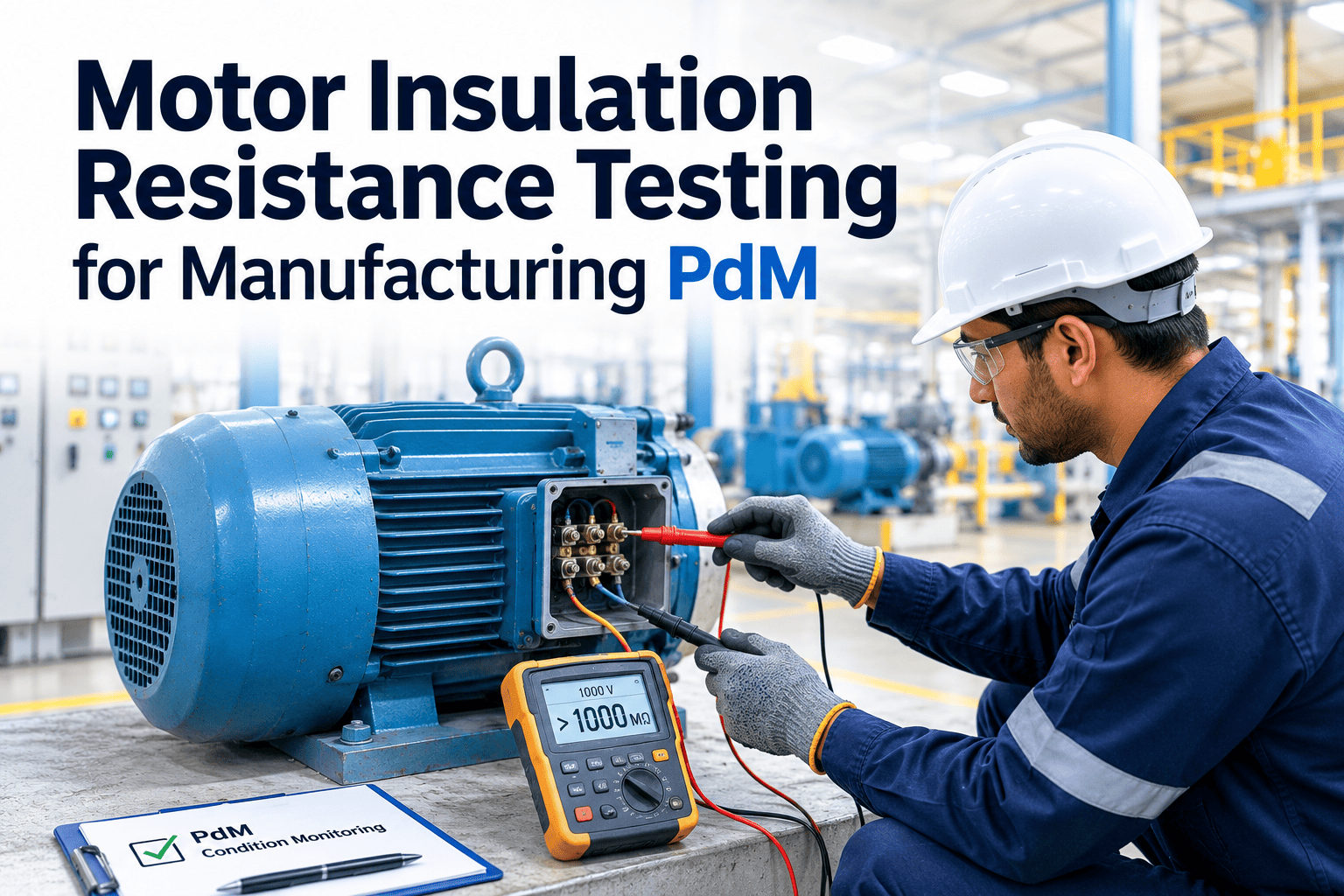
Motor insulation resistance testing remains the single most cost-effective predictive maintenance tool available to a manufacturing plant, yet most facilities run it reactively or not at all. For a typical plant with 3,000+ installed motors, a $1,500 megohmmeter and a disciplined IR testing route can prevent six-figure unplanned downtime events, extend winding life by 30 to 50 percent, and catch phase-to-ground degradation weeks before a catastrophic short. The methodology is governed by IEEE 43, which defines test voltages, polarization indices, and minimum acceptable insulation values for rotating machinery rated up to 13.8 kV. This guide breaks down the practical intervals, trending protocols, and CMMS scheduling patterns that turn a 10-minute megger test into a plant-wide failure prevention engine, and you can Start Free Trial to deploy it inside your maintenance workflow this week.
Can a $1,500 megohmmiter protect 3,000 motors from six-figure failures?
For most plants, motor insulation resistance testing is the highest-ROI PdM activity they are not running consistently. A 10-minute IR test, trended over time and scheduled inside your CMMS, catches winding degradation months before a short circuits your production line.
The cheapest PdM test you are not running consistently
Over 40 percent of low- and medium-voltage motor failures originate in the winding insulation system, and the vast majority are detectable with a megger test weeks or months before breakdown.
Most receive no insulation testing until after failure.
Insulation degradation is the leading root cause.
Production loss plus emergency repair often exceeds this on critical assets.
A 200 HP motor that fails during a production run can cost $4,000 to $9,000 per hour in lost output. The megger test that would have caught it takes ten minutes and costs nothing after the instrument is purchased.
Test voltages, minimum values, and the polarization index
IEEE 43 is the governing standard for insulation resistance testing of rotating machinery. It defines the applied DC voltage, the minimum acceptable IR value, and the dielectric absorption ratios that distinguish good windings from marginal ones.
A DAR above 1.4 indicates healthy insulation. Below 1.25, the winding is suspect and trending should intensify.
PI above 2.0 is excellent. Below 1.0, the insulation system is deteriorating and the motor should be flagged for rewind planning.
| Motor Rated Voltage | Test DC Voltage | Min IR (IEEE 43-2013) | Recommended DAR |
|---|---|---|---|
| Up to 1 kV | 500 V | 5 MΩ | > 1.4 |
| 1.1 kV to 4.0 kV | 1,000 V | 100 MΩ | > 1.6 |
| 4.1 kV to 13.8 kV | 2,500 V to 5,000 V | 100 MΩ + kV rating | > 2.0 |
| Inverter-fed (VFD) | 500 V to 1,000 V | Per nameplate + trend | > 1.5 |
A tiered megger route schedule that fits a real maintenance calendar
Not every motor deserves the same test frequency. A 3,000-motor plant cannot megger everything quarterly, so intervals should be driven by criticality, service history, and operating stress.
Process-critical, N+0 redundancy
Main cooling water pumps, boiler ID/FD fans, primary production drives. Any failure stops the line or creates a safety event. Run IR test plus DAR quarterly, PI annually.
Important but with standby or workaround
Secondary pumps, HVAC motors, conveyor drives with bypass. Failure reduces throughput but does not halt production. Test IR twice a year, DAR annually.
Support equipment, redundant or low-impact
Lighting transformers, exhaust fans, utility motors. Failure is inconvenient and repairable within hours. Annual IR test with DAR on any motor that shows a downward trend.
VFD-fed, wet, hot, or high-cycle motors
Inverter-fed motors, motors in washdown areas, and high-start-cycle applications degrade insulation faster. Test monthly and trend aggressively; voltage transients from VFDs accelerate dielectric breakdown.
From single readings to a 12-month failure prediction window
A single IR reading tells you almost nothing. The predictive power comes from trending the same motor over time, watching for the characteristic decline curve that precedes a winding fault by 3 to 9 months.
A Midwest food processing plant with 2,400 motors implemented quarterly IR trending on 180 Tier 1 assets. Over 14 months, the route identified 11 motors with declining insulation values. Eight were rewound during planned outages; three were replaced outright. Zero unplanned motor failures occurred on trended assets during the period, down from a baseline of 9 to 12 per year. Estimated avoided cost: $340,000 in emergency repair and production downtime, against a program cost of roughly $18,000 in labor and instrument amortization.
Schedule your motor IR routes inside a CMMS built for PdM
Oxmaint turns IEEE 43 test intervals, DAR/PI thresholds, and trending curves into automated work orders so nothing slips through the cracks.
Building the IR route as a repeatable, auditable work order
The trending curve only works if tests happen on schedule and readings are captured consistently. A CMMS makes the IR route a structured work order with predefined fields, not a clipboard exercise.
Auto-generated test schedule
Each motor inherits its test interval from the criticality tier. Quarterly, semi-annual, and monthly routes generate automatically and assign to the correct technician round.
Trend curve per asset
Every IR reading feeds a per-motor trend chart. When the slope exceeds a configured decline rate, the CMMS raises a flagged notification and recommends a DAR or PI follow-up.
Threshold alerts
Configure IEEE 43 minimums, DAR thresholds, and PI floors per voltage class. A reading below floor triggers an automatic work order for follow-up testing or rewind planning.
Audit-ready history
Every reading, technician, instrument serial, temperature, and humidity reading is stored permanently. Insurance auditors and ISO 55000 reviews pull the trend report in one click.
What disciplined IR trending delivers on the plant floor
Plants that move from reactive megger testing to a structured, trended, CMMS-scheduled IR route see measurable results within the first 12 to 18 months.
We trended 240 critical motors on a quarterly IR route and caught 14 windings in decline before they failed. The first one we caught would have taken out a refrigeration compressor during peak season — that alone paid for three years of program cost.
Motor insulation resistance testing, answered
How often should I megger test the motors in my plant?
Tier 1 critical motors with no redundancy should be tested quarterly with DAR, and receive a full PI test annually. Tier 2 essential motors get semi-annual IR, Tier 3 general-purpose motors get annual IR, and any motor on a VFD, in a wet environment, or cycling more than 20 starts per day should be tested monthly. The key is consistency — a single reading is nearly meaningless without a trend baseline to compare it against.
What is the difference between IR, DAR, and PI tests?
IR is a single insulation resistance reading taken at one minute. DAR (Dielectric Absorption Ratio) compares the 60-second reading to the 30-second reading and takes about one minute to perform. PI (Polarization Index) compares the 10-minute reading to the 1-minute reading and takes ten minutes. DAR and PI measure how well the insulation polarizes under voltage — a healthy winding absorbs charge slowly, producing a rising resistance curve. You can set up automated DAR and PI work orders by logging into Oxmaint and assigning the test template to your motor asset records.
Can I test a motor while it is connected to a VFD?
You must isolate the motor from the VFD before megger testing. The output semiconductors in a drive can be damaged by the high DC test voltage, and the drive circuitry will produce false leakage paths that corrupt your reading. Disconnect the motor leads at the terminal box or use the VFD manufacturer's approved isolation procedure. VFD-fed motors should be tested more frequently because voltage transients from the drive accelerate insulation breakdown in the winding end-turns.
What IR reading is considered acceptable under IEEE 43?
IEEE 43-2013 sets a minimum of 5 MΩ for motors rated up to 1 kV, and 100 MΩ for motors rated above 1 kV (plus an additional 1 MΩ per kV of rated voltage above 1 kV for machines rated above 12 kV). However, the absolute number matters less than the trend. A motor that drops from 800 MΩ to 120 MΩ is still above the IEEE minimum, but the 85 percent decline is a strong predictor of impending failure and should trigger a DAR, PI, and shortened retest interval.
How do I schedule and trend IR tests without spreadsheets?
A CMMS like Oxmaint lets you assign a test interval to each motor based on its criticality tier, auto-generate work orders on that cadence, capture the IR reading in a structured field, and plot the trend curve automatically. When the slope exceeds your configured decline threshold, the system raises an alert and creates a follow-up work order for DAR or PI testing. You can see this workflow live by booking a 30-minute demo and asking the team to show you the motor IR trending module.
Start catching winding failures months before they shut you down
Deploy a structured motor IR testing program with IEEE 43 intervals, automated trending, and threshold-based alerts — all inside your CMMS.
Free 14-day trial · No credit card