Acoustic emission testing is one of the few condition-monitoring techniques that hears damage forming inside a component before that damage becomes visible to vibration analysis or thermal imaging. For a manufacturing plant running hundreds of pumps, gearboxes, pressure vessels, and welded structures, that early signal is the difference between a $400 bearing swap and a $28,000 unplanned line stoppage. This guide breaks down how AE testing works on the floor, where to place sensors, which frequency bands map to which failure modes, and how to wire AE findings straight into your CMMS so an alert becomes a scheduled work order, not a forgotten spreadsheet row. When you're ready to operationalize it, you can Start Free Trial and connect AE alerts to your asset hierarchy in an afternoon.
What if your equipment could tell you it was about to fail — three weeks before it did?
Acoustic emission sensors catch the micro-stress events of crack growth, bearing spalling, and steam-trap leaks in the 20 kHz–1 MHz range — long before vibration crosses its first alarm threshold. Plants that log AE hits inside their CMMS routinely cut unplanned downtime by 35–55%.
The physics that lets you hear cracks form
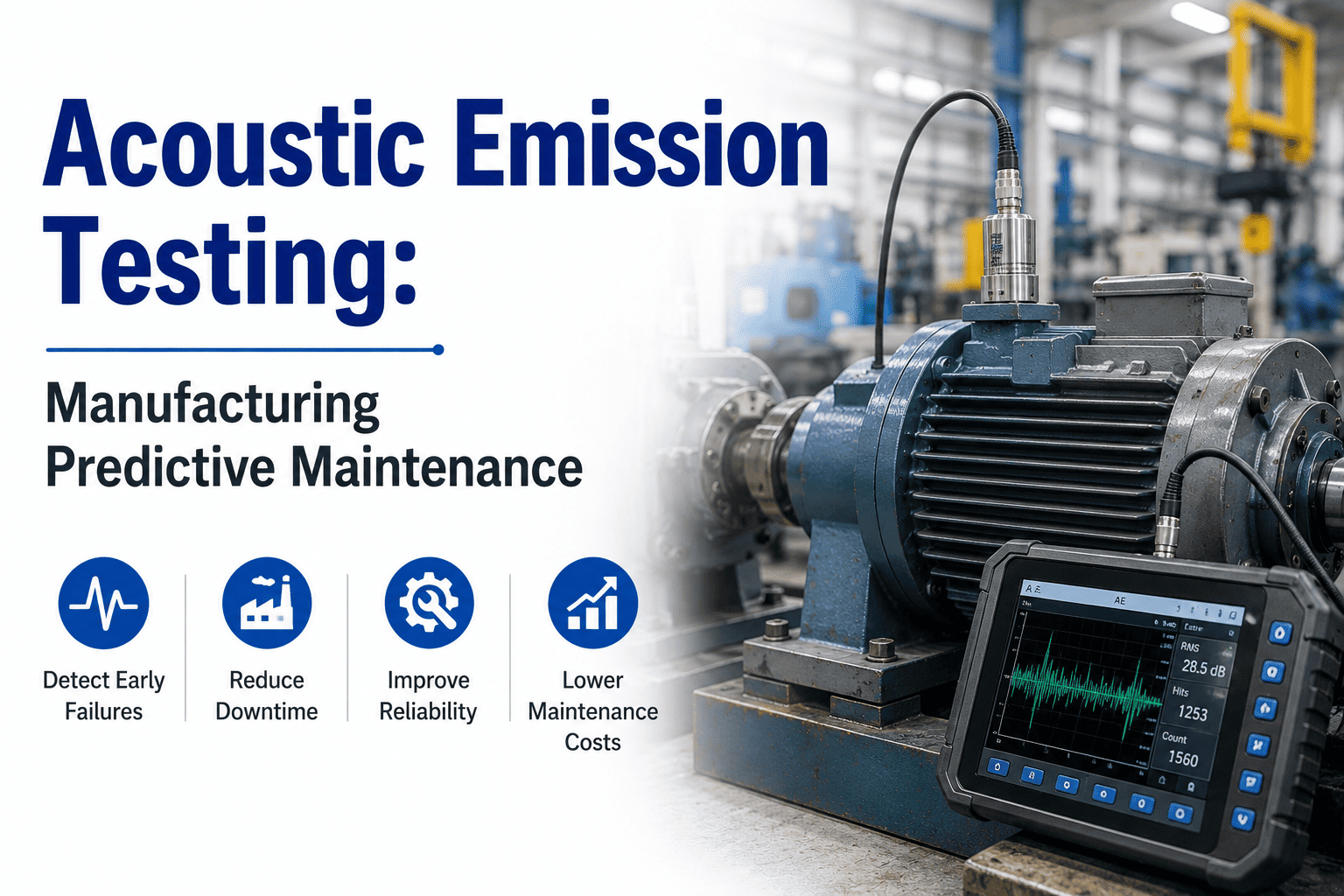
Acoustic emission testing listens for transient elastic waves released when a material undergoes localized stress — crack tip advance, frictional rub, cavitation, or phase change. A piezoelectric sensor bonded to the asset surface converts those waves into electrical hits, and a processor counts, rates, and locates the source.
Unlike vibration, which measures the symptom of an existing defect, acoustic emission measures the activity of the defect forming. That's why AE routinely flags a problem two maintenance cycles earlier.
Which frequency band catches which fault
Sensors are broadband or resonant, and the frequency window you filter to determines what you can hear. Use this map to pick the right sensor and filter pair for each asset class on your floor.
| Failure Mode | AE Frequency Band | Typical Asset | Lead Time vs. Vibration | Sensor Type |
|---|---|---|---|---|
| Bearing spalling / pitting | 20–60 kHz | Pumps, motors, fans | 14–28 days earlier | Resonant 30 kHz |
| Crack growth in welds | 100–300 kHz | Pressure vessels, storage tanks | Not detectable by vibration | Broadband |
| Valve internal leak / cavitation | 30–120 kHz | Control valves, steam traps | 7–21 days earlier | Resonant 60 kHz |
| Gear tooth fracture initiation | 80–250 kHz | Reducers, gearboxes | 10–20 days earlier | Broadband |
| Stress corrosion cracking | 150–400 kHz | Pipe elbows, heat exchangers | Not detectable by vibration | Broadband |
| Composite delamination | 50–200 kHz | Filament-wound tanks, fan blades | 30–60 days earlier | Broadband |
Six placement rules that decide whether AE data is trustworthy
A sensor in the wrong spot turns a $4,500 AE channel into noise. These six rules — drawn from ASME BPVC Section V Article 12 and CARP-recommended practice — govern where the puck goes and how the signal stays clean.
AE attenuates roughly 1–3 dB per 30 cm in steel. Beyond 2 m, hit amplitude drops below the 40 dB threshold and you lose source location triangulation. For long shafts, place a sensor every 1.5 m.
Bond a 150 mm steel rod between the sensor and the hot surface. It drops surface temperature at the puck face by 60–90 °C while preserving 90% of signal amplitude above 60 kHz.
A 0.1 mm air gap kills 18 dB of signal. Use vacuum grease or a silicone couplant rated for the asset temperature, and re-apply every 90 days on continuous-monitor channels.
On vessels, sensors go on nozzles, weld caps, and support skirts — the geometric discontinuities where stress concentrates. A flat-plate center is the worst location for crack detection.
Adhesive bonds shear under vibration and temperature cycling. Magnetic mounts hold 8 kg pull-force on ferrous surfaces; clamp bands secure to non-ferrous pipe without degrading couplant.
A 0.3 mm HB lead snapped 2 mm from the sensor should register 80–95 dB and a clear waveform. If it reads below 70 dB, re-prep the surface and re-couple before trusting any data.
What a 180-asset plant actually saves in year one
A worked example makes the value tangible. Consider a mid-sized discrete-manufacturing plant with 180 rotating and pressure assets, currently spending $42,000 per year on reactive repairs and lost production from bearing and weld failures.
| Cost Category | Before AE (Annual) | With AE (Annual) | Savings |
|---|---|---|---|
| Unplanned repair labor | $14,500 | $5,800 | $8,700 |
| Expedited parts & freight | $9,200 | $2,400 | $6,800 |
| Lost production throughput | $15,300 | $5,100 | $10,200 |
| Safety & environmental incident reserve | $3,000 | $1,200 | $1,800 |
| Total | $42,000 | $14,500 | $27,500 |
Turn AE alerts into scheduled work orders, not paper reports
An AE system that ends at a dashboard is a diagnostic toy. The value materializes when each alert auto-creates a CMMS work order tied to the right asset, priority, and failure code — so the fix gets planned, parts get ordered, and the alert closes when the work does.
Tag every AE sensor channel to a CMMS asset ID. A 180-asset plant finishes this in 3–4 days with a CSV import. Without this link, alerts have nowhere to land.
Map each AE hit class (crack, rub, leak, spall) to a CMMS failure code and priority level. A hit above 70 dB on a pressure vessel weld auto-creates a Priority 1 inspection order.
Configure rules: bearing AE energy crosses 2× baseline for 48 hours → open a corrective WO with parts list and standard job plan attached. No human triage needed for the first escalation.
When the WO closes, the CMMS writes the resolution back to the AE channel's history. Over 6 months this feedback trains the threshold model and cuts false alarms by 30–45%.
Stop reacting to failures your sensors already heard coming
Oxmaint connects AE alerts to your asset hierarchy and auto-generates prioritized work orders — so a 70 dB hit on a critical bearing becomes a scheduled fix, not a Monday-morning surprise.
What maintenance leaders ask before deploying AE
Vibration measures the mechanical response of an existing defect — a spall, a worn race, an unbalance — once it's already large enough to move mass. Acoustic emission measures the stress-wave energy released as the defect forms, so it detects crack initiation and micro-spalling 2–4 weeks before vibration alarms trigger. The two are complementary, not substitutes: AE catches early, vibration confirms severity.
Yes — and this is where AE outperforms vibration most clearly. At low RPM the vibration signature of a bearing defect drops below the noise floor of accelerometers, but the AE energy from a spall or crack event remains well above threshold. Wind turbine main bearings, kiln drives, and low-speed slewing rings are the strongest AE use cases. To see it on your slow-speed assets, Book a Demo and we'll map your top three candidates.
Couplant should be re-applied every 90 days on continuous-monitor channels, and a pencil-lead break verification test should be run monthly on each sensor. Full recalibration against a reference source is recommended annually per ASME BPVC Section V Article 12. Magnetic and clamp mounts should be inspected every 6 months for corrosion on the bond surface.
Most background mechanical noise sits below 20 kHz, while AE monitoring for cracks and bearing defects filters to 30 kHz and above. Frequency-domain filtering plus hit-duration gating (rejecting events longer than 1 ms) typically removes 85–95% of plant noise. For extreme environments, a guard sensor placed on a non-critical adjacent surface can subtract structure-borne noise from the active channel.
Each sensor channel is tagged to a CMMS asset ID at install. When an AE hit crosses its configured threshold for a defined duration, the gateway pushes an event to the CMMS API, which auto-creates a work order with the asset, failure code, priority, and attached job plan. When the WO closes, the resolution feeds back to the AE channel history, refining future thresholds. You can pilot this flow in a free Oxmaint workspace — Start Free Trial.
Hear the failure before it costs you a shift
Deploy AE monitoring, map it to your asset hierarchy, and let every alert become a scheduled work order — not a post-mortem. Oxmaint makes the closed loop live in days, not quarters.
Free 14-day trial · No credit card