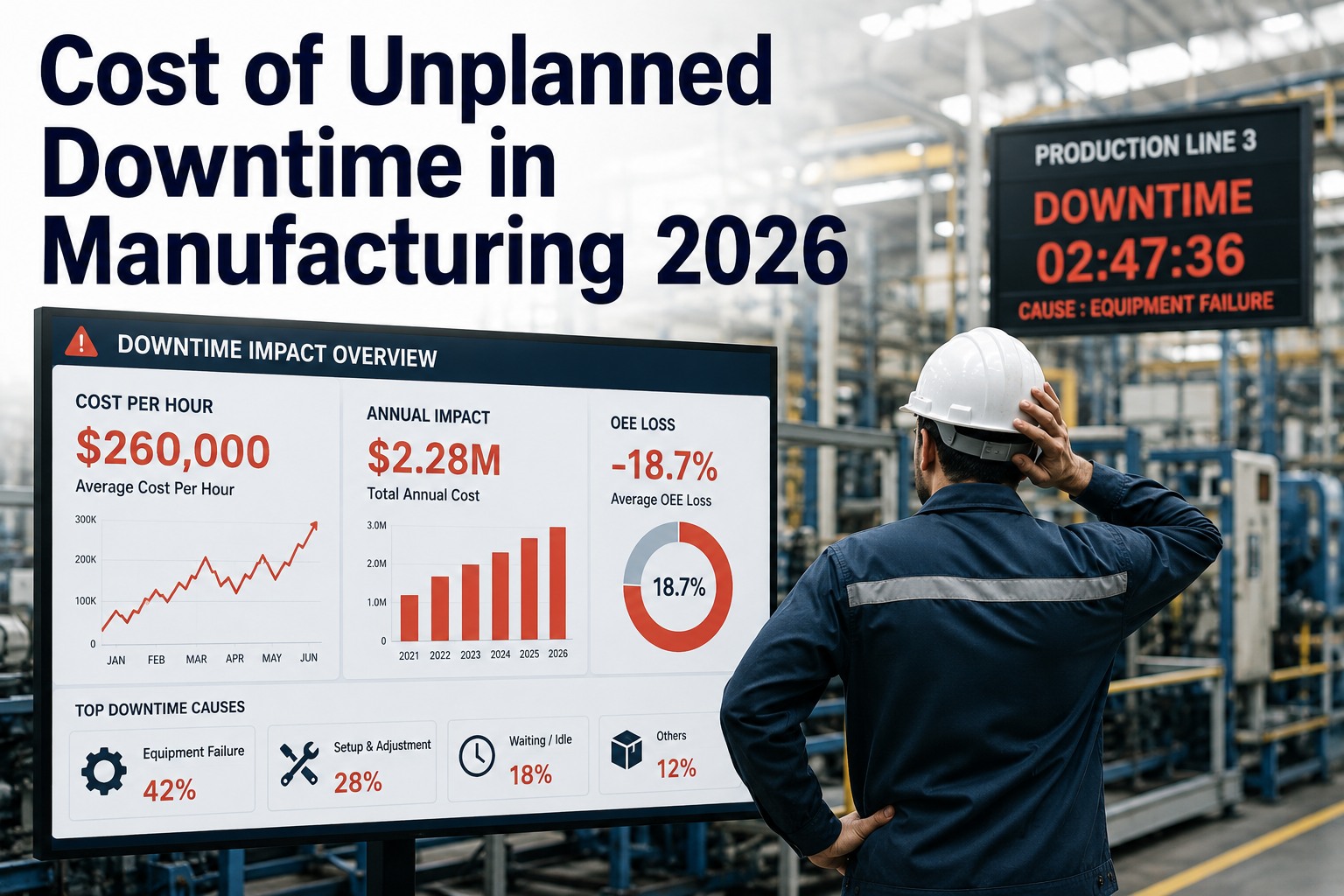
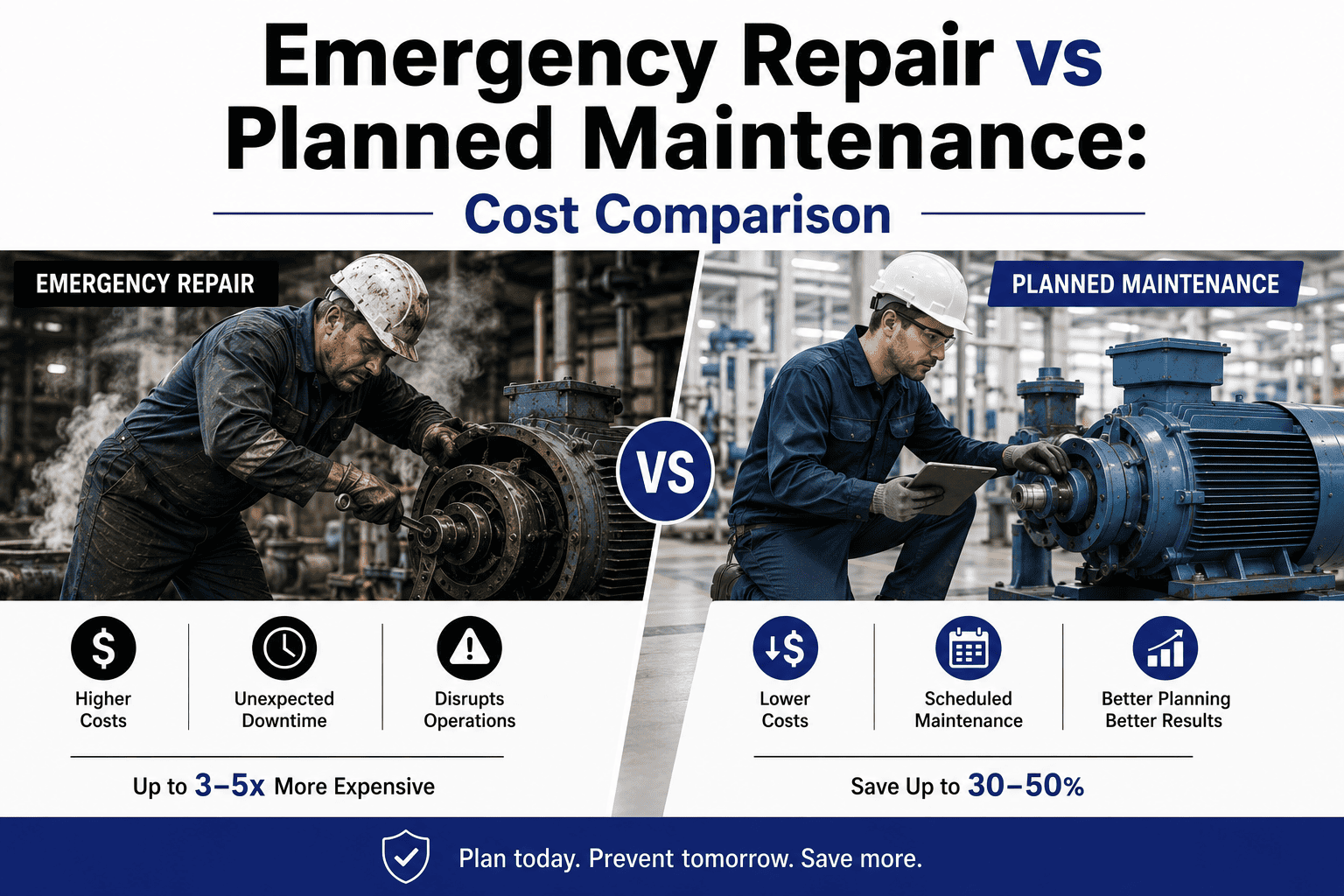
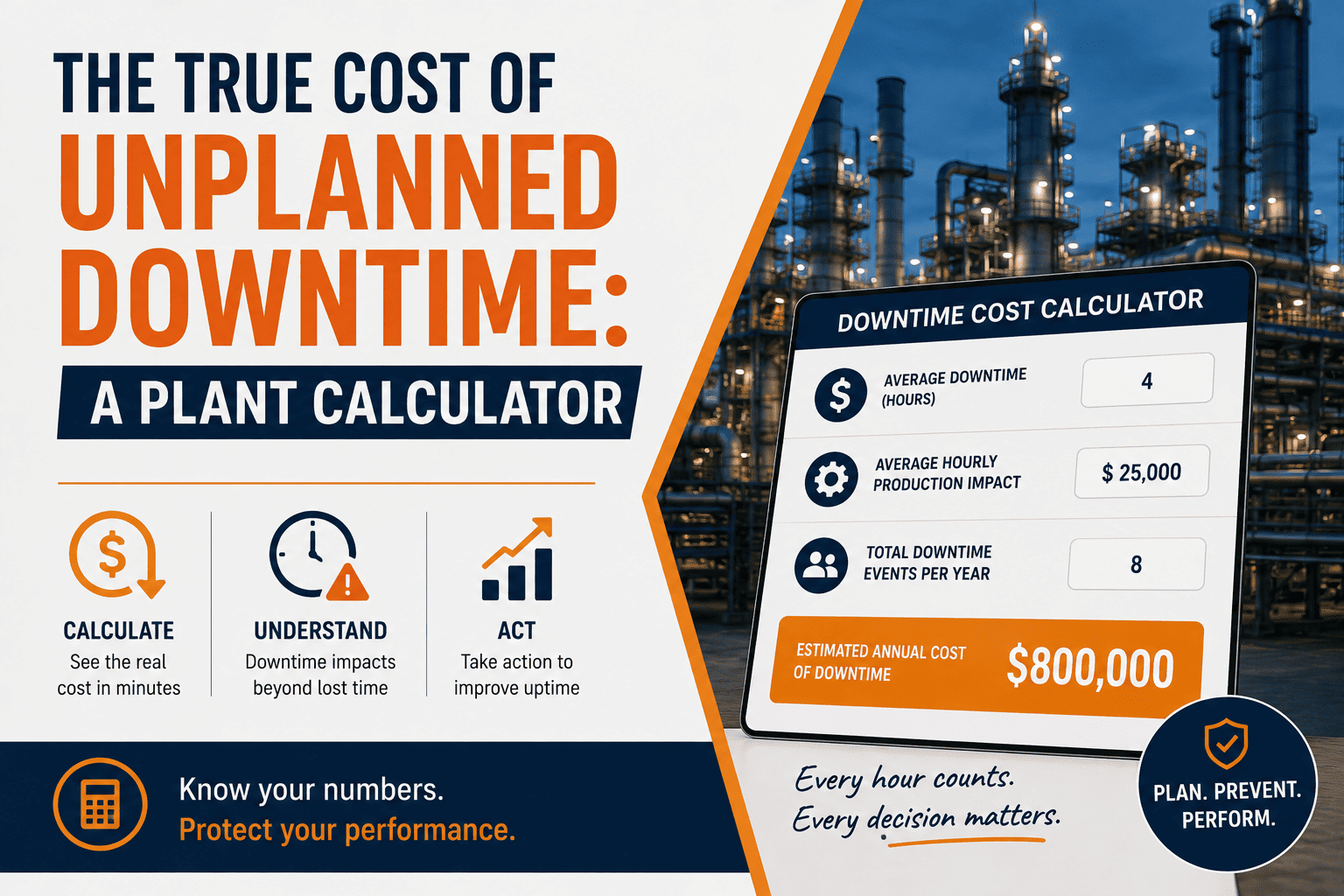
Manufacturing downtime costs vary wildly by industry — from $22,000 per hour in automotive to over $260,000 per hour in semiconductor fabrication — but one constant holds across every sector: unplanned downtime costs 3-5 times more than the same repair executed during scheduled maintenance. The hidden multiplier is not just emergency labor premiums or expedited parts shipping. It is lost production revenue, downstream supply chain disruption, quality issues from rushed restarts, and the compounding effect of scrambling your maintenance team away from preventive work that would have caught the next failure. Smart manufacturers measure this gap precisely because modern CMMS platforms track both planned and reactive maintenance costs in real-time and the data always tells the same story: prevention is not just cheaper, it is exponentially cheaper.
Manufacturing Economics · Maintenance ROI · Cost Analysis
Planned vs Unplanned Maintenance: The True Cost Comparison Manufacturers Need to See
Reactive maintenance feels cheaper on the monthly budget — until you calculate lost production, emergency labor premiums, expedited shipping, quality losses, and the preventive work that didn't happen because your team was fighting fires. Here is what the numbers actually show.
Planned Maintenance
$1,200
Typical bearing replacement during scheduled outage
vs
Unplanned Failure
$4,800
Same bearing fails mid-shift with collateral damage
Cost Breakdown
Where the 4x Cost Multiplier Comes From
Unplanned maintenance is not just planned maintenance done urgently. It is a fundamentally different cost structure where every component of the repair accumulates premiums and penalties that compound into total costs several times higher.
Direct Labor Costs
Planned
$240
Regular time, 4 hours at $60/hr, scheduled crew
Unplanned
$600
Overtime premium, call-in pay, 6 hours at $100/hr
Parts & Materials
Planned
$450
Ordered 6 weeks ahead, bulk pricing, no rush fees
Unplanned
$920
Overnight air freight, distributor markup, expedite fees
Lost Production
Planned
$0
Scheduled during off-shift or low-demand period
Unplanned
$2,400
6 hours downtime at $400/hr lost margin
Secondary Damage
Planned
$0
Replacement before failure, no collateral damage
Unplanned
$680
Damaged shaft, seal replacement, contamination cleanup
Quality & Scrap
Planned
$0
Controlled shutdown and restart procedures
Unplanned
$200
Off-spec product from sudden stop, restart scrap
Total Cost Planned Maintenance
$690
Total Cost Unplanned Failure
$4,800
Unplanned costs 7x more for the same repair
Industry Benchmarks
Unplanned Downtime Cost by Manufacturing Sector
The hourly cost of unplanned downtime varies dramatically by industry based on asset intensity, product value, and production volume. Here is what manufacturers are actually losing when critical equipment stops unexpectedly.
| Industry Sector |
Downtime Cost per Hour |
Typical Failure Duration |
Average Incident Cost |
| Semiconductor Fabrication |
$240,000 - $280,000 |
4-8 hours |
$1.1M - $2.2M |
| Pharmaceutical Manufacturing |
$180,000 - $220,000 |
6-12 hours |
$1.4M - $2.6M |
| Automotive Assembly |
$20,000 - $35,000 |
2-6 hours |
$60K - $210K |
| Food & Beverage |
$15,000 - $25,000 |
3-8 hours |
$50K - $200K |
| Chemical Processing |
$30,000 - $50,000 |
8-24 hours |
$300K - $1.2M |
| Steel Production |
$40,000 - $70,000 |
12-48 hours |
$500K - $3.4M |
| Paper & Pulp |
$12,000 - $18,000 |
6-16 hours |
$80K - $290K |
| Plastics & Packaging |
$8,000 - $14,000 |
2-6 hours |
$20K - $85K |
Source: Industry benchmarks from ARC Advisory, LNS Research, and Plant Engineering surveys 2023-2024
Track Every Dollar
Know exactly what reactive maintenance is costing you versus what prevention would cost
OxMaint separates planned, preventive, and reactive work order costs automatically — labor, parts, downtime, everything. See which assets drain your budget and where proactive maintenance pays back fastest.
Maintenance Mix
Optimal Planned vs Reactive Maintenance Ratio
World-class manufacturers spend the majority of their maintenance budget on planned work. Reactive facilities let equipment dictate the schedule. The ratio between these categories determines total maintenance cost and overall plant reliability.
Reactive Facility
Reactive 65%
Preventive 25%
Predictive 10%
Maintenance Cost Index
1.8x baseline
Equipment Availability
82-88%
Unplanned Downtime Events
18-25 per year
Balanced Approach
Reactive 35%
Preventive 45%
Predictive 20%
Maintenance Cost Index
1.0x baseline
Equipment Availability
92-95%
Unplanned Downtime Events
8-12 per year
Proactive Excellence
Reactive 15%
Preventive 50%
Predictive 35%
Maintenance Cost Index
0.6x baseline
Equipment Availability
97-99%
Unplanned Downtime Events
2-4 per year
Hidden Costs
The Unplanned Maintenance Costs That Never Appear on Invoice
Beyond direct repair costs and lost production, reactive maintenance creates cascading inefficiencies that erode profitability in ways most ERP systems never capture.
Deferred Preventive Maintenance
When technicians scramble to fix breakdowns, scheduled PM gets postponed. This creates a debt cycle where each emergency increases the probability of the next failure. Annual cost impact: 15-25% increase in total maintenance spend.
Inventory Carrying Cost Inflation
Reactive facilities hoard more spare parts to survive unpredictable failures. Insurance inventory ties up capital and warehouse space. Excess obsolescence when equipment upgrades. Typical waste: $80K-$200K annually per 100 assets.
Customer Relationship Damage
Missing delivery commitments erodes customer trust faster than price increases. Late penalties, expedited freight to recover schedules, lost future orders. One automotive tier-1 supplier calculated $1.2M annual revenue impact from reliability reputation.
Team Morale & Turnover
Constant firefighting burns out skilled technicians. Best people leave for plants with better planning. Replacement hiring and training costs 1.5-2x annual salary. Knowledge loss accelerates failure rates further.
Regulatory Compliance Risk
Emergency repairs bypass proper documentation, lockout-tagout procedures, and quality checks. OSHA violations, environmental incidents, product recalls all spike in reactive environments. Single serious incident: $500K-$5M in fines and remediation.
Strategic Shift
How to Migrate from Reactive to Planned Maintenance
Phase 1
Stabilize the Top 20%
Identify the 20% of assets causing 80% of downtime. Implement basic PM schedules and condition monitoring on just those machines. Track reactive vs planned work order ratio monthly. Target: reduce reactive by 30% on critical assets within 90 days.
Timeline: 3 months
Phase 2
Build Preventive Calendar
Create OEM-based PM task libraries in CMMS. Schedule recurring work orders for all production equipment. Train technicians on checklist execution and photo documentation. Measure PM compliance weekly. Target: 85% on-time PM completion.
Timeline: 6 months
Phase 3
Add Predictive Monitoring
Install vibration sensors, thermal cameras, oil analysis programs on highest-value assets. Integrate sensor data with CMMS to trigger condition-based work orders. Adjust PM frequencies based on actual wear rates. Target: 25% reduction in total maintenance hours.
Timeline: 12 months
Phase 4
Optimize & Sustain
Analyze failure patterns to refine PM tasks. Eliminate low-value inspections. Expand predictive coverage. Benchmark against industry standards. Celebrate milestones. Target: world-class 15% reactive / 85% planned maintenance mix.
Timeline: 18-24 months
Financial Impact
Real Savings from Shifting to Planned Maintenance
Mid-Size Manufacturer
150 production assets · 8 maintenance techs · $4.2M annual revenue
Reactive maintenance cost baseline
$680K/year
After 12-month planned shift
$420K/year
Annual Savings: $260K (38% reduction)
Automotive Tier-1 Supplier
450 production assets · 22 maintenance techs · $85M annual revenue
Reactive maintenance cost baseline
$2.8M/year
After 18-month transformation
$1.6M/year
Annual Savings: $1.2M (43% reduction)
Food Processing Plant
280 production assets · 14 maintenance techs · $32M annual revenue
Reactive maintenance cost baseline
$1.1M/year
After 15-month proactive program
$710K/year
Annual Savings: $390K (35% reduction)
Common Questions
Planned vs Unplanned Maintenance Questions Answered
Why does unplanned maintenance cost so much more than planned?
Emergency repairs accumulate cost premiums across every category: overtime labor rates, expedited parts shipping, lost production during prime shift, secondary equipment damage from catastrophic failure, and quality losses from rushed restarts. These multipliers compound to 3-7x the cost of the same repair done proactively.
What percentage of maintenance should be planned vs reactive?
World-class manufacturers target 85% planned and 15% reactive maintenance. Most facilities start at 60-70% reactive. The journey from reactive to proactive typically takes 12-24 months and requires systematic PM scheduling, CMMS adoption, and condition monitoring investment.
How do you calculate the true cost of unplanned downtime?
Multiply lost production hours by your hourly margin per line, add emergency labor premiums, expedited parts costs, quality losses, and deferred PM impact. Most manufacturers underestimate true downtime cost by 40-60% when they exclude indirect costs like customer relationship damage and technician overtime burnout.
Can CMMS software really reduce unplanned maintenance costs?
Yes. A modern CMMS automates PM scheduling, tracks asset condition trends, calculates cost by work order type, and flags equipment approaching failure thresholds. Facilities that implement CMMS with discipline see 30-45% reduction in reactive maintenance within the first year through better planning and early failure detection.
How long does it take to shift from reactive to planned maintenance?
Stabilizing critical assets takes 3-6 months. Building a comprehensive preventive program requires 12-18 months. Achieving world-class planned-to-reactive ratios typically takes 18-24 months with sustained management commitment, CMMS implementation, technician training, and continuous improvement discipline.
Stop Paying the Emergency Premium
Track Planned vs Reactive Costs in Real-Time and Watch Unplanned Failures Drop
OxMaint separates every work order into planned, preventive, predictive, and reactive categories automatically. See exactly where your maintenance budget goes, identify the assets bleeding cash, and prove ROI as your planned-to-reactive ratio improves month over month.