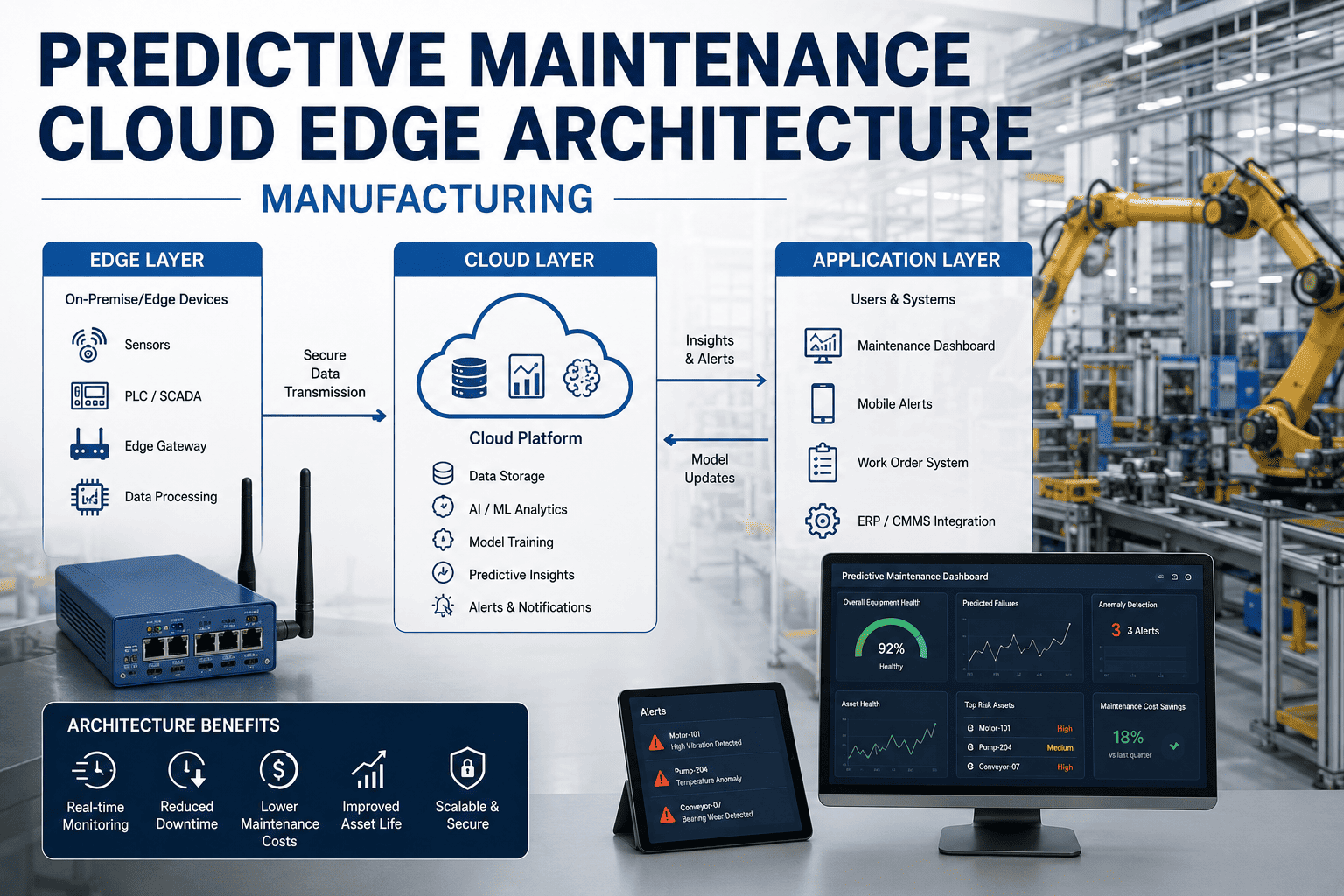
Choosing between cloud and edge architecture for predictive maintenance is the single most consequential infrastructure decision a plant will make this decade — get it wrong and you either drown in bandwidth costs or miss the millisecond window that prevents a bearing failure. Most maintenance leaders assume "cloud" means scalable and "edge" means fast, but the real trade-off is far more nuanced, spanning latency budgets, offline resilience, cybersecurity posture, and how cleanly vibration and current data flow into your CMMS. A 180-asset plant spending $42K a year on condition monitoring can cut that bill by 30–55% simply by placing inference at the right tier. The framework below maps latency, bandwidth, and integration so you can size each layer correctly — then Start Free Trial to model it against your own asset register.
Cloud or Edge for PdM — which one actually survives a 4 AM spindle failure?
The wrong choice costs a 200-machine plant roughly $18K a year in excess bandwidth — or worse, a 90-second latency gap that turns a $1,200 bearing repair into a $34,000 gearbox swap.
Where milliseconds and megabytes actually accumulate
Every predictive maintenance data path has four tollbooths — acquisition, transport, inference, and CMMS write-back. Cloud-only architectures pay at transport; edge-only pays at inference hardware. The table below shows what each tier really costs a 200-asset plant running 10 kHz vibration sampling.
| Dimension | Cloud-Only | Edge-First Hybrid | Plant Impact |
|---|---|---|---|
| Inference latency | 800–2,000 ms | 20–50 ms | Catches incipient bearing faults in the same rotation |
| Bandwidth / 100 sensors / mo | 1.4 TB | ~40 GB | $1,250/mo saved on a typical MPLS link |
| Offline resilience | Stops scoring on WAN loss | Local inference continues 24/7 | No blind window during a 6-hour ISP outage |
| CMMS write-back | Batched, 5–15 min lag | Sub-second work-order triggers | Trigger-to-WO under 1 second |
| Storage cost / yr (200 assets) | ~$8,400 cold tier | ~$1,100 (features only) | 87% reduction in cloud storage spend |
| Capex threshold | Low — pay per use | ~$6K–$14K gateway per line | Break-even at month 4–7 typically |
A reference PdM architecture that splits the work correctly
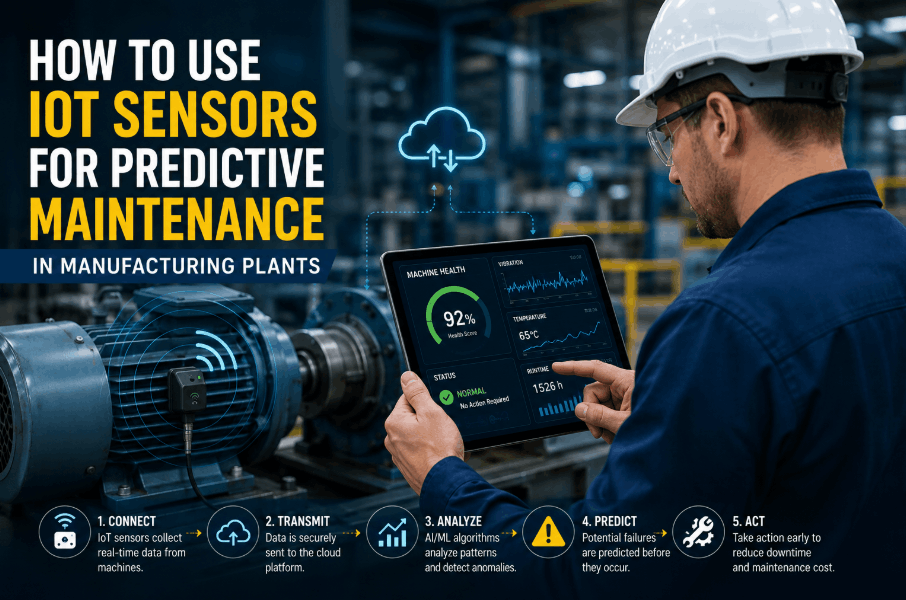
Mature plants don't choose cloud OR edge — they assign each layer the job it does best. The numbered stream below traces a single high-frequency vibration sample from sensor to scheduled work order.
Sensor tier — 10 kHz acceleration capture
Wireless tri-axial accelerometers sample at 6.4–25.6 kHz. Raw waveforms are buffered locally for 30–60 seconds, then either forwarded or discarded based on a threshold gate. Typical MTBF target: 36 months on a coin-cell or 5+ years on a harvest-powered node.
Edge gateway — feature extraction & inference
An industrial edge appliance (4-core ARM, 8 GB RAM) runs FFT, envelope analysis, and a lightweight gradient-boosted model. It outputs a health score every 60 seconds and a fault classification only when confidence exceeds 0.82. This is where 97% of the raw bytes get reduced to kilobytes.
Plant historian — context & retention
Features, scores, and flagged waveforms land in a local historian (typically 90-day hot retention). Operators see live dashboards without touching the public internet. A 200-asset plant stores roughly 11 GB locally per month — a $0 cloud bill for historical query.
Cloud — model retraining & fleet benchmarking
Only anonymized features and confirmed failure labels are uplinked weekly for model retraining. The cloud also runs cross-plant benchmarking — comparing pump A in Ohio to 412 similar assets across the fleet — and pushes updated model weights back to every gateway in under 12 minutes.
CMMS write-back — trigger to work order
When the edge model flags a Stage-2 bearing defect, a REST call hits the CMMS API and auto-creates a work order with fault code, confidence, recommended action, and the last 24 hours of waveform context attached. Median trigger-to-WO time: 0.8 seconds. No human triage step required for high-confidence calls.
The math that decides your architecture
A 200-asset plant streaming raw 10 kHz vibration data to the cloud continuously will burn through roughly 2.8 TB per month — and pay for it twice, once in MPLS fees and again in object storage. Edge feature extraction collapses that to a formula you can size in five minutes.
200 sensors × 10,000 × 16 × 3 × 2,592,000 ≈ 2.8 TB/month
200 × 2 KB × 1,440 × 30 + ~0.6 TB bursts ≈ 40 GB/month
What happens when the WAN drops at 2 AM
Industrial networks fail more often than the assets they monitor — a 2024 study of 340 plants found a median of 4.3 unplanned WAN outages per month averaging 22 minutes each. Cloud-only PdM goes blind during every one of those windows. Edge-first systems keep scoring, keep alerting, and queue only the uplink.
Air-gap tolerance
Edge inference runs on the PLC subnet with no internet dependency. A plant can operate fully disconnected for 72+ hours while local buffering holds 90 days of features and the last 200 anomaly waveforms for later sync.
Data sovereignty
Raw 10 kHz waveforms never cross the facility firewall. Only 2 KB feature vectors and anonymized fault labels leave the plant — satisfying ITAR, GDPR, and most internal data-residency policies without a custom legal review per site.
Continuous scoring
Edge models keep producing health scores and triggering local work orders through any outage. The cloud resumes retraining and fleet benchmarking automatically when the link returns — no operator intervention, no missed alerts.
A 180-asset automotive stamping plant, year one
Consider a Tier-1 stamping facility running 180 critical assets — presses, robots, air handlers, and coolant pumps — on a legacy route-based vibration program costing $42K annually in contractor walks and unplanned downtime. Here is what each architecture delivers in the first 12 months.
"We moved from a cloud-only pilot to edge-first inference on 142 motors and cut our monthly cloud bill from $1,940 to $180 — while catching two gearbox faults the cloud model missed during a Saturday WAN outage."
— Reliability Lead, mid-size food & beverage plantNot sure which tier your assets actually need?
Run your asset register through our architecture profiler and get a tier-by-tier bandwidth, latency, and payback breakdown in under 10 minutes.
Architecture questions, answered directly
How do I decide which assets get edge inference vs cloud-only monitoring?
Use three filters: criticality, failure velocity, and data volume. Assets whose failure mode develops in minutes to hours (high-speed spindles, VFD-driven pumps) need edge inference to catch the window. Assets with slow thermal or oil-degradation trends (transformers, gearboxes) can tolerate cloud-only polling at 15-minute intervals. A good rule: if a 90-second latency gap would turn a repair into a replacement, put it on edge.
Does an edge-first architecture mean I still need the cloud at all?
Yes — for model retraining, fleet benchmarking, and cross-site analytics. The cloud's job shifts from real-time scoring to weekly model updates and long-horizon trend analysis. Most plants find that 97–99% of bytes should be processed at the edge, with only features and confirmed failure labels going up. You can model this split for your own fleet when you Start Free Trial and connect a sample gateway.
What happens to my CMMS integration if the internet goes down?
Edge-first systems keep calling the CMMS API locally — work orders are created on the plant LAN with no internet required. The only thing that queues is the cloud sync of features and labels, which flushes automatically when connectivity returns. Cloud-only architectures cannot create new work orders during an outage because the inference engine itself is unreachable.
How much edge hardware capex should I budget per line?
A ruggedized edge gateway capable of handling 40–60 vibration channels costs $6,000–$14,000 installed, depending on ATEX/UL rating and I/O count. Most 200-asset plants need 3–5 gateways. Against typical bandwidth savings of $1,200–$1,800 per month, the break-even falls between month 4 and month 7 — well inside a single fiscal year.
Can I migrate a cloud-only PdM program to edge-first without re-instrumenting?
In most cases, yes. Existing wireless accelerometers and current sensors can feed an edge gateway through OPC-UA, MQTT, or Modbus without replacement. The migration is a software + gateway layer, not a sensor rip-and-replace. A 30-minute walkthrough with our team — Book a Demo — will map your current sensor fleet to an edge tier plan.
Build the PdM architecture your uptime actually needs
Profile your assets, size your edge tier, and watch the bandwidth math collapse in real time. Free for 14 days, no credit card required.
Free 14-day trial · No credit card