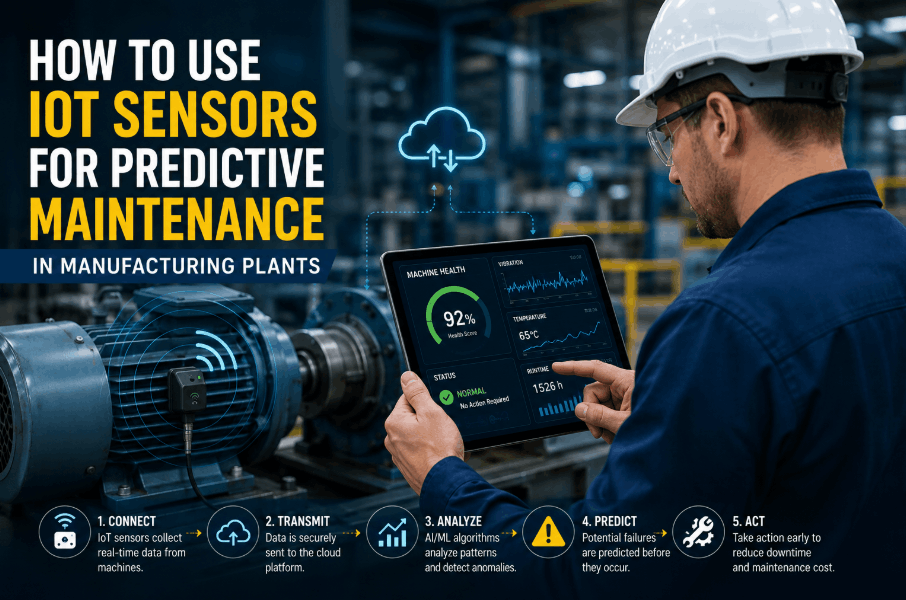
Predictive maintenance is rewriting the rules of manufacturing uptime — and the plants adopting it earliest are pulling ahead fastest. Unplanned equipment failures cost manufacturers an average of $260,000 per hour in lost production, emergency labor, and expedited parts. Unlike reactive maintenance (fixing what breaks) or preventive maintenance (scheduled servicing whether needed or not), predictive maintenance uses real-time sensor data, AI-driven analytics, and condition monitoring to catch failures before they happen — cutting unplanned downtime by up to 50% and extending asset life by 20–40%. If your plant is still running on clipboard-based rounds and calendar-based PMs, you are spending more money than you need to. Start your free OXmaint account and connect your first monitored asset today.
Predictive Maintenance
Stop Fixing Failures. Start Preventing Them.
Condition monitoring + AI analytics = failures caught weeks before they happen. Here is what the data looks like for plants that have made the switch.
50%
Less unplanned downtime
10x
First-year ROI
$260K
Average cost per hour of unplanned stoppage in manufacturing
40%
Longer asset lifespan with condition monitoring
3 weeks
Avg. advance warning for bearing failures
Why It Matters Now
Three Maintenance Strategies — and Why Two Are Costing You
Manufacturing plants operate under one of three maintenance philosophies. Only one is built around data.
Fix on Failure
- Equipment runs until it breaks
- Emergency repair costs 3–5× planned maintenance
- Secondary damage to adjacent assets
- No data on failure history or patterns
- Zero lead time for parts or labor
High Risk · High Cost
Fix on Schedule
- Calendar-driven PMs regardless of condition
- 30–50% of PM tasks performed unnecessarily
- Over-maintenance accelerates wear
- False sense of coverage — gaps still exist
- High labor cost for low-value inspections
Safer · But Wasteful
Fix When Data Says So
- Condition-based — act only when thresholds breach
- Failures detected 2–8 weeks before they occur
- Planned parts, labor, and window scheduling
- Continuous trend data builds failure models
- Reduces total maintenance spend by 25–30%
Lower Cost · Higher Uptime
The Technology Stack
Four Sensor Technologies That Power PdM in Manufacturing
Each sensor type targets a specific failure mode — together they give maintenance teams a complete, continuously updated asset health picture.
Vibration Analysis
Detects: Bearing faults, misalignment, imbalance, looseness
Assets: Motors, pumps, compressors, fans, gearboxes
Lead Time: 2–8 weeks before failure
Accelerometers capture frequency spectra — bearing defect frequencies are mathematically calculable from RPM and bearing geometry. A bearing fault appears as amplitude at specific frequencies months before the bearing seizes.
Thermal Imaging (IR)
Detects: Overloaded circuits, loose connections, blocked cooling
Assets: Switchgear, transformers, drives, motor windings
Lead Time: Hours to days before failure
Infrared cameras capture heat patterns invisible to the naked eye. A termination with high resistance heats up long before it arcs or trips a breaker. Thermal scans of panels and motor housings identify these hours or days ahead.
Oil & Lubricant Analysis
Detects: Metal wear particles, viscosity breakdown, contamination
Assets: Gearboxes, hydraulic systems, turbines, compressors
Lead Time: Weeks to months before failure
Ferrous particle count in oil samples is a direct proxy for gear and bearing wear rate. Rising iron or copper content signals accelerating internal wear. Inline oil sensors now deliver this data continuously — no lab samples required.
Ultrasonic Detection
Detects: Air/steam leaks, electrical arcing, partial discharge
Assets: Compressed air lines, steam traps, switchgear, valves
Lead Time: Immediate — catches active faults
Ultrasonic sensors detect high-frequency sound signatures that human hearing cannot pick up. Electrical partial discharge inside switchgear is audible ultrasonically well before it becomes a visible arc flash event.
OXmaint Predictive Maintenance Platform
Sensor Data Is Worthless Without a System That Acts On It
OXmaint connects directly to your IoT sensors, vibration monitors, and thermal cameras — automatically generating prioritized work orders the moment a threshold is breached. Your maintenance team stops chasing failures and starts preventing them.
Common Failure Modes
The 6 Failures PdM Catches Before They Shut Your Line
These six failure categories account for over 70% of unplanned manufacturing downtime. Each has a detectable signature weeks before catastrophic failure.
01
Bearing Degradation
Responsible for 40–50% of all rotating equipment failures. Vibration sensors detect sub-surface fatigue cracks through BPFI/BPFO frequency signatures 4–8 weeks before failure. Condition-based replacement replaces 30% fewer bearings than time-based schedules.
Vibration + Temperature
02
Motor Winding Insulation Breakdown
Heat and electrical stress degrade winding insulation over thousands of operating hours. Thermal cameras spot hot windings before they ground fault. Motor current signature analysis detects developing insulation problems without any physical access to the motor.
Thermal + Current Analysis
03
Gear Tooth Wear and Pitting
Gearbox oil particle counts rise as tooth surfaces pit and spall. Vibration analysis shows gear mesh frequency harmonics that indicate wear progression. Both signals together allow a confident failure timeline — and a planned replacement versus an emergency rebuild.
Oil Analysis + Vibration
04
Pump Cavitation
Cavitation erodes impeller surfaces and generates broadband high-frequency vibration. Ultrasonic sensors pick up the characteristic bubble-collapse signature before any mechanical damage becomes visible. Flow and pressure sensors confirm the system conditions driving cavitation onset.
Ultrasonic + Flow Monitoring
05
Electrical Connection Degradation
Loose or corroded terminations in motor control centers increase contact resistance — generating heat that thermal cameras capture as hot spots. Catching a 15°C rise prevents an arc flash event that could take a panel offline for weeks.
Thermal Imaging
06
Compressed Air and Hydraulic Leaks
The average manufacturing plant loses 20–30% of its compressed air to leaks — a direct energy cost with no production benefit. Ultrasonic detectors locate the exact leak point in noisy environments. Online flow monitoring quantifies total leak volume across the entire compressed air system.
Ultrasonic + Flow Meters
Implementation Roadmap
How Manufacturing Plants Roll Out PdM in 4 Phases
Most plants go from zero to fully operational PdM in 90 to 180 days. Start with your highest-criticality assets and expand from there.
Rank all production assets by failure consequence: downtime cost per hour, safety risk, lead time for replacement, and historical failure frequency. The top 20% of assets typically drive 80% of unplanned downtime cost. These are your first sensor installations.
Output: Prioritized asset list with failure mode mapping and sensor type selection per asset
Install sensors on priority assets and collect 4–6 weeks of baseline data under normal operating conditions. This establishes the healthy-state fingerprint for each asset — the reference point against which anomalies are measured. No alerts fire during baselining.
Output: Asset health baselines, sensor calibration records, connectivity validation
Connect sensor data streams to your CMMS via API — OXmaint supports direct integration with all major IoT sensor platforms. Configure alert thresholds by asset class and failure mode severity. Set up auto-generated work orders with pre-populated findings and assigned technician routing.
Output: Live sensor-to-work-order pipeline operational for all Phase 1 assets
With 90+ days of condition data and completed work orders in the system, AI models begin learning asset-specific failure signatures. Prediction windows extend from threshold-based alerts to pattern-based forecasts. Expand coverage to the next tier of critical assets using validated thresholds from Phase 1.
Output: ML-driven failure forecasting active, plant-wide PdM coverage in progress
Business Case
The ROI of Predictive Maintenance: By the Numbers
PdM programs typically pay back initial investment within 6–12 months. Here is how the financial case stacks up across a mid-size manufacturing plant.
| Cost Category |
Reactive |
Preventive |
Predictive |
| Emergency repair labor (per year) |
$280K–$420K |
$120K–$180K |
$40K–$70K |
| Unplanned downtime hours (annual) |
200–400 hrs |
80–160 hrs |
20–50 hrs |
| Parts spend (rush order premium) |
+35–50% |
+10–15% |
Standard pricing |
| Unnecessary PM tasks performed |
— |
30–50% of all PMs |
Under 5% |
| Average asset lifespan vs. spec |
60–75% |
80–90% |
105–125% |
| Safety incidents from equipment failure |
High frequency |
Moderate |
Significantly reduced |
25–30%
Reduction in total maintenance costs for manufacturers implementing full PdM vs. PM-only programs
70–75%
Reduction in equipment breakdowns with continuous vibration and thermal monitoring vs. manual inspection
3 weeks
Average advance warning window for bearing failures — enough for planned, zero-downtime replacement
Common Questions
Frequently Asked Questions About Predictive Maintenance in Manufacturing
What is the difference between predictive maintenance and condition-based maintenance?
Condition-based maintenance (CbM) triggers maintenance when a sensor reading crosses a set threshold — for example, replacing a bearing when vibration amplitude exceeds a defined limit. Predictive maintenance goes further: it uses trend analysis and AI to forecast when a threshold will be breached before it actually happens, enabling earlier and more planned intervention. Most modern PdM implementations begin with CbM thresholds and evolve toward AI-driven prediction as data accumulates.
OXmaint supports both approaches within the same platform so you can start simple and mature into predictive forecasting without switching systems.
How many sensors do I need to start predictive maintenance in my plant?
You do not need plant-wide sensor coverage to start seeing results. Most successful PdM rollouts begin with 10–20 sensors on the five to ten most critical assets — typically the production line assets whose failure would cause the most costly downtime. Within 60–90 days of baseline data collection, those assets are generating actionable condition data.
Book a demo with OXmaint to map your highest-criticality assets and design a sensor deployment that pays back in the first year.
Does predictive maintenance require replacing my existing CMMS or maintenance software?
No — modern PdM sensor platforms and CMMS systems like OXmaint integrate via REST API, meaning sensor data flows into your existing maintenance workflow rather than replacing it. If your current CMMS supports API connections, sensor findings can automatically generate work orders without any manual data entry. If you are evaluating a CMMS upgrade,
OXmaint is built from the ground up to receive sensor data and close the loop from anomaly detection to completed and verified work orders.
How long before predictive maintenance starts reducing downtime?
Most plants see the first actionable anomaly detection within 60–90 days of sensor installation once baseline data is established. Measurable downtime reduction typically appears in the 4–6 month range as the system builds a track record of early interventions. Full ROI — including labor savings and reduced parts premium spend — is generally documented within the first 12 months. Plants using
OXmaint to close the sensor-to-repair loop consistently see faster time-to-value.
What types of manufacturing plants benefit most from predictive maintenance?
Any facility where rotating equipment — motors, pumps, compressors, gearboxes, conveyors — drives production value will see significant returns. Automotive, food and beverage, chemical, pharmaceutical, and metals manufacturers report the strongest PdM ROI cases because equipment failures directly stop production lines. Plants with 24/7 operations benefit most since they have no scheduled downtime windows for traditional preventive maintenance.
Talk to an OXmaint specialist to map PdM to your specific plant type and asset mix.
Start Today with OXmaint
Every Day Without Predictive Maintenance Is a Day Your Competition Gains Ground
The plants running PdM programs today are achieving 50% less unplanned downtime, 25–30% lower maintenance costs, and safer working environments — all from the same workforce. OXmaint gives you the platform to connect your sensors, automate your work orders, and build the data history your AI needs to get smarter over time.