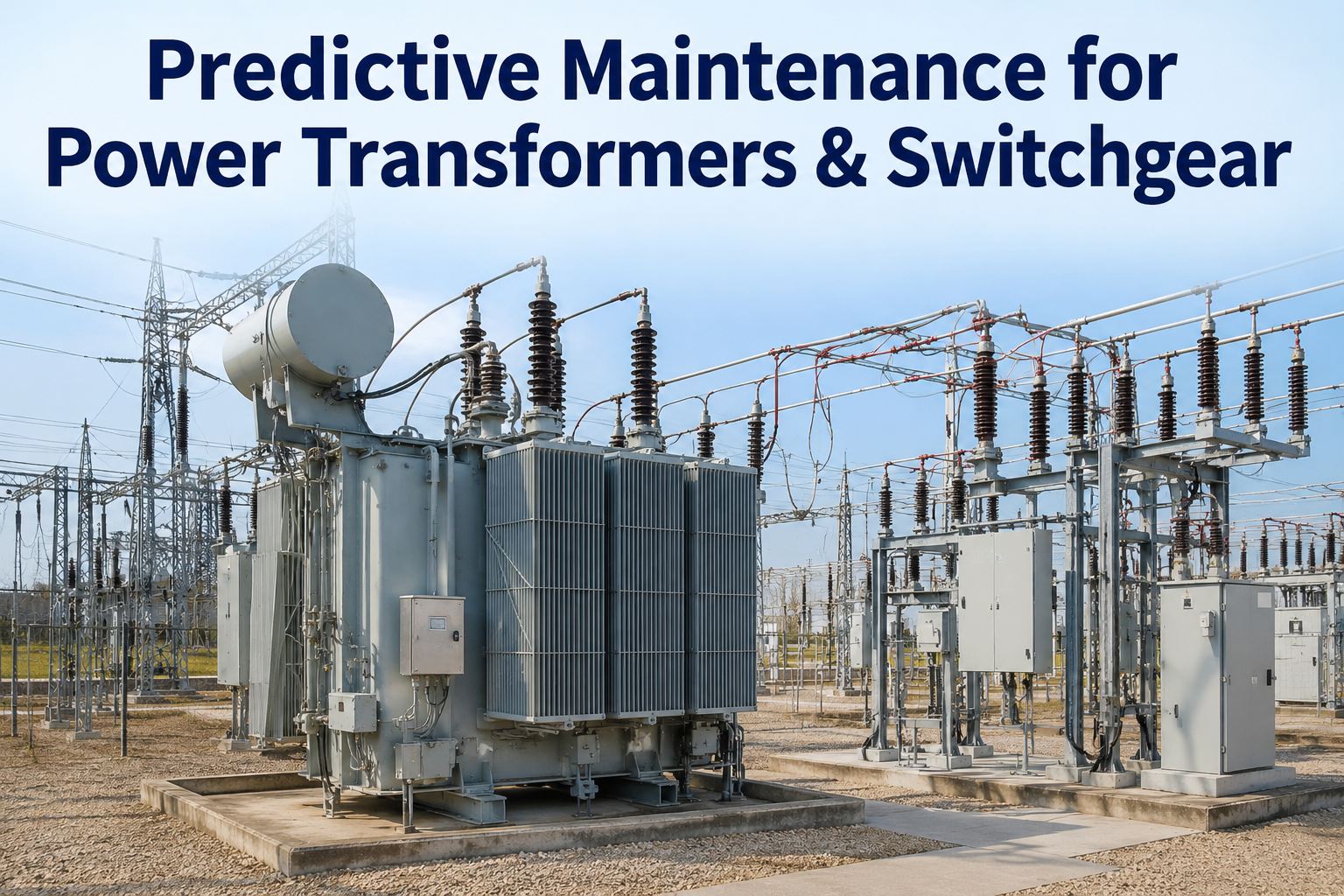
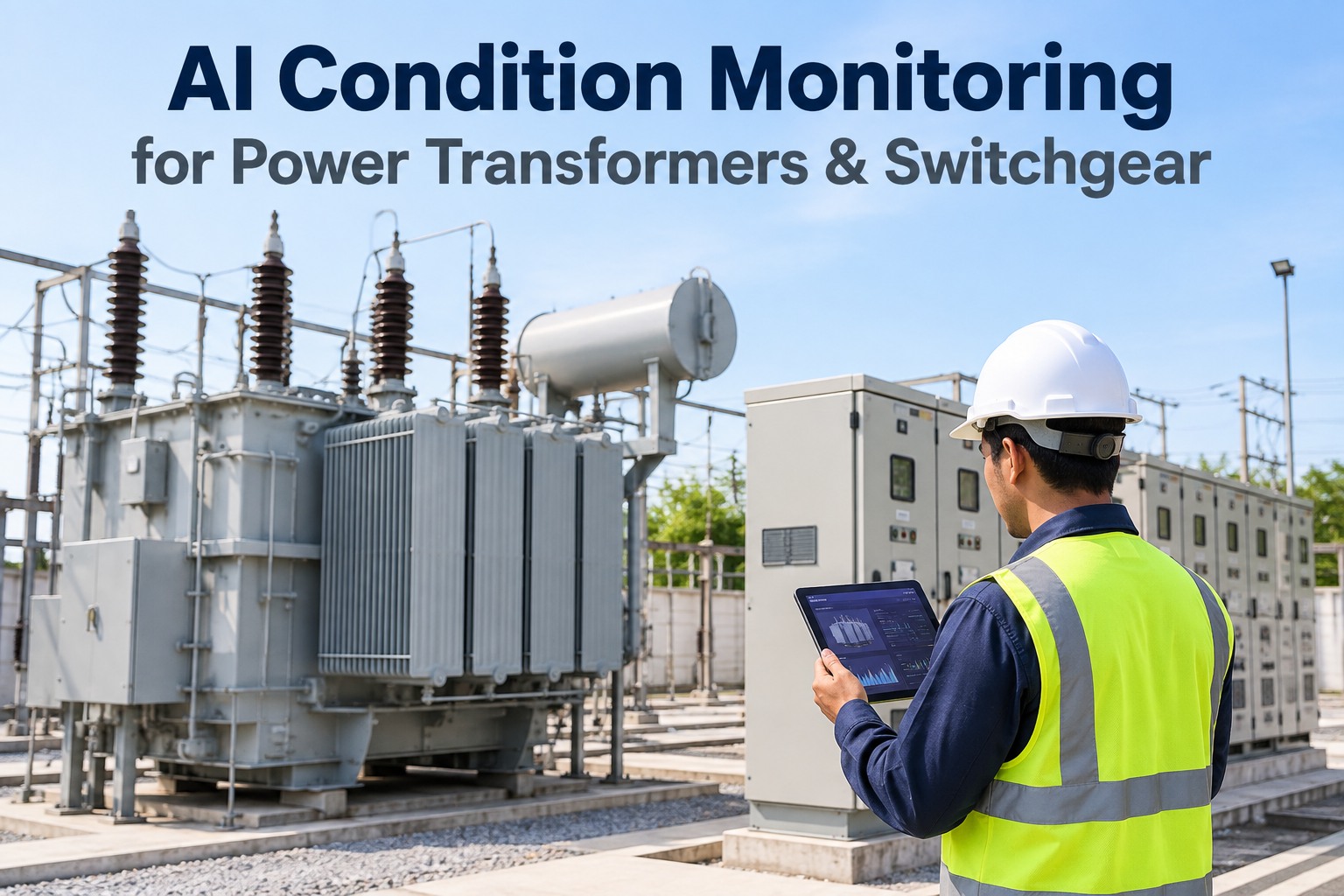
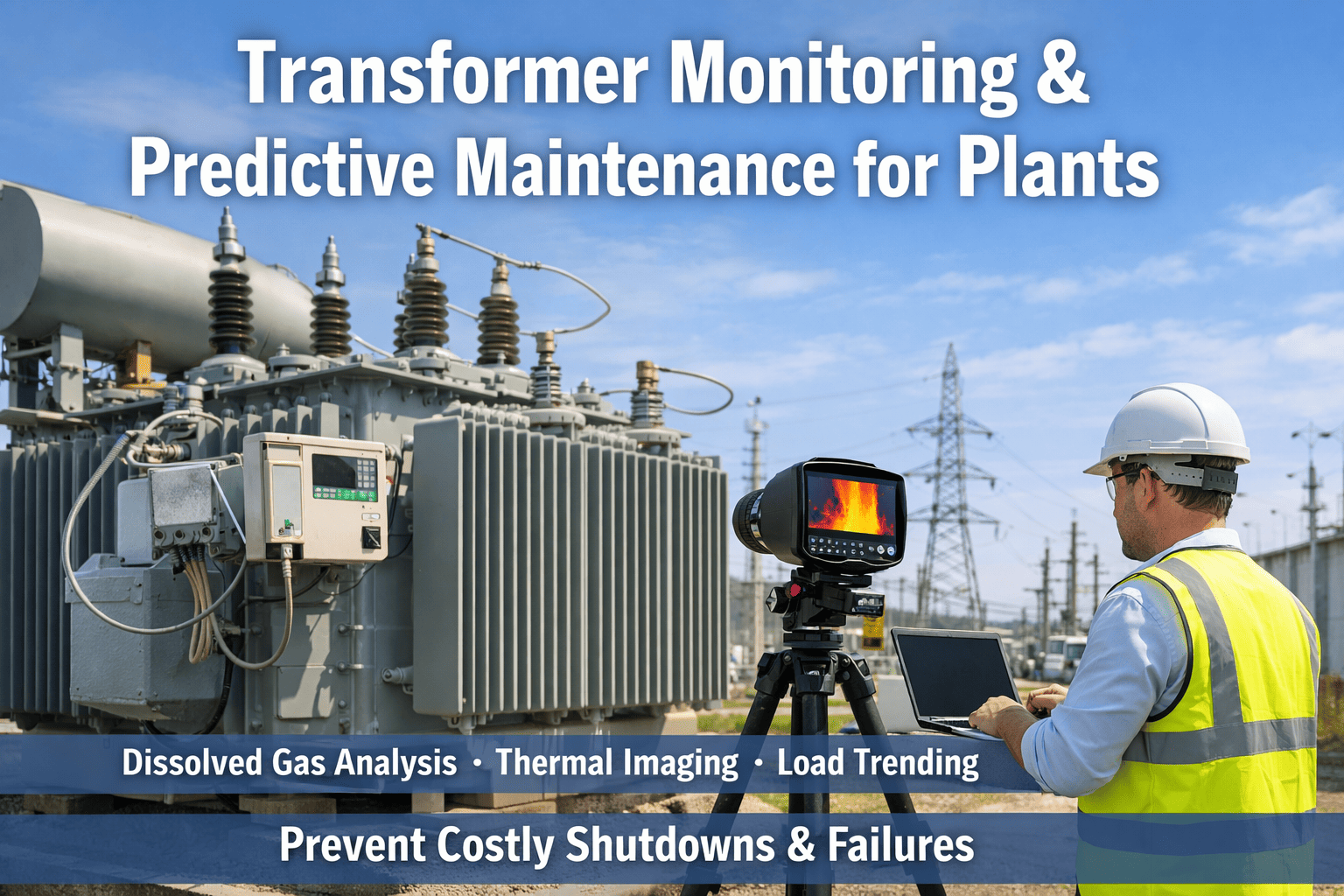
A power transformer is usually the single most expensive asset in the substation — and when it fails without warning, it doesn't just stop; it can take the whole distribution segment down with it and take months to replace. Switchgear carries a quieter but nastier risk: a protection relay that silently fails is only discovered during an actual fault, exactly when it's needed most, and its misoperation can cascade into a total station blackout in seconds. The reassuring part is that neither asset fails silently to the instruments. A transformer broadcasts incipient faults through the gases dissolving in its oil months ahead. Insulation breakdown announces itself as partial discharge long before flashover. Loose connections radiate heat weeks before they burn. The problem is that most electrical maintenance is still calendar-based — a periodic inspection that can miss a fault developing between visits. This guide covers predictive maintenance for power transformers and switchgear the way it works in 2026 — the failure modes, the monitoring techniques and what each detects, and how a CMMS turns a gas reading or a discharge alert into a staged work order before the lights go out. Book a live predictive-maintenance demo for your electrical assets.
Your Most Expensive Asset Warns You First
Transformers speak through gas, switchgear through discharge — both months before they fail.
DGA
Dissolved gas analysis — the single most powerful transformer predictive tool
Months
Lead time gas and discharge trends give before a functional failure
Seconds
How fast a relay misoperation can cascade into a station blackout
Online
Continuous monitoring now complements periodic lab testing on critical units
Where Transformers & Switchgear Actually Fail
Predictive maintenance starts with knowing what you're watching for. These assets fail through insulation degradation, thermal faults, and electrical discharge — each of which leaves an early, measurable trace long before the failure becomes functional.
Insulation Breakdown & Partial Discharge
Localized dielectric breakdown in voids, gaps, and imperfections within the insulation. Small sparks erode the insulation over time and, unchecked, progress toward flashover — the dominant electrical failure path.
Thermal Faults & Overheating
Winding hot spots, overloading, and cooling-system decline overheat the oil and paper insulation, accelerating aging. Loose connections generate resistive heat that climbs toward ignition if not caught.
Oil & Dielectric Degradation
Moisture ingress, loss of dielectric strength, and additive depletion reduce the oil's ability to insulate and cool. A leading precursor to both thermal and electrical faults in oil-immersed transformers.
Protection Relay & Breaker Faults
The hidden failure. A protection relay or breaker that has silently failed is often discovered only during a fault — when its misoperation can cascade into a station blackout in seconds.
The Predictive Techniques · What Each One Detects
No single technique sees everything. Each monitors a different physical signal and catches a different failure earliest — DGA reads the transformer's chemistry, PD hears its insulation, thermography sees its heat, and relay testing exposes hidden protection faults. A real program layers them.
Dissolved Gas Analysis (DGA)
The heart of transformer monitoring
When insulation overheats, arcs, or discharges, the oil and paper decompose into characteristic gases. Their type, quantity, and rate of production correlate to the specific fault — winding overheating, partial discharge, or arcing — enabling diagnosis months ahead, by periodic lab sampling or continuous online monitors.
Partial Discharge Monitoring
Hears insulation failing early
UHF, acoustic, and ultrasonic detectors catch the tiny electrical discharges that precede insulation breakdown — especially vital for gas-insulated switchgear. A reading above roughly 5 dB over background at the same location on two consecutive surveys triggers isolation and internal inspection.
Infrared Thermography
Fast screening for hot spots
Infrared imaging reveals loose connections, overloaded conductors, and cooling problems as heat signatures well before failure. A quick scan route across bushings, terminations, and switchgear connections flags assets for deeper investigation.
Relay Testing & SF6 Management
Exposes the hidden faults
Scheduled protection-relay and breaker testing surfaces faults that would otherwise appear only during a real fault. For GIS, SF6 purity (above 97%) and moisture (below 200 ppm) tracking — with elevated SO2 confirming prior internal arcing — completes the picture.
Map Your Electrical PdM Program in 30 Minutes
Working session with our reliability team — bring your transformer and switchgear list. We'll match failure modes to monitoring techniques, set alert thresholds for DGA, PD, and thermography, and show how OxMaint turns each reading into an auto-generated work order with parts staged.
Transformer vs Switchgear · Different Assets, Different Playbook
Though they sit side by side in the substation, transformers and switchgear fail differently and need different monitoring emphasis. A program that treats them the same misses the point of each.
Power Transformers
DGA is the primary tool — reads oil chemistry
Oil quality, moisture, dielectric strength tracked
Winding and hot-spot temperature monitoring
Bushing and tap-changer condition
Online monitors on the most critical units
Switchgear (incl. GIS)
Partial discharge survey is the primary tool
SF6 purity and moisture management on GIS
Protection relay and breaker function testing
Thermography on busbars and connections
Enclosure and bushing-interface integrity
The P-F Interval · Why Early Detection Pays
Every electrical failure travels a path from first detectable symptom (P) to functional failure (F). The entire return on predictive maintenance comes from acting inside that window — and for a months-of-lead-time transformer, that window is wide enough to plan a fix instead of suffering an outage.
EARLY
Incipient — DGA & PD Detect First
Trace fault gases appear in the oil; low-level partial discharge begins. Cheapest intervention: oil reconditioning, moisture removal, a planned inspection. No functional impact yet, months of runway.
DEVELOPING
Progressing — Heat & Rising Gas Confirm
Gas generation accelerates, thermography shows hot spots, PD climbs above threshold. Plan the repair — bushing, tap-changer, or winding work — for a scheduled outage with parts procured ahead.
CRITICAL
Functional Failure — Outage & Cascade
Flashover, winding failure, or relay misoperation. Forced outage, a transformer that can take months to replace, and the risk of a cascading station blackout. The outcome predictive maintenance exists to prevent.
How OxMaint Runs Electrical Predictive Maintenance
OxMaint is an AI-native CMMS and RCM platform that turns condition data into action — IoT and sensor integration, DGA and PD threshold alerts, auto-generated PM tasks, continuous FMEA and criticality analysis, SAP and Maximo overlay, and cloud reliability reporting that replaces spreadsheet RCM, from one dashboard on desktop or mobile.
Integrate
DGA, PD & Sensor Data
Ingest gas readings, partial-discharge surveys, thermography, and oil results against each asset — lab and online-monitor data in one record, the base for trending.
Detect
Threshold & Fault Alerts
A rising key gas, a PD reading above background on two surveys, or a thermal hot spot that breaches its limit fires an alert tied to the specific predicted fault.
Trigger
Auto-Generated Work Orders
An alert converts to a prioritized work order with the right parts and procedure staged — mobile-first, with offline mode and QR asset tags for the field.
Schedule
Relay & PD Test Cadence
Protection-relay tests, PD surveys, and SF6 checks auto-generate on cadence — the hidden-function tests that catch faults before a real fault does.
Analyze
Continuous FMEA & Criticality
Live failure-mode libraries and criticality scoring focus predictive effort on the transformers and switchgear whose failure hurts most — no flat calendar, no spreadsheet RCM.
Overlay
SAP & Maximo + Reporting
Sit over existing SAP PM or IBM Maximo as the reliability layer, with cloud KPI reporting on downtime, asset life, and OEE across a single plant or a global network.
Catch the Fault Months Before the Blackout
Cut unplanned downtime, extend the life of your most expensive assets, and hit your reliability targets. See how OxMaint fuses DGA, partial discharge, and thermography into staged work orders across your electrical fleet. Free forever plan available.
Frequently Asked Questions
What is predictive maintenance for transformers and switchgear?
It's a condition-based strategy that continuously monitors the actual health of electrical assets — through dissolved gas analysis, partial discharge, thermography, and relay testing — to detect developing faults months before they cause failure, so repairs happen on a planned schedule rather than after an outage. Instead of calendar-based inspection that can miss a fault developing between visits, predictive maintenance reads real condition and prescribes action only when the data shows a fault emerging. For transformers and switchgear that means targeting insulation breakdown, thermal faults, oil degradation, and hidden protection-relay failures inside their detectable window.
Book a demo to see it on your fleet.
Why is dissolved gas analysis so important for transformers?
DGA is widely regarded as the single most powerful predictive tool for oil-immersed transformers because it reads the fault directly from the transformer's own chemistry. When insulation overheats, arcs, or partially discharges, the oil and paper decompose into characteristic gases, and the type, concentration, and rate of production of those gases correlate to the specific fault — winding overheating, partial discharge, or arcing. That lets engineers diagnose an incipient fault and even classify its nature months before it becomes a functional failure. It's performed by periodic lab sampling and, increasingly, continuous online monitors on the most critical units, making it the heart of any transformer condition-monitoring program.
What is partial discharge and why monitor it?
Partial discharge is a localized breakdown of the insulation — a small spark or electrical breakdown in voids, gaps, or imperfections within the dielectric — that erodes the insulation over time and, unchecked, progresses toward full flashover. Monitoring it with UHF, acoustic, or ultrasonic detectors catches insulation failure at an early stage, which is especially critical for gas-insulated switchgear. A common practice is to survey bays during operation and treat any reading above roughly 5 dB over background noise at the same location on two consecutive surveys as a trigger for isolation and internal inspection. Because PD and DGA detect faults through different physics and timelines, many operators use both on their most critical transformers.
Why do transformers and switchgear need different monitoring?
Because they fail differently. A transformer's dominant risks live in its oil and insulation, so DGA, oil-quality testing, moisture and dielectric measurement, and winding-temperature monitoring lead the program. Switchgear — particularly gas-insulated switchgear — centers on partial discharge surveys, SF6 gas purity and moisture management, and protection-relay and breaker function testing, with thermography on busbars and connections. The protection relay is a special case: a silently failed relay is often discovered only during an actual fault, when its misoperation can cascade into a blackout in seconds, so scheduled relay testing is essential. Treating both assets with one generic calendar misses the specific early-warning signal each one gives.
Sign up free to build both programs.
How does OxMaint support electrical predictive maintenance?
OxMaint is an AI-native CMMS and RCM platform that ingests DGA, partial-discharge, thermography, and oil data against each transformer and switchgear asset, fires threshold and fault alerts tied to specific failure modes, and auto-generates prioritized work orders with parts and procedures staged. It schedules the hidden-function tests — relay testing, PD surveys, SF6 checks — on cadence, runs continuous FMEA and criticality analysis to focus effort where failure hurts most, overlays existing SAP PM and IBM Maximo, and delivers cloud reliability reporting on downtime, asset life, and OEE. It runs mobile-first with offline mode and QR asset tags, across one plant or a global network. A free forever plan and live demos are available.