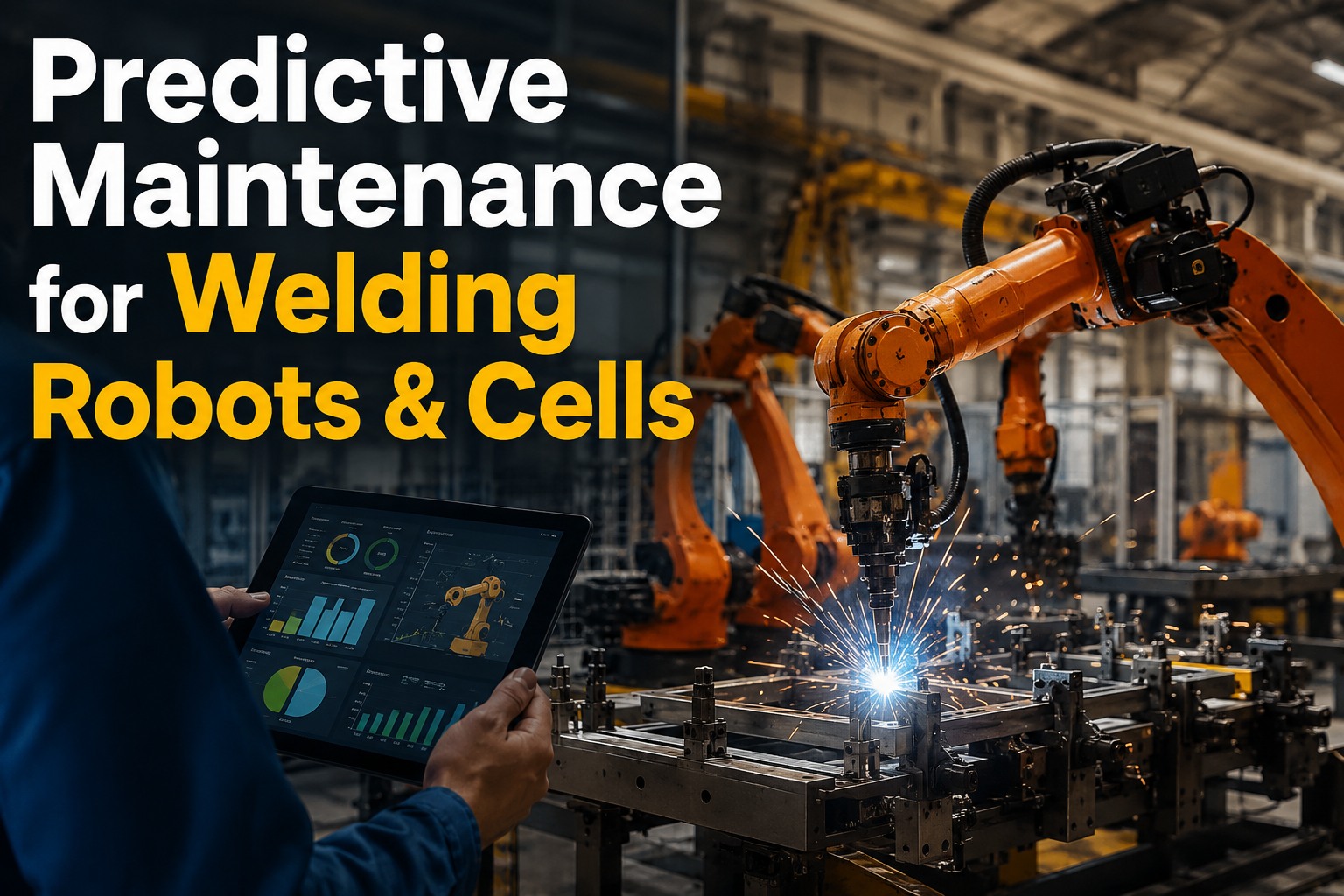
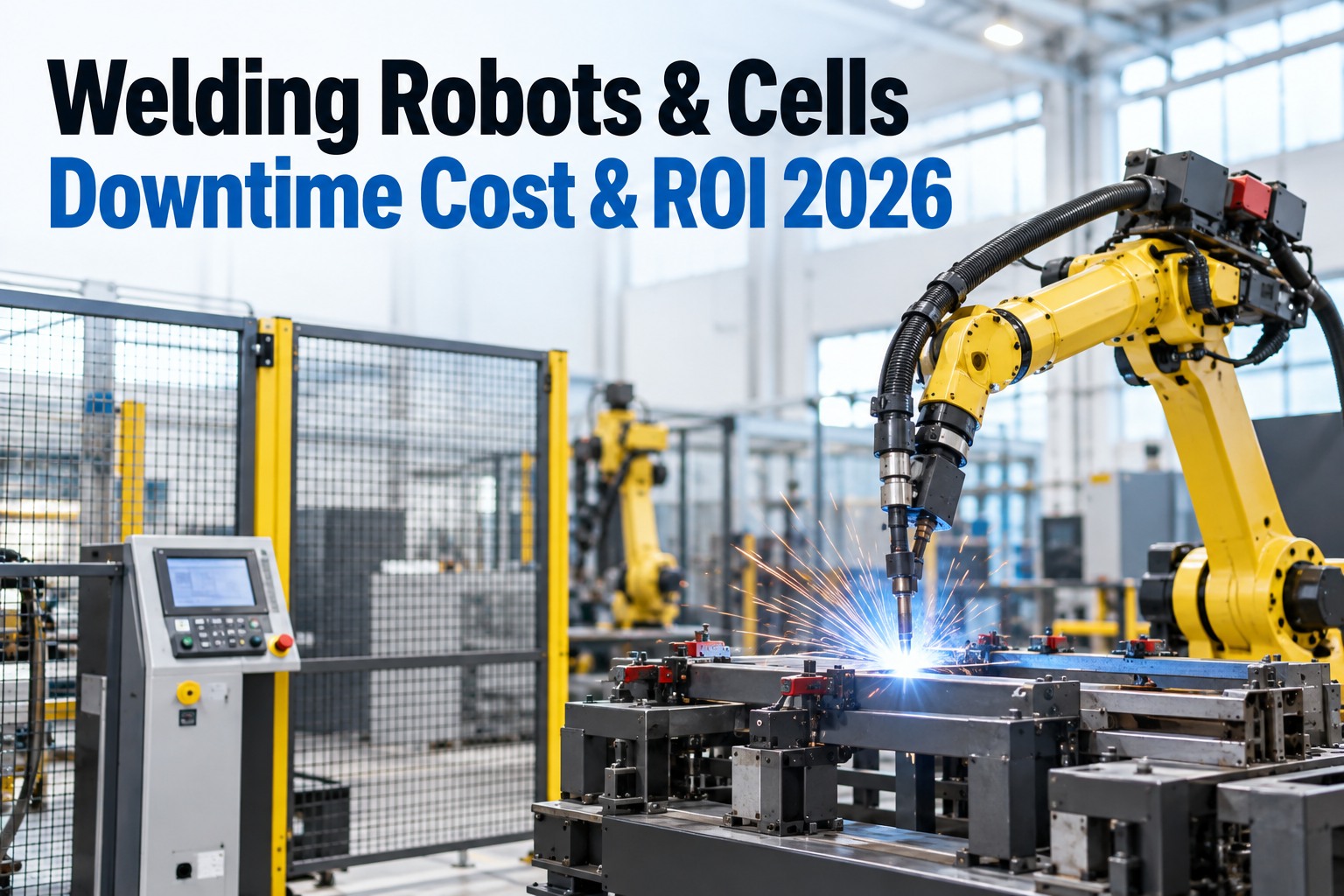
A robotic welding cell rarely fails all at once — it fails a reject weld at a time. Long before a cell actually stops, a contaminated liner, a drifting drive-roll pressure, or an enlarging contact-tip bore is already degrading weld quality, so scrap and rework pile up while every availability metric still reads green. That's what makes welding cells distinctive for predictive maintenance: the failure shows up in the product before it shows up in the uptime. In one documented case, a cell's wire-feed motor was failing for 18 days — signaling the whole time in its motor current — before it produced a single reject weld, and nobody was listening. A welding cell isn't one machine either; it's a system of interdependent subsystems where degradation in any one cascades into defects, downtime, or both, and a single cell failure can stop an entire automotive line within 30 seconds. This guide covers predictive maintenance for welding robots and cells: the subsystems and how they fail, the signals that reveal it early, why quality degrades before availability, and how a CMMS turns those signals into work before the first bad weld. Book a live predictive-maintenance demo for your welding cells.
A Welding Cell Fails a Reject Weld at a Time — Not All at Once
Quality degrades before uptime does. The signals are there for days — the question is whether anyone is listening.
$10K/hr
Lost production while a robotic welding cell sits idle
84%
Unplanned-downtime reduction reported with AI predictive maintenance
30 sec
How fast one cell failure can stop an entire automotive line
30%
Robot life extension from condition-based maintenance
The Cell Is a System of Subsystems
Effective predictive maintenance starts by treating the cell as what it is — several interdependent subsystems, each with its own failure modes, where a fault in one propagates into the others. These are the four zones to watch.
Robot Mechanicals
Servo motors, reducers, axes. Servo bearing wear, reducer degradation, wrist-axis bearing wear, and encoder noise — showing as rising motor current and TCP repeatability drift. Over a third of robots develop calibration drift each year.
Wire Feed System
The #1 defect root cause. Drive rolls, feed motor, liner, straightener. A 5% drive-roll pressure drift causes erratic arc starts; liner contamination brings burn-back and bird-nesting. Feed-motor current is the earliest warning.
Torch & Consumables
Wears fastest, hits quality first. Contact-tip bore wear of just 0.2mm shifts arc characteristics enough to reject a structural-code weld; nozzle spatter buildup restricts shielding gas and causes porosity.
Gas Delivery & Controller
The quiet ones. Regulator wear, hose degradation, and leaks alter shielding coverage; controller overheating threatens the whole cell. Both signal through flow, pressure, and temperature trends.
Failure Modes to Signal · What Reveals Each Early
The power of welding-cell predictive maintenance is that every subsystem broadcasts its health through data the cell already generates — servo currents, arc parameters, cycle data, error logs. Each mode has an early signature.
Failure Mode
Early Signature
Monitoring Signal
Servo bearing / reducer wear
Rising motor current for the same motion
Servo current trend + vibration
Wire feed degradation
Feed-motor current climb, tension variance
Feed-motor current + wire tension
Contact tip / nozzle wear
Arc instability, voltage drift, spatter rise
Arc parameters + thermal signature
TCP / repeatability drift
Cycle-time drift, seam-tracking correction
Cycle time + position repeatability
Gas coverage loss
Flow drop, pressure change, porosity
Gas flow + pressure trend
Controller overheating
Rising cabinet temperature, error logs
Temperature + fault-code monitoring
Map Your Welding-Cell PdM Program in 30 Minutes
Working session with our reliability team — bring your cell and robot list. We'll match subsystem failure modes to the signals that catch them, set consumable-wear and drift thresholds, and show how OxMaint turns a rising current trend into a work order.
The Monitoring Signals · What the Cell Already Tells You
No new instrumentation is needed to start — welding cells already produce the signals. The discipline is capturing and trending them against a recipe-specific baseline, because normal looks different for each joint, wire class, and thickness.
Motor & Servo Current
A gradual rise in current for the same motion is the earliest sign of bearing, reducer, or feed-motor wear — the single most useful trend in the cell.
Arc & Thermal Signature
Voltage stability, arc parameters, and thermal profiles around the consumables reveal contact-tip and nozzle wear — often before the reject weld, tied to quality outcomes.
Cycle Time & Repeatability
Cycle-time drift often signals end-of-arm tool degradation, and position repeatability exposes TCP drift before it moves welds off the seam.
Error Logs & Consumable Cost
Fault-code patterns flag developing controller and axis faults; a rising cost-per-weld on tips, liners, and nozzles is itself a degradation signal.
Quality Before Downtime · The P-F Interval
The welding-cell P-F interval has a distinctive shape: the first functional failure is usually a quality escape, not a stoppage. Catching the signal early means acting in the quality-drift window, long before the line goes down.
SIGNAL
Detectable Drift — Weld Still Good
Motor current rises, drive-roll pressure drifts, tip bore enlarges. The signal is present and trending, but welds still pass. Cheapest intervention: a scheduled consumable swap or adjustment at leisure.
DEFECTS
Reject Welds — Scrap & Rework Climb
Degradation crosses the quality threshold. Porosity, spatter, underfill, and off-seam welds appear; reject rate climbs and rework cost accelerates — while the cell still runs, masking the problem.
STOPPAGE
Functional Failure — The Line Stops
Wire jam, bird-nest, seized axis, or controller trip. The cell goes down, and in a tightly coupled line it takes downstream stations with it in seconds. The outcome predictive maintenance exists to prevent.
How OxMaint Runs Welding-Cell Predictive Maintenance
OxMaint is an AI-native CMMS and RCM platform that turns cell signals into action — IoT and sensor integration, live FMEA and criticality, condition triggers, auto-generated work orders, consumable and asset tracking, SAP and Maximo overlay, and reliability reporting that replaces spreadsheet RCM, from one dashboard on desktop or mobile.
Integrate
Robot & Weld Data
Ingest servo current, arc parameters, cycle data, gas flow, and error logs against each robot, feeder, and power source — normalized across Fanuc, ABB, KUKA, and Yaskawa.
Baseline
Recipe-Specific Thresholds
Set condition thresholds per joint, wire class, and thickness — so an alert reflects real drift from that recipe's normal, not a one-size-fits-all limit.
Detect
Drift & Wear Alerts
A rising current trend, arc instability, or TCP drift fires an alert tied to the subsystem — in the quality-drift window, before the first reject weld.
Trigger
Auto-Generated Work Orders
An alert becomes a prioritized work order with the subsystem, history, and parts staged — mobile-first, with offline mode and QR tags on each cell.
Consumables
Tip, Liner & Nozzle Tracking
Track consumable life and cost-per-weld, so tips, liners, and nozzles are replaced on real wear — and a rising cost trend surfaces as a signal.
Report
OEE, Uptime & Reliability
Arc-on time, reject rate, PM compliance, and OEE dashboards plus ISO 55000-aligned records, with SAP and Maximo overlay across every cell.
Catch the Drift Before the First Reject Weld
Stop discovering wear in the scrap bin. See how OxMaint turns the servo, arc, and cycle signals your cells already generate into work orders that fire in the quality-drift window — before the line stops. Free forever plan available.
Frequently Asked Questions
What is predictive maintenance for welding robots and cells?
It's a condition-based strategy that monitors the real health of a robotic welding cell — servo motor current, arc and weld parameters, cycle data, gas flow, thermal signatures, and error logs — to detect developing faults before they cause reject welds or a stoppage, so maintenance is planned rather than reactive. A welding cell is a system of interdependent subsystems — robot mechanicals, wire feed, torch and consumables, gas delivery, and controller — where degradation in any one cascades into quality defects and downtime. Predictive maintenance catches each mode in its own detectable window, which for welding usually opens as quality drift before availability is ever affected.
Book a demo.
What failure modes can it detect?
Across the cell's subsystems: servo motor bearing and reducer wear, wrist-axis bearing wear, and TCP repeatability drift on the robot side; wire-feed degradation from drive rolls, feed motor, and liner contamination; contact-tip bore wear and gas-nozzle blockage on the torch; gas-coverage loss from regulator, hose, and leak issues; and controller overheating. Wire feed is the number-one root cause of robotic MIG weld defects, and torch consumables wear fastest and hit quality first. Each mode has a distinct early signature — for example, a gradual rise in motor current indicates bearing wear, while cycle-time drift often signals end-of-arm tool degradation.
Why does weld quality degrade before the cell stops?
Because most welding-cell degradation crosses a quality threshold well before it crosses a functional one. A contact tip with an enlarged bore, a liner starting to contaminate, or a drive roll with drifted pressure will still move the wire and strike an arc — but the weld it produces drifts out of spec, so porosity, spatter, underfill, or off-seam welds appear while the cell keeps running and looks available. In one documented case a wire-feed motor signaled failure in its motor current for 18 days before the first reject weld. That's why monitoring the signals, not just tracking uptime, is essential — the reject welds are the early functional failure.
Start free.
Do welding cells need new sensors for predictive maintenance?
Usually not to begin — the cell already generates the key signals. Servo currents, arc parameters, cycle times, gas flow, and error logs come from the robot and power source themselves, and modern platforms ingest them and normalize across robot brands. The discipline is capturing and trending those signals against a recipe-specific baseline, since normal differs by joint, wire class, and thickness, and correlating drift with quality outcomes. Additional sensors like accelerometers or thermocouples can deepen coverage on critical cells, but a strong program can start with the data the cell produces today.
How does OxMaint support welding-cell predictive maintenance?
OxMaint ingests servo current, arc parameters, cycle data, gas flow, and error logs against each robot, feeder, and power source, normalized across major robot brands; sets recipe-specific condition thresholds per joint and wire class; and fires alerts when current, arc stability, or TCP drift crosses the line — in the quality-drift window, before the first reject weld. Alerts become prioritized, mobile-first work orders with the subsystem, history, and parts staged; consumable life and cost-per-weld are tracked so tips, liners, and nozzles are changed on real wear; and OEE, arc-on time, reject rate, and reliability dashboards keep it audit-ready, with SAP and Maximo overlay. A free forever plan is available.