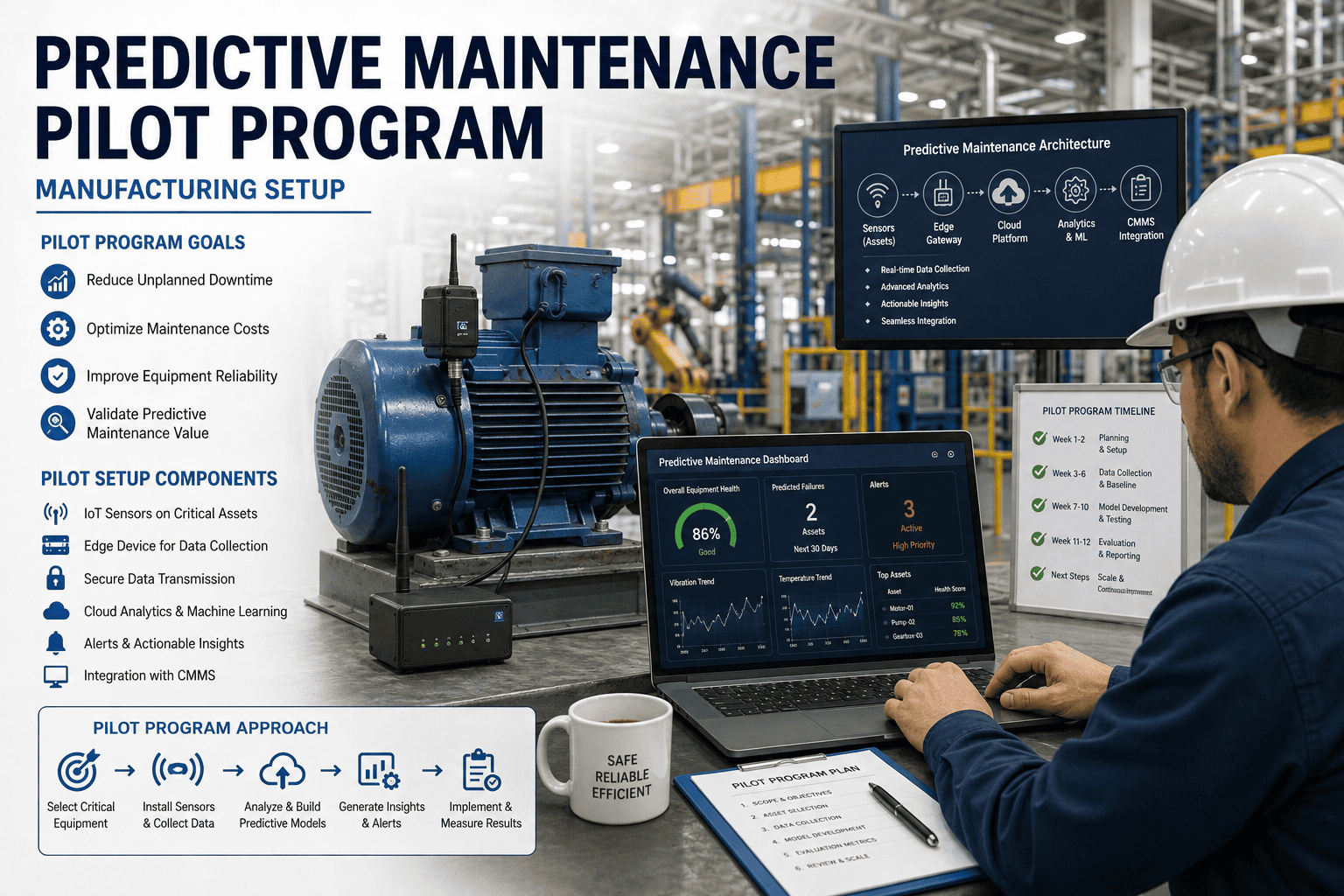
Most predictive maintenance pilots collapse before the 12-week mark — and the cause is almost never the sensor stack or the analytics layer. It is pilot design: the wrong asset chosen for the trial, no clean baseline captured before sensors went live, and success metrics so vague that no one can tell whether the experiment worked. Plants that get this right routinely cut unplanned downtime 30–45% inside the first quarter and unlock seven-figure scale-up budgets; plants that get it wrong shelve PdM for another two years. This guide walks through the exact asset selection criteria, baseline measurement, sensor deployment, alert workflow, and ROI story you need to run a defensible pilot. When you are ready to test the workflow on your own floor, you can Start Free Trial and configure the pilot CMMS in under an hour.
What does a successful 12-week PdM pilot actually look like on a plant floor?
Not a vendor demo. Not a slide deck. A scoped trial on one real production asset, with a captured baseline, live sensor alerts, and a defensible ROI story your CFO will sign off on. Here is how to design one that survives review.
Why most PdM pilots fail before sensors are even mounted
Industry studies put the failure rate of first predictive maintenance pilots near 60%. The technology is rarely the culprit — the pilot design is.
Wrong asset selected
Teams pick a brand-new motor with zero failure history and then declare victory when nothing breaks. No failure mode, no data, no story.
No baseline captured
Without 90 days of pre-pilot MTBF, downtime hours, and repair spend recorded, there is no denominator to prove the pilot moved the needle.
Vague success metric
"Improve reliability" cannot be measured at week 12. Pilots need a single hard KPI — downtime hours, OEE delta, or avoided repair cost — agreed in writing before day one.
Alerts with no workflow
Sensors fire into a shared inbox nobody owns. Without an assigned alert owner and a defined triage path in the CMMS, every warning becomes noise within three weeks.
Choose the one asset that can prove the case in 90 days
A pilot asset must fail often enough to generate signal — but not so often that it is already a known rebuild item. Score candidates against these six criteria before mounting a single sensor.
Criticality score ≥ 7/10
If this asset stops, a production line or safety system stops with it. Non-critical assets make poor pilot candidates — the savings are too small to defend at budget review.
Failure interval 3–9 months
Too long and the pilot ends before a single failure pattern emerges. Too short and you are predicting what everyone already schedules. Aim for bearings, pumps, or fans that fail 2–4× per year.
Sensor-mountable failure mode
Bearing wear, imbalance, misalignment, cavitation, thermal drift — these produce measurable vibration, temperature, or acoustic signatures. Electrical faults need different sensors; pick what matches your asset.
12 months of clean history
You need work-order records, downtime logs, and parts spend for the prior year to build a baseline. Assets with missing CMMS history cannot produce a defensible before/after comparison.
Accessible for sensor install
If mounting a tri-axial vibration sensor requires a 12-hour outage and a lift rental, the pilot economics break. Pick an asset where sensors can be fitted during a routine 2-hour PM window.
Repair cost ≥ $8K per event
Each avoided failure must be large enough to move the payback math. A $1,200 rebuild on a non-critical pump will never justify a $15K sensor stack, no matter how clean the data.
The 90-day numbers you must record before sensors go live
A pilot without a baseline is an experiment without a control. Pull these six figures from your CMMS for the 90 days immediately preceding sensor installation — they become the denominator for every ROI claim at week 12.
A 180-asset food-packaging plant piloted PdM on a single 75 kW packaging-line motor that failed 4× in the prior year. Baseline: 38 unplanned downtime hours, $42,000 in repair parts and labor, and 22,000 lost units of capacity. After 12 weeks of vibration + temperature monitoring, two early-stage bearing warnings were caught and corrected during scheduled windows — zero unplanned failures, zero lost units, and a $31,500 avoided-cost figure that paid for the full sensor deployment in under four months.
Week-by-week pilot execution plan
A defensible pilot is not "turn sensors on and wait." It is a scheduled sequence of baseline capture, sensor deployment, alert tuning, and ROI reporting compressed into 12 weeks.
Baseline + asset scoring
Pull 90 days of CMMS history for top-10 candidate assets. Score each against the six selection criteria. Lock the pilot asset, assign a pilot owner, and publish a one-page success criteria document signed by maintenance and operations.
Sensor deployment + CMMS integration
Mount tri-axial vibration and surface-temperature sensors during a routine PM. Connect the sensor gateway to your CMMS via API or native integration. Confirm data flow and tag mapping before tuning alerts.
Learning mode + alert tuning
Run sensors in learning mode to establish vibration baselines per axis. Tune thresholds against ISO 10816 vibration severity bands. Suppress known-noise patterns. No alerts are actioned yet — only logged and reviewed daily.
Live alerts + workflow activation
Switch to live mode. Every warning auto-generates a CMMS work order assigned to a named technician with a 4-hour triage SLA. Document each alert: true positive, false positive, or actionable prediction. Tune thresholds weekly.
ROI report + scale-up proposal
Compare post-pilot MTBF, downtime hours, and repair spend against the 90-day baseline. Build the avoided-cost model and the 20-asset scale-up proposal. Present to plant leadership with a go/no-go decision date.
From sensor signal to closed work order in under 4 hours
An alert without an owner is noise. Map every PdM warning to a named technician, a triage SLA, and a CMMS work order before the first signal fires — then measure the pilot against five hard KPIs.
Every warning must reach a named owner and be acknowledged inside four hours. Longer than that and the team has stopped trusting the alerts.
Eight in ten alerts should confirm a real, actionable condition. Below 60% the system is crying wolf and technicians will silently ignore it.
Top-quartile pilots cut unplanned downtime on the monitored asset by a third to nearly half inside the 12-week window.
A single avoided $25K–$40K failure on a critical asset typically recovers the full sensor, gateway, and integration cost in under four months.
The numbers that unlock the 20-asset scale-up budget
Your CFO does not buy vibration signatures — they buy avoided cost. Build the ROI story around five concrete line items that map directly to the baseline you captured in weeks 1–2.
| ROI line item | Baseline (90 days pre-pilot) | Pilot outcome (90 days) | Avoided cost |
|---|---|---|---|
| Unplanned downtime hours | 38 hrs | 6 hrs | 32 hrs saved |
| Repair parts + labor | $42,000 | $10,500 | $31,500 |
| Lost production units | 22,000 units | 3,500 units | 18,500 units |
| Capacity margin recovered | $28,600 | $4,550 | $24,050 |
| OEE delta on parent line | 71.2% | 78.9% | +7.7 pts |
| Total avoided cost (90 days) | — | — | $55,550 |
Figures based on the 180-asset food-packaging plant scenario. Annualized and scaled across 20 critical assets, the same model projects $1.1M+ in avoided cost — the figure that typically clears a scale-up budget review.
Ready to design your 12-week PdM pilot?
Configure the pilot CMMS, mount sensors, and capture your baseline in days — not the quarter most plants lose to spreadsheet planning.
PdM pilot questions, answered straight
How long should a predictive maintenance pilot run?
A defensible pilot runs 12 weeks. The first two weeks are baseline capture and asset scoring, weeks 3–7 cover sensor deployment and learning-mode tuning, and weeks 8–12 produce live alerts and the ROI comparison. Anything shorter than 90 days rarely generates enough failure signal on a single asset to convince a finance committee.
Which asset should I pick for the pilot?
Choose a critical asset (criticality 7/10 or higher) that fails two to four times per year, has at least 12 months of clean CMMS history, costs $8K+ per repair event, and is sensor-mountable during a routine PM. Avoid brand-new equipment with no failure history and assets so unreliable they are already on a rebuild schedule.
What sensors do I need for a manufacturing PdM pilot?
For most rotating equipment — motors, pumps, fans, gearboxes — a tri-axial vibration sensor plus a surface-temperature probe covers 80% of failure modes including bearing wear, imbalance, misalignment, and thermal drift. Add acoustic emission sensors for cavitation in pumps and current-clamp sensors for electrical faults. You can Start Free Trial and configure sensor tags inside the pilot CMMS before any hardware ships.
How do I prove ROI from a 12-week pilot?
Compare post-pilot MTBF, unplanned downtime hours, repair parts and labor spend, and recovered capacity margin against the 90-day baseline you captured before sensors went live. The avoided-cost figure — typically $25K–$55K on a single critical asset — is the number that unlocks scale-up budget. Always tie the saving to a specific avoided failure, not a theoretical model.
Can I run a PdM pilot with my existing CMMS?
Yes, if your CMMS supports API or native sensor integration and can auto-generate work orders from external alerts. If it cannot, run the pilot on a purpose-built PdM CMMS for 12 weeks, then export the work-order and alert history into your legacy system. You can Book a Demo to see the integration path for your specific CMMS before committing.
Stop planning. Start piloting.
Your competitors are not waiting another quarter. Configure your 12-week PdM pilot today, mount sensors next week, and present the ROI story before the next budget review.
Free 14-day trial · No credit card