Most factories still running 10–20-year-old equipment are sitting on a goldmine of untapped data — and the gap between them and Industry 4.0 leaders is closing fast. Start your smart factory journey with Oxmaint free and turn your existing machines into connected, AI-driven assets without replacing a single piece of equipment.
Smart Factory Implementation Roadmap
A step-by-step guide to deploying IoT sensors, AI-driven analytics, and predictive manufacturing — built for operations teams who need results, not theory.
Why Most Smart Factory Initiatives Stall Before They Scale
The promise of Industry 4.0 has been discussed for nearly a decade, but most manufacturers are still stuck in pilot purgatory — small proof-of-concept deployments that never expand to the full plant floor. The reason is almost never the technology. It is fragmented data ecosystems, siloed legacy systems, and the mistaken belief that smart manufacturing requires ripping out existing equipment and starting from scratch.
The reality is different: modern IoT sensors attach externally to equipment that is 10, 20, or even 30 years old. AI platforms integrate with existing PLCs, SCADA systems, and ERP via standard APIs. The path to a connected factory starts with a clear roadmap — not a replacement budget. Book a demo to see how Oxmaint integrates with your existing infrastructure without disruption.
Fragmented Data
Legacy MES, SCADA, and PLC systems generate data in isolation. No unified view means no actionable intelligence.
No Clear Roadmap
Teams jump to technology before assessing current state. IoT without a strategy creates expensive noise, not insight.
Skills Gap
35% of executives cite adapting workers to digital tools as their top concern — more than culture or safety risk.
Pilot Paralysis
Successful single-line pilots never scale because there is no structured plan to expand across facilities.
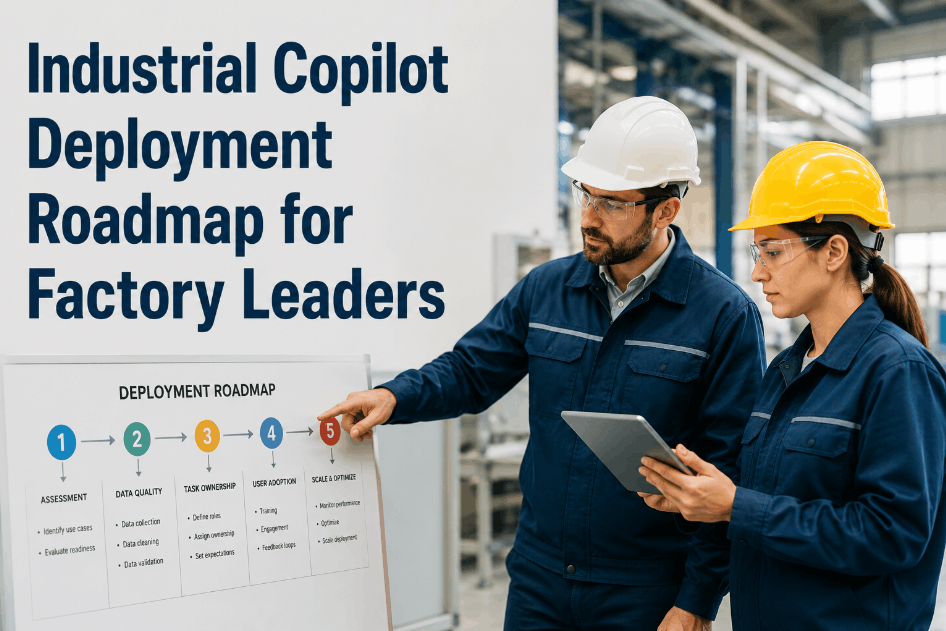
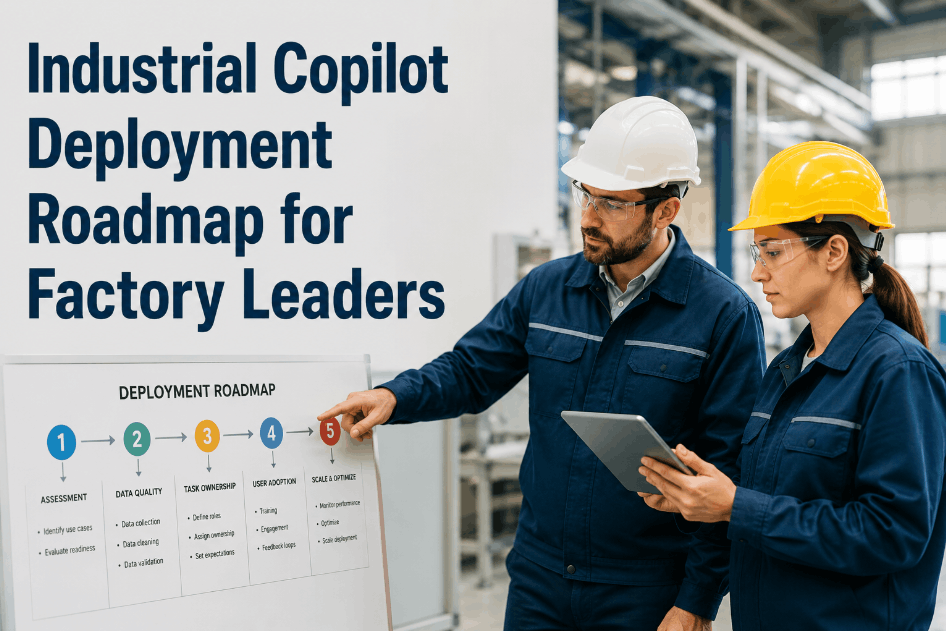
The 5-Phase Smart Factory Implementation Roadmap
This roadmap is designed for manufacturers who want measurable results at each stage — not a three-year transformation with value appearing only at the end. Each phase builds on the last, with clear outputs that justify investment for the next step.
Map every asset, system, and data source on the plant floor. Identify where data exists but is not captured, where systems are siloed, and where manual processes carry the highest failure risk.
Deploy wireless sensors on priority equipment — vibration, temperature, pressure, current draw. External attachment requires no machine modification. Connect to a unified data platform. Begin real-time monitoring immediately.
Layer AI models on top of sensor data to detect degradation patterns before failure occurs. Predictive maintenance moves the team from reactive firefighting to scheduled, condition-based work orders. AI improves as more data accumulates.
Connect previously siloed systems — CMMS, ERP, MES, SCADA — via APIs and middleware. Sensor data flows into the CMMS automatically. Work orders trigger from AI alerts. Production and maintenance operate from a single source of truth.
Expand successful implementations to additional lines, shifts, and facilities. Apply lessons from the pilot to accelerate rollout. Introduce digital twins and autonomous scheduling as data maturity increases. Sign up for Oxmaint to manage this entire journey from a single platform.
The Technology Stack That Powers a Smart Factory
A smart factory is not a single product — it is a layered architecture where each technology depends on the one below it. Deploying AI without clean sensor data produces bad predictions. Integrating systems without a data strategy creates an expensive mess. Understanding the stack helps you prioritize investment correctly.
Industrial IoT Sensors
Vibration, temperature, pressure, current, and flow sensors deployed on equipment. Wireless connectivity eliminates wiring costs. IoT sensor unit costs have dropped to $0.10–$0.80, making full-floor coverage economically viable.
SCADA and PLC Integration
Existing control systems already output process data. Connecting this data stream to a modern analytics platform requires API integration or OPC-UA bridging — not equipment replacement.
AI and Machine Learning
Pattern recognition algorithms analyze sensor streams to detect degradation before failure. Computer vision monitors product quality inline. AI-driven energy management achieves an average 12% energy savings once deployed at scale.
Digital Twins
Virtual replicas of physical systems updated in real time from sensor data. Engineers simulate changes in the digital environment before executing on the production floor — eliminating trial-and-error shutdown risk.
CMMS and Predictive Maintenance
The CMMS receives AI-generated alerts and converts them automatically into scheduled work orders. Maintenance shifts from calendar-based guessing to condition-based precision. Oxmaint connects AI alerts to work orders automatically — sign up free to configure it for your equipment.
MES and ERP Integration
Production execution data flows from the MES into the ERP automatically. Supervisors see machine health, quality metrics, and inventory levels in one dashboard. AI combines historical business data with real-time sensor data to identify optimization opportunities impossible to spot manually.
Ready to connect your factory floor to AI-driven maintenance and monitoring?
Oxmaint gives your team IoT-connected asset management, predictive maintenance, and real-time equipment visibility — without replacing your existing systems.
What Smart Factory ROI Actually Looks Like — By Timeline
One of the most common reasons manufacturers delay smart factory investment is uncertainty about when and how value appears. The data from deployments at scale tells a consistent story: early wins come fast, compounding returns follow.
| Timeline | What Changes | Measurable Outcome | Who Sees the Value |
|---|---|---|---|
| Days 45–90 | First AI alert prevents unplanned failure | First documented ROI event — avoided repair cost + avoided downtime | Maintenance manager, plant director |
| Month 6 | Predictive maintenance patterns established | Before/after downtime comparison report available. 25–40% maintenance cost reduction trending. | Operations director, CFO |
| Month 12 | Full floor sensor coverage, AI model matured | OEE improvement visible. Energy savings at 12% average. Payback period typically achieved at 6–18 months. | Executive leadership, board |
| Year 2+ | Scale to multi-site, digital twin layer active | 78% of facilities using AI report measurable waste reduction. Autonomous scheduling reducing labor cost. | Group operations, supply chain |
Swipe to view all columns on mobile
Where to Deploy First — Priority Matrix for IoT and AI
Not every machine deserves a sensor in phase one. Starting with the highest-impact equipment produces the fastest ROI and builds internal confidence for broader rollout. Use this matrix to sequence your deployment.
Critical Path Equipment
Assets where a single unplanned failure stops the production line. Typically 5–15% of total equipment count but responsible for 80%+ of unplanned downtime cost. Vibration and temperature sensors here deliver fastest payback.
High-Wear Assets
Equipment that degrades predictably but where manual inspection misses the inflection point. AI pattern recognition catches the 48–72 hour warning window that human rounds cannot detect. Reduces over-maintenance cost from early calendar replacements.
Quality-Critical Processes
Processes where parameter drift causes defects before the batch fails inspection. Real-time monitoring with AI anomaly detection catches drift in temperature, pressure, or flow before product is scrapped. Computer vision replaces manual sampling.
Common Questions About Smart Factory Implementation
Does smart factory implementation require replacing existing machinery?
No — the most effective and cost-efficient approach is retrofitting existing equipment with external IoT sensors and connecting them to a modern analytics platform. Modern wireless sensors attach without machine modification and work with equipment that is 20–30 years old. Oxmaint integrates with existing PLCs, SCADA, and ERP systems via standard APIs, making retrofitting the default strategy rather than the exception.
How long does it take to see ROI from an IoT and AI deployment?
The first measurable ROI event — typically an AI alert that prevents an unplanned failure — occurs within 45–90 days of sensor deployment. A full before/after statistical comparison with documented maintenance cost reduction is typically available at the 6-month mark. Most AI manufacturing systems achieve full payback within 6–18 months depending on plant scale and equipment criticality. Book a demo to see Oxmaint's 90-day implementation roadmap and the ROI benchmarks from comparable plant deployments.
What is the biggest mistake manufacturers make when implementing Industry 4.0?
Deploying technology before assessing current state and defining specific goals. According to Capgemini's North America Industry 4.0 practice, experts consistently advise against starting with "plug in IoT" — the first conversation should be about current process maturity and data readiness. A roadmap without a current state baseline creates expensive data noise rather than actionable intelligence. Start with asset inventory, failure analysis, and priority equipment identification before a single sensor is ordered.
How does predictive maintenance differ from preventive maintenance in a smart factory?
Preventive maintenance replaces or services equipment on a fixed calendar schedule, regardless of actual condition — which means either over-maintaining healthy assets or missing early-stage degradation between rounds. Predictive maintenance uses continuous IoT sensor data and AI pattern recognition to flag the specific machine showing degradation signatures 48–72 hours before failure. Oxmaint's predictive maintenance module converts AI alerts directly into scheduled work orders, cutting both unplanned downtime and unnecessary maintenance labor simultaneously.
Build your smart factory on a platform designed for operations teams — not IT departments
Oxmaint connects IoT sensor data, AI-driven predictive maintenance, and CMMS work order management into a single platform your maintenance and production teams will actually use.