Smart Manufacturing: Leveraging AI for Real-Time Process Optimization

By oxmaint on March 6, 2026

smart-manufacturing-ai-real-time-process-optimization

Manufacturing floors are evolving faster than most operations teams realize. In 2026, the global smart manufacturing market is projected to surpass $446 billion—fueled by AI systems that can detect equipment failure before it happens, optimize production parameters on the fly, and cut waste by learning from millions of real-time data points. For plant managers still relying on manual inspections and reactive maintenance, the competitive gap is widening every quarter. This guide breaks down exactly how AI-powered process optimization works, what results leading manufacturers are seeing, and how to start building a smarter factory today. Schedule a free consultation to discover which AI optimizations will deliver the fastest ROI for your plant.

The $446 Billion Shift: Why Manufacturers Are Going Smart in 2026

Smart manufacturing is no longer a future concept—it is the present reality for early adopters. The convergence of affordable IoT sensors, powerful edge computing, and increasingly accurate machine learning models has made real-time process optimization accessible to mid-size and large manufacturers alike. The AI in manufacturing market alone is expected to grow from $34 billion in 2025 to $155 billion by 2030, at a staggering 35% annual growth rate. Here is what is driving this acceleration.

$446B
Global smart manufacturing market projected for 2026, up from $394B in 2025
35.3%
CAGR for AI in manufacturing through 2030—the fastest-growing industrial tech segment
29%
Of manufacturers already using AI and ML at the facility or network level (Deloitte 2025)

Three forces are converging to make 2026 a tipping point. First, labor shortages—48% of manufacturers report moderate to significant challenges filling production and operations roles. Second, energy costs and carbon-pricing regulations are making waste unacceptable. Third, supply chain volatility demands manufacturing agility that only data-driven systems can deliver. The manufacturers who invested in Industry 4.0 infrastructure over the past two years are now seeing those investments compound, while laggards face an increasingly steep catch-up curve.


Ready to close the gap? Oxmaint gives your maintenance team real-time asset visibility, automated work orders, and predictive scheduling—no rip-and-replace required. Create your free Oxmaint account now and start tracking assets in minutes, or schedule a personalized walkthrough with our team to see how it fits your plant.

Five Pillars of Real-Time AI Process Optimization

Real-time process optimization is not a single technology—it is an architecture. Five interconnected pillars work together to create a closed-loop system where data flows from the shop floor to AI models and back to equipment in milliseconds. Understanding each pillar helps manufacturers prioritize investments and avoid technology gaps that limit results.

01

Sensor Networks and Industrial IoT
Vibration, thermal, acoustic, and vision sensors deployed across production lines capture operational data at sub-second intervals. Modern IIoT deployments deliver up to 52% productivity gains and 25% cost reductions by providing granular visibility into every machine, conveyor, and workstation. The critical decision is sensor density—more monitoring points mean faster anomaly detection and richer training data for AI models.
02

Edge Computing for Instant Response
Edge devices process sensor data locally, enabling real-time anomaly detection and automated responses without cloud latency. When a spindle vibration pattern deviates from baseline, the edge layer can flag the issue and adjust parameters in under 100 milliseconds—long before a cloud round-trip would complete. This is essential for high-speed manufacturing where seconds of deviation mean thousands in scrap.
03

Machine Learning and Deep Neural Networks
ML models trained on operational data detect patterns invisible to human operators and rule-based systems. Deep learning achieves 95-100% defect detection accuracy in controlled environments and continuously improves as it ingests more production data. Reinforcement learning algorithms optimize process parameters—temperature, pressure, speed—in real time by learning which settings produce the best quality at the lowest cost.
04

Digital Twin Simulation
Virtual replicas of physical production lines let manufacturers test process changes, simulate failure scenarios, and optimize workflows without disrupting live operations. The digital twin market is projected to surge from $24.5 billion in 2025 to over $155 billion by 2030, with manufacturing as the leading adopter. Digital twins can slash maintenance costs by up to 40% while boosting asset uptime by 5-10%.
05

CMMS Integration and Automated Action
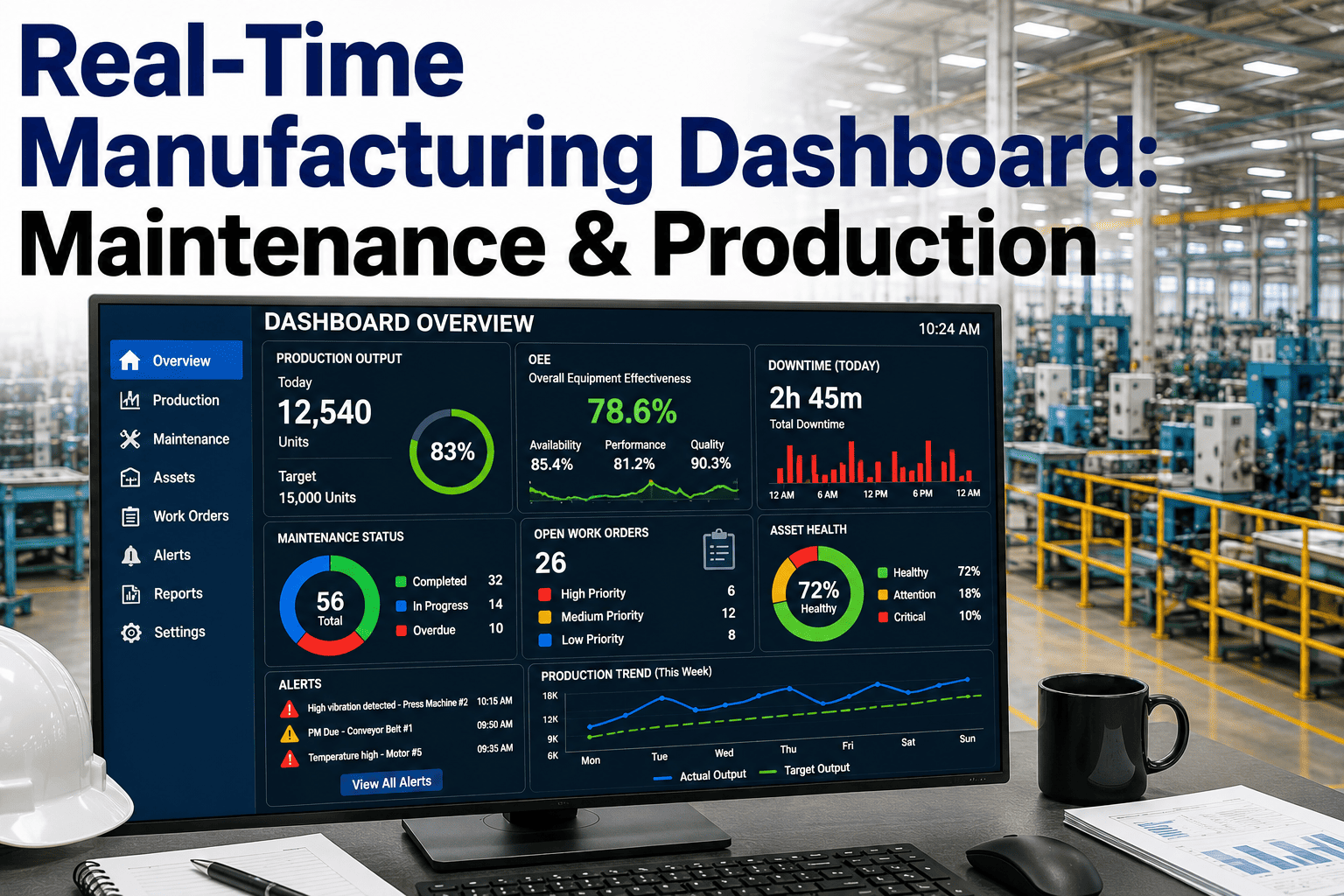
AI insights are only valuable when they trigger action. Direct integration with CMMS platforms enables automated work order generation, predictive PM scheduling, and real-time maintenance prioritization. When a machine learning model detects early bearing wear, the system automatically creates a work order, assigns a technician, and reserves parts—all before the operator notices anything wrong. Sign up for Oxmaint to automate work orders the moment AI detects equipment anomalies.

Predictive Maintenance: From Reactive Repairs to Near-Zero Downtime

Predictive maintenance is the most adopted and highest-ROI application of AI in manufacturing. It transforms maintenance from a cost center into a strategic advantage by using sensor data and machine learning to predict equipment failures before they cause unplanned downtime. In 2024, predictive maintenance held the largest share of AI applications in manufacturing—and the gap is widening as more plants prove the business case.

The Predictive Maintenance Business Case
95% of adopters report positive ROI from predictive maintenance programs
27% achieve full payback in under 12 months
10x potential return documented by U.S. Department of Energy
12% reduction in unplanned downtime within 12 weeks of deployment (Siemens case study)
How It Works

Sensors continuously monitor vibration, temperature, acoustic emissions, and electrical signatures

Edge devices perform initial anomaly detection and filter noise from signal

ML models compare current patterns against failure signatures from historical data

Risk scores trigger automated work orders in the CMMS before failure occurs

Maintenance is scheduled during planned windows—zero production impact

Most experts recommend starting with predictive maintenance on critical rotating equipment—pumps, motors, fans—as the quickest win. This establishes the sensor infrastructure and data foundation for more advanced applications like AI-powered quality control and production optimization. Schedule a demo to see how Oxmaint turns sensor alerts into automated maintenance schedules for your critical assets.

Machine Vision: AI Quality Control at Production Speed

AI-powered machine vision is transforming quality control from a sampling-based, post-production activity into a real-time, 100% inspection capability. Computer vision systems identify surface defects, dimensional errors, assembly mistakes, and contamination at line speed—catching issues that human inspectors miss while dramatically reducing scrap and rework costs.

98-100%
Detection Accuracy
AI vision systems in controlled manufacturing environments routinely achieve near-perfect defect detection rates, far exceeding manual visual inspection
$5B+
Defect Detection Market by 2026
The global AI-powered defect detection market is projected to reach $5 billion by 2026, growing at 7.5% annually as manufacturers scale automated inspection
40%
Material Savings via Generative Design
AI-driven generative design reduces material usage by up to 40% and accelerates design cycles by 60%, further reducing manufacturing waste and cost

Connect quality data to your maintenance workflows. When AI vision detects recurring defects, Oxmaint automatically triggers equipment inspection work orders to address root causes before scrap rates climb. Book a 30-minute demo to see how automated defect-to-work-order workflows reduce your scrap rate, or sign up free and start connecting quality alerts to maintenance actions today.

Industry 4.0 Adoption: Where AI Delivers Results by Sector

Different manufacturing sectors present unique optimization opportunities based on their process types, equipment profiles, and regulatory environments. AI adapts to each context—whether it is continuous process manufacturing, discrete assembly, or batch production—delivering measurable improvements tailored to industry-specific challenges.

AI Impact Across Manufacturing Sectors
Sector Top AI Application Measurable Outcome Adoption Priority (2026)
Automotive Robotic weld inspection, paint defect detection, line balancing 25% less machine downtime, 12% lower production costs Factory automation hardware (41% of manufacturers)
Semiconductor Wafer defect detection, yield optimization, clean room monitoring Near-zero defect rates, accelerated design-to-production cycles Active sensors and vision systems (34%)
Aerospace Composite inspection, digital twin simulation, precision machining 40% maintenance cost reduction, 5-10% uptime improvement via digital twins Digital twin and simulation platforms (18.7% CAGR)
Food and Beverage Contamination detection, batch optimization, CIP efficiency Reduced waste, faster changeovers, regulatory compliance automation IoT-connected quality monitoring
Pharmaceuticals Process analytical technology, environmental control, batch release Improved GMP compliance, yield improvement, fewer deviations Data-driven validation and compliance
Heavy Equipment Fleet predictive maintenance, structural monitoring, idle reduction Extended asset life, reduced fuel waste, improved operator safety Predictive maintenance on rotating equipment
Automotive leads smart manufacturing adoption at 26% market share in 2025, followed by semiconductor and electronics. Renewable energy is the fastest-growing segment for AI adoption through 2033.

From Manual to Intelligent: What Changes on the Factory Floor

The transformation from traditional to smart manufacturing is not just a technology upgrade—it is an operational paradigm shift. Every process, from maintenance scheduling to quality assurance, changes fundamentally when real-time data and AI replace manual observation and fixed procedures.

Operational Transformation Snapshot
Maintenance Strategy
Calendar-based PMs and breakdown repairs
Condition-based predictive maintenance with automated work orders
Quality Control
Statistical sampling and manual visual inspection
100% inline AI vision inspection at production speed
Production Scheduling
Fixed weekly plans with manual override
Dynamic AI scheduling responding to real-time demand and constraints
Energy Management
Monthly utility bill review
Real-time consumption optimization tied to production output
Decision Making
Gut instinct and historical reports
Data-driven recommendations from AI analytics dashboards
Make Your Factory Floor Smarter—Starting Today
Oxmaint digitizes your maintenance operations with real-time asset tracking, mobile work orders, and automated PM scheduling. No complex IT infrastructure required. Start seeing results in your first month.

Connecting AI to Your Existing Plant Systems

One of the biggest misconceptions about smart manufacturing is that it requires a full technology overhaul. In reality, non-invasive connectivity solutions like clip-on power sensors and protocol converters can extract data from legacy equipment—including PLCs from the 1980s—without risking uptime. The key is building an integration layer that connects AI insights to your existing operational systems.

System Integration Architecture for Smart Manufacturing
Plant System Integration Approach What AI Enables
SCADA / DCS Real-time bidirectional via OPC-UA protocol Automated parameter adjustments, process optimization loops
MES (Manufacturing Execution) Transaction-based API connections Production-correlated analytics, energy-per-unit tracking
CMMS / EAM Event-triggered work order automation Predictive work orders, spare parts forecasting, PM optimization
ERP / Financials Scheduled batch synchronization True cost-per-unit, maintenance budget optimization, procurement
QMS (Quality Management) Continuous real-time data feed SPC alerts, CAPA triggers, non-conformance root cause analysis

The most effective approach is to start with CMMS integration—connecting sensor data to automated maintenance workflows—because maintenance is where most manufacturers see the fastest payback. Sign up for Oxmaint to centralize all your equipment data, work orders, and PM schedules in one smart platform. From there, extending AI connections to MES, ERP, and quality systems creates a comprehensive digital thread across the operation.


The factory itself is becoming like one large, integrated machine. The entire production line gets layered with IoT sensors to sense, centralized AI platforms to decide, and automated equipment that adjusts itself to act. The concept of the smart factory is becoming real for early adopters heading into 2026.
— Advanced Manufacturing Industry Analysis, 2025-2026

From Pilot Line to Full Plant: A Realistic Deployment Path

Successful smart manufacturing rollouts follow a phased strategy that delivers measurable wins early while building the data foundation and organizational confidence for plant-wide scaling. Most industry experts recommend starting with a single pilot line focused on critical rotating equipment—the results from this initial phase fund the broader expansion.

Typical Smart Manufacturing Deployment Timeline

Weeks 1-4
Assess and Baseline
Audit current equipment, map critical assets, establish performance baselines, and deploy CMMS platform for data capture.


Weeks 5-10
Pilot Line Launch
Install IoT sensors on 5-10 critical assets, deploy edge computing, begin predictive maintenance on rotating equipment. Target: first quick wins within 30 days.


Months 3-5
Expand and Optimize
Add quality inspection, production scheduling optimization, and energy analytics. Extend monitoring to additional production lines based on pilot results.


Month 6+
Plant-Wide Intelligence
Full deployment with digital twin simulation, cross-system integration, continuous AI model retraining, and enterprise-wide analytics dashboards.

What Holds Manufacturers Back—and How to Overcome It

Despite compelling ROI data, smart manufacturing adoption faces real barriers. Understanding these challenges—and their proven solutions—helps manufacturing leaders plan realistic transformation programs that build momentum rather than stalling at the pilot stage.
Legacy Equipment Integration
Impact: Data gaps that limit AI model accuracy Solution: Non-invasive clip-on sensors and protocol converters extract data from older PLCs without replacing equipment. Start with power monitoring to establish baselines, then add process-specific sensors as ROI is proven.

Data Quality and Silos
Impact: False anomalies, inaccurate baselines, poor model performance Solution: AI-powered data validation, automated gap filling, and a unified data platform that breaks down departmental silos. Industrial DataOps tools provide the context that AI models require for accurate predictions.

Workforce Skills Gap
Impact: 48% of manufacturers report moderate to significant hiring challenges Solution: Deploy collaborative AI tools that augment existing workers rather than replacing them. Low-code CMMS platforms like Oxmaint reduce the technical barrier. Invest in parallel workforce training alongside technology deployment.

Organizational Resistance
Impact: Low adoption of AI recommendations, stalled pilots Solution: Start with high-visibility quick wins that build trust. Operator dashboards with clear savings attribution, gamification, and management visibility create a pull for broader adoption rather than top-down mandates.
Build a Smarter Factory with Oxmaint
Your spreadsheets cannot predict a bearing failure or dynamically schedule maintenance around production peaks. Oxmaint gives you real-time equipment visibility, AI-powered work order automation, and mobile-first tools your technicians will actually use—turning reactive maintenance into a strategic advantage. Join thousands of manufacturing teams already running smarter operations.

Frequently Asked Questions

What is smart manufacturing and how does AI fit into it?
Smart manufacturing integrates IoT sensors, AI, cloud computing, and advanced analytics to create production environments that monitor, analyze, and optimize themselves in real time. AI is the intelligence layer—it processes data from sensors and systems to predict equipment failures, detect quality defects, optimize process parameters, and automate scheduling. The result is a factory that learns and improves continuously. Sign up for Oxmaint and start digitizing your factory maintenance in under 10 minutes.
How long does it take to see ROI from smart manufacturing investments?
Most manufacturers see measurable returns within 3-6 months when starting with predictive maintenance on critical assets. Industry data shows that 95% of predictive maintenance adopters report positive ROI, with 27% achieving full payback in under a year. The U.S. Department of Energy has documented potential 10x returns. A phased approach—starting with high-impact, lower-complexity use cases—accelerates time-to-value while building toward comprehensive optimization.
Do we need to replace existing equipment to implement AI in manufacturing?
No. Non-invasive connectivity solutions—clip-on power sensors, protocol converters, and retrofit IoT gateways—extract data from legacy equipment without risking uptime or requiring replacement. Platforms like Oxmaint integrate with existing PLCs, SCADA systems, and ERP platforms. You can start capturing value from your current assets immediately. Book a demo to see how Oxmaint integrates with your existing PLCs, SCADA, and ERP without disrupting operations.
What is the difference between Industry 4.0 and smart manufacturing?
Industry 4.0 is the broader framework describing the fourth industrial revolution—the convergence of digital and physical systems. Smart manufacturing is the practical application of Industry 4.0 principles on the factory floor, using specific technologies like IIoT, AI, digital twins, and autonomous systems to optimize production. Think of Industry 4.0 as the concept and smart manufacturing as the implementation.
How does Oxmaint support smart manufacturing operations?
Oxmaint provides a centralized CMMS platform purpose-built for modern manufacturers. Key capabilities include real-time asset tracking across facilities, automated work order generation from IoT alerts, predictive maintenance scheduling, mobile access for field technicians, and integration with SCADA, MES, and ERP systems. The platform helps bridge the gap between traditional maintenance and intelligent, data-driven operations management.

Share This Story, Choose Your Platform!