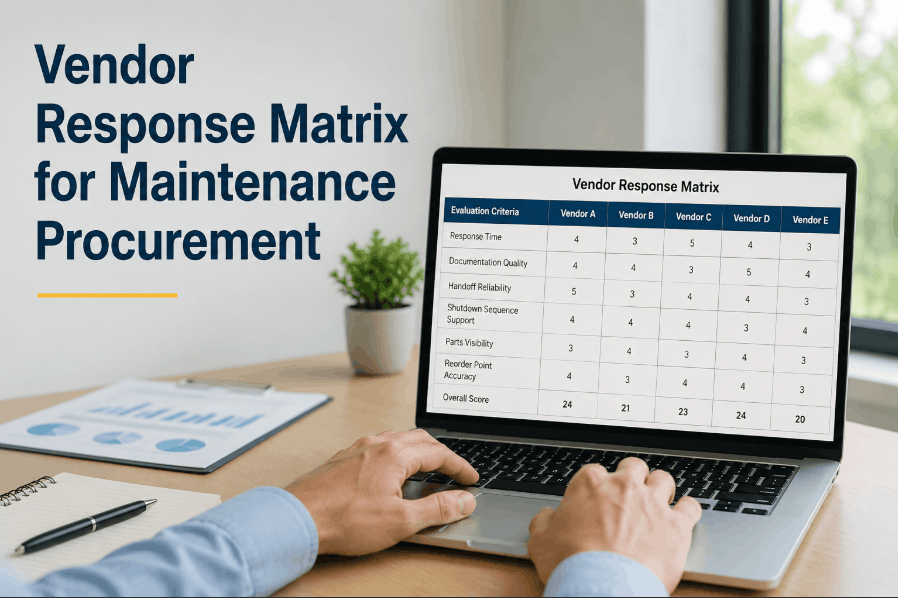
Maintenance procurement is only as reliable as the suppliers behind it. When a critical component fails and a work order is raised, the speed and quality of supplier response determines how long production stays down. Supplier response variance — the spread in delivery timing, escalation quality, and fulfillment reliability across the vendor base — is one of the most undertracked metrics in industrial maintenance operations. Some suppliers consistently deliver to committed lead times; others stretch, delay, and require repeated chasing. Without measuring that variance systematically, procurement teams cannot distinguish reliable partners from underperforming ones — or justify supplier rationalisation decisions to leadership. Sign Up Free to start linking procurement events to work order outcomes in Oxmaint. Oxmaint AI connects maintenance work orders to procurement records, enabling maintenance and procurement teams to measure supplier response quality against actual downtime impact and build evidence-based vendor scorecards. Book a Demo to see how supplier response data flows from Oxmaint work orders into vendor performance metrics.
Measure Which Suppliers Are Actually Supporting Your Maintenance Operations
Oxmaint AI links maintenance work orders to procurement outcomes — giving maintenance managers and procurement teams the supplier response data they need to measure delivery variance, build vendor scorecards, and make evidence-based sourcing decisions.
Why Supplier Response Variance Goes Unmeasured in Maintenance Procurement
Gap #1
No Delivery Performance Tracking
Purchase orders are raised and received but actual delivery timing versus committed lead time is never recorded — making it impossible to quantify which suppliers are consistently late and by how much.
Gap #2
Escalation Quality Not Scored
When urgent maintenance orders require expediting, the quality of supplier escalation response varies widely — but this variation is captured only as anecdotal feedback, not as measurable vendor performance data.
Gap #3
Work Order Impact Disconnected
Supplier delivery delays extend work order duration and increase downtime costs — but this causal link is never captured in procurement records, so suppliers are never held accountable for their contribution to maintenance failures.
Gap #4
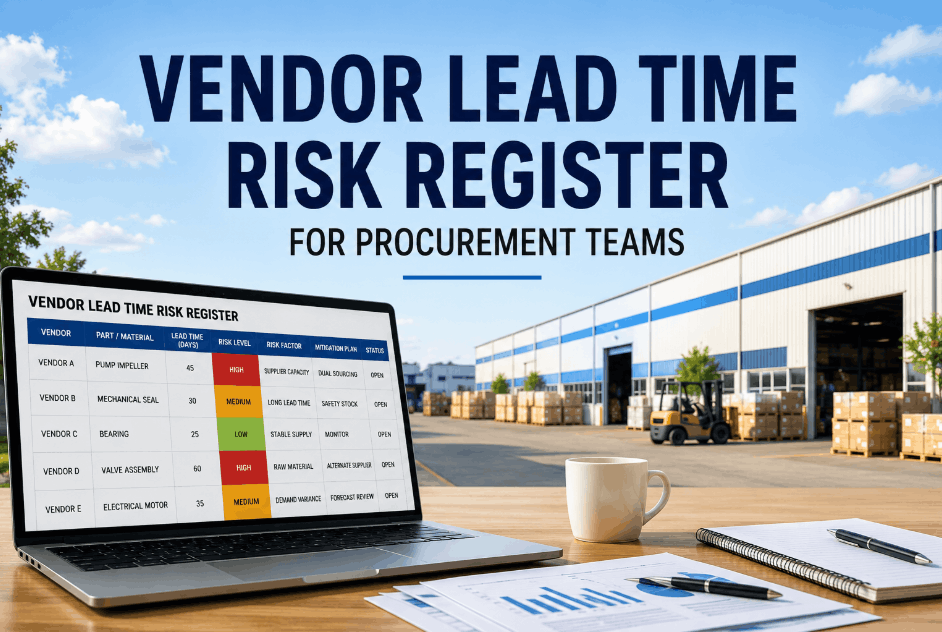
Lead Time Spread Invisible
Procurement teams use average lead times from supplier contracts to set planning parameters — but the actual spread around that average is what determines stockout risk, and that spread is never measured or reported.
Gap #5
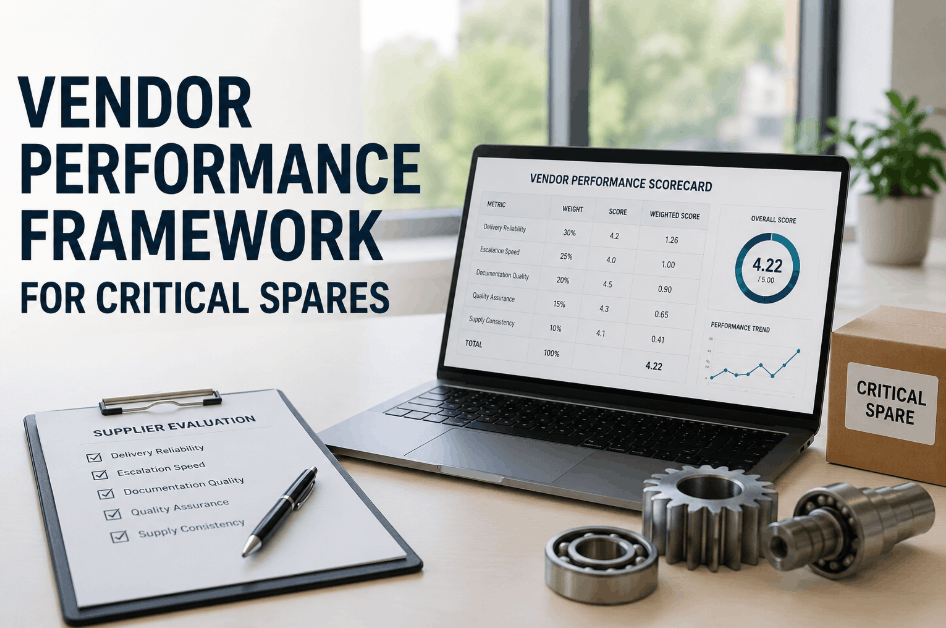
No Vendor Scorecard
Without structured performance data, vendor reviews rely on relationship history and subjective preference rather than measurable delivery reliability, fulfillment accuracy, and urgent order response capability.
Gap #6
Single-Source Risk Unquantified
Critical components sourced from a single supplier carry concentrated supply continuity risk — but without response variance data, procurement teams cannot quantify that exposure or justify alternative source development investment.
How Oxmaint AI Connects Supplier Performance to Maintenance Outcomes
01
Work Order Procurement Link
Parts procurement events raised from Oxmaint work orders capture the supplier, order date, committed lead time, and asset criticality — linking each purchase to the maintenance context that drove demand.
→
02
Delivery Variance Capture
Actual delivery date is recorded at goods receipt — creating a committed-vs-actual lead time record for every supplier order that can be aggregated into delivery variance metrics over time.
→
03
Escalation Response Tracking
Urgent maintenance orders flagged in Oxmaint capture escalation events, supplier response time, and resolution outcome — building a structured record of how each supplier performs under emergency conditions.
→
04
Vendor Scorecard Reporting
Oxmaint aggregates supplier delivery variance, escalation response, and fulfillment accuracy into vendor performance dashboards — giving procurement teams the data needed for evidence-based supplier review and rationalisation.
What Oxmaint Captures Per Supplier Performance Record
Delivery Performance
Committed vs actual lead time recorded per order
Delivery variance spread calculated by supplier and part class
Late delivery frequency and average delay duration tracked
Escalation Quality
Urgent order escalation response time captured per event
Escalation resolution outcome recorded against work order
Supplier communication responsiveness scored per escalation
Fulfillment Accuracy
Order fulfillment rate against original purchase specification
Substitution and partial delivery incidents recorded per supplier
Quality rejection events linked to supplier and part number
Procurement Outcome
Evidence-based vendor scorecards updated from live order data
Supplier rationalisation decisions supported by performance evidence
Planning lead times refined based on actual delivery variance data
42%
Of extended maintenance downtime events include a supplier delivery delay as a contributing root cause factor
2.5×
Higher procurement planning accuracy when actual delivery variance data replaces contracted lead time assumptions
48hrs
Typical time to deploy Oxmaint and begin capturing linked procurement and work order performance records
90days
Average time to generate a statistically meaningful vendor performance dataset after Oxmaint procurement tracking deployment
Oxmaint AI vs Standard CMMS for Supplier Performance Visibility
Standard CMMS — Limited Supplier Visibility
Purchase orders recorded but delivery variance against committed lead time never calculated
Escalation events handled informally with no structured response quality record
No link between supplier delivery delays and work order duration or downtime cost
Vendor reviews rely on relationship history rather than measured delivery performance data
Lead time planning parameters based on contract commitments rather than actual delivery variance
Single-source supply risk unquantified — no performance data to support alternative sourcing decisions
Oxmaint AI — Supplier Performance Tracked in Real Time
Committed vs actual delivery time recorded per order — variance calculated automatically — Sign Up Free
Escalation response time and resolution outcome captured per urgent maintenance order
Supplier delivery delays linked to work order duration and asset downtime impact
Evidence-based vendor scorecards generated from actual delivery, escalation, and fulfillment data
Planning lead times updated from actual delivery variance distributions per supplier and part class
Single-source exposure quantified — performance data supports alternative source development decisions
6 KPIs to Measure Supplier Response Variance in Maintenance Procurement
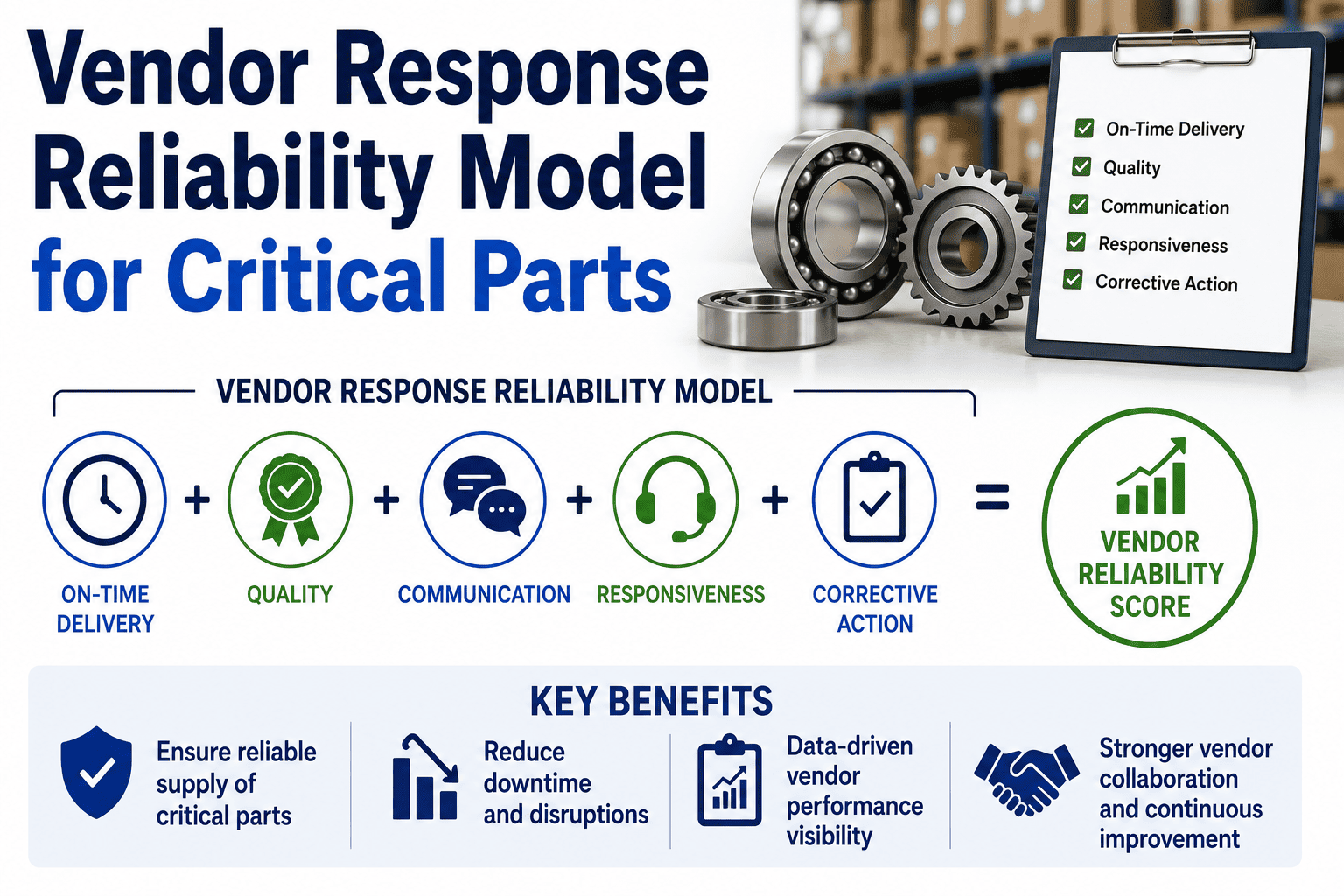
These KPIs give maintenance procurement teams the metrics to identify underperforming suppliers, tighten planning assumptions, and build a vendor base that reliably supports urgent maintenance demand. Book a Demo to see how Oxmaint tracks all six from linked work order and procurement records.
KPI 01
On-Time Delivery Rate by Supplier
Percentage of purchase orders delivered within the committed lead time window, measured per supplier. The primary indicator of supplier delivery reliability and planning dependability across the maintenance vendor base.
Delivery Reliability
KPI 02
Lead Time Variance Spread
Standard deviation of actual delivery lead times around the supplier's committed average. High variance suppliers require larger safety stock buffers than low-variance suppliers with equivalent average lead times.
Planning Risk
KPI 03
Urgent Order Response Time
Average time from escalation request to confirmed delivery commitment on urgent maintenance orders. Identifies suppliers capable of supporting breakdown maintenance versus those who cannot accelerate when production is stopped.
Escalation Quality
KPI 04
Order Fulfillment Accuracy Rate
Percentage of purchase orders fulfilled to original specification — correct part, correct quantity, correct condition. Partial or substituted deliveries extend work order duration even when delivery timing is on schedule.
Fulfillment Quality
KPI 05
Supplier-Attributable Downtime Contribution
Total production downtime hours where supplier delivery delay was identified as a contributing root cause. Connects vendor performance to production impact — making the business case for supplier rationalisation quantifiable.
Downtime Impact
KPI 06
Vendor Scorecard Coverage Rate
Percentage of active maintenance suppliers with a current performance scorecard based on measured delivery, escalation, and fulfillment data. Coverage gaps mean procurement decisions are still based on opinion rather than evidence.
Data Completeness
Industries Using Oxmaint to Track Maintenance Supplier Performance
Mining and Resources
Supplier Response Tracking for Remote Operations
Mining operations use Oxmaint to track parts delivery performance against remote site maintenance work orders — measuring which suppliers can reliably deliver to site within committed timeframes and which require contingency stock buffers to compensate for delivery variance. Sign Up Free for your operation.
Process Manufacturing
Vendor Performance Measurement for Critical Asset Procurement
Chemical and refining plants use Oxmaint to measure supplier response quality on critical rotating equipment parts — linking procurement lead time variance to work order duration and building the vendor scorecards needed for annual supplier rationalisation reviews. Book a Demo for your facility.
Food and Beverage
Supplier Response Tracking for Hygiene-Critical Components
F&B manufacturers track supplier delivery performance on sanitary and food-grade components through Oxmaint — ensuring that hygiene-critical parts required during breakdown maintenance on production lines are available from suppliers with proven delivery reliability records.
Utilities and Infrastructure
Long Lead Time Vendor Performance for Critical Infrastructure
Power and water utilities use Oxmaint to track actual vs committed delivery performance on long lead time components — measuring supplier reliability over extended procurement cycles to support sourcing decisions on transformer parts, switchgear, and pump components with 6-24 month lead times.
Your Suppliers Know Their Lead Times. Do You Know Their Variance?
Oxmaint AI links maintenance work orders to procurement records, measures actual delivery performance against committed lead times, and builds the vendor scorecard data your procurement team needs to make evidence-based sourcing decisions. Book a Demo to see supplier response tracking applied to your maintenance procurement workflow.
Frequently Asked Questions
What is supplier response variance in maintenance procurement?
Supplier response variance is the spread in a vendor's delivery timing, escalation quality, and fulfillment reliability across multiple purchase orders. High variance means unpredictable supply performance that forces maintenance teams to carry larger safety stocks, plan for longer work order durations, and manage more frequent escalation events than low-variance suppliers require.
How does Oxmaint link supplier delivery delays to maintenance downtime?
Oxmaint links each procurement event to the work order that raised the parts requirement — so when a supplier delivery delay extends the time a work order remains open, that delay is captured as a contributing factor in the work order's duration record and can be aggregated into supplier-attributable downtime metrics.
What data does Oxmaint use to build a vendor scorecard?
Oxmaint vendor scorecards are built from actual purchase order delivery data — committed vs actual lead time per order, escalation response time on urgent orders, fulfillment accuracy rate, and quality rejection incidents — giving procurement teams a performance record based on measured outcomes rather than relationship history.
How can I use delivery variance data to improve safety stock planning?
By replacing contracted average lead times with actual delivery variance distributions from Oxmaint procurement records, stores teams can calculate safety stock requirements that reflect real supply risk — reducing stockout exposure on high-variance suppliers while freeing excess stock held against low-variance suppliers who consistently deliver on time.
Can Oxmaint support supplier performance tracking across multiple sites?
Yes. Oxmaint aggregates procurement performance data across all sites in a single dashboard — enabling procurement teams to compare supplier delivery reliability across regions, identify suppliers who perform consistently across all locations, and flag those whose performance varies significantly by site or order urgency.
Stop Letting Supplier Variance Extend Your Work Orders.
Oxmaint AI measures actual delivery performance against committed lead times, tracks escalation response quality, and builds the vendor scorecards that give procurement teams the evidence to manage supplier performance rather than accept it.