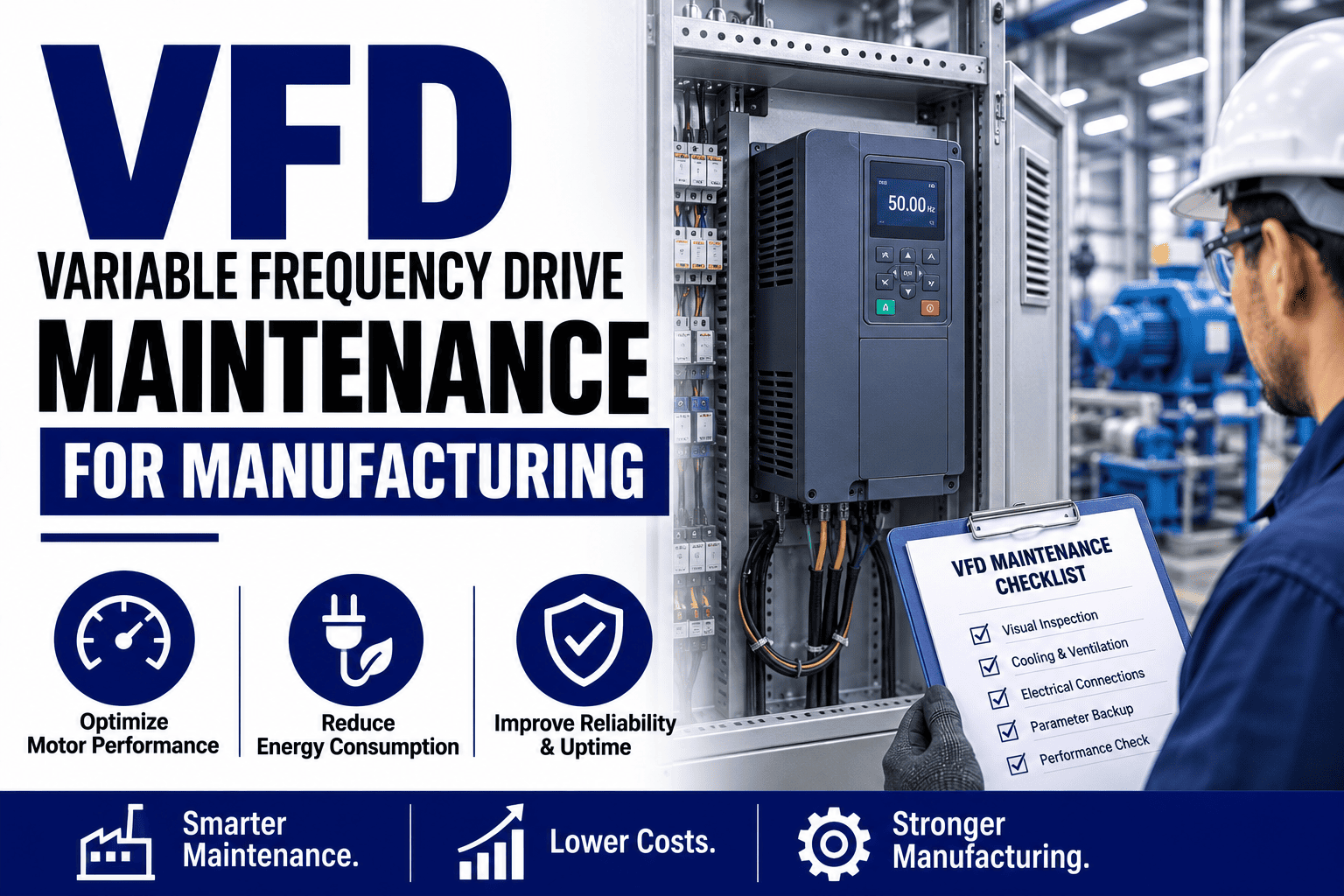
VFD maintenance in manufacturing plants is the systematic inspection, cleaning, and testing of variable frequency drives — cooling fans, DC bus capacitors, input/output terminals, firmware, and harmonics — to prevent the nuisance trips and premature failures that idle production lines. Because variable frequency drives control an estimated 60–70% of the motors in a modern plant, a single neglected drive can take down a conveyor, pump, or compressor worth $10K–$50K per hour of lost output. This variable frequency drive maintenance guide covers the PM tasks, intervals, and warning signs reliability teams need, plus how to build a runtime-based VFD PM schedule inside a CMMS so nothing slips. If your team still tracks drive service in spreadsheets, Start Free Trial and see how OxMaint automates the entire VFD maintenance schedule.
Why do VFDs fail years before their rated life — and how do you stop it?
Most variable speed drive failures trace back to five preventable causes: clogged cooling filters, dried-out capacitors, loose terminals, outdated firmware, and unchecked harmonics. A structured VFD PM schedule catches all five before they trip a line.
What belongs on a VFD maintenance checklist for manufacturing plants?
A complete variable frequency drive maintenance program has six recurring workstreams. Skip any one of them and failure rates climb sharply after year three of service.
1. Cooling & Filter PM
Inspect and replace enclosure air filters every 1–3 months in dusty plants; clean heatsinks quarterly. Cooling fans have a 3–5 year bearing life — schedule replacement by runtime hours, not calendar, before they seize and overheat the drive.
2. Capacitor Life Tracking
DC bus electrolytic capacitors lose capacitance and gain ESR with heat and age — expect 5–7 years at rated temperature, halving for every 10°C above it. Measure ripple current annually and log capacitance readings to trend degradation.
3. Terminal & Torque Checks
Thermal cycling loosens input/output power terminals. Re-torque to manufacturer spec annually with the drive locked out, and inspect for discoloration, arcing marks, or insulation damage on motor and line-side cabling.
4. Thermal Imaging
Infrared scans under load reveal hot terminals, failing fans, and unbalanced phases months before failure. A 10–20°C rise over baseline on any connection is a corrective work order, not a note in a logbook.
5. Harmonic & Power Quality
VFDs inject harmonic distortion that overheats transformers and trips other equipment. Measure THD annually — IEEE 519 recommends keeping voltage THD under 5% at the point of common coupling. Rising harmonics often signal failing capacitors or line reactors.
6. Firmware & Parameters
Back up parameter sets after every change and apply manufacturer firmware updates that fix known trip faults. A saved parameter file turns a 4-hour drive swap into a 40-minute swap — critical at 2 a.m. on a production weekend.
A VFD PM schedule: monthly, quarterly, and annual tasks
Plants that calendarize VFD service by interval — and trigger fan and capacitor work by runtime hours — report up to 70% fewer drive-related stoppages. Use this schedule as your baseline.
| Interval | VFD Maintenance Task | Why It Matters |
|---|---|---|
| Monthly | Check/replace cooling filters; verify fan operation; review fault and trip history logs | Blocked airflow is the #1 heat driver; fault logs reveal recurring overcurrent patterns |
| Quarterly | Clean heatsinks and enclosure interiors; inspect for dust, moisture, corrosion; verify ambient temperature | Conductive dust causes short circuits; every 10°C rise halves capacitor life |
| Semi-Annual | Thermal imaging under load; measure DC bus ripple; check line reactor and filter condition | Catches loose connections and rising capacitor ESR 3–6 months before failure |
| Annual | Re-torque all power terminals; insulation resistance test on motor leads; THD measurement; firmware review; parameter backup | Prevents arc faults, winding damage, and harmonic-related trips plant-wide |
| By Runtime | Cooling fan replacement (~30K–40K hrs); capacitor reforming or replacement (~50K hrs / 5–7 yrs) | Runtime-based triggers beat calendar guesses — OxMaint meters drive hours automatically |
What reactive VFD service actually costs a mid-size plant
Consider a packaging plant running 45 VFDs across conveyors, pumps, and air handlers, averaging two drive failures a year with no PM program.
Reactive: Run-to-Failure
- 2 failures/yr × 6 hrs average downtime = 12 lost production hours
- At $18K/hr line value: $216K annual downtime exposure
- Emergency drive replacement + rush labor: ~$9K/yr premium
- Capacitor failures cascade — damaging rectifiers and motors
- Zero audit trail for insurers or ISO 55000 asset reviews
Proactive: CMMS-Driven VFD PM
- ~90 PM labor hours/yr across 45 drives ≈ $6.5K in planned labor
- Fans and capacitors replaced on schedule: ~$4K/yr parts
- Drive failures drop to near zero — downtime avoided: $200K+/yr
- Every reading, torque value, and thermal image logged per asset
- Payback: the program pays for itself if it prevents one 40-minute stoppage
VFD PM ROI = (Downtime hours avoided × line value per hour) − (PM labor + planned parts). For this plant: ($216K − $10.5K) ÷ $10.5K ≈ 19× return on every maintenance dollar spent.
VFD CMMS software: how OxMaint runs your drive maintenance program
Spreadsheets can't trigger a fan replacement at 35,000 runtime hours or remind a technician which of 45 drives is due for torque checks. OxMaint can — automatically.
Runtime-Based PM Triggers
Meter-driven preventive maintenance auto-generates work orders when a drive hits fan or capacitor service hours — no calendar guessing. Plants cut drive failures 30–50% in the first year.
Asset History & Trend Logs
Every thermal reading, torque value, ripple measurement, and parameter backup lives on the drive's asset record — so you spot rising ESR trends and recurring trip codes before they stop a line.
Spare Parts Inventory
Link fans, capacitors, fuses, and line reactors to each VFD asset with min/max stock levels. OxMaint alerts you before a PM is due and the part isn't on the shelf — eliminating 3-day waits for a $40 fan.
Maintenance Analytics & Audit Trail
Dashboards show PM compliance, MTBF by drive model, and cost per asset — ISO 55000-ready documentation for auditors and insurers, and hard numbers to justify reliability budgets.
See OxMaint running a VFD PM route on your assets
Book a 30-minute demo and we'll map your drive list, PM intervals, and spare parts into a live OxMaint workspace.
5 symptoms your variable speed drive maintenance is overdue
Drives telegraph failure weeks in advance. If your team sees any of these, the drive needs a work order this week — not next quarter.
Nuisance overcurrent or overvoltage trips
Random trips that clear on reset usually mean rising capacitor ESR, loose terminals, or incoming power quality problems — all detectable on a semi-annual PM route.
Drive running hotter than its baseline
A heatsink temperature 10°C above historical norms points to clogged filters or a dying fan. Compare against logged baselines, not the nameplate maximum.
Audible fan noise or vibration
Grinding or pulsing fan bearings give you days-to-weeks of warning. A runtime-based replacement schedule means you never hear this sound at all.
Display flicker or DC bus voltage instability
Fluctuating bus voltage under steady load is the classic signature of capacitors nearing end of life — schedule a reform or replacement before the drive faults out mid-shift.
Other equipment tripping when the drive runs
Rising harmonic distortion from an aging drive stresses transformers, breakers, and nearby electronics. A THD measurement tells you whether the drive is the source.
VFD maintenance FAQs for manufacturing teams
How often should VFD cooling filters be replaced in a manufacturing plant?
Inspect filters monthly and replace them every 1–3 months depending on airborne dust, fibers, and oil mist. A clogged filter can raise internal drive temperature 15–20°C, which halves capacitor life for every 10°C of sustained rise.
What is the typical lifespan of VFD DC bus capacitors?
Expect 5–7 years at rated temperature and load — roughly 50,000 operating hours. Track capacitance and ESR annually, and use a CMMS like OxMaint to trigger replacement by runtime hours so aging capacitors never surprise you mid-production.
Should VFD maintenance be scheduled by calendar or runtime hours?
Use both: calendar intervals suit inspections, cleaning, and torque checks, while wear components — cooling fans (~30K–40K hrs) and capacitors (~50K hrs) — should trigger by runtime. OxMaint's meter-based PMs automate runtime triggers so a drive running three shifts gets serviced sooner than one running one.
Can a CMMS really reduce VFD failures and nuisance trips?
Yes — plants moving from reactive to CMMS-scheduled drive maintenance typically report 30–50% fewer drive failures in year one, because heat, capacitor wear, and loose terminals get corrected before they trip. Book a Demo to see a VFD PM route built live on your asset list.
What records should be kept for each VFD asset?
Keep parameter backups, thermal images, torque values, capacitance/ESR readings, THD measurements, fault history, and every fan or capacitor replacement per drive. This audit trail supports ISO 55000 asset management, warranty claims, and root-cause analysis when a failure does occur.
Stop losing production hours to preventable VFD failures
Put every drive on a runtime-based PM schedule with automated work orders, spare-parts tracking, and full asset history — all in OxMaint.
Free 14-day trial · No credit card required · Set up your first VFD PM route in under an hour