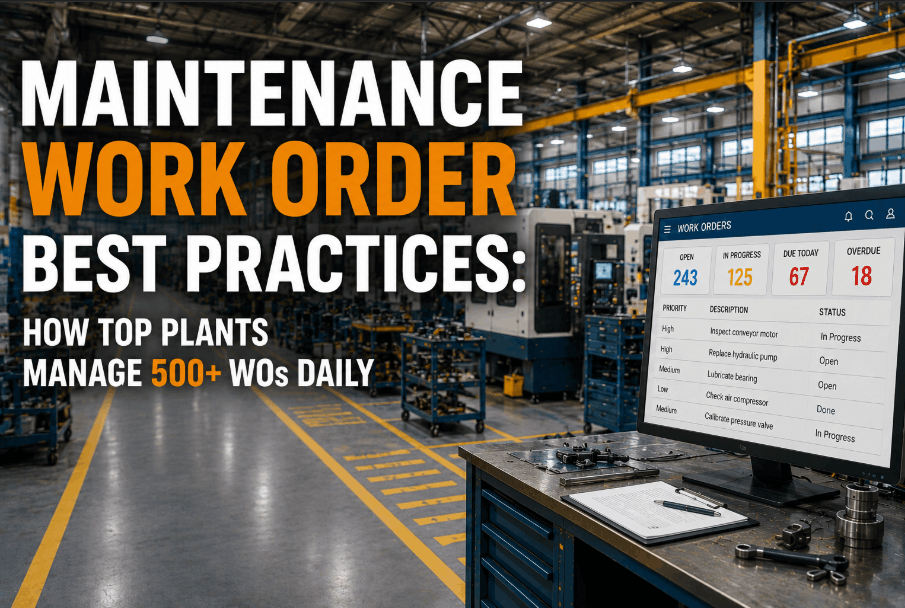
High-volume plants generate work orders faster than most maintenance systems can track them — and when burn-down rate falls behind creation rate, queue pressure builds until reactive events force priority reassignment. Understanding burn-down patterns across shifts, lines, and technician groups gives maintenance planners the operational intelligence to rebalance workloads before stacking backlogs interrupt throughput. Facilities that Sign Up Free on Oxmaint can monitor work order burn-down in real time — with shift-level closure rates, priority-queue adherence tracking, and automatic flags when line-level accumulation trends toward critical thresholds. For plants managing complex multi-line environments, Book a Demo to see how Oxmaint's work order flow engine surfaces burn-down risk before it affects the production schedule.
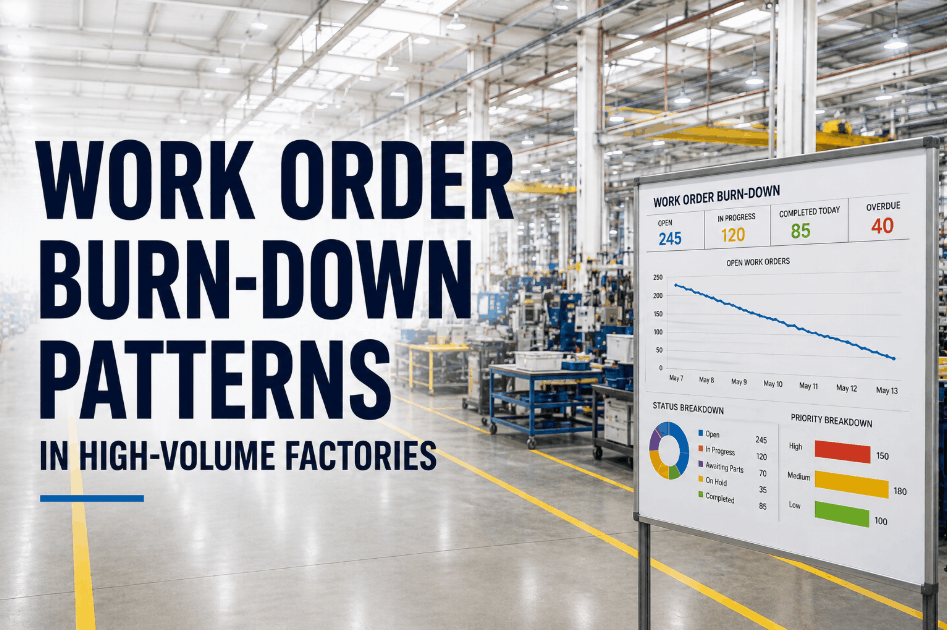
Oxmaint tracks burn-down ratio by shift, line, and technician group — so planners know whether their queue is shrinking or accumulating before throughput pressure arrives.
6 Work Order Burn-Down Patterns That Signal Queue Health
Burn-down patterns are not uniform across shifts or lines in high-volume plants. Some queues clear quickly on day shift and rebuild overnight. Others accumulate steadily across the week until a bottleneck asset triggers a cascade. Identifying which pattern applies to each line is the starting point for effective workload balancing. Facilities that Sign Up Free on Oxmaint can visualise burn-down curves per line without building custom reports.
Closures consistently lag creations across all shifts. This pattern signals a structural capacity shortfall — not a temporary surge — and requires headcount or scope review rather than scheduling adjustment.
Day shift closes faster than nights, leaving queue growth concentrated in low-staffing windows. Targeted priority rule changes on night shifts typically resolve this without additional headcount.
Queue spikes sharply after planned maintenance windows or changeovers, then burns down before the next event. This pattern is manageable but requires accurate PM scheduling to prevent overlap with production demands.
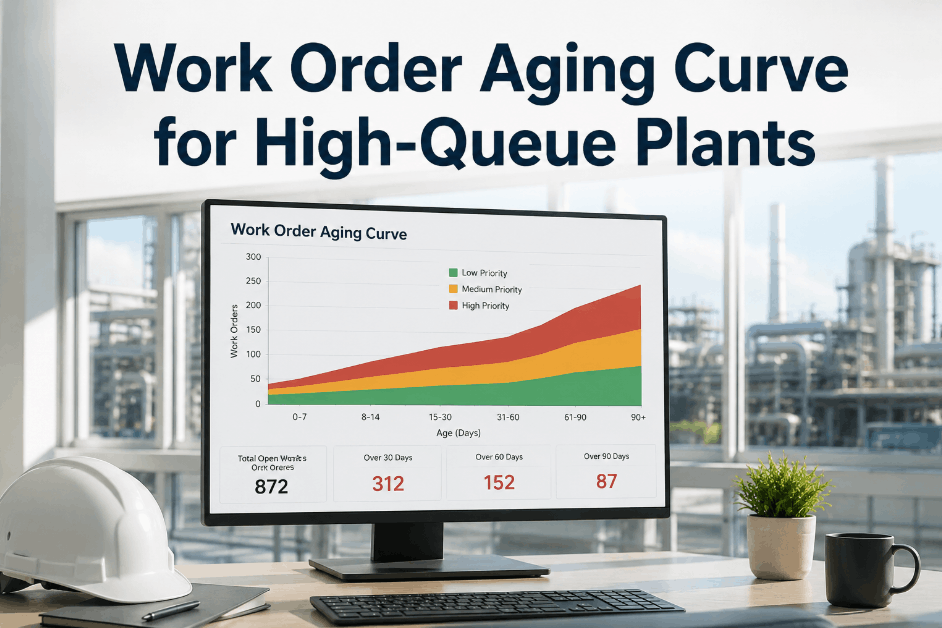
Low-priority tasks close faster than critical work because they are shorter or easier to access. This pattern inflates apparent burn-down rates while high-priority backlog ages — a dangerous mismatch for reliability.
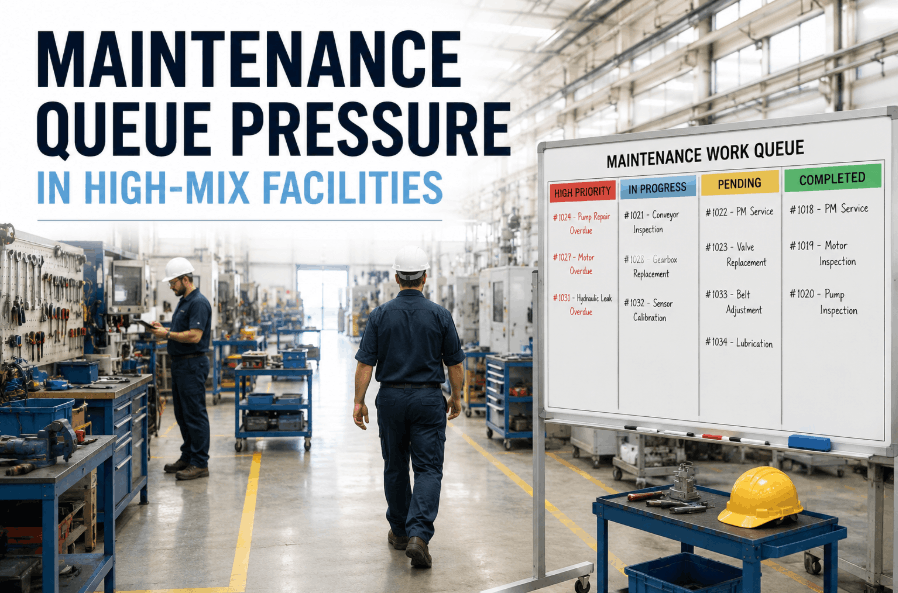
One asset or line consistently generates more work orders than it closes. This points to an asset reliability issue or parts availability constraint that a scheduling intervention alone cannot resolve.
Closures consistently exceed creations at a ratio above 1.2, priority rules are followed, and no line exceeds its backlog density threshold. This is the target state that Oxmaint's planning tools help teams maintain.
Burn-Down Pattern Diagnostics: Matching Pattern to Corrective Action
Each burn-down pattern has a different root cause and a different corrective response. Misdiagnosing a bottleneck asset pattern as a staffing problem wastes resources without resolving the queue. Use this framework to align pattern identification with the right maintenance response. Teams ready to move from manual queue tracking to automated burn-down monitoring can Book a Demo with Oxmaint.
| Burn-Down Pattern | Key Signal | Root Cause | Corrective Action | Priority |
|---|---|---|---|---|
| Steady Accumulation | Ratio < 0.8 all shifts | Structural capacity shortfall | Review headcount or PM scope reduction | Critical |
| Shift-Dependent Clearing | Night ratio < 0.6, day > 1.2 | Staffing imbalance by shift | Adjust night priority rules or add coverage | Critical |
| Priority Inversion | P3 closes faster than P1 | Scheduling discipline failure | Enforce priority lock in planner rules | Critical |
| Bottleneck Asset | One line drives 40%+ of open WOs | Asset reliability or parts constraint | Trigger reliability review or parts audit | Important |
| Burst-and-Clear | Spike after PM windows | PM scheduling conflict with production | Stagger PM windows across lines | Important |
| Dispatch Lag | WOs created but unassigned >2hr | Planner bandwidth or shift handover gap | Automate assignment rules by skill and shift | Important |
| PM Overdue Spike | Overdue rate >15% week-over-week | Reactive work displacing planned PMs | Protect PM blocks from corrective task displacement | Routine |
| Compliant Pattern | Ratio >1.2, no aging breaches | Healthy queue — sustain | Monitor weekly; adjust thresholds for seasonal load | Routine |
How High-Volume Plants Monitor Burn-Down Without Adding Reporting Overhead
The operational challenge is not calculating burn-down — it is keeping the calculation current across every shift without adding reporting work to planners who are already managing queue pressure. Oxmaint automates burn-down ratio calculation, priority adherence scoring, and bottleneck asset detection across all production lines in the asset hierarchy. Facilities can Sign Up Free and activate burn-down dashboards from day one — no custom reporting configuration required.
- Real-time burn-down ratio by shift, line, and technician group
- Priority queue adherence scored automatically from WO closure sequence
- Bottleneck asset detection based on per-line open WO density trends
- Automatic flags when burn-down ratio drops below configurable thresholds
- PM overdue rate tracked in parallel to corrective work closure rates
- Shift handover summary showing inherited queue and previous shift closure rate
- Manual tracking? Oxmaint calculates ratio automatically from WO lifecycle data
- Shift handover gaps? Automated queue summaries transfer context between shifts
- Priority inversion? Configurable priority-lock rules enforce dispatch discipline
- Bottleneck assets invisible? Per-line density view surfaces high-accumulation assets
- No mobile visibility? Field technicians see live queue status and priority order on mobile
- Audit gaps? Every WO creation, assignment, and closure is timestamped and attributed
16 Questions to Ask Before Selecting a Work Order Flow Management Platform
A good demo shows clean charts. These questions expose whether the system actually tracks burn-down accurately by shift, enforces priority rules, and surfaces bottleneck assets without manual analysis. Teams evaluating CMMS platforms can Book a Demo with Oxmaint for documented answers.
- Is burn-down ratio calculated automatically per shift and per production line?
- Can ratio thresholds trigger planner alerts without manual report generation?
- Does the system compare burn-down patterns week-over-week per asset class?
- Is historical burn-down data available for trend analysis without data exports?
- Can the platform enforce priority-lock rules to prevent P3 work displacing P1 tasks?
- Is assignment lag tracked from WO creation to technician acceptance automatically?
- Does the dispatch engine support automatic assignment by skill, shift, and line?
- Are priority inversion events flagged automatically in planner dashboards?
- Can the platform identify which assets consistently generate more WOs than they close?
- Is per-line open WO density tracked with threshold-based escalation?
- Does the system surface bottleneck assets to reliability engineers automatically?
- Can bottleneck patterns be linked to asset failure history in the same view?
- Are shift handover summaries generated automatically with queue status and priority flags?
- Can planned vs reactive ratio be filtered by line and asset class without custom reports?
- Is burn-down data used to inform the following week's capacity planning input?
- What is the total cost of ownership for a high-volume multi-line plant environment?
Work Order Burn-Down ROI: What Controlled Queue Flow Delivers to High-Volume Plants
Per-user SaaS pricing with no server infrastructure. Most high-volume facilities activate burn-down dashboards and priority rules within the first 30 days of onboarding.
Planners in high-volume plants spend hours per week compiling queue status from spreadsheets. Automated burn-down tracking eliminates this entirely and improves data accuracy simultaneously.
When low-priority work closes while critical tasks age, eventual failures on bottleneck assets carry disproportionate production cost. Priority-lock enforcement is the lowest-cost prevention available.
Plants with controlled burn-down ratios and active bottleneck detection report measurable reductions in unplanned line stops — directly protecting production schedules and customer commitments.
Automated burn-down tracking and priority flagging reduce daily planner coordination overhead — freeing scheduling capacity for proactive workload balancing rather than reactive fire-fighting.
Automated shift summary reports with inherited queue status and burn-down context reduce handover miscommunication — one of the most common causes of overnight queue accumulation in high-volume plants.
Oxmaint gives high-volume plants live burn-down ratio tracking, priority enforcement, and bottleneck asset detection — without adding reporting work to planners.
Work Order Burn-Down — Questions Planners and Operations Leaders Ask
Burn-down rate is the ratio of work orders closed to work orders created within a given period. When this ratio falls below 1.0 consistently, queues accumulate and eventually trigger reactive events that interrupt throughput on high-volume lines.
Oxmaint derives burn-down ratio directly from work order lifecycle data — comparing closure timestamps to creation timestamps by shift, line, and technician group without manual calculation or report exports.
Priority inversion occurs when lower-priority tasks close faster than critical work because they are shorter or more accessible. This inflates apparent burn-down rates while high-priority backlog ages — creating hidden reliability risk that surfaces as unexpected failures.
Yes. Oxmaint's dispatch engine supports configurable priority-lock rules that enforce task sequence by criticality tier — preventing lower-priority closures from masking critical queue accumulation in planner views.
Most facilities configure their line hierarchy, priority tiers, and burn-down thresholds within the first week. Live burn-down dashboards are typically active within 30 days of initial setup with no IT project involvement.
Yes. Oxmaint generates automated shift summary views showing inherited queue size, burn-down ratio from the previous shift, and priority flags on aging open work — reducing handover miscommunication and overnight queue accumulation.
Oxmaint delivers live burn-down tracking, priority enforcement, and bottleneck detection — helping high-volume maintenance teams clear queues before production pressure builds.