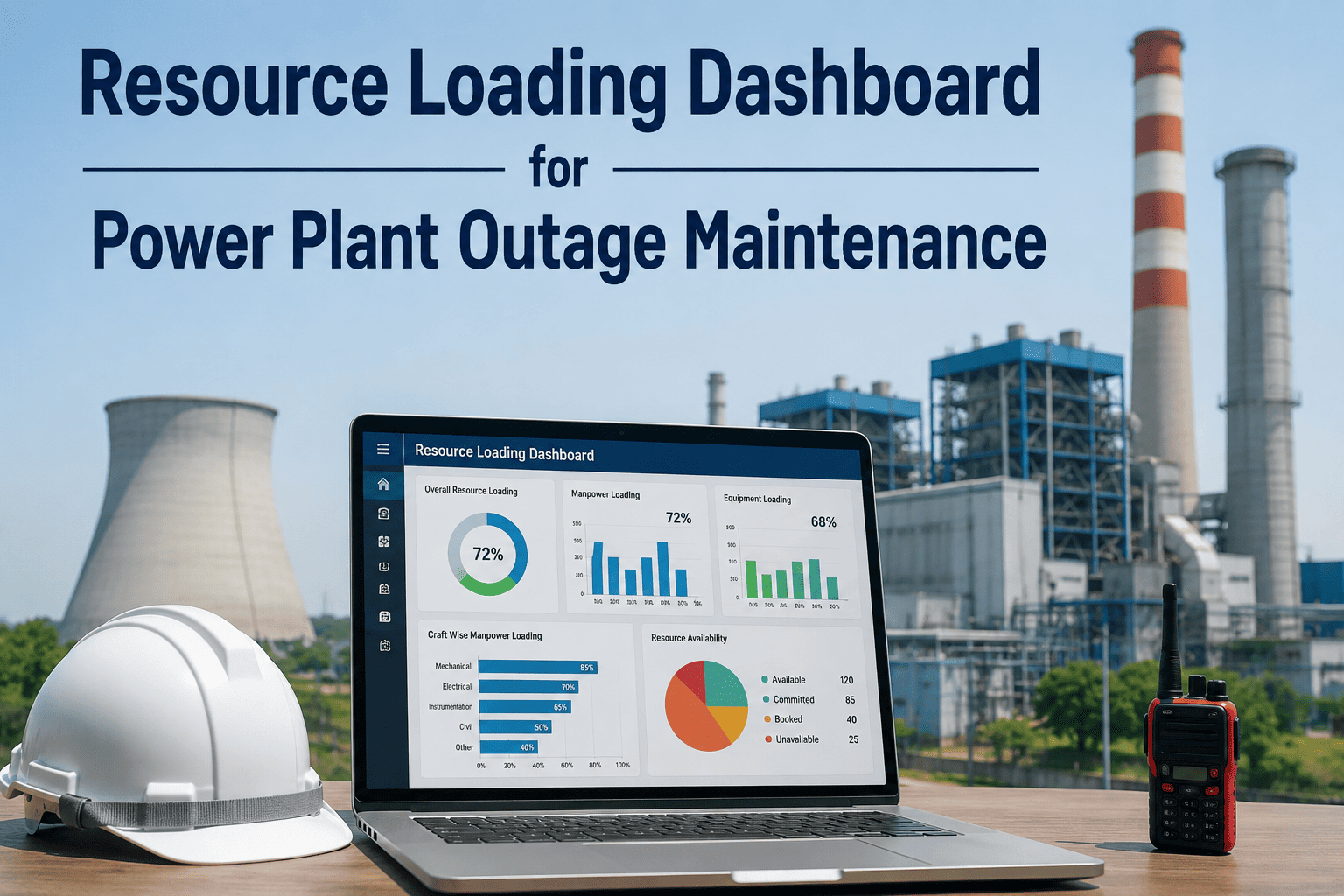
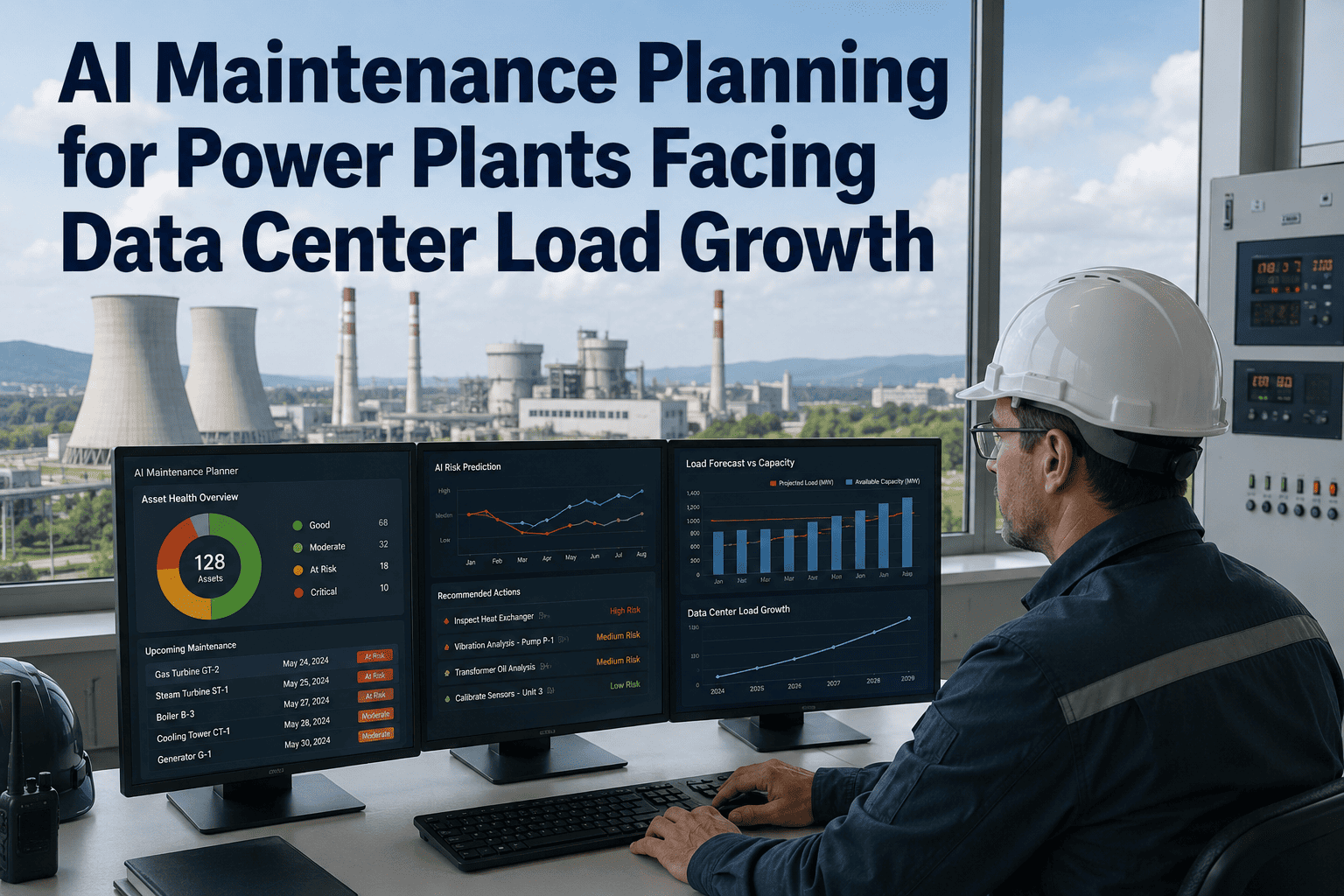
Power grids feeding AI data centers now face load swings that traditional maintenance calendars were never built to handle — a single hyperscale campus can pull 500 MW and ramp demand in minutes. Reactive maintenance under these conditions means missed outage windows, cascading failures, and penalty clauses that dwarf the cost of the failure itself. Oxmaint gives power plant engineers a live view of asset health, risk-ranked outage windows, and crew readiness dashboards so your maintenance schedule flexes with grid demand — not against it. If your plant is supplying AI infrastructure and still running maintenance on paper, start your free trial or book a 30-minute demo with a reliability specialist today.
500 MW+
Single hyperscale campus peak draw
3x
Faster load ramp vs. traditional industry
$2.4M
Avg. penalty per unplanned outage on AI contracts
40%
Plants still using spreadsheet-based PM scheduling
Why AI Data Center Load Growth Changes Everything for Plant Maintenance
AI workloads do not behave like residential or legacy industrial loads. Training runs kick in without warning, inference clusters scale instantly, and cooling systems cycle with every GPU batch job. This creates mechanical stress patterns your OEM never modeled — and maintenance intervals that were calibrated for steady baseload are now dangerously misaligned.
Challenge 01
Thermal Cycling Fatigue
Rapid load ramps drive repeated thermal expansion and contraction in turbine casings, heat exchangers, and boiler pressure parts. Assets designed for 2-4 start cycles per day may now see 12-18. Standard annual inspection intervals no longer reflect actual wear accumulation.
Challenge 02
Compressed Outage Windows
AI infrastructure contracts often include guaranteed uptime clauses with 4-hour maximum response windows. Planned outages must be coordinated with hyperscaler demand forecasts — a scheduling problem that manual work order boards cannot solve in real time.
Challenge 03
Crew Readiness Gaps
When an asset health alert fires at 2 AM during a peak training run, your maintenance crew needs to be pre-positioned and the right parts pre-staged. Plants without digital crew scheduling and parts inventory visibility lose 4-6 hours before a wrench touches the problem.
Challenge 04
Risk Blind Spots
Without a live risk score for every rotating asset, plant engineers cannot tell leadership which assets are one load surge away from forced outage. That blind spot costs plants their most valuable commodity in AI-era generation: predictability.
How Oxmaint Solves AI-Era Maintenance Planning
01
Outage Risk Scoring
Every asset gets a live risk score combining condition data, thermal cycle count, age, and failure mode probability. Plant managers see which assets are green, amber, or red before the next load surge — not after.
02
Demand-Aware Maintenance Windows
Maintenance schedules sync with load forecasting data. Oxmaint flags maintenance windows during predicted low-demand periods so your outages never collide with peak AI training cycles.
03
Crew Readiness Dashboard
Technician availability, certifications, and current task load are visible in one view. When a critical alert fires, dispatch takes minutes — not the 4-6 hours spent tracking down who is on shift and what parts are in stock.
04
Asset Health Alerts
Vibration anomalies, temperature trend deviations, and oil analysis flags trigger prioritized mobile alerts to the right technician — not a flood of unranked DCS alarms that operators learn to ignore.
05
Reliability Reporting for Contracts
Generate availability reports, forced outage rate summaries, and maintenance cost breakdowns that satisfy hyperscaler contract audit requirements — produced in under 2 hours, not 20 staff-days.
Your Grid Reliability Is an AI Infrastructure Asset
Hyperscalers choose power suppliers who can guarantee uptime at scale. Oxmaint gives your plant the operational intelligence to make that guarantee and keep it — with live asset health, smarter outage planning, and crew readiness built in from day one.
Critical Assets Under AI Load Pressure
| Asset |
AI Load Stress Factor |
Failure Risk Without APM |
Oxmaint Response |
| Gas Turbines |
High thermal cycling from rapid dispatch |
Hot section cracking, bearing wear |
Cycle-based PM triggers, EGT trend alerts |
| Transformers |
Repeated load swings stress insulation |
Winding degradation, thermal runaway |
DGA trending, thermal alert thresholds |
| Cooling Systems |
Peak load drives continuous full-capacity operation |
Fill media fouling, fan failure |
Condition-triggered inspection, water chemistry log |
| HV Switchgear |
Frequent switching accelerates contact erosion |
Contact failure, arc flash events |
Contact resistance logging, post-switching workflow |
| Generator Stators |
Load variation causes end-winding vibration |
Insulation aging, coolant blockage |
PI test records, partial discharge trending |
Before and After: Maintenance Planning Under AI Load Growth
Monthly asset health reports — 30 days stale
Outage windows set by calendar, not load forecasts
Crew dispatch takes 4-6 hours after alert
Risk assessment done manually per engineer judgment
Contract reliability reports take 20+ staff-days
Live asset health scores across all critical assets
Maintenance windows aligned to demand forecasts
Crew dispatch in minutes with pre-staged parts visibility
Automated risk ranking updated every inspection cycle
Availability reports generated in under 2 hours
Frequently Asked Questions
How does Oxmaint handle rapid load change scenarios common with AI data center clients?
Oxmaint tracks thermal cycle counts alongside standard maintenance intervals and triggers condition-based work orders when cycle thresholds are exceeded — not just calendar dates. This means assets under high AI load stress get inspected when they need it, not when the calendar says so.
Book a demo to see cycle-based PM in action.
Can Oxmaint help coordinate planned outages around hyperscaler demand forecasts?
Yes. Maintenance windows can be tagged against operational constraints so your scheduling team sees which upcoming work orders conflict with peak demand periods. The platform surfaces low-demand windows for maintenance planning, reducing the chance of a planned outage colliding with a major AI training run.
Try it free for your first plant.
How quickly can Oxmaint be deployed across an existing plant asset inventory?
Most power plant deployments reach full operational status within 10-14 weeks, including asset import, inspection templates, and mobile crew activation. There is no rip-and-replace of existing systems.
Book a scoping session for a deployment timeline specific to your facility.
Does the platform work in areas of the plant with no network connectivity?
The Oxmaint mobile app operates fully offline. Field technicians capture readings, photos, and GPS confirmation with no connectivity, and data syncs automatically when a connection is restored.
Sign up to test offline capability in your environment at no cost.
What ROI can a plant expect in the first year of Oxmaint deployment?
Plants typically see 2.8x ROI within 12 months, driven by avoided outage costs, 15-25% labor efficiency gains, and capital deferral through extended asset life. A single avoided forced outage under an AI infrastructure contract usually recovers the full annual platform cost.
Schedule an ROI modeling session using your actual asset count and outage history.
The Plants That Win AI Infrastructure Contracts Are the Ones That Never Trip
Oxmaint gives your operations team the asset health visibility, outage risk scoring, and crew readiness tools to deliver the reliability AI data centers demand. Deploy in under 12 weeks, no IT project required.