Power plants that still run on calendar-based maintenance schedules and reactive repair are leaving millions on the table — a single forced turbine outage costs $200,000 to $500,000 per day, and the average U.S. thermal plant experiences five to eight of them every year. AI is changing that math entirely: plants deploying AI-driven maintenance are catching equipment degradation four to twelve weeks before failure, converting emergency shutdowns into planned service windows, and achieving 12–22x ROI in the first year alone. If your plant is ready to move from firefighting to intelligent prediction, start with OxMaint's AI maintenance platform or book a 30-minute demo with a power generation specialist to see your plant's numbers.
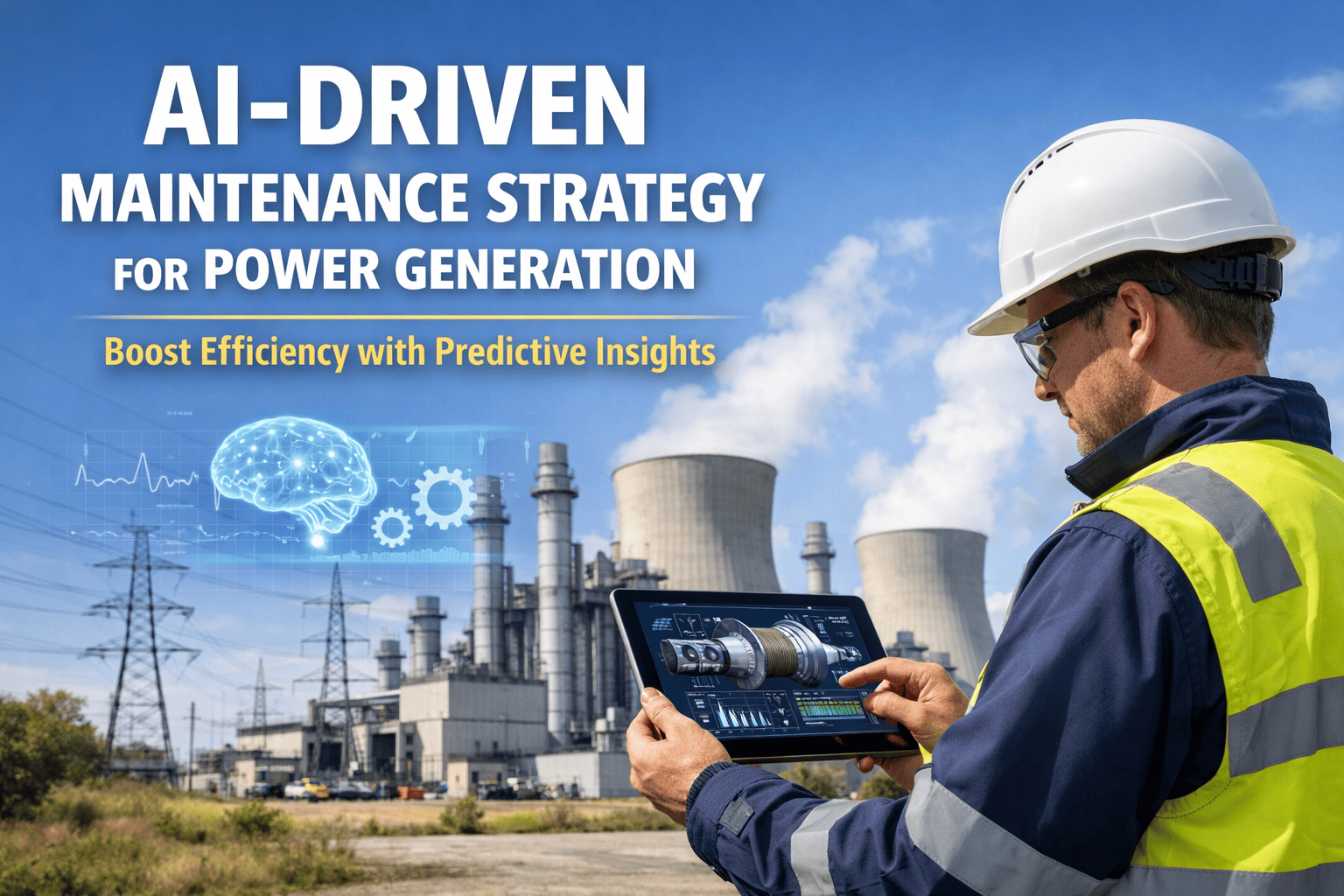
AI-Driven Maintenance Strategy for Power Generation: Boost Efficiency with Predictive Insights
68% of major equipment failures send detectable warning signals 2–8 weeks before causing physical damage. AI-driven maintenance is the strategy that captures those signals — before a single megawatt of generation is lost.
The Maintenance Strategy Spectrum: From Reactive to AI-Predictive
Most power plants exist somewhere between reactive maintenance (fix it when it breaks) and time-based preventive maintenance (service it on a calendar regardless of condition). Both approaches carry enormous hidden costs. Reactive maintenance triggers emergency labor premiums, expedited parts at 2.4x normal cost, and unplanned generation loss. Time-based maintenance wastes budget on assets that don't need service while missing the ones that do. AI-driven predictive maintenance is the strategy that eliminates both failure modes.
How AI Predictive Maintenance Works in a Power Plant
Continuous Sensor Data Collection
IoT sensors monitor vibration, bearing temperature, current draw, pressure, and exhaust gas patterns across critical assets in real time — feeding data streams to the AI platform through standard OPC-UA, Modbus, and PI Historian connectors. Your existing DCS and SCADA systems remain unchanged.
AI Model Training on Plant-Specific Baselines
Unlike generic threshold alerts, AI models learn each asset's individual behavioral baseline — accounting for seasonal load variations, fuel type changes, and equipment age. Anomalies are scored against that specific asset's history, not industry averages, eliminating the false alarm noise that erodes operator trust in traditional monitoring.
Early Degradation Detection — Weeks Ahead
When an asset's pattern deviates from its learned baseline, the AI scores the anomaly by severity and production impact. Bearing wear in a gas turbine is detected 4–8 weeks before failure. HRSG tube degradation shows detectable signatures months before rupture. These detection windows transform emergency shutdowns into planned repairs.
Automated Work Order Generation
When anomaly scores cross configurable risk thresholds, OxMaint automatically generates a CMMS work order with sensor data, anomaly classification, asset location, and recommended action attached. The right technician gets the right information before the failure window opens — not after it closes.
See AI Predictive Maintenance Running on Power Generation Assets
OxMaint deploys on your existing sensor infrastructure and starts detecting anomalies within 60 days — no infrastructure replacement required.
6 Critical Asset Categories for AI Monitoring in Power Plants
Not every asset needs AI monitoring — but the rotating equipment categories below account for 88% of unplanned power plant downtime and 91% of emergency maintenance spending. Deploying AI on these six categories first delivers ROI that funds the entire predictive maintenance program within the first year.
ROI That Compounds: What Power Plants Actually Report
A large U.S. utility deployed over 400 AI models across 67 generation units — reducing forced outages and documenting $60 million in annual savings while cutting carbon emissions by 1.6 million tons. The DOE estimates that AI-driven predictive maintenance eliminates 70–75% of equipment breakdowns entirely for adopting facilities.
Shifting from Reactive to Predictive: The Implementation Roadmap
Sensor Baseline Collection
Connect IoT sensors on priority assets — turbines, generators, and boiler systems first. Begin establishing each asset's behavioral baseline through continuous monitoring without generating alerts yet.
AI Model Training & Validation
AI models train on your plant's specific operational data — not generic industry averages. Shadow-mode validation runs alongside your existing monitoring, identifying detectable failures that your current system would have missed.
Live Deployment with CMMS Integration
AI anomaly detection goes live with direct integration to OxMaint work order generation. The first automatically-generated predictive work order — backed by sensor data — lands in your technician's queue. Most plants identify their first preventable failure event within 60 days.
Continuous Model Refinement
Every completed work order outcome and equipment intervention feeds back into the AI model — improving detection accuracy and reducing false positive rates over time. The system becomes more valuable the longer it runs on your plant's data.
Frequently Asked Questions
No replacement required. OxMaint connects to your existing DCS, SCADA, and historian systems via OPC-UA, Modbus, and PI Historian protocols — adding AI intelligence as a layer on top of your current control infrastructure. Your operators keep their familiar interfaces. Book a demo to see how integration works for your specific plant architecture.
Most plants achieve positive ROI within 6–12 months of full deployment, and payback typically occurs after preventing just one major forced outage — an event that costs $1M–$3M. 95% of adopters report positive ROI within 18 months. Start your free trial to begin building your plant-specific ROI projection from your first connected assets.
Start with gas and steam turbines (43% of all equipment failures), HRSG and boiler tube systems (52% of thermal plant forced outages), and generators (longest replacement lead times). These three categories account for 77% of all mechanical forced outages and deliver the fastest payback on sensor deployment. Book a demo for a prioritized deployment plan built on your asset portfolio.
No — and this misconception costs plants that delay adoption. AI predictive maintenance amplifies your team's effectiveness by giving technicians intelligence and priority ranking, freeing them from low-value scheduled rounds so they can focus on high-impact interventions. Plants consistently report higher technician satisfaction after adoption because work becomes purposeful rather than reactive. Sign up free to see how the AI copilot works alongside your team.
OxMaint's AI learns each asset's individual behavioral baseline rather than applying generic thresholds — dramatically reducing false positive rates compared to traditional alarm systems. Anomaly scores are calibrated to each machine's specific operating patterns. OxMaint deployments consistently achieve high precision rates that build technician confidence within the first 60 days. Book a demo to see real anomaly detection data from power generation deployments.
Stop Reacting. Start Predicting. Your Equipment Is Already Sending the Signals.
OxMaint's AI-driven maintenance platform connects to your power plant's existing sensor infrastructure, learns your equipment's behavioral baselines, and converts invisible degradation signals into planned maintenance windows — before a single forced outage occurs. Plants on OxMaint see their first preventable failure event identified within 60 days of deployment.