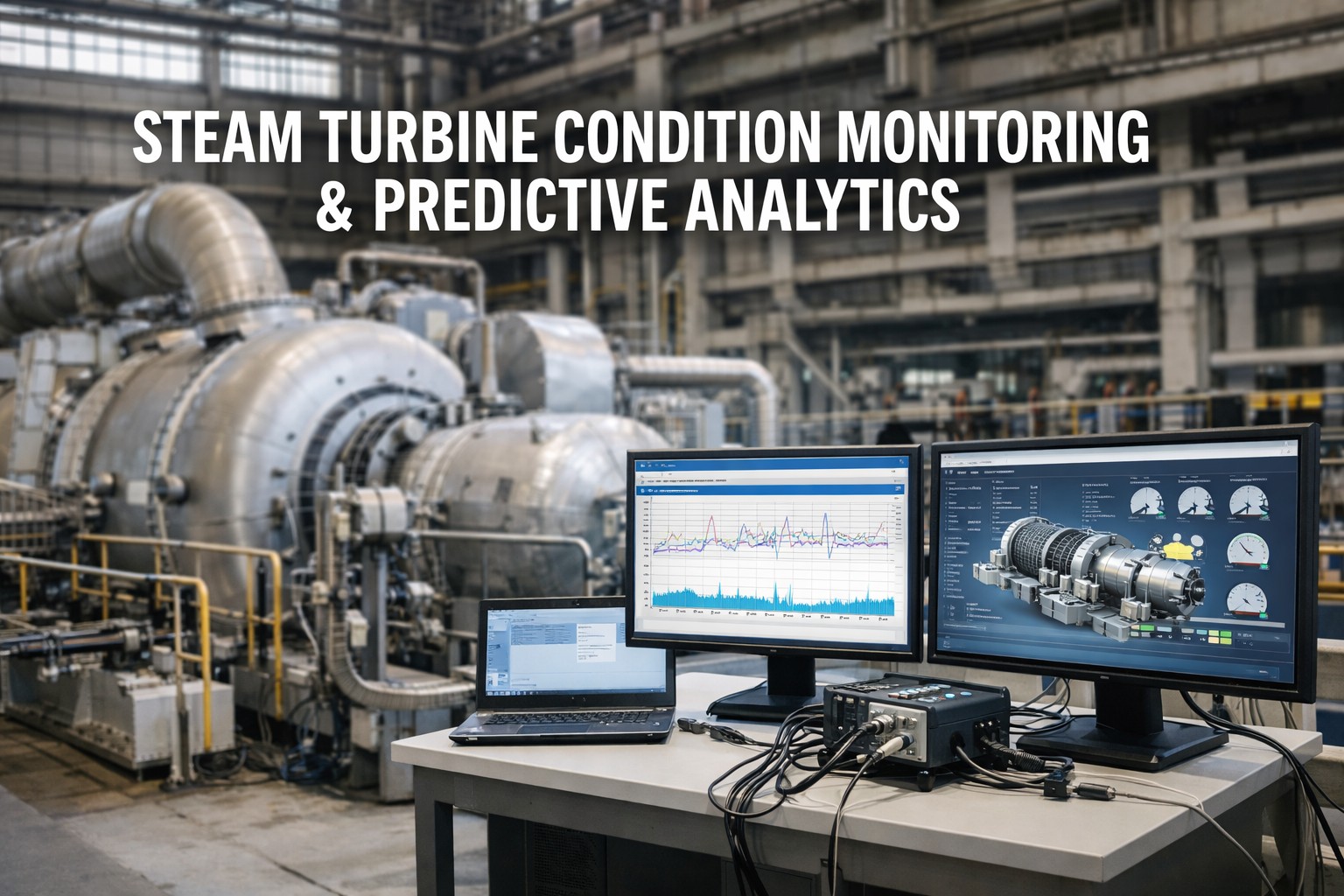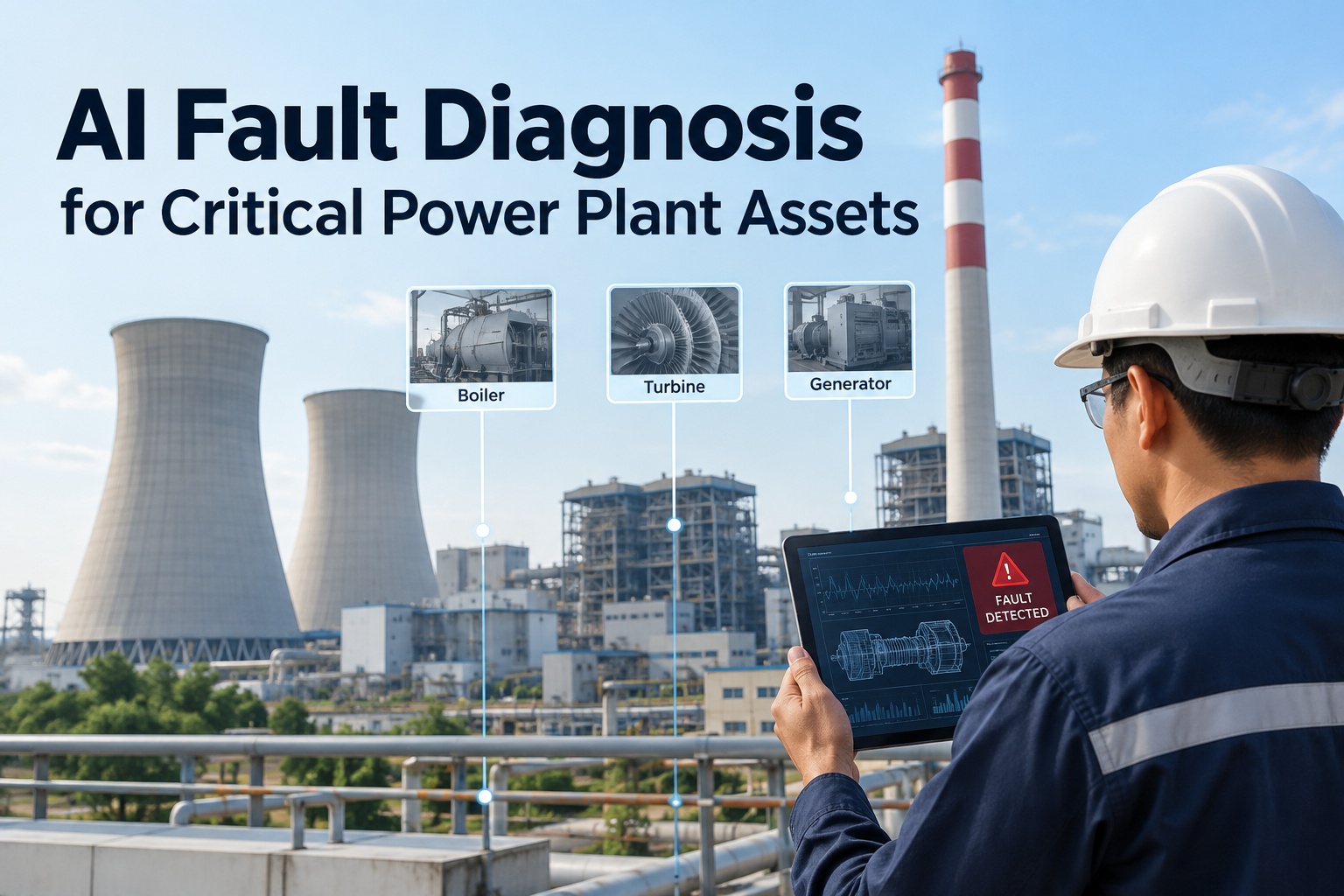
AI Fault Diagnosis for Critical Power Plant Assets

By William Jerry on September 9, 2026

ai-fault-diagnosis-critical-power-plant-assets

The turbine that trips offline at 2 AM didn't fail at 2 AM. It started failing weeks earlier, in a vibration trend your sensors captured and no one analyzed — because a human can't watch thousands of signals a second across every load condition, and a fixed threshold alarm only fires after the fault has already crossed into the danger zone. That's the gap AI fault diagnosis closes. It learns what "normal" looks like for each asset across every operating mode, flags the deviation 48–96 hours before failure, diagnoses the probable root cause, and hands maintenance a work order instead of a raw waveform. With turbines accounting for roughly 43% of power-plant equipment failures and boiler-tube issues driving 52% of thermal-plant forced outages — and unplanned outages costing on the order of $125,000 an hour — catching the fault early isn't a nicety, it's the margin. This guide walks the AI diagnosis pipeline and how OxMaint's maintenance management software runs it on your fleet. Start free or book a demo.

Power Generation · AI Fault Diagnosis · Critical Assets · 2026

AI Fault Diagnosis for Critical Power Plant Assets

From thousands of raw sensor signals to a diagnosed fault and a dispatched work order — the AI pipeline that catches turbine, boiler and generator faults days before they trip the unit.

48–96 hr
early warning AI gives before a fault becomes a failure
$125K/hr
typical cost of an unplanned power-generation outage
43% / 52%
turbine share of failures · boiler-tube share of forced outages
No new HW
runs on existing DCS, PI historian & SCADA data

Why Threshold Alarms Aren't Fault Diagnosis

A threshold alarm answers one question — "has this value crossed a fixed line?" — and it only answers it once the line is already crossed, which on critical plant assets is often too late to prevent the trip. AI fault diagnosis answers three harder questions the alarm can't: is this reading abnormal for these operating conditions, what is it going to become, and what is actually causing it. That's the leap from a bell that rings after the fact to a diagnosis that acts before it. Sign up free and OxMaint builds a normal-operating envelope per asset across all load and ambient conditions.

Threshold Alarm
Fires when a value crosses a fixed line
Blind to load & ambient context — false alarms or missed faults
No forecast, no cause — just "high" or "low"
Alerts after the danger line, often too late
AI Fault Diagnosis
Learns normal per asset, per operating mode
Seasonal & load baselines cut false alarms
Trends the anomaly and names the root cause
Warns 48–96 hrs out — time to plan the fix

The Pipeline: From Raw Signal to Dispatched Work Order

AI fault diagnosis isn't one model — it's a four-stage pipeline, and the value compounds down the chain. Each stage turns something the plant already generates into something the maintenance team can act on. The last stage is the one that matters most: it collapses the gap between diagnosis and dispatched action from days to minutes. Book a demo to see the full pipeline on your historian data.

1
Learn Normal
The AI ingests DCS/PI/SCADA history and builds a normal-operating envelope for each asset across every load, ambient and mode — the baseline everything is measured against.
↓
2
Detect Anomaly
Every asset carries a live health score. When it trends upward over successive readings — even below the alarm line — the deviation is flagged for review before it's urgent.
↓
3
Diagnose Root Cause
Vibration spectra, motor-current signatures, performance-ratio drift and chemistry trends are cross-read to name the fault — not just "abnormal" but "outer-race bearing defect."
↓
4
Generate Work Order
A confirmed root cause auto-creates a structured CMMS work order — failure mode, inspection steps, parts from repair history, skill level — pre-populated and ready to dispatch.

No Single Model Catches Everything — So Use an Ensemble

Different faults hide in different data. A cracked tooth screams in the vibration spectrum but is invisible in oil chemistry; a slow efficiency drift shows in performance ratios long before any vibration moves. That's why robust diagnosis combines complementary techniques rather than betting on one — maximizing detection coverage while keeping alerts accurate enough that crews act on findings, not noise. Sign up free to see multi-technique scoring on your assets.

Vibration Spectrum
Frequency analysis identifies imbalance, misalignment, bearing wear, looseness and resonance — comparing the live spectrum to the learned healthy fingerprint.
Motor Current Signature
Current analysis finds rotor-bar faults, stator issues and load changes; power-quality monitoring catches harmonics that age insulation.
Performance-Ratio Drift
Turbine heat rate, pump efficiency curves, compressor surge margin and boiler efficiency drift before a component fails — pointing to a specific root cause.
Chemistry & Oil Trends
Water chemistry, lube-oil analysis and combustion-gas changes flag corrosion, contamination and combustion faults — a sodium spike ties straight to condenser tube integrity.

A Fault Rarely Fails Alone. AI Maps the Cascade.

Power-plant failures propagate: a degrading cooling-tower fan raises condenser backpressure, turbine output drops, and boiler firing rate climbs to compensate — four assets, one root cause. AI maps those upstream-and-downstream dependencies so you fix the source, not the symptom. OxMaint links each anomaly to the assets it affects, so the diagnosis points at the fan, not the four things reacting to it.

The Cascade in One Picture

Here's why symptom-chasing wastes outages: a single degradation ripples across four systems, and a team reading only the turbine output would replace the wrong part. Follow the chain back and the fix is one fan. Book a demo to see dependency mapping on your plant.

Cooling-tower fan degrades
Root cause
→
Condenser backpressure rises
Effect 1
→
Turbine output drops
Effect 2 — what the operator sees
→
Boiler firing rate climbs
Effect 3

Fault Diagnosis Across the Four Critical Systems

Each major asset class has its own high-consequence faults and the AI signature that catches them. Here's the mapping across boiler, turbine, generator and balance of plant. Start free and connect your first critical asset this week.

System
High-Consequence Fault
AI Signature That Catches It
Boiler
Water-wall / superheater tube leak
Multivariate deviation in flow, temp & pressure; early-warning models flag ~3 days out
Turbine
Bearing wear, blade issue, imbalance
Vibration spectrum + heat-rate drift cross-read against the healthy baseline
Generator
Stator/rotor winding & insulation fault
Motor-current signature, partial-discharge trend & power-quality harmonics
Balance of Plant
Pump/condenser degradation, fouling
Efficiency-curve drift + chemistry trends linked to the affected asset record

Threshold Alarms & Manual Review vs. OxMaint AI Diagnosis

The point isn't more alarms — it's fewer, smarter, earlier, and already attached to an action. Here's what changes when diagnosis is automated and wired to the CMMS. Start free and put one critical asset under AI diagnosis this week.

Element
Alarms & Manual Review
OxMaint AI Diagnosis
Warning time
After the danger line is crossed
48–96 hrs before failure
Context
Fixed limit, load-blind
Normal envelope per operating mode
Output
"High" — no cause, no forecast
Named root cause + confidence score
Cascade
Each alarm read in isolation
Dependencies mapped to the root asset
Action
Engineer investigates, then writes WO
Work order auto-generated, pre-populated
Hardware
Often new sensors required
Runs on existing DCS/PI/SCADA data

What OxMaint Gives the Power-Plant Reliability Team

OxMaint runs the whole pipeline — learn, detect, diagnose, dispatch — on your existing historian data, so anomalies become owned work orders instead of unread trends. Here's the concrete mapping. Book a demo to see it on your fleet.

Live Asset Health Scoring
Every turbine, boiler, generator and auxiliary asset carries a continuously updated anomaly score, flagged when it trends up — even below the alarm line.
Multi-Technique Ensemble
Three complementary model types combined for coverage and accuracy, so crews act on real findings rather than a flood of false alarms.
Root-Cause Diagnosis
Vibration, current, performance and chemistry signals cross-read to name the fault and rank probable causes with confidence.
Dependency & Cascade Mapping
Upstream/downstream links so a single alert points at the root asset, not the several assets reacting to it.
Auto Work-Order Generation
Confirmed diagnosis creates a structured CMMS work order — failure mode, steps, parts and skill level — closing diagnosis-to-dispatch from days to minutes.
Historian-Native, No New Hardware
Connects to existing DCS, PI historian and SCADA data — most turbines, boilers and generators are already instrumented enough to start.

Use this pipeline plus OxMaint to catch faults 48–96 hours early, diagnose the true root cause across all four critical systems, and turn every anomaly into a dispatched work order — cutting unplanned outages and protecting the megawatt-hours a trip would cost. Try OxMaint free or book a demo to see it on your plant.

"

Our DCS threw hundreds of alarms a day and every one was after the fact — a value already over the line, no context, no cause. The night a turbine tripped at 2 AM, the vibration trend had been climbing for three weeks; the data was there, nobody was reading it. We connected our PI historian to OxMaint, it learned each asset's normal envelope, and now anomalies surface days early with a named cause and a work order already written. It caught a cooling-tower fan degrading that we'd have chased as a turbine problem — the cascade map pointed straight at the fan. No new sensors, and we've cut unplanned trips sharply. It's the difference between an alarm and a diagnosis.

Reliability Manager · Combined-Cycle Power Plant

Frequently Asked Questions

How is AI fault diagnosis different from a threshold alarm?
An alarm fires only after a value crosses a fixed line, blind to operating context. AI learns each asset's normal envelope per load and ambient condition, flags deviations 48–96 hours early, and diagnoses the root cause instead of just reporting "high."
Do we need new sensors to start?
Usually not. The models run on your existing DCS, PI historian and SCADA data — most steam turbines, generators and boilers are already instrumented enough to begin, and gaps can be identified up front.
Why combine multiple AI techniques instead of one?
No single method catches every fault type — a cracked tooth shows in vibration but not chemistry, a slow drift shows in performance ratios but not vibration. An ensemble maximizes coverage while keeping alerts accurate enough to act on.
How does AI handle cascading failures?
It maps upstream and downstream dependencies, so when one asset degrades and several others react, the diagnosis points at the root cause — the cooling-tower fan — rather than the turbine output that merely reflects it.
What happens once a fault is diagnosed?
OxMaint auto-generates a structured work order with the failure mode, inspection steps, parts from repair history and skill level — so diagnosis becomes dispatched action in minutes. Sign up free to see it.

Catch the Fault at Week 1, Not the Trip at 2 AM.

OxMaint learns each critical asset's normal, scores anomalies live, diagnoses the true root cause across boiler, turbine, generator and BOP, and writes the work order automatically — all on your existing historian data. Turn thousands of unread signals into faults you catch days early. Start free — no credit card, unlimited users, forever. Or book a demo.

Share This Story, Choose Your Platform!