Power plants have always run on precision — every turbine rotation, every pressure reading, every maintenance interval measured and managed. But the gap between plants still running on paper logs and clipboards and those leveraging AI-driven CMMS platforms is widening fast. The global power plant maintenance software market reached $1.74 billion in 2024 and is growing at 10.2% CAGR, driven by one urgent reality: reactive maintenance costs are unsustainable. Plants that detect equipment degradation before failure rather than after it don't just avoid unplanned shutdowns — they operate with 15 to 25% lower maintenance spend. The transformation from paper-based, reactive maintenance to a fully digital, predictive model is not a technology investment. It is an operational survival decision. Start your free trial on Oxmaint and see how plants digitize their first 20 critical assets within a week, or book a 30-minute walkthrough tailored to your plant type.
AI Platform · Digital Transformation · Power Generation
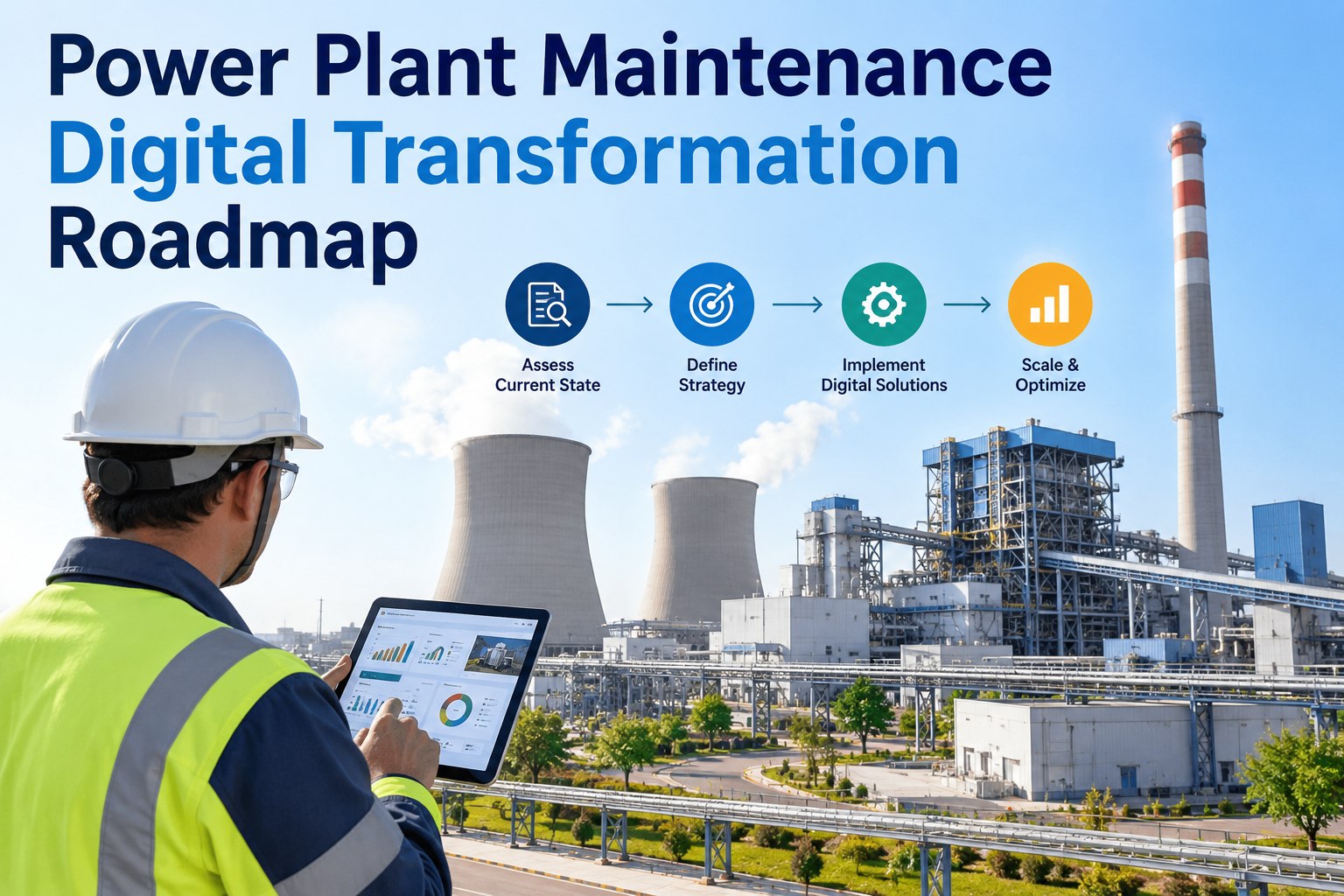
Power Plant Maintenance Digital Transformation
How power plants are replacing reactive breakdowns and paper logs with AI-driven CMMS, predictive analytics, and real-time asset intelligence — and the measurable results they achieve within 90 days.
10.2%
Annual growth rate of power plant maintenance software market through 2033
25%
Reduction in maintenance spend at plants using digital predictive models
80%
Of utilities expect digital technologies to be their primary efficiency driver by 2030
90 days
Typical window to see first prevented failure event after CMMS go-live
Where Most Plants Are Today — And Why That Is a Problem
The majority of power plants still operate with a maintenance model built for the 1990s: scheduled PM driven by calendar intervals, reactive repairs triggered by operator complaints, and asset history stored in spreadsheets or binders. This model had a defensible logic when equipment was simpler and energy demand was predictable. Neither condition holds in 2026.
Before Digital Transformation
- Paper work orders take 48–72 hours to reach a technician
- PM schedules built on OEM intervals, not actual equipment condition
- Reactive repairs cost 3–5× more than planned maintenance
- Compliance documentation assembled manually before audits
- No visibility into which assets are approaching failure
- Maintenance history lost when experienced technicians leave
→
After Digital Transformation
- Work orders issued, assigned, and tracked in real time on mobile
- PM intervals adjusted by actual asset health data from IoT sensors
- Planned maintenance rate exceeds 85%, reactive events drop significantly
- Compliance records auto-generated, timestamped, technician-signed
- AI flags degradation patterns 2–4 weeks before failure events
- Full asset history persists in CMMS regardless of workforce changes
The Four Technologies Driving the Shift
Digital transformation in power plant maintenance is not a single technology adoption. It is the convergence of four layers — each multiplying the value of the others. Plants that implement all four layers within 12 months consistently outperform those that adopt any one in isolation.
01
CMMS at the Core
A Computerized Maintenance Management System is the foundation. Every asset, every work order, every PM schedule, every part consumed, and every technician hour is logged in one platform. This replaces the fragmented data living in spreadsheets, emails, and paper binders — and creates the asset history that every other technology layer depends on.
Impact: PM compliance improves within 60 days. First prevented failure typically occurs within 90–120 days of go-live.
02
IoT Sensor Integration
Sensors on turbines, boilers, generators, and auxiliary systems feed temperature, vibration, pressure, and performance data directly into the CMMS. Instead of scheduled PM at fixed calendar intervals, maintenance is triggered when sensor readings cross defined thresholds — shifting from time-based to condition-based maintenance automatically.
Impact: Over 1.2 billion IoT devices are now deployed in the global energy sector, with the fastest adopters reporting 15–20% OPEX reduction.
03
AI Predictive Analytics
Machine learning models trained on asset history and sensor data identify degradation patterns that no scheduled inspection would catch. AI can flag a bearing approaching failure 2–4 weeks before it fails, allowing planned replacement during a scheduled outage rather than an emergency repair during peak generation. McKinsey data shows AI-based maintenance improves asset reliability by up to 20%.
Impact: Unplanned outage frequency becomes statistically measurable at 6 months when PM completion rates exceed 85%.
04
Mobile-First Field Execution
A digital transformation that stays on desktop fails on the plant floor. Technicians need mobile apps that issue work orders, capture completion evidence, flag parts needs, and close jobs without post-shift paperwork. The fastest-adopting plants report 80% of repairs logged digitally within the first 30 days — because the mobile interface is simpler than the paper process it replaces.
Impact: 80% digital work order logging within 30 days of mobile rollout at plants using Oxmaint.
Oxmaint is built for power plants moving from paper to digital — with CMMS, IoT integration, AI analytics, and mobile-first execution in one platform. Your first automated PM work orders can be live within a week.
The Transformation Roadmap — 90 Days to Measurable Results
Successful digital transformation does not require a 12-month implementation project. Plants that adopt a phased, outcome-focused rollout reach measurable operational improvement within 90 days. The three-phase model below is based on actual rollout patterns from power plant implementations.
Phase 1
Days 1–30
Digital Foundation
Import your asset list — turbines, pumps, transformers, auxiliary systems — into the CMMS
Configure PM templates for your 20 most critical assets using OEM documentation as baseline
Train maintenance crew on mobile app for work order receipt and completion logging
Quick Win: First automated PM work orders generated within 7 days. 80% of repairs logged digitally within 30 days.
Phase 2
Days 31–60
Data Accumulation
Activate IoT sensor feeds or manual condition readings for critical rotating equipment
Establish approval workflows for high-cost repairs — every part consumed creates an audit trail
Begin tracking labour hours, parts cost, and MTTR per asset for baseline measurement
Quick Win: PM compliance rate becomes visible. Reactive vs planned ratio becomes measurable for the first time.
Phase 3
Days 61–90
Predictive Operations
Activate AI analytics on accumulated asset history — first anomaly flags typically appear within this window
Review first data-driven PM interval adjustments based on actual failure patterns, not OEM defaults
Build first compliance report for regulatory review — generated automatically from CMMS records
Quick Win: First prevented failure event. Compliance documentation ready in hours, not days.
Industry 4.0 in Power Generation — What the Numbers Show
$64B
Global utility digital transformation spend projected for 2025
20%
Grid stability improvement from AI-based forecasting (McKinsey)
15%
Reduction in outage duration from real-time grid monitoring
4.8×
Cost of reactive emergency repair versus the same job done as planned maintenance
70%
Of US transmission lines over 25 years old — aging assets driving urgent digital maintenance need
95%
Of utility executives say energy transition is impossible without digital transformation
Frequently Asked Questions
Does digital transformation require replacing our existing ERP or purchasing system?
No. A CMMS like Oxmaint integrates with existing ERP systems via API rather than replacing them. The CMMS handles maintenance workflow and asset history — the ERP handles financial processing. Both systems do what they do best, connected.
See integration options in a free trial.
What if our asset data is scattered across old spreadsheets and paper files?
This is the most common starting point. Oxmaint's implementation team helps import asset lists from spreadsheets, PDFs, or manual entry. You do not need a clean database before you start — the system builds asset history progressively as work orders are completed.
How does a CMMS handle compliance documentation for NERC or environmental permits?
Every work order in Oxmaint is automatically timestamped, linked to the relevant asset, and signed off by the completing technician. Compliance reports are generated directly from work order records — no manual assembly before audits.
Book a demo to see compliance reporting live.
How long before we see measurable results after going digital?
Most plants see measurable PM compliance improvement within 60 days. The first prevented failure event typically occurs within 90–120 days. The full impact on unplanned outage frequency becomes statistically clear at the 6-month mark when PM completion rates consistently exceed 85%.
Is mobile-first CMMS realistic for field technicians who are not tech-savvy?
The fastest path to adoption is a mobile interface simpler than the paper process it replaces. Most crews adopt it within their first shift when they realize it eliminates post-shift paperwork. Start with early adopters — peer influence does the rest across the team.
Your Plant's Digital Transformation Starts With One Work Order
Oxmaint is built for power plants moving from paper to digital. Guided onboarding, mobile-first crew interface, and IoT-ready CMMS — your first automated PM work orders live within a week.