Coal combustion residuals (CCR) — the fly ash, bottom ash, boiler slag, and flue gas desulfurization materials generated by burning coal — are subject to federal disposal regulations under EPA's CCR Rule, which has been substantially expanded through 2024 legacy impoundment requirements that now govern ash management at both active and inactive power plant sites. The 2015 CCR Rule established groundwater monitoring, structural integrity assessment, closure, and post-closure care requirements for active ash landfills and surface impoundments. The 2024 Legacy CCR Rule extended these requirements to inactive impoundments and CCR management units that had been previously unregulated, requiring facilities to conduct facility evaluations, install groundwater monitoring wells, and prepare closure plans for ash disposal areas that may date back decades. For plant operators and compliance managers, the practical challenge is not just meeting EPA's technical requirements — it is maintaining a continuous, retrievable documentation trail that proves every required step was taken on schedule, because EPA's own enforcement data shows widespread noncompliance concentrated in groundwater monitoring, corrective action implementation, and closure record-keeping. Sign up free on OxMaint to connect your CCR compliance inspection schedules, groundwater monitoring records, and closure documentation to a single audit-ready platform that keeps your program current as EPA's deadlines evolve.
EPA CCR Rule · Coal Ash Compliance · Groundwater Monitoring · Ash Pond Closure
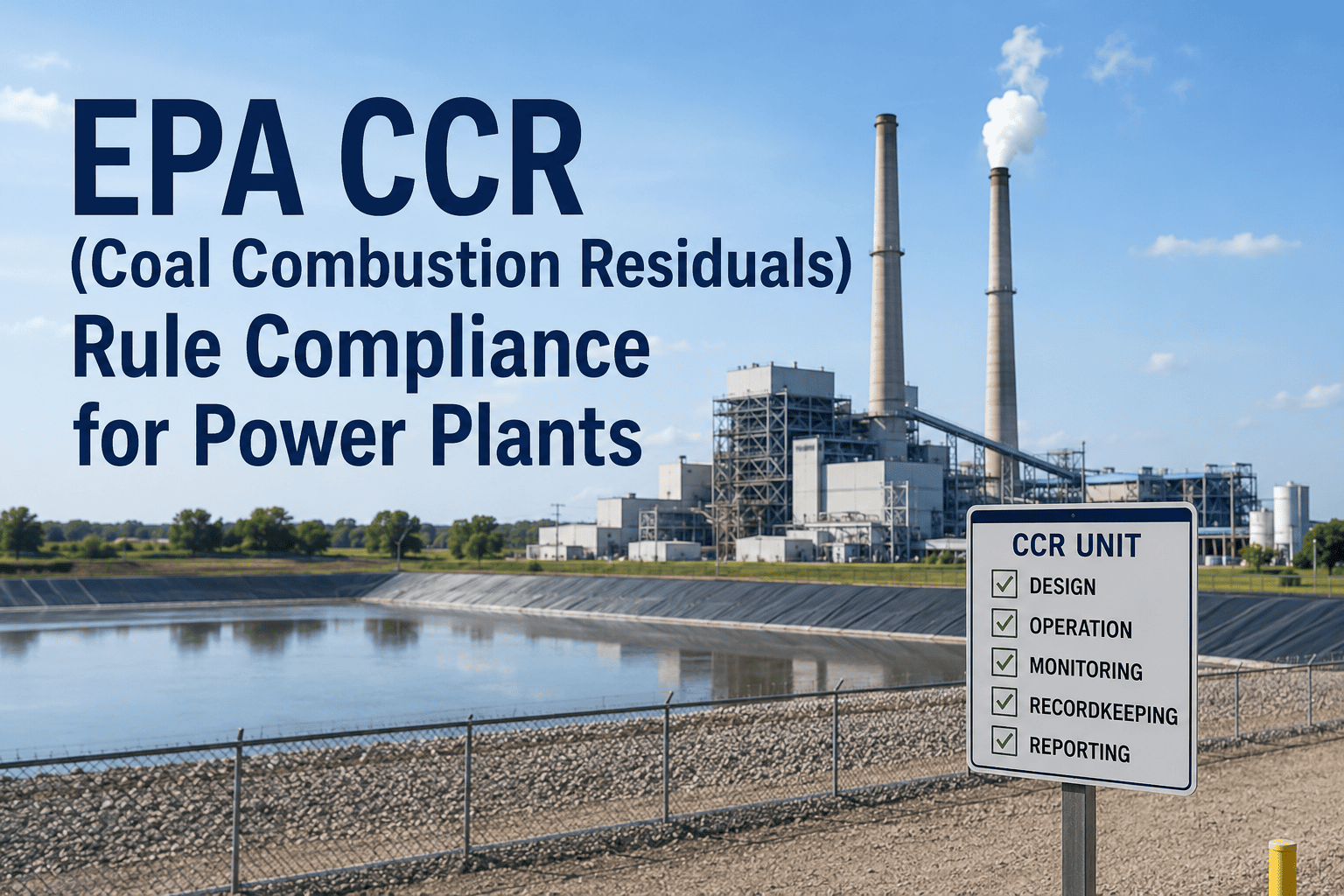
EPA CCR Rule Compliance for Power Plants:
From Ash Pond to Audit-Ready Records
The 2015 and 2024 CCR rules govern every active and legacy coal ash disposal unit at your plant. Groundwater exceedances, structural failures, and closure documentation gaps are the three compliance risks EPA enforcement is focused on — here's how to address all three.
2015
Year EPA established first federal coal ash disposal standards under RCRA
2024
Legacy CCR Rule extended requirements to inactive impoundments and unregulated CCR units
Widespread
EPA's 2023 enforcement alert found pervasive noncompliance in groundwater and closure programs
2x yearly
Minimum frequency for independent third-party groundwater sampling at CCR units
Rule Scope
What the CCR Rule Actually Covers — Active Sites, Legacy Sites, and the 2024 Expansion
Many plant operators are surprised to discover that their 2024 compliance obligations extend well beyond their currently operating ash disposal units. The 2024 Legacy CCR Rule expanded the program in three important directions.
Regulated Unit Types
Active CCR surface impoundments (wet ash ponds)
Active CCR landfills (dry ash disposal)
Units at active electric utility plants
Core Requirements
Groundwater monitoring program with upgradient and downgradient wells
Structural stability and hazard potential classification assessments
Emergency action plan for each surface impoundment
Annual inspection by independent qualified engineer
Closure and post-closure care upon cessation of disposal
Public website with all CCR compliance data posted annually
Newly Regulated Unit Types
Inactive impoundments at active plants (never previously regulated)
Legacy CCR surface impoundments at inactive utility sites
CCR management units (CCRMUs) — any area where CCR was placed, regardless of design or intent
Additional Requirements Added
Facility evaluation to identify and delineate all CCR management units on-site
Groundwater monitoring installation at newly regulated units
Closure and post-closure planning for legacy impoundments
Structural assessments for legacy impoundments that may lack engineering records
Corrective action if groundwater exceedances detected
Groundwater Monitoring
The Four-Phase Groundwater Monitoring Program — What Each Phase Requires
The CCR Rule's groundwater monitoring program is not a one-time test — it is a phased, ongoing program that can take years to complete and triggers increasingly stringent action requirements if exceedances are detected. Understanding where your facility sits in the program determines your current compliance obligations.
Phase 1
Detection Monitoring
Annual sampling of groundwater at all upgradient and downgradient wells for a defined list of CCR constituents (Appendix III). If constituent concentrations in downgradient wells exceed background levels, the facility must move to Assessment Monitoring. All facilities regulated under the 2015 rule should be in or past this phase.
Trigger to next phase: Any Appendix III constituent statistically above background at any downgradient well
Phase 2
Assessment Monitoring
Semi-annual sampling for a broader list of constituents (Appendix IV). Facility must determine whether groundwater protection standards (GWPS) have been exceeded. This phase requires the facility to post results to its public website within 30 days of receipt. Alternate Source Reviews (ASRs) may be used to demonstrate that non-CCR sources are causing the detections.
Trigger to next phase: Any Appendix IV constituent exceeds groundwater protection standard (GWPS)
Phase 3
Assessment of Corrective Measures (ACM)
The facility must assess all potential corrective measures capable of achieving compliance with GWPS. This includes pump-and-treat systems, source control (closure), enhanced monitoring, and monitored natural attenuation. The ACM report must evaluate each alternative and select the remedy within a defined timeframe — a step that requires detailed engineering analysis and creates significant documentation requirements.
Trigger to next phase: Completion of ACM report and selection of corrective measure
Phase 4
Corrective Action Implementation
The selected remedy must be implemented and maintained until GWPS are achieved and maintained for three consecutive years. Progress reports are filed annually. If the selected remedy fails to achieve GWPS, the facility must reassess and potentially select a more aggressive corrective measure. Corrective action at large sites can span 10–30 years.
Completion: Three consecutive years of GWPS compliance at all monitoring points
CCR Compliance Documentation With OxMaint
Annual Inspections. Semi-Annual Sampling. Quarterly Reports. One Platform.
CCR compliance generates a continuous stream of required documentation — groundwater sampling records, inspection reports, structural assessments, closure progress reports, and public website data. OxMaint organizes every required task, tracks due dates, and maintains the complete record in a format that satisfies EPA inspectors and state environmental agency reviewers on demand.
Closure Options
CCR Unit Closure — Closure by Removal vs. Closure in Place
When a CCR unit ceases receiving waste, the facility must formally close it under one of two regulatory pathways. Each has distinct technical requirements, timelines, and long-term obligations that determine the documentation burden your maintenance program must support.
All CCR and CCR-contaminated materials are physically removed from the disposal unit and disposed at a lined CCR landfill or beneficially used. The underlying soil must be demonstrably free of CCR contamination above background levels.
Compliance Advantages
Eliminates ongoing groundwater monitoring obligations once verification is complete
No post-closure care period (30-year minimum avoided)
No long-term institutional controls or deed restrictions required
Strongest defense against future liability from groundwater contamination
Practical Challenges
High capital cost — large impoundments can cost $100M+ to excavate and relocate
Requires receiving facility with permitted capacity and liner system
Excavation may disturb contaminated soils and create air quality issues
CCR remains in the unit, which is capped with an engineered cover system designed to minimize infiltration and prevent future releases. The facility must demonstrate that the cover system meets performance standards and will maintain integrity over the 30-year post-closure care period.
Compliance Advantages
Lower upfront capital cost for large impoundments
Avoids large-scale CCR excavation and transport logistics
Feasible timeline for plants retiring on accelerated schedules
Long-Term Obligations
30-year post-closure care period with annual inspection, groundwater monitoring
Institutional controls (deed restrictions) required to prevent future disturbance
Cover system integrity inspection and maintenance throughout post-closure period
Compliance Deadlines
Key CCR Compliance Deadlines — What's Required and When
CCR compliance is deadline-driven. Missing a required action date creates both an enforcement risk and a compliance gap that auditors flag even if the underlying technical work was eventually completed. Track these deadlines actively.
Common Questions
EPA CCR Compliance Frequently Asked Questions
What qualifies as a CCR Management Unit (CCRMU) under the 2024 rule?
A CCRMU is broadly defined to include any area at a regulated CCR facility where CCR was placed, regardless of how it was placed, when it was placed, or whether it was intended as a formal disposal unit. This includes historic fly ash fill areas, areas where ash was spread for dust control, old burn piles, and informal disposal areas that predate the 2015 rule. The facility evaluation required under the 2024 rule is specifically designed to identify these previously unregulated areas.
OxMaint's asset tracking can help you catalog and document each identified CCRMU for ongoing compliance management.
What happens if groundwater monitoring detects a CCR constituent above background?
Detection of an Appendix III constituent above background at any downgradient well requires the facility to move into Assessment Monitoring within 90 days, begin semi-annual sampling for Appendix IV constituents, and notify the public via the facility's CCR website within 30 days. Importantly, initial detection does not automatically mean the CCR unit is the source — Alternate Source Reviews can be used to demonstrate natural background or non-CCR contamination sources, but the ASR must be conducted and documented within 90 days of detection.
Is beneficial use of coal ash regulated under the CCR Rule?
Beneficial use — using fly ash as a cement replacement in concrete, road base material, or structural fill — is generally excluded from CCR Rule requirements, provided the use meets EPA's criteria: the CCR must provide a functional benefit, must substitute for a material that would otherwise be used, and for certain unencapsulated uses, must not exceed the amount needed for the application. The 2026 proposed amendments would eliminate the environmental demonstration requirement for non-roadway unencapsulated CCR uses under 12,400 tons, potentially expanding beneficial use flexibility.
Book a demo to see how OxMaint tracks beneficial use documentation alongside disposal compliance records.
What are the most common CCR Rule violations EPA has cited in enforcement actions?
EPA's 2023 CCR enforcement alert identified the most common violations as: failure to conduct or document required groundwater sampling on schedule, failure to implement corrective actions when GWPS exceedances were confirmed, failure to properly close disposal units that ceased receiving waste (continuing to operate without initiating closure), and failure to maintain required inspection records and post data to the public compliance website on the 30-day deadline. These are documentation and scheduling failures, not primarily technical failures — they are preventable with a structured compliance tracking system.
How long does the post-closure care period last for an ash pond closed in place?
The minimum post-closure care period under the CCR Rule is 30 years from the date the closure is certified complete. During this period, the facility must conduct annual inspections of the cover system, continue groundwater monitoring, maintain the cover's vegetative or engineered surface, and keep records of all O&M activities. If groundwater monitoring indicates ongoing leachate migration, the post-closure care period may be extended beyond 30 years until the facility demonstrates compliance with groundwater protection standards.
CCR Compliance Is a 30-Year Commitment
From Active Ash Pond to Post-Closure Monitoring — OxMaint Keeps the Record Current
EPA enforcement is focused on facilities where groundwater monitoring lapses, inspection records go missing, and closure milestones slip past without documentation. OxMaint gives your CCR compliance program a continuous, organized record that survives personnel turnover, plant ownership changes, and the three decades of post-closure obligations your facility will carry forward.