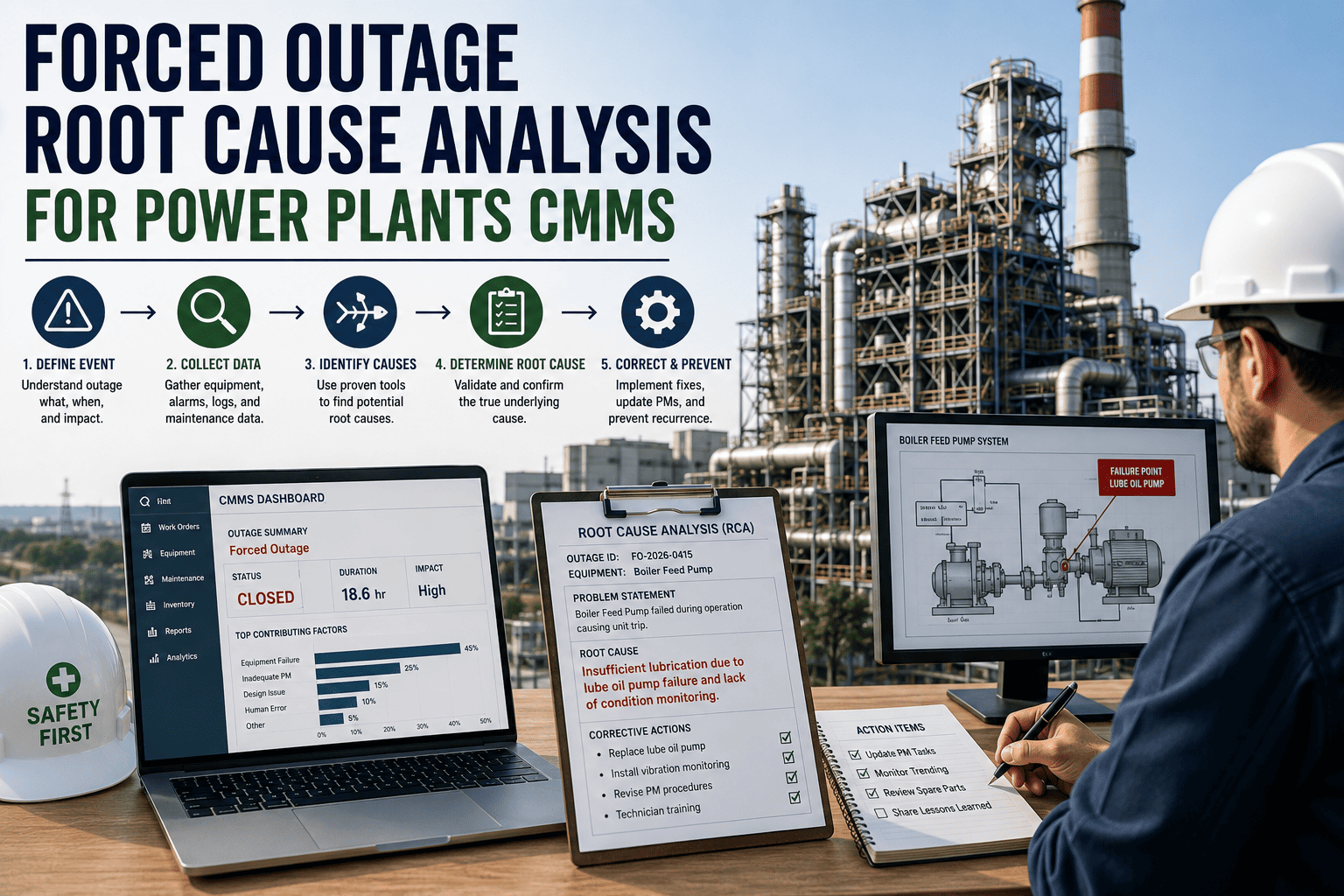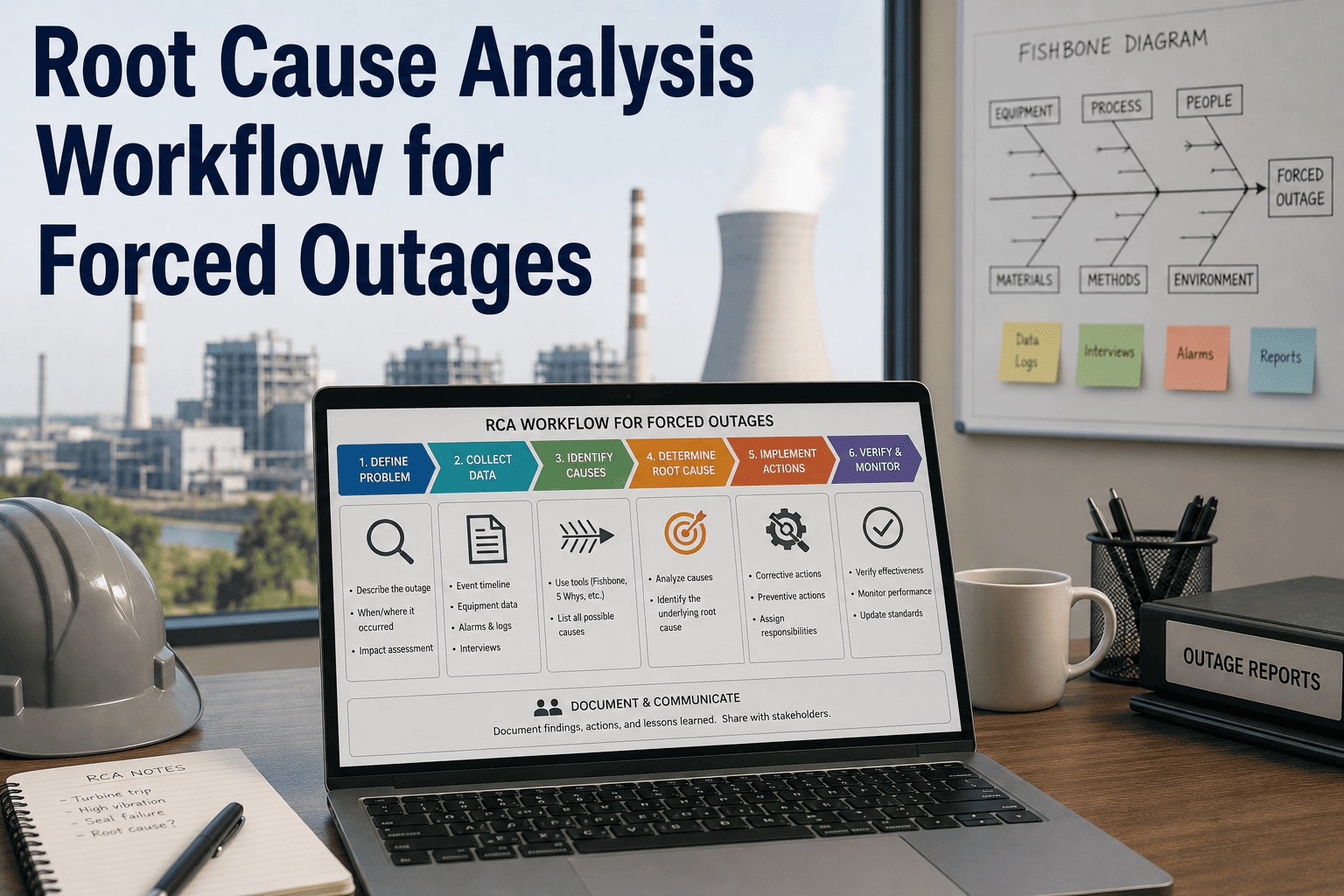
Forced outages are the most expensive events in power plant operations — not just because of lost generation, but because without a structured root cause analysis, the same failure will repeat. Industry data shows that plants without formal RCA workflows see 30–50% recurrence rates on the same failure modes within 24 months. A structured RCA workflow captures the outage timeline, preserves physical evidence, maps failed components to maintenance history, and locks in corrective actions before institutional memory fades. This guide walks through how to build an effective RCA process for forced outages — and how OxMaint's CMMS connects every step from incident trigger to reliability improvement. Ready to eliminate repeat failures at your plant? Book a walkthrough with our team.
Stop Repeat Failures. Build a RCA Workflow That Actually Works.
Most forced outages are preventable — if the previous one was properly analyzed. OxMaint's structured RCA workflow captures timeline, evidence, root causes, and corrective actions in one auditable record.
4 Reasons Most Forced Outage Investigations Go Nowhere
Most plants run some form of post-outage review — but few have a repeatable system. Here's where the process breaks down.
Evidence Disappears Within Hours
Failed components get repaired, cleaned, or discarded before photographs or measurements are taken. Once the unit returns to service, physical evidence is gone forever.
Timeline Reconstruction Is Guesswork
Without timestamped operator logs, DCS alarm exports, and maintenance history linked to the asset, the failure sequence relies on memory — which is unreliable and inconsistent.
Corrective Actions Are Never Closed
RCA reports are written, filed, and forgotten. No owner, no due date, no verification. The same recommendation appears in three consecutive incident reports with zero implementation.
Findings Don't Reach the Maintenance Schedule
Even when a root cause is correctly identified, it rarely updates the PM frequency, inspection criteria, or spare parts strategy. The lesson is learned and then lost.
Structured RCA in 5 Phases — From Alarm to Action Closure
Immediate Incident Capture
Within the first 2 hours of forced trip: create the RCA record in OxMaint, log exact timestamp, unit state at trip, alarm sequence, and operator actions. Assign an RCA lead immediately. Tag all involved assets.
Evidence Preservation & Documentation
Photograph failed components before cleaning or repair. Collect lube oil samples, vibration data exports, thermography images. Download DCS trend data for the 4-hour window before trip. All evidence attached directly to the OxMaint RCA record.
Timeline Reconstruction & Fault Tree
Build a minute-by-minute timeline from DCS alarms, operator rounds, and maintenance logs. Apply 5-Why or fault tree analysis to map causal chain from symptom back to physical, human, and latent root causes. OxMaint pulls the full maintenance history of each tagged asset automatically.
Corrective Action Assignment
Every finding generates a corrective action with an owner, due date, and priority level. Immediate fixes (before return to service), short-term actions (within 30 days), and long-term systemic changes are tracked separately. OxMaint converts approved actions directly into work orders or PM updates.
Reliability Integration & Closure
Verified corrective actions close the RCA record. Findings update the relevant PM task lists, inspection frequencies, and spare parts requirements. Reliability trends are updated to reflect the improvement and the event is added to the plant's forced outage register for benchmarking.
Run Your First Structured RCA in OxMaint — Free
OxMaint gives your team a ready-to-use RCA workflow: incident capture, evidence attachments, 5-Why builder, corrective action tracking, and PM integration — all in one platform.
What to Document in the First 72 Hours
The 72-hour window after a forced outage is the most critical period for investigation. After that, physical evidence degrades and memories blur. This is what your team needs to capture.
Mapping Failures to Root Cause Types
Every forced outage has multiple contributing factors. Identifying all three root cause layers — physical, human, and latent — is what separates a complete RCA from a symptom fix.
| Root Cause Type | Definition | Common Examples in Power Plants | Where It Appears in OxMaint |
|---|---|---|---|
| Physical Root Cause | The physical mechanism that caused failure — what broke and how | Bearing fatigue, seal face cracking, impeller erosion, insulation breakdown | Failed component log, inspection findings, lab analysis results |
| Human Root Cause | The action or inaction by a person that allowed or caused the physical failure | Incorrect torque applied, wrong lubricant used, alarm bypassed, inspection skipped | Work order history, procedure deviation records, personnel sign-offs |
| Latent Root Cause | The underlying system, process, or organizational condition that enabled the human error | No vibration monitoring on critical pump, PM frequency too low, inadequate procedure, training gap | PM task library, training records, policy review actions, reliability improvement log |
| Contributing Factor | Conditions that worsened the outcome but did not independently cause it | High ambient temperature, elevated load during failure, deferred maintenance backlog | Asset operating conditions log, maintenance backlog reports, environmental parameters |
KPIs That Measure Whether Your RCA Program Is Working
Forced Outage Rate (FOR)
The percentage of time a unit is unavailable due to forced outages. Target is below 2% for combined cycle plants and below 4% for steam units. Trending FOR over time shows whether reliability is improving.
Corrective Action Closure Rate
The percentage of RCA corrective actions closed on time vs. overdue. A closure rate below 70% indicates a systemic accountability problem, not an investigation quality problem.
Repeat Failure Index
Count of forced outages caused by the same failure mode within 24 months of a previous RCA on the same asset. Target is zero. Any repeat failure indicates RCA corrective actions were incomplete or unimplemented.
Mean Time to RCA Completion
The average time from incident to approved RCA report with all corrective actions assigned. Industry benchmark is 30 days for complete investigations. Longer cycles reduce action effectiveness.
PM Update Rate from RCA Findings
Percentage of completed RCAs that result in at least one update to a preventive maintenance task, interval, or procedure. A low rate means the reliability learning loop is broken.
Outage Cost Trend
Rolling 12-month total cost of forced outages (repair plus lost generation). This is the ultimate measure of RCA program ROI — if the number trends down consistently, the program is working.
Frequently Asked Questions
What is the difference between a forced outage RCA and a routine maintenance review?
A forced outage RCA is a structured investigation triggered by an unplanned, unscheduled unit trip or derating event. Unlike a routine maintenance review, it requires a formal causal analysis reaching back to physical, human, and latent root causes — with tracked corrective actions. OxMaint's RCA module separates these record types and enforces the full investigative workflow.
How many people should be on a forced outage RCA team?
Best practice is a cross-functional team of 3–6 people: the RCA lead (reliability engineer), operations representative, maintenance technician who knows the system, and a process engineer if the failure involves chemistry or thermal mechanisms. Larger teams slow down decision-making; smaller teams miss perspectives. OxMaint assigns roles and tracks individual contributions within each RCA record.
How does OxMaint connect RCA findings to the preventive maintenance schedule?
When a corrective action in OxMaint is classified as a PM change, it generates a task update request linked to the relevant PM template. Approved changes automatically update the task, frequency, or inspection criteria for that asset going forward — closing the learning loop between failure analysis and scheduled maintenance. Learn more by booking a walkthrough.
What analysis methods does OxMaint support for root cause investigation?
OxMaint supports 5-Why, fault tree analysis (FTA), and cause-and-effect (fishbone/Ishikawa) structured within the RCA record. Each method captures the causal chain from immediate cause back to latent systemic factors, with evidence attachments at each node for full auditability.
How do you prevent corrective actions from being ignored after an RCA is submitted?
OxMaint assigns each corrective action an owner, due date, and priority level. Overdue actions appear on the responsible person's dashboard and escalate to their supervisor automatically. No RCA is considered closed in the system until all actions reach verified completion status — removing the common problem of reports filed and forgotten.
Every Forced Outage Is a Lesson. Make Sure It Sticks.
OxMaint gives your reliability team a structured, auditable RCA workflow — from incident capture to corrective action closure — so every investigation actually improves your plant's reliability record.
Typical implementation: under 1 week. First RCA closed in OxMaint: often within the first incident.