Every FERC-licensed hydropower dam in the United States operates under a legal obligation that most asset management systems are not built to support. Part 12 of FERC's regulations requires licensed dam owners to maintain structured safety inspection programs, document instrumentation readings against action levels, track finding remediation to closure, and produce a complete audit-ready evidence package every five years for an independent consultant safety inspection. A missed piezometer reading, an undocumented seepage observation, or a Part 12 finding without a tracked corrective action date can turn a routine inspection into a license condition — or worse, a directed engineering study that halts generation. The hydro plants that consistently pass Part 12 inspections without findings are not luckier than their peers — they run tighter documentation programs, trending instrumentation data in real time and linking every field observation to a formal work order with a closure date. Start a free OxMaint trial to see how a CMMS-backed Part 12 program works end to end, or book a 30-minute demo with a dam safety specialist.
FERC Part 12 Compliance
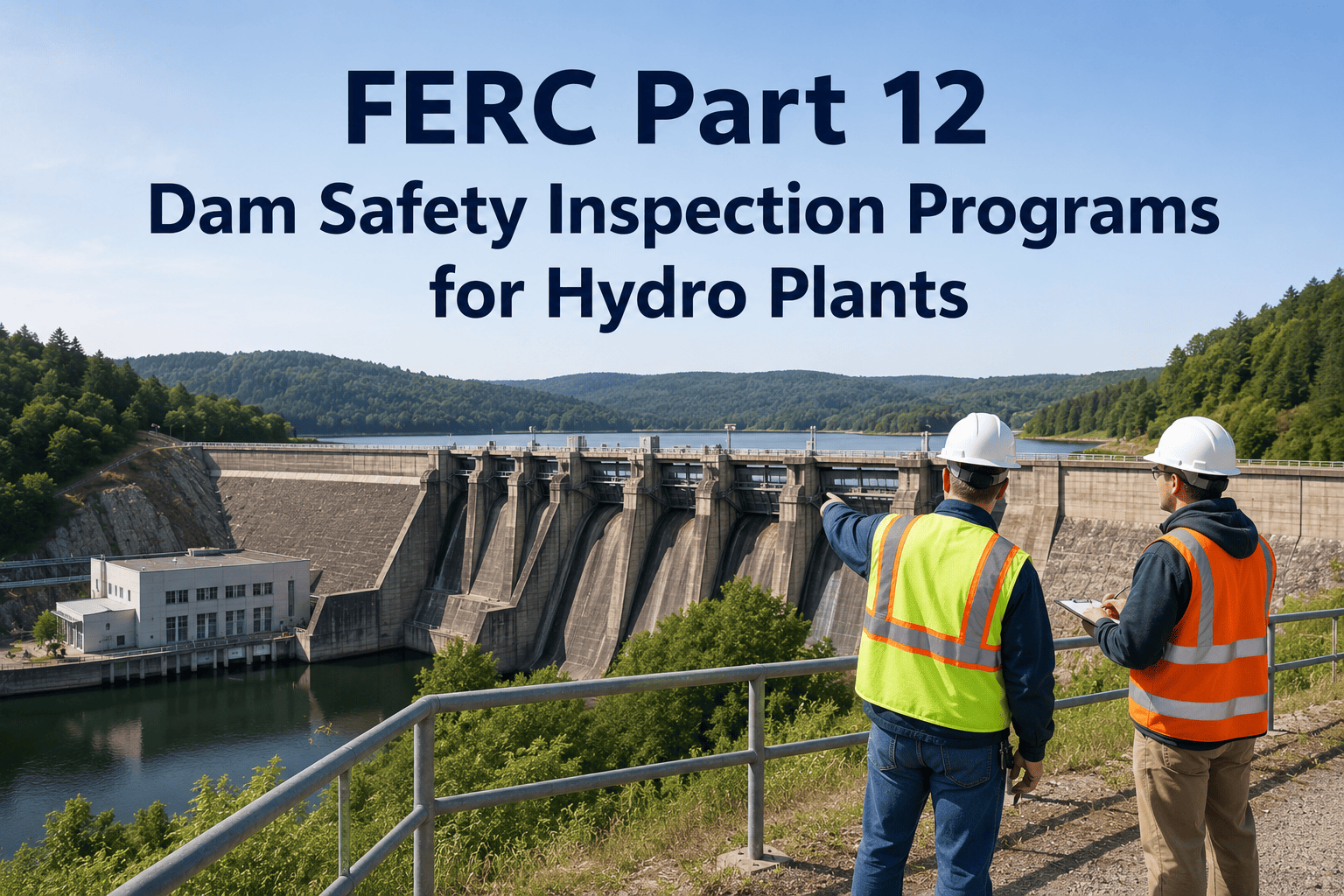
Dam Safety Inspection Programs for FERC-Licensed Hydro Plants
Seepage monitoring, crack tracking, spillway records, instrumentation trending, and finding remediation — all in one CMMS-backed program built for Part 12 compliance.
5 yrs
Independent Consultant inspection cycle under FERC Part 12
2-Tier
New PI + CA inspection structure effective April 2022
15,600+
high-hazard US dams requiring structured safety programs
60 days
advance IC approval submittal required before each Part 12 inspection
Regulatory Framework
What FERC Part 12 Actually Requires — The Two-Tier Structure
FERC's 2022 final rule restructured Part 12 inspections into two alternating tiers on a 10-year cycle. Understanding what each tier requires — and how your ongoing documentation feeds into both — is the starting point for building a compliant program.
Every 5 Years — Alternating
Periodic Inspection (PI)
An independent consultant-led field inspection of all project structures — dam, spillway, powerhouse, and appurtenances. Evaluates current physical condition, reviews surveillance and monitoring data, and checks compliance with FERC directives from the prior inspection cycle.
Physical condition of all structures
Seepage and instrumentation review
Prior finding remediation verification
O&M Manual compliance check
Alternating 10-Year Cycle
2024 PI → 2029 CA → 2034 PI
Every 10 Years — Deeper Scope
Comprehensive Assessment (CA)
A more intensive evaluation that includes a Potential Failure Mode Analysis (PFMA), Semi-Quantitative Risk Assessment (SQRA), and in-depth review of instrumentation trends, seismic hazard, and hydrologic loading. Requires a broader independent consultant team with multi-discipline expertise.
Potential Failure Mode Analysis (PFMA)
Semi-Quantitative Risk Assessment (SQRA)
Hydrologic hazard and spillway adequacy
Full instrumentation trend history review
Between Inspections: What Dam Owners Must Do
Annual
Owner-conducted safety inspections — documenting embankment condition, seepage, settlement, concrete condition, and gate operability
Scheduled
Instrumentation readings at FERC-approved frequencies — piezometers, weirs, settlement monuments, crack gauges, inclinometers
Event-Based
Post-flood, post-earthquake, and post-operational-anomaly inspections with documented condition assessments
Ongoing
Finding remediation tracking — every IC-directed corrective action must be documented from open status through verified closure
What Gets Inspected
Five Critical Inspection Domains — and What Failure Looks Like in Each
A FERC Part 12 inspection does not evaluate a single structure. It reviews every project work — from embankment toe drains to spillway gate actuators — against both current physical condition and the facility's history of monitoring data. These are the five domains where documentation gaps most often create findings.
01
Embankment and Seepage Monitoring
Seepage at the downstream face, abutments, and toe drain is the primary indicator of internal erosion. Piezometer readings must be logged at FERC-approved frequencies and trended against action levels. New or increasing seepage between readings with no documented investigation is a direct Part 12 finding.
Common Finding
Piezometer readings logged but not trended against action levels — data exists, analysis does not
02
Concrete Condition and Crack Monitoring
Concrete gravity and arch dams require visual inspection of all exposed surfaces plus crack gauge readings at documented locations. Crack width trends over time are more important than absolute values — an IC will ask for the historical trend, not just the most recent reading. Undocumented new cracks are major Part 12 findings.
Common Finding
Crack gauge readings recorded in field notebooks but never transferred to a trending database or formally reported
03
Spillway and Gate Operability
FERC requires annual spillway gate operation testing and certification. Each gate must be exercised through its full range of motion, and the results documented. Maintenance records for gate seals, hoisting mechanisms, and electrical controls must be available for IC review. An untested or undocumented gate is a compliance deficiency.
Common Finding
Annual gate test completed but certificate not filed — or maintenance records stored in a separate system unreachable during the inspection
04
Settlement and Deformation Monitoring
Settlement monuments and inclinometers track embankment and foundation movement over time. Readings must be compared to prior surveys, with any acceleration in settlement rate documented and investigated. The IC looks for continuity of the monitoring record — gaps of more than one reading cycle create questions that are difficult to answer without documentation.
Common Finding
Missing readings due to technician turnover — no record of who was responsible or that the gap was even noticed
05
Owner Dam Safety Program (ODSP) Documentation
FERC requires high-hazard potential projects to maintain a documented Owner's Dam Safety Program — a formal framework covering inspection schedules, monitoring procedures, corrective action processes, and staff training records. The ODSP must be current, internally consistent with actual practice, and available for IC review. Inconsistencies between the ODSP and actual records are a recurring finding category.
Common Finding
ODSP inspection schedule says quarterly visits — actual records show annual. The document does not match the records
OxMaint for FERC Part 12
Your Next Part 12 Inspection Starts Today.
Every inspection record you log now is evidence your IC will review in 12 to 60 months. OxMaint turns daily dam safety observations into a structured, auditable record — so your next Part 12 inspection starts from a position of strength, not a scramble to reconstruct history.
Instrumentation Program
FERC Instrumentation Monitoring — Reading Frequencies and Action Levels
FERC-approved surveillance and monitoring plans specify exact reading frequencies for every instrument at a project. Those frequencies are not suggestions — they are documented commitments that the IC will verify against actual reading records. Instrument programs that miss readings or log them without comparison to action levels create findings regardless of the underlying dam condition.
| Instrument Type |
Typical Reading Frequency |
Action Level Trigger |
Event-Based Requirement |
Documentation Required |
| Piezometers (standpipe / vibrating wire) |
Weekly to monthly (FERC-approved plan) |
Threshold and action levels per O&M Manual |
Daily if reservoir above trigger elevation |
Dated reading log, trend graph, AL comparison |
| Seepage weirs and flow measurements |
Weekly to monthly |
Increase greater than baseline variation |
Increased frequency after flood events |
Reading with flow rate, trend vs. seasonal baseline |
| Settlement monuments (survey) |
Annual (minimum) |
Acceleration of settlement rate |
Post-seismic event re-survey |
Survey report with comparison to prior benchmark |
| Crack gauges |
Monthly to quarterly |
Trend change or absolute width threshold |
Post-earthquake or post-flood inspection |
Reading log with trend graph across inspection cycles |
| Inclinometers |
Semi-annual to annual |
Deformation rate exceeding design threshold |
Post-seismic event if installed |
Deviation plot with prior survey comparison |
| Strong-motion seismographs |
Continuous (auto-triggered) |
Ground motion exceeding 0.05g PGA |
Immediate post-event inspection required |
Event record plus post-event visual inspection report |
| Spillway gate operation test |
Annual (FERC-required certification) |
Gate fails to reach full open or full closed |
Pre-flood season operability check |
Annual certificate filed with FERC Regional Office |
OxMaint assigns instrument readings to technicians with frequency, location, and prior action levels pre-loaded. When a submitted reading crosses a threshold, the system notifies the dam safety engineer and generates a condition report automatically.
Sign up free to configure your monitoring plan.
CMMS for Dam Safety
How OxMaint Supports a Complete Part 12 Documentation Program
The gap between a plant that passes Part 12 with no findings and one that receives six directed corrective actions is almost always a documentation gap — not a structural deficiency. OxMaint closes that gap by linking every inspection observation, every instrument reading, and every finding remediation into one searchable, exportable record system.
Step 1
Instrument Reading Assignments
Every piezometer, weir, crack gauge, and settlement monument is set up as an asset in OxMaint with its reading frequency, location, and action level thresholds. Technicians receive reading work orders on mobile — arriving at the instrument with prior values and action levels visible on screen before they take the new reading.
Step 2
Action Level Alerting
When a submitted reading exceeds a threshold or action level, OxMaint immediately notifies the dam safety engineer and generates a condition report. The alert is time-stamped and linked to the instrument record — creating an auditable chain from reading to response that the IC can review record by record.
Step 3
Owner Inspection Checklists
Annual and special-event owner inspections are completed on mobile checklists aligned with FERC's dam safety guidelines. Each inspection section — embankment, spillway, concrete, gates, and instrumentation — produces a signed, time-stamped record with photos attached at each finding. No paper reconstruction required.
Step 4
Finding Remediation Tracking
Every Part 12 finding is entered with priority classification, responsible engineer, committed remediation date, and FERC-directed completion deadline. Status tracks from open through corrective action to verified closure — with escalation alerts when deadlines approach and evidence documentation attached before formal closure.
Step 5
Part 12 Audit Export
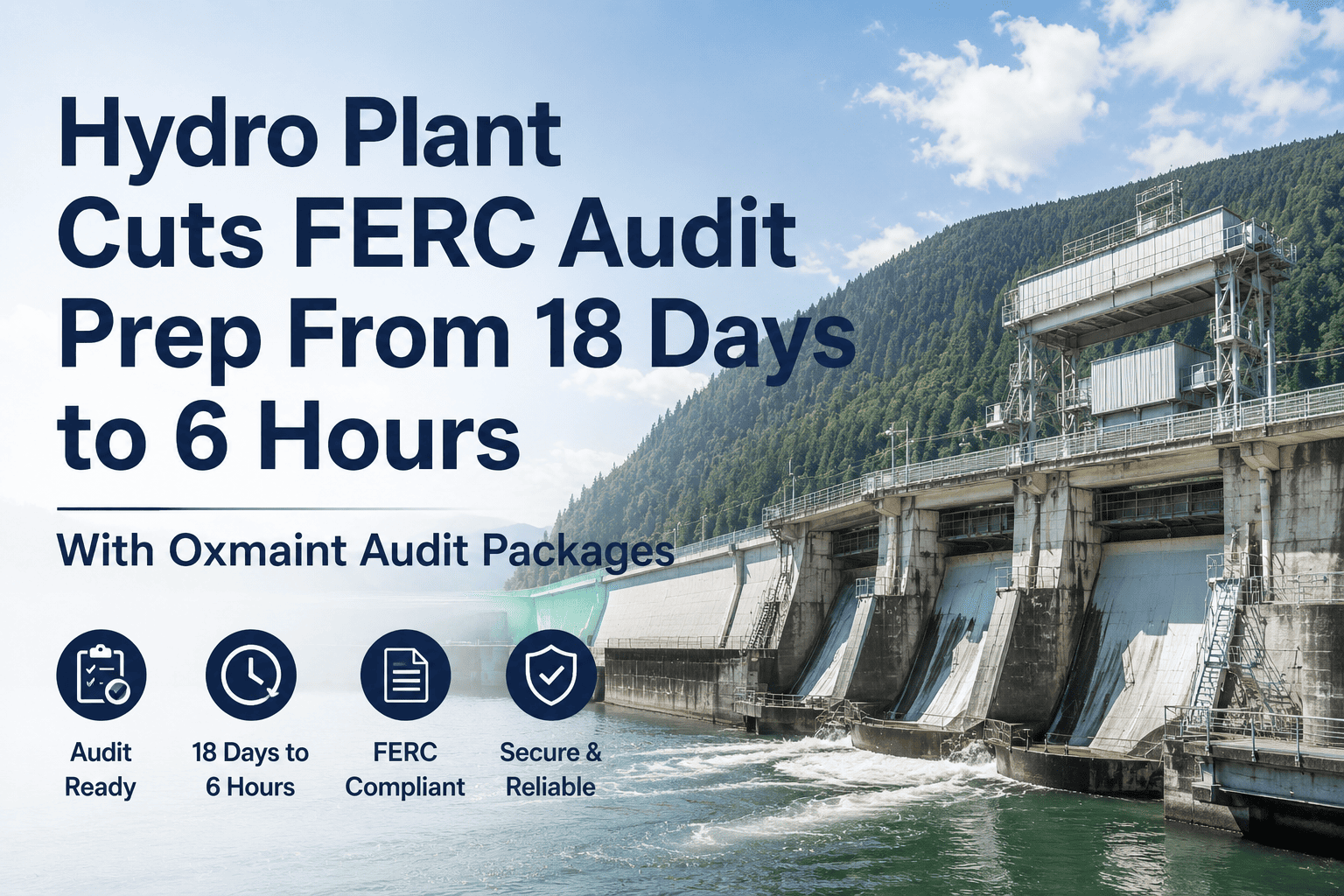
When your IC arrives on site, OxMaint exports the complete inspection record package — instrument trends, owner inspection reports, finding remediation status, spillway gate certificates, and O&M Manual compliance evidence — by date range, by structure, or by FERC-directed scope. Audit preparation that used to take weeks is ready in hours.
Compliance Timeline
The Part 12 Compliance Calendar — What Needs to Happen and When
Part 12 compliance is not a five-year event — it is a continuous program with annual deliverables and event-triggered obligations. Missing any item in this calendar creates documentation gaps that an IC will surface during the next inspection cycle.
Ongoing
Instrumentation Reading Program
Piezometers, weirs, crack gauges, and inclinometers read at FERC-approved frequencies. Readings logged with action level comparisons and trend data updated continuously.
Event-Based
Post-Flood and Post-Seismic Inspections
Reservoir above trigger elevation, flood event, or seismic event above 0.05g PGA requires immediate visual inspection and increased instrumentation reading frequency — documented with a formal condition report.
Annual
Owner Safety Inspection and Spillway Gate Certificate
Formal owner-conducted safety inspection of all project works with documented findings. Annual spillway gate operation test and FERC certificate filing. O&M Manual review and update if required.
60 Days Pre-Inspection
Independent Consultant Approval Submittal
Detailed IC team resume submitted to FERC's Director of Hydropower Licensing for approval — including all team member credentials and scope qualification. Late submittal can delay the inspection window.
Every 5 Years
Part 12 Periodic Inspection or Comprehensive Assessment
IC-led inspection of all project works. IC reviews all owner inspection records, instrument trends, finding remediation status, and O&M compliance since the prior inspection. Every gap in the record is a potential finding.
Post-Inspection
Finding Remediation Plan and FERC Filing
FERC and the licensee review the IC report. Directed corrective actions must be acknowledged with a remediation plan and schedule. Failure to remediate within the directed timeframe can result in license conditions or enforcement action.
FAQ
Frequently Asked Questions
What is the difference between a Periodic Inspection and a Comprehensive Assessment under the new Part 12 rules?
A Periodic Inspection is a field-based review of physical conditions and monitoring records — similar in scope to prior Part 12D inspections. A Comprehensive Assessment adds a Potential Failure Mode Analysis and Semi-Quantitative Risk Assessment, requiring a broader IC team with multi-discipline expertise. The two alternate on a 10-year cycle.
Book a demo to see how OxMaint helps you prepare for both inspection types.
How does OxMaint handle instrumentation readings that exceed FERC action levels?
When a technician submits a reading that crosses a threshold or action level, OxMaint immediately notifies the dam safety engineer, generates a timestamped condition report linked to the instrument record, and creates a follow-up work order. The full chain — reading, alert, response, and resolution — is stored against the instrument asset record and available for IC review.
Start a free trial to configure action levels for your monitoring program.
What documentation does FERC expect to see for owner-conducted annual safety inspections?
FERC expects dated inspection records covering embankment and concrete condition, seepage observations, instrumentation operability, gate testing status, and any new or changed conditions since the prior inspection. Each observation should be signed by the responsible inspector and linked to any follow-up action taken. OxMaint's mobile checklists capture all required fields with photo documentation at each inspection point.
Book a demo to see the dam safety inspection workflow.
How long does it take to implement OxMaint for a FERC Part 12 program at a single-dam project?
For a single-structure hydropower project, implementation typically takes two to four weeks — covering asset and instrument setup, historical finding migration, inspection checklist configuration, and O&M Manual task import. No IT integration or software development is required. Your dam safety engineer or O&M coordinator can complete setup using OxMaint's guided configuration workflow.
Start a free trial to begin configuration today.
Can OxMaint produce the complete inspection record package that an IC needs before arriving on site?
Yes. OxMaint exports the full audit package — instrument trend reports, owner inspection records, finding remediation status, spillway gate certificates, and O&M compliance evidence — by date range, by structure, or by regulatory scope. Audit preparation that previously required weeks of record reconstruction is available on demand.
Book a demo to see the Part 12 export workflow.
OxMaint Dam Safety
Every Gap in Your Records Is a Finding Waiting to Happen. Close the Gap Before Your IC Does.
OxMaint gives your dam safety team instrument reading workflows with action level alerting, mobile owner inspection checklists, finding remediation tracking, and on-demand Part 12 audit exports — in one CMMS built for FERC-licensed hydropower projects. Most plants are up and running in under four weeks.