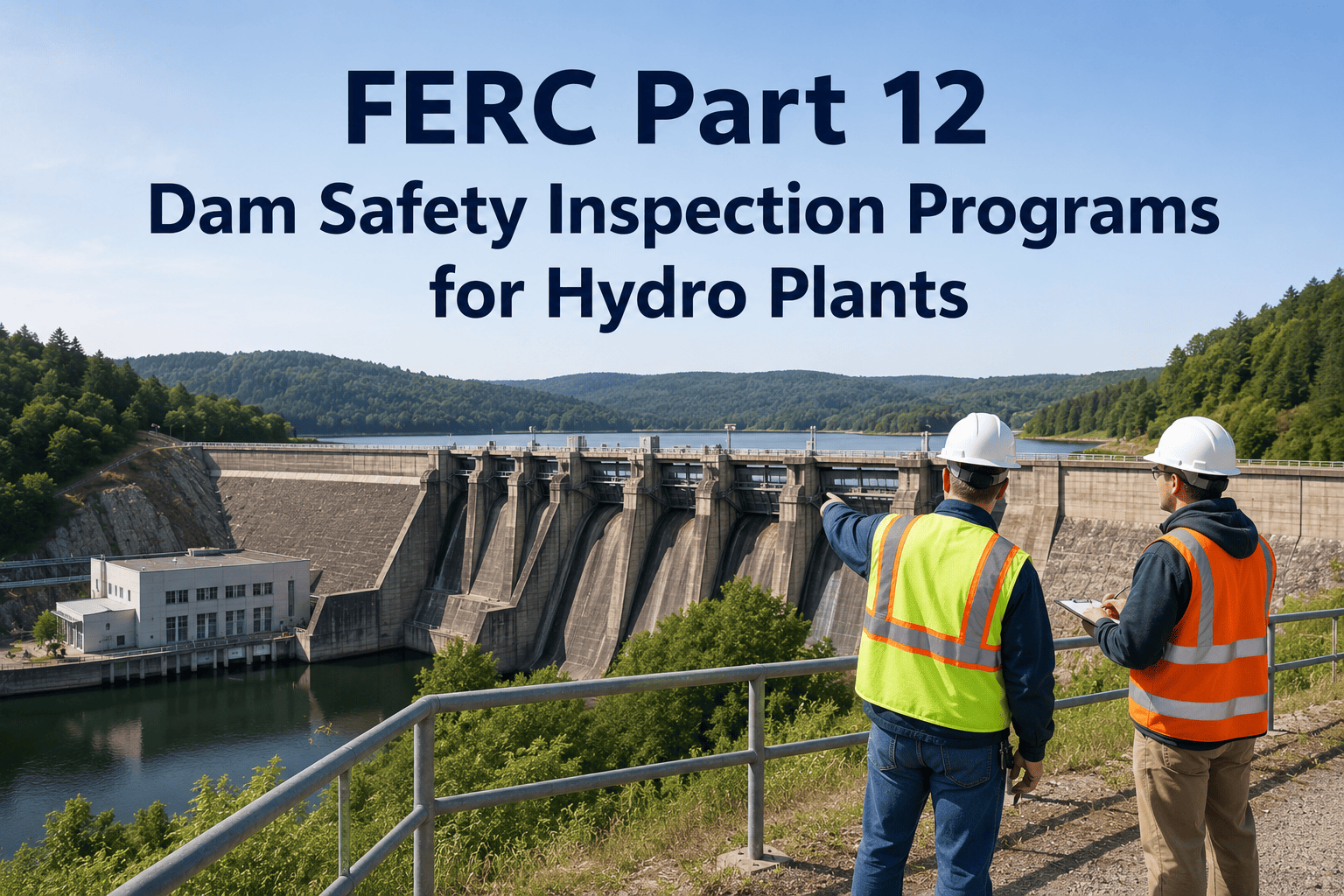
Hydropower facilities generate over 31% of global renewable electricity — yet the average hydro plant operates with maintenance systems that were never designed for the complexity of managing dam safety inspections, penstock structural assessments, turbine performance curves, and FERC compliance documentation inside a single operational platform. When a dam safety deficiency goes unrecorded, a Francis turbine runner operates past its efficiency threshold, or a FERC Part 12 inspection deadline is missed, the consequences range from regulatory enforcement action to catastrophic infrastructure failure. The hydropower operators who are outperforming their peers on both reliability and compliance are using purpose-built CMMS platforms that unify dam inspection tracking, turbine asset management, and FERC compliance into one auditable system — not three disconnected spreadsheets and a shared drive.
Dam Safety · Turbine Management · FERC Compliance · Penstock Inspection
Hydropower Plant Maintenance Software: Dam Safety, Turbine Performance and FERC Compliance in One Platform
Built for hydro operations managers, dam safety engineers, and reliability teams who need one system to manage every inspection, every asset, and every compliance deadline across the full facility lifecycle.
90,000+
Dams in the U.S. — over 17,000 classified as high-hazard by ASDSO
$4.8B
Annual cost of deferred dam and hydro infrastructure maintenance in North America
68%
Of FERC compliance deficiencies stem from documentation gaps, not actual safety failures
$25K/day
Maximum FERC civil penalty per violation per day for non-compliant licensees
The Unique Maintenance Challenge of Hydropower Facilities
No other power generation asset class combines the structural complexity of civil infrastructure, the rotating equipment demands of power generation, and the regulatory intensity of federal dam safety oversight inside a single operational boundary. A coal or gas plant can be managed almost entirely through equipment-focused CMMS. A hydro facility requires its maintenance platform to simultaneously track concrete crack propagation in a 60-year-old spillway, monitor Kaplan runner blade clearances, schedule penstock ultrasonic thickness testing across multiple spans, and produce FERC-ready inspection documentation — all within a unified system where nothing falls through the gap between asset categories.
HYDROPOWER MAINTENANCE DOMAINS — WHAT A SINGLE PLATFORM MUST MANAGE
CIVIL STRUCTURES
Dam embankment monitoring
Spillway gate inspection
Concrete crack mapping
Seepage & piezometer trending
Abutment stability records
HYDRAULIC SYSTEMS
Penstock inspection & thickness testing
Intake gate & trash rack maintenance
Draft tube condition assessment
Wicket gate actuator servicing
Relief valve testing records
ROTATING EQUIPMENT
Turbine runner inspection & balancing
Generator bearing vibration monitoring
Shaft seal condition tracking
Governor system calibration records
Efficiency curve trending per unit
REGULATORY COMPLIANCE
FERC Part 12 inspection documentation
Emergency Action Plan maintenance
State dam safety permit records
NERC reliability reporting
License condition tracking
Dam Safety Inspection Tracking: What FERC and State Regulators Expect
FERC-licensed hydropower facilities are subject to mandatory dam safety inspections under 18 CFR Part 12 — including independent consultant inspections every five years and owner inspections at least annually for high-hazard projects. State dam safety programs layer additional inspection requirements on top of federal oversight. The documentation expectations are specific: inspection findings must be categorized by deficiency type, remediation timelines must be assigned and tracked, and the entire record must be producible on demand during FERC enforcement reviews. A CMMS that cannot generate a complete deficiency-to-closure audit trail for every dam safety inspection is not adequate for a FERC-licensed facility.
FERC PART 12 COMPLIANCE REQUIREMENTS vs. OXMAINT CAPABILITY
FERC-READY DOCUMENTATION — GENERATED AUTOMATICALLY
Stop Building Your FERC Compliance Package from Scattered Files
OxMaint's Dam Inspection Tracking and FERC Compliance module gives hydropower operators a live deficiency register, auto-scheduled inspection reminders, and complete audit-ready documentation — accessible from the field, the office, and during any regulatory review.
Turbine and Generator Asset Management: Where Hydro Performance Is Won or Lost
A Francis or Kaplan turbine operating at 3% below its design efficiency curve costs a 100 MW plant over $800,000 per year in unrealized generation revenue at average wholesale electricity prices. The degradation that creates that gap — runner blade cavitation damage, bearing clearance drift, governor response lag — is measurable, trackable, and correctable with condition-based maintenance. What prevents most hydro operators from capturing this value is not lack of data. It is lack of a maintenance system that connects sensor readings, inspection findings, and work order history into a single equipment health picture for every generating unit.
HYDRO TURBINE ASSET MANAGEMENT — KEY PERFORMANCE TRACKING AREAS
Most Critical Asset
Francis & Kaplan Runner Condition
Cavitation damage mapping, blade wear measurements, and runner balance records tracked per unit — with work order history connecting each inspection finding to the completed repair and post-repair efficiency test result.
3–8%
Efficiency recovery achievable from runner restoration based on condition data
$800K+
Annual revenue impact of a 3% efficiency gap on a 100 MW unit
High Impact
Generator Bearing Monitoring
Thrust and guide bearing temperature, vibration signature, and oil sample trending feed early warning of degradation that costs $2–4M in forced outage and repair if it reaches failure — and is entirely predictable 4–8 weeks in advance with consistent condition monitoring.
4–8 wks
Advance warning window for bearing degradation detection
$2–4M
Cost of unplanned bearing failure vs. planned replacement
High Impact
Governor & Controls Calibration
Governor response time testing, dead band calibration records, and actuator stroke measurements scheduled on condition-based intervals — with results compared against OEM specifications and previous test history to detect regulatory response degradation before it affects grid participation.
NERC BAL
Governor response records required for frequency response compliance
Auto-logged
Every calibration result with technician sign-off in OxMaint
Significant Impact
Shaft Seal & Packing Records
Seal replacement history, leakage rate trend data, and packing adjustment records maintained per unit — enabling interval optimization that reduces unnecessary outages while preventing the water ingress damage that accelerates bearing and rotor degradation.
40%
Reduction in unnecessary seal replacements with condition-based intervals
Per-unit
Seal history tracked individually — not averaged across the fleet
Penstock Inspection Management: The Infrastructure Risk That Demands Better Tracking
Penstocks are the most structurally consequential assets at most hydropower facilities — and the most underserved by standard CMMS platforms. A penstock failure can drain a reservoir, destroy a powerhouse, and result in downstream casualties within minutes. The FERC Engineering Guidelines for the Evaluation of Hydropower Projects require structured penstock inspection programs including visual inspection, coating assessment, and periodic ultrasonic thickness testing across multiple inspection zones. Managing this across a facility with multiple penstocks, multiple elevation zones, and inspection cycles spanning 3–10 years is exactly the kind of complex, long-horizon tracking that paper records and generic work order systems cannot sustain reliably.
Without Structured Penstock Tracking
Inspection zones tracked in separate spreadsheets per penstock
Thickness readings not compared against historical baseline by zone
Coating degradation findings not linked to remediation work orders
FERC documentation assembled manually before each inspection cycle
No corrosion rate trending — replacement decisions based on age only
With OxMaint Penstock Management
Every inspection zone registered as a sub-asset with coordinates and full condition history
Thickness readings trended by zone — corrosion rate calculated automatically
Coating finding triggers work order with photo attachment and remediation deadline
FERC inspection package exportable in under 20 minutes from live records
Predicted remaining service life based on actual corrosion rate — not calendar age
What Hydropower Operators Achieve with OxMaint: Documented Performance Gains
The performance improvements below are drawn from hydropower industry research, EPRI hydro reliability studies, and documented operational outcomes from facilities that have deployed centralized CMMS platforms with integrated dam safety and compliance modules. They reflect what becomes achievable when inspection tracking, asset management, and FERC documentation share a single data model — rather than existing as three separate record-keeping burdens.
BEFORE
6–8 weeks
to prepare documentation for a FERC Part 12 independent inspection
▼
AFTER
Under 2 days
live records exportable directly from OxMaint dashboard
−96% prep time
BEFORE
41% PM completion
across civil, hydraulic, and rotating equipment maintenance tasks
▼
AFTER
93% PM completion
with auto-scheduling, mobile sign-off, and supervisor visibility
+52 percentage points
BEFORE
No corrosion data
penstock replacement decisions based on age estimates and visual impression
▼
AFTER
Zone-level trending
predicted remaining service life calculated per zone from actual UT data
Data-driven CapEx decisions
BEFORE
$340K/year
emergency repair spend on rotating equipment across a typical 3-unit hydro facility
▼
AFTER
$98K/year
planned maintenance capturing failures before they become emergency callouts
−71% emergency spend
From Dam Foundation to Generator Terminal — One Platform for Every Maintenance Record
OxMaint manages civil structures, hydraulic systems, and rotating equipment in a unified asset model — so your dam safety engineer, turbine technician, and compliance officer all work from the same live system. See how OxMaint handles hydropower's full maintenance scope in a live walkthrough with our energy team.
Frequently Asked Questions — Hydropower CMMS and FERC Compliance
How does OxMaint structure dam safety inspection records to satisfy FERC Part 12 documentation requirements?
OxMaint organizes dam safety inspections as structured events linked to the specific civil assets being inspected — dam embankment sections, spillway gates, abutments, and instrumentation stations are each registered as distinct assets with their own inspection history. Findings are classified by deficiency type and severity, with remediation work orders generated directly from each finding and tracked to closure. The complete record — inspection date, inspector credentials, findings, photos, corrective actions, and close-out confirmation — is exportable as a single package formatted for FERC review.
Book a demonstration to see how the deficiency register and audit trail work in a live high-hazard project scenario.
Can OxMaint manage both civil dam infrastructure and rotating generating equipment in the same platform?
Yes — OxMaint's asset model supports multiple asset categories within a single facility, meaning your penstock inspection zones, spillway gate actuators, turbine runners, and generator bearings all exist within the same asset registry with separate PM schedules, inspection checklists, and work order workflows appropriate to each category. This unified model eliminates the fragmentation problem most hydro facilities face — where civil structures are tracked in one system, rotating equipment in another, and compliance records in neither.
Start a free trial and explore the asset hierarchy configuration before committing to a full deployment.
How does penstock inspection zone tracking work in OxMaint, and can it handle ultrasonic thickness reading history?
Each penstock is registered as a parent asset in OxMaint, with individual inspection zones — identified by station, elevation, or clock position — registered as child assets. Ultrasonic thickness readings are recorded against each zone during inspections and stored with the technician name, date, instrument calibration record, and reading value. OxMaint then calculates corrosion rate from successive readings at each zone and projects remaining service life based on actual measured deterioration — giving your dam safety engineer data-driven replacement planning rather than calendar-based estimates.
See the penstock inspection module in a live walkthrough with our hydro engineering team.
Does OxMaint support mobile field inspections for dam safety walks and powerhouse rounds?
OxMaint's mobile application is designed for field use in both connected and offline environments — critical for dam inspections conducted at remote sites without reliable cellular coverage. Inspection checklists are downloaded to the device before the inspection, completed with photo attachments and observation notes in the field, and synced back to the central system when connectivity is restored. Digital signatures, GPS timestamps, and photo metadata are all captured automatically — satisfying the documentation requirements that handwritten field forms leave ambiguous.
Try OxMaint mobile on your next dam safety walk and compare the result against your current inspection record format.
What is the implementation timeline for deploying OxMaint at a hydropower facility with multiple generating units?
A three-unit run-of-river or storage hydro facility typically completes initial OxMaint deployment — asset registry, PM schedule build-out, and inspection template configuration — in 8 to 14 weeks depending on the availability of existing asset data and the complexity of the civil inspection program. Facilities with complete asset lists and existing inspection records in digital format move faster. The FERC compliance module and dam inspection tracking are configured in parallel with the equipment PM setup, so both capabilities are operational from the first day of live use.
Book a scoping session to get a deployment estimate specific to your facility's asset count and inspection program complexity.
BUILT FOR HYDROPOWER · DAM SAFETY · TURBINES · FERC COMPLIANCE
Every Dam. Every Turbine. Every Compliance Deadline. One Platform.
OxMaint gives hydropower operators the unified maintenance platform that civil infrastructure, hydraulic systems, and rotating equipment all deserve — with FERC-ready documentation that takes hours to produce, not weeks. Join the hydro facilities using OxMaint to manage every asset, every inspection, and every regulatory deadline from a single system that works in the field and in the boardroom.