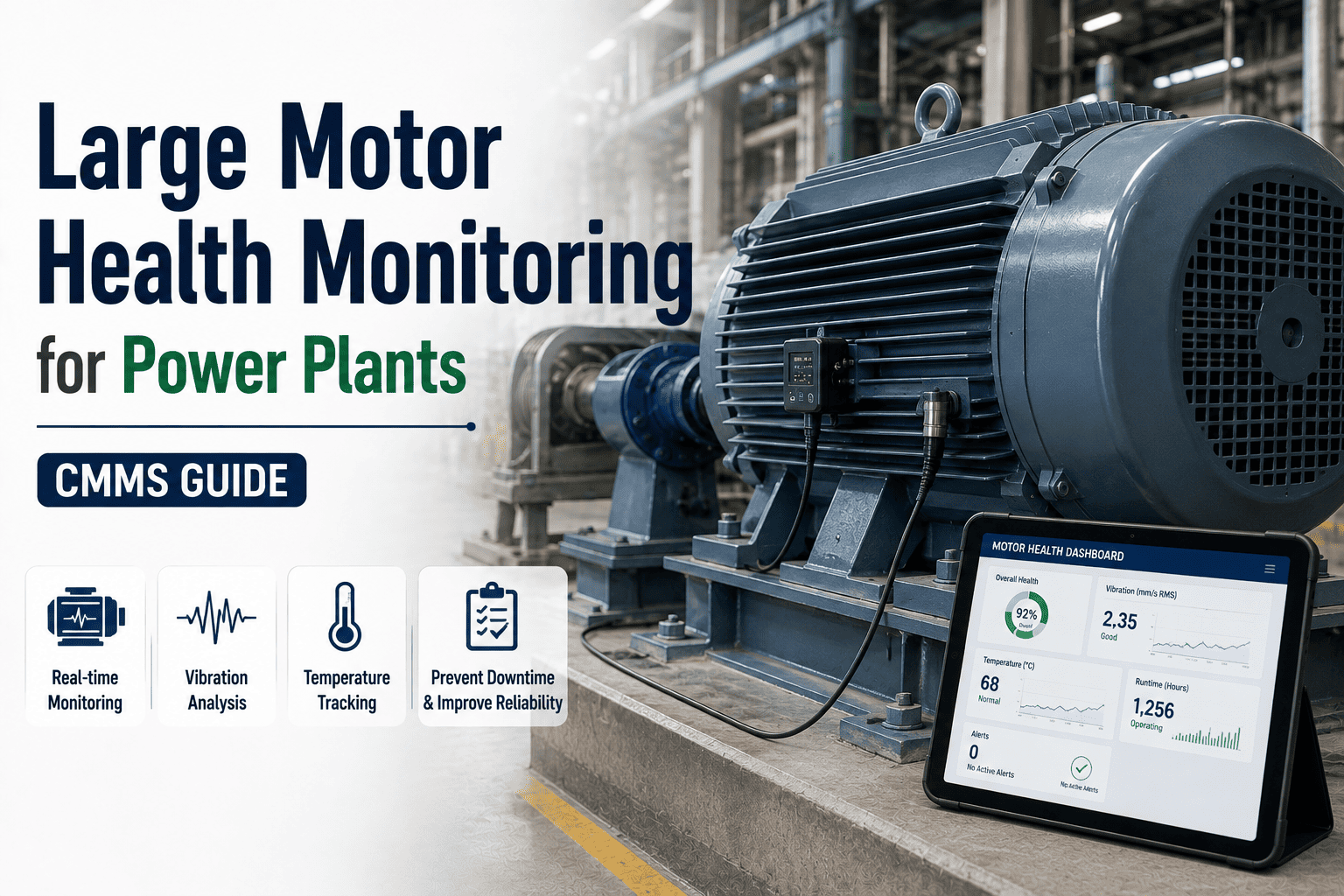
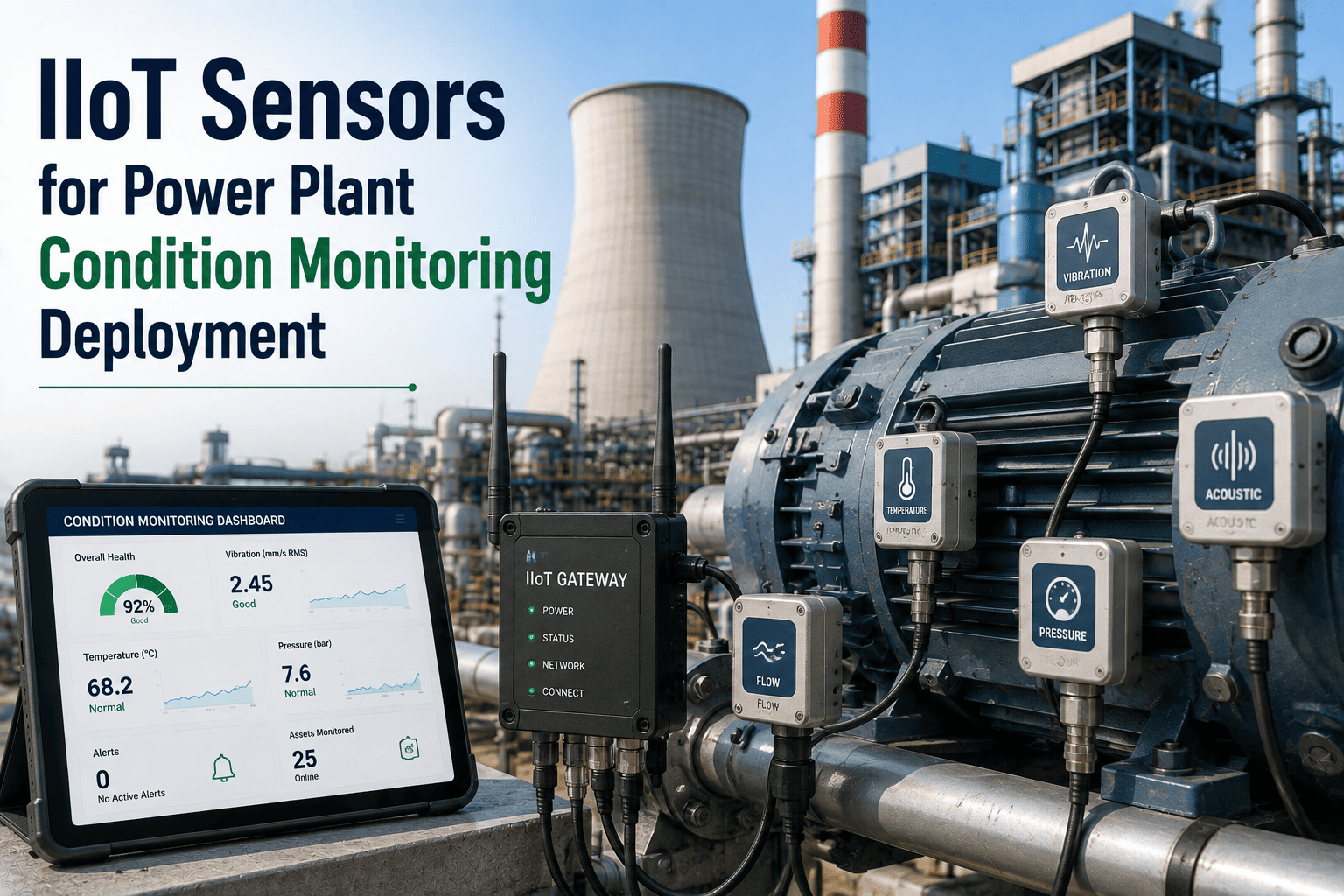
A power plant operating without IIoT sensors is essentially flying blind — maintenance crews walking rounds every 8 hours cannot detect the bearing degradation that develops in 90 minutes or the transformer thermal anomaly that accelerates overnight. Industrial IoT sensors connected to a modern CMMS eliminate that visibility gap, delivering continuous asset health data that triggers automated work orders before failures cost your plant six-figure outage events. Start a free trial with Oxmaint to see how IIoT-connected maintenance automation works across your full asset inventory, or book a 30-minute demo with a power generation specialist today.
Why IIoT Changes Everything
The Monitoring Gap That Manual Rounds Cannot Close
Traditional maintenance rounds cover a 500 MW plant's critical assets approximately 3 times per day. IIoT sensors cover the same assets 86,400 times per day. That difference in observation frequency is not incremental — it is the difference between catching a developing fault in its early stage and discovering it after the trip.
Manual Rounds
3×
Daily asset checks per critical asset
8-hour detection window
Human error exposure on every round
No data between inspections
Documentation completed after the fact
VS
IIoT Sensor Monitoring
86,400×
Daily data points per critical asset
Under 60-second anomaly detection
Consistent, bias-free measurement
Continuous trend and pattern data
Auto-timestamped, audit-ready records
40%
Reduction in unplanned downtime with IIoT-connected monitoring
70%
Of maintenance triggers automated — no manual initiation needed
$847K
Average annual savings per unit from automated condition monitoring
6 wk
Average early warning lead time before failure event detected
Sensor Types and Coverage
Six IIoT Sensor Categories That Cover Every Critical Asset Class
IIoT sensor deployment in power generation is not a single technology — it is a layered network of measurement modalities, each tuned to the failure modes of specific asset classes. Here is what a complete sensor architecture looks like across a thermal power plant.
Primary Assets
Steam turbines, gas turbines, generators, pumps, compressors, fans
Detects
Bearing defects, shaft imbalance, misalignment, looseness, gear mesh faults — typically 4–8 weeks before mechanical failure
Primary Assets
Transformers, switchgear, motor control centers, cable joints, busbars
Detects
Hotspot formation, connection resistance increase, insulation breakdown, overloaded circuits — critical for fire prevention in electrical infrastructure
Primary Assets
Valves, pressure vessels, steam traps, piping systems, boiler tubes
Detects
Compressed gas and steam leaks, partial discharge in high-voltage equipment, cavitation in pumps, early-stage valve seat degradation
Primary Assets
Turbine lube oil systems, transformer oil, hydraulic systems, gearboxes
Detects
Metal debris indicating wear, moisture contamination, viscosity degradation, oxidation — enabling condition-based oil change scheduling instead of fixed intervals
Primary Assets
Motors, generators, variable frequency drives, protection relays
Detects
Rotor bar cracks, stator winding faults, eccentricity, broken rotor bars — without physical access to the machine during normal operation
Primary Assets
Cooling towers, condensers, heat exchangers, flue gas systems, water treatment
Detects
Fouling buildup, cooling efficiency degradation, stack emission parameter drift, water quality deviations — feeds both maintenance and environmental compliance simultaneously
Connect Your IIoT Sensor Network to a CMMS That Acts on the Data
Oxmaint integrates with your existing sensor infrastructure — vibration, thermal, ultrasonic, and electrical — and converts condition alerts into automated work orders without manual intervention. Deployments are live in 8–12 weeks across your full asset inventory.
The Automation Chain
How IIoT Sensors Trigger Automated Maintenance — From Signal to Repair
The value of IIoT sensors is not the data they collect — it is what happens to that data in the milliseconds after collection. The automation chain from raw sensor signal to completed work order eliminates the human latency that turns detectable faults into unplanned outages.
01
Sensor Signal Acquisition
IIoT sensors transmit raw measurement data — vibration frequency spectra, temperature readings, electrical waveforms — via industrial protocols (MQTT, OPC-UA, Modbus) to an edge gateway or directly to a cloud historian. Sampling rates are configured per asset criticality, with high-criticality rotating equipment typically monitored at sub-second intervals.
↓
02
Edge Processing and Anomaly Detection
Edge computing modules run first-pass anomaly detection locally — before data reaches the cloud — enabling sub-second alert generation even in environments with intermittent connectivity. Statistical models trained on the asset's historical baseline flag deviations that fall outside normal operating envelopes, filtering noise from genuine fault signatures.
↓
03
Health Score Update and Threshold Evaluation
The APM platform updates the asset's live health score using the incoming condition data, cross-referenced against the asset's FMEA failure mode library. When a configurable threshold is crossed — whether a single parameter breach or a composite health score decline — the system moves automatically to the next stage without waiting for human review.
↓
04
Automated Work Order Generation and Crew Dispatch
A prioritized work order is automatically created in the CMMS — pre-populated with asset details, fault description, recommended inspection tasks, and required parts from the failure mode library. The work order is assigned to the qualified crew, notifications are pushed to mobile devices, and escalation timers begin. If the work order is not acknowledged within the configured window, the system escalates to supervisors automatically.
↓
05
Field Execution and Documentation Capture
Field engineers complete the work order on mobile — capturing findings, photos, meter readings, and GPS confirmation in the field app with full offline capability. All records are timestamped and inspector-attributed on completion, feeding back into the asset's health record and automatically satisfying documentation requirements for NERC, OSHA PSM, and environmental compliance frameworks.
Before and After
IIoT-Connected Maintenance vs Traditional Manual Operations
These operational benchmarks represent power generation facilities that transitioned from manual inspection rounds to IIoT sensor-connected CMMS operations. Results are measured at 12–18 months post-deployment.
| Operational Metric |
Manual Rounds (Before) |
IIoT-Connected (After) |
| Fault detection lead time |
Hours to days post-onset |
Minutes from onset, pre-failure |
| Daily asset health touchpoints |
2–4 manual checks per asset |
Continuous — 86,400+ per day |
| Work order initiation time |
4–12 hrs from fault discovery |
Automated — under 5 minutes |
| Unplanned outage frequency |
12–18 days downtime/unit/yr |
3–5 days downtime/unit/yr |
| Maintenance labor on rounds |
35–50% of field labor time |
Under 12% — redirected to repairs |
| Compliance documentation time |
18 staff-days per audit |
Under 4 staff-days per audit |
| False alarm / nuisance trip rate |
High — single-point threshold alerts |
Low — multi-parameter composite scoring |
| Asset life extension |
No active program |
+15–22% through condition-based care |
96%
PM compliance within 14 months
74%
Reduction in audit preparation time
3.2×
ROI within first 18 months of deployment
8 wk
Average deployment timeline to go-live
Implementation Pathway
How to Deploy IIoT-Connected Maintenance at Your Power Plant
A full IIoT sensor deployment does not need to happen in one phase. The highest-ROI approach starts with the assets where failure consequences — in lost generation, repair cost, or safety exposure — are highest, and expands from there as operational confidence builds.
Phase 1 — Weeks 1–3
Asset Criticality Mapping
Identify which assets carry the highest consequence of failure — turbines, main power transformers, boiler feed pumps, and generator step-up transformers typically lead this list. Prioritize sensor deployment on these assets first to maximize early ROI and demonstrate value to leadership before full fleet rollout.
Phase 2 — Weeks 2–5
Sensor Installation and Integration
Wireless IIoT sensors can be retrofit onto legacy assets without shutdowns for most mounting configurations. Edge gateways are configured for your plant's communication protocols, and data pipelines are connected to the Oxmaint APM platform via API — pulling historian data from existing SCADA infrastructure where sensors are already present.
Phase 3 — Weeks 4–8
Baseline Establishment and Threshold Configuration
Each asset builds a baseline signature over an initial operating period. FMEA-aligned alert thresholds are configured per asset class, with composite health scores calibrated against known failure mode patterns. This phase eliminates nuisance alarms before live condition monitoring goes fully operational — a step that separates reliable predictive systems from noisy ones.
Phase 4 — Week 8 onward
Automated Operations and Continuous Improvement
With automated work order generation live, maintenance teams shift from reactive dispatch to planned execution. Condition data accumulates over each operating cycle — improving model accuracy, extending alert lead times, and feeding capital planning decisions with actual remaining useful life data rather than engineering estimates.
Frequently Asked Questions
IIoT Sensors for Power Plant Maintenance: Common Questions
QCan IIoT sensors be installed on legacy power plant equipment without major shutdowns?
Yes — wireless IIoT sensor retrofit is specifically designed for legacy assets where hardwired instrumentation was never installed. Vibration, temperature, and ultrasonic sensors can be magnetically or adhesively mounted on most asset surfaces during normal operation, with battery-powered or energy-harvesting options available for locations without local power.
Book a demo with Oxmaint's deployment team to assess the retrofit feasibility for your specific asset classes — most thermal power plant equipment supports non-invasive sensor installation without outage windows.
QHow does the IIoT sensor network connect to an existing CMMS or SCADA system?
IIoT gateways communicate over standard industrial protocols — OPC-UA, MQTT, Modbus TCP, and REST API — allowing direct integration with existing plant historian, SCADA, and DCS platforms without replacing them. Oxmaint's APM layer sits above your existing systems, consuming sensor streams and historian data to generate automated maintenance triggers.
Start a free trial to explore the integration architecture for your current technology stack — deployment does not require decommissioning or replacing any existing plant systems.
QHow do IIoT-triggered maintenance records satisfy NERC CIP and OSHA PSM compliance requirements?
Every automated work order generated from an IIoT alert carries a full audit trail — sensor reading at time of trigger, alert threshold that was crossed, timestamp of work order creation, crew assignment, field findings captured on mobile, photo attachments, and digital sign-off. This chain of evidence satisfies NERC CIP traceable maintenance records and OSHA PSM mechanical integrity documentation requirements without separate reporting workflows.
Oxmaint's compliance export feature produces audit packages for 100+ assets in under 4 hours — documentation that previously required 18 staff-days of manual compilation.
QWhat is the typical ROI timeline for IIoT sensor deployment in a power generation facility?
Most facilities recover their full IIoT and APM platform investment from a single prevented major failure event — typically within the first 2–4 months of live operation. A single prevented turbine trip at a 500–1,000 MW plant saves $1.2–1.8 million in lost generation and emergency labor alone. Beyond failure prevention, facilities report 30–45% reductions in maintenance labor on manual rounds within six months, as automated condition monitoring frees field crews for planned repair execution.
Book a demo to model the ROI for your plant's specific capacity profile.
QHow does Oxmaint handle cybersecurity for IIoT sensor data in a NERC CIP environment?
IIoT sensor data in a power generation environment flows through a network architecture that is designed to comply with NERC CIP electronic security perimeter requirements — with sensor gateways positioned in defined network zones, data transmission encrypted at rest and in transit, and access controls aligned to NERC CIP-007 requirements.
A 30-minute session with Oxmaint's technical team covers the full network architecture and security documentation needed to satisfy your plant's CIP compliance program before deployment begins.
24/7 Asset Health Monitoring. Automated Work Orders. Zero Missed Failures.
Power plants running Oxmaint's IIoT-connected APM platform reach 96% PM compliance within 14 months, cut unplanned downtime by more than 70%, and produce audit-ready compliance documentation in under 4 hours per review cycle. Your sensor infrastructure is the starting point — deployment is live in under 12 weeks with no rip-and-replace of existing plant systems.