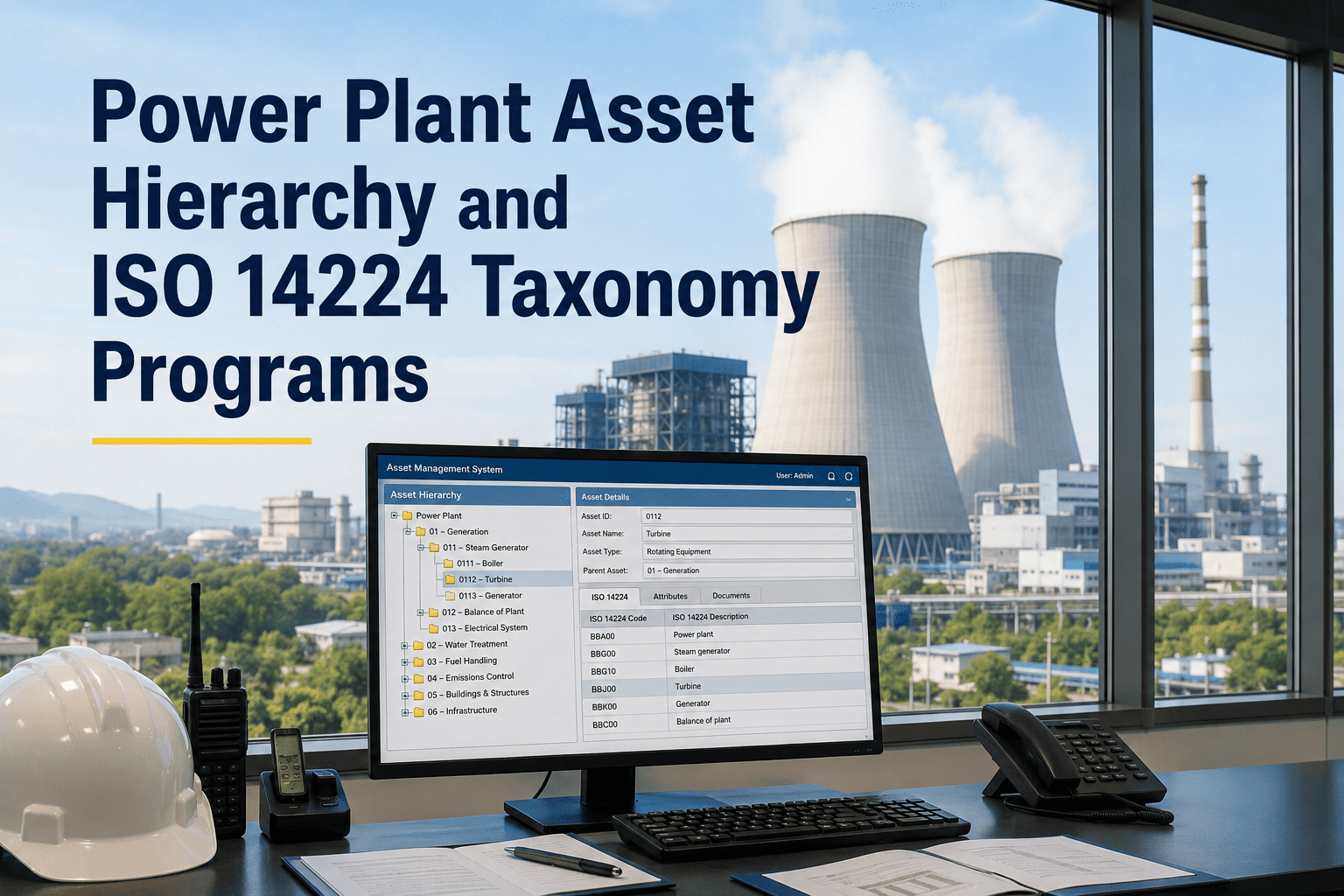
Every maintenance decision in a power plant sits on top of an asset hierarchy — whether that hierarchy is formally documented or exists only in the heads of senior engineers. When it is undocumented, reliability programmes stall: work orders cannot be tracked to the right equipment level, failure data cannot be aggregated meaningfully, and RAM models have no structural foundation to stand on. ISO 14224 gives power plant operators a globally recognised taxonomy — a five-tier equipment classification system that connects raw failure data to asset function, system boundary, and maintenance strategy. Implemented correctly and enforced through a properly configured CMMS, ISO 14224 transforms scattered maintenance records into structured reliability intelligence. This page explains how the five-tier hierarchy works, how to deploy it across a power plant asset register, and how to maintain data quality in a live CMMS environment. To see how OxMaint structures ISO 14224-compliant asset hierarchies for power generation clients, book a 30-minute demo or start a free trial today.
Power Plant Operations · Asset Management · ISO 14224
Power Plant Asset Hierarchy and ISO 14224 Taxonomy Programs
Without a structured asset hierarchy, your CMMS is collecting noise, not reliability data. ISO 14224 gives every piece of equipment a defined place in the taxonomy — so failure rates, RAM models, and maintenance strategies are built on data that actually means something.
Why Asset Hierarchy Failures Cost More Than People Expect
88%
of plants outsource some maintenance because they cannot locate the institutional knowledge they need — a direct consequence of undocumented asset hierarchy
14%
average rate of correctly entered asset data in CMMS systems across manufacturing and power — meaning 86% of the asset register is wrong, incomplete, or missing
3x
longer failure investigation time when asset hierarchy is flat or inconsistent — engineers cannot isolate the failure to a system boundary without structured parent-child relationships
70%
of companies do not know when their equipment is actually due for service — the direct result of PM schedules not being tied to a structured asset register
ISO 14224 Framework
The Five-Tier ISO 14224 Asset Hierarchy — How It Applies to Power Plants
ISO 14224 defines a taxonomy for collecting reliability and maintenance data across the petroleum, natural gas, and energy industries. The standard establishes five hierarchical levels — from the plant as a whole down to the maintainable component — and specifies the failure data that should be collected at each level. Here is how each tier applies in a power generation context.
Tier 1
Business Category / Plant
Example: Gas Power Station, Combined Cycle Power Plant, Hydro Facility
The highest level in the hierarchy — defines the operating unit for which overall availability, production efficiency, and risk are measured. RAM studies at this level answer: what is the expected annual energy output and what are the dominant contributors to generation shortfall?
Tier 2
Installation / Unit
Example: Unit 1 Gas Turbine Train, Unit 2 Steam Turbine, Auxiliary Power Unit
Defines discrete generating or process trains within the plant. Availability and reliability KPIs — Equivalent Forced Outage Rate (EFOR), Equivalent Availability Factor (EAF) — are typically calculated at this level. Unit-level hierarchy is the anchor point for capacity planning and outage scheduling.
Example: Fuel Gas System, Cooling Water System, Lube Oil System, Generator Excitation
Systems are functional groupings of equipment that together perform a defined process function. System boundaries are the foundation of FMEA and RAM modelling — a lube oil system failure that causes a forced outage should roll up to the unit availability, not disappear into a generic "mechanical" category. ISO 14224 defines approximately 30 standard system categories for power generation.
Tier 4
Equipment Class / Tag
Example: GT-101 (Gas Turbine Compressor), P-201A (Lube Oil Pump), HX-301 (Lube Oil Cooler)
Individual equipment items — each with a unique tag number, equipment class, and maintainable boundary. This is where CMMS work orders, PM schedules, spare parts, and failure records are attached. ISO 14224 specifies standard equipment classes (centrifugal pumps, heat exchangers, compressors, turbines) with associated failure mode taxonomies for each class. Consistency in equipment class naming across the fleet is what enables cross-plant benchmarking.
Tier 5
Maintainable Item / Component
Example: Bearing Assembly, Mechanical Seal, Impeller, Control Valve Actuator
The lowest level of the hierarchy — specific components within an equipment item that can be independently inspected, repaired, or replaced. Failure modes are recorded at the component level. This granularity enables root cause analysis that distinguishes between bearing failure, seal failure, and impeller erosion on the same pump — critical for reliability-centred maintenance prioritisation.
OxMaint Asset Hierarchy Builder
Build an ISO 14224-Compliant Asset Register in Days, Not Months
OxMaint ships with a configurable five-tier asset hierarchy template pre-mapped to ISO 14224 equipment classes for power generation. Import your existing equipment list, assign system boundaries, attach PM schedules and spare parts, and start collecting structured failure data from the first work order — without a six-month CMMS configuration project.
Implementation
Deploying the Five-Tier Hierarchy in a Live Power Plant CMMS
The hierarchy structure is the easy part. The hard part is migrating existing asset data — scattered across Excel files, OEM documentation, and printed P&IDs — into a consistent, searchable, and correctly linked CMMS record. These are the four stages of a successful deployment.
Phase 1
Asset Identification and Boundary Definition
Walk the plant with P&IDs and equipment lists. Define system boundaries — which pumps belong to the lube oil system versus the hydraulic system. Tag every maintainable item with a unique ID following a consistent naming convention. Rule: if it can be independently worked on, it needs its own tag and CMMS record. This phase typically takes 2–4 weeks for a combined cycle plant and should involve both maintenance and operations leads to ensure operational function is correctly reflected.
Phase 2
ISO 14224 Equipment Class Assignment
Assign every Tier 4 equipment tag to the correct ISO 14224 equipment class — centrifugal pump, reciprocating compressor, shell-and-tube heat exchanger, and so on. The equipment class drives which failure mode taxonomy the CMMS will use for work order coding. Inconsistent class assignment is the single biggest cause of unusable reliability data — a pump tagged as a compressor will never appear in pump failure rate benchmarks. Use the ISO 14224 Annex A equipment class list as the authoritative reference.
Phase 3
PM Schedule Attachment and Criticality Ranking
Attach PM schedules to each equipment tag at Tier 4. Assign a criticality rank — typically A (safety/availability critical), B (production impact), C (non-critical) — using a structured criticality matrix that considers consequence of failure, detectability, and redundancy. Criticality rank determines PM strategy: A-ranked assets receive condition-based or predictive monitoring; C-ranked assets can run to failure. OxMaint stores criticality rank as an asset field, driving automatic PM frequency recommendations.
Phase 4
Data Quality Governance and Ongoing Audit
An ISO 14224 programme degrades without governance. Assign a data owner for each system boundary — typically the system engineer or reliability lead. Conduct quarterly CMMS audits: verify that new equipment additions have been correctly classified, that work orders are being closed with failure codes, and that spare parts are linked to the correct asset tags. OxMaint's audit reports flag orphaned work orders, assets without PM schedules, and failure codes that are missing or incorrect.
Failure Mode Taxonomy
ISO 14224 Failure Mode Coding — The Data That Makes RAM Models Work
ISO 14224 specifies a structured failure mode taxonomy for each equipment class. When work orders are closed with ISO 14224 failure codes, the resulting dataset can be used directly in reliability block diagrams and RAM models. The table below shows the standard failure mode structure for two common power plant equipment classes.
| Equipment Class |
Failure Mode |
Failure Mechanism (Examples) |
Detection Method |
RAM Impact |
| Centrifugal Pump |
Vibration — high |
Bearing wear, misalignment, cavitation, imbalance |
Online vibration monitoring, periodic route |
Forced derating if lube oil pump; process impact if cooling water |
| Centrifugal Pump |
Leakage — external |
Mechanical seal degradation, gasket failure, corrosion |
Visual inspection, lube oil level trending |
Environmental event; potential forced outage if seal loss leads to pump failure |
| Gas Turbine Compressor |
Fouling — internal |
Salt, dust, and hydrocarbon deposition on compressor blades |
Inlet dP trending, compressor efficiency monitoring |
Gradual output derating; 1–3% efficiency loss before correction |
| Gas Turbine Compressor |
Structural failure |
Blade erosion, FOD ingestion, corrosion fatigue |
Borescope inspection, exhaust temperature spread |
Catastrophic forced outage; high EFOR contribution |
| Heat Exchanger |
Fouling — tube-side |
Scale deposition, biological growth, corrosion product buildup |
Approach temperature trending, pressure drop increase |
Cooling capacity degradation; cascading thermal issues |
| Heat Exchanger |
Leakage — tube to shell |
Tube erosion, galvanic corrosion, thermal fatigue cracking |
Water-in-oil analysis, shell-side sampling |
Contamination event; potential unit trip |
RAM Analysis Foundation
How a Five-Tier Hierarchy Enables Credible RAM Modelling
Reliability, Availability, and Maintainability (RAM) analysis answers the questions that matter to plant owners: what is the expected annual generation output, what is the probability of unplanned forced outage in any given month, and where should reliability investment be directed? But a RAM model is only as credible as the failure rate data it is built on — and that data requires a correctly structured asset hierarchy.
Failure Rate Data Source
ISO 14224 failure rate databases — including the OREDA handbook — provide industry-average failure rates for each equipment class. These are starting-point values. Plants with 3 or more years of correctly coded failure data in their CMMS should calibrate RAM models to their own fleet data, as site-specific operating conditions often produce failure rates that deviate significantly from industry averages. OxMaint exports CMMS failure data in ISO 14224 format for direct import into RAM modelling tools.
System Boundary Definition
RAM models represent equipment as blocks in a reliability block diagram (RBD). The system boundaries defined at Tier 3 of the hierarchy determine which equipment items are in series (one failure causes system loss) versus in parallel (redundancy available). Incorrect system boundaries — a common problem when Tier 3 is skipped or poorly defined — produce RAM models that overestimate availability by ignoring hidden serial dependencies between supposedly redundant systems.
Maintenance Strategy Validation
Once a RAM model is calibrated, maintenance strategy changes can be simulated before implementation. Extending a PM interval from 6 months to 12 months on a Tier 4 compressor increases its modelled failure rate — the RAM model quantifies the resulting change in unit EFOR and annual generation shortfall. This gives maintenance leaders a defensible, data-driven argument for PM budgets and frequencies rather than relying on OEM recommendations that may not reflect actual plant operating conditions.
Frequently Asked Questions
ISO 14224 and Power Plant Asset Hierarchy — Common Questions
Does ISO 14224 apply to all power plant types or only oil and gas facilities?
ISO 14224 was originally written for petroleum and natural gas facilities, but its equipment taxonomy and failure mode structure apply directly to gas turbine, steam turbine, combined cycle, and auxiliary power plant equipment. Many power generators adopt ISO 14224 as their reliability data standard because the equipment classes — centrifugal pumps, compressors, heat exchangers, control valves — are identical.
OxMaint supports ISO 14224 taxonomy for all power plant types.
How long does it take to build a five-tier hierarchy for a combined cycle power plant?
A typical combined cycle plant (2 gas turbines, 1 steam turbine, heat recovery systems) has 800–1,500 maintainable items at Tier 4. With structured templates and a pre-mapped ISO 14224 equipment class list, experienced CMMS teams can complete the hierarchy build in 4–8 weeks. The critical path is obtaining accurate P&IDs and resolving naming convention conflicts between operations and maintenance teams — not the data entry itself.
Book a demo to see OxMaint's hierarchy import workflow.
What is the difference between ISO 14224 taxonomy and a general CMMS asset register?
A general CMMS asset register is typically a flat list of equipment with a tag number and description — enough to raise work orders, not enough to support RAM analysis or cross-fleet benchmarking. ISO 14224 adds standardised equipment class codes, a five-tier parent-child structure, and a defined failure mode taxonomy that makes failure data comparable across plants and over time. Without that standardisation, CMMS data cannot be aggregated into meaningful reliability statistics.
Can OxMaint integrate ISO 14224 asset data with ERP and SCADA systems?
Yes. OxMaint connects to ERP, SCADA, and MES platforms via API, mapping ISO 14224 asset tags to ERP material master numbers and SCADA tag names. This eliminates duplicate data entry and ensures that CMMS work orders, spare parts transactions, and sensor-triggered alerts all reference the same asset hierarchy. Integration scope is confirmed during the implementation review.
How do we maintain ISO 14224 data quality as the plant evolves and new equipment is added?
Data quality requires governance, not just initial configuration. Assign system data owners responsible for classifying new equipment before it enters service. OxMaint flags newly created asset records that are missing equipment class, criticality rank, or linked PM schedule — blocking incomplete records from accepting work orders. Quarterly data audits using OxMaint's compliance report catch classification drift before it corrupts the failure rate dataset.
Start a free trial to see the governance tools.
OxMaint · Power Plant Asset Management
Give Your Reliability Programme the Foundation It Needs — a Correct Asset Register
Every FMEA, every RAM model, every KPI dashboard, and every maintenance strategy decision rests on the quality of your asset hierarchy. OxMaint brings ISO 14224-compatible structure, pre-built equipment class templates for power generation, and the governance tools to keep data quality from degrading over time — so your reliability data reflects reality, not the chaos of the initial CMMS setup.