Walk into ten different power plants and ask what their "reliability engineer" actually does all day, and you will get ten different answers — in far too many of them, the honest answer is data entry, parts chasing, and covering for an overloaded maintenance planner. That is not reliability engineering; it is firefighting with a better job title. The actual discipline is narrower and more powerful than most plants treat it: systematically finding why assets fail and removing the cause, using a small set of well-established frameworks, a defined set of KPIs, and condition monitoring data that feeds decisions instead of just filling a dashboard. This handbook lays out what the role is actually for, the three frameworks every reliability engineer should master, the KPIs that prove the work is paying off, and the career path that leads into it. See how OxMaint's Reliability Analytics gives reliability engineers the failure data and KPI tracking this role actually depends on.
Handbook · Reliability Engineering · Reliability Analytics
Power Plant Reliability Engineer Handbook
85%+
OEE achieved by world-class plant reliability programs
<20%
Reactive work ratio in a mature, well-run reliability program
3
Core frameworks every reliability engineer should master
A working reference for reliability engineers, maintenance managers, and anyone building a reliability function from scratch — covering the role, the frameworks, the KPIs, and the career path.
Role Definition
What a Reliability Engineer Actually Does — and Doesn't Do
The role gets diluted constantly because reliability engineers are skilled, available, and sit close to the action. Protecting the scope below is what separates a real reliability function from a maintenance planner with a different title.
Core to the Role
Conducting FMEA on critical assets to identify and prioritize failure modes
Leading root cause failure analysis on significant or repeat failures
Developing and optimizing PM/PdM strategies from actual failure data
Analyzing MTBF trends to identify bad actors and drive improvement
Managing the RCM process for the facility's critical asset classes
Not the Role
Routine work order data entry and CMMS housekeeping
Chasing spare parts for today's job
Day-to-day PM scheduling and technician dispatch
Daily firefighting and reactive breakdown response
Acting as default IT support for the CMMS platform
The Toolkit
The Three Core Frameworks
Most mature reliability programs combine all three of these, applying the right one to the right situation rather than treating any single framework as a complete methodology on its own.
| Framework |
Question It Answers |
Typical Output |
| RCM (Reliability Centered Maintenance) |
What maintenance does this asset actually need to keep doing its job? |
A documented maintenance strategy per asset or function |
| FMEA (Failure Modes & Effects Analysis) |
What could fail, how, and how severe would the consequence be? |
A ranked list of failure modes by severity and likelihood |
| RCA / RCFA (Root Cause Analysis) |
Why did this specific failure actually happen? |
A documented root cause and corrective action plan |
Condition Monitoring
The Predictive Maintenance Toolkit
These techniques are how reliability engineers turn "we think this might fail" into "this will fail in roughly six weeks if nothing changes."
OxMaint's Reliability Analytics pulls FMEA rankings, failure history, and condition data into one place — so reliability engineers spend their time on analysis, not chasing data across five different tools.
The Scoreboard
The KPI Dashboard Every Reliability Engineer Should Track
These six metrics, tracked together rather than in isolation, tell you whether a reliability program is actually improving or just generating activity.
MTBF Trend
Target: Sustained Upward Trend
Track direction, not just the number — a rising MTBF on a specific asset class is the clearest sign a reliability program is actually working.
MTTR
Target: As Low as Planning Allows
How fast the team recovers once something does fail — driven by planning quality and parts availability as much as technical skill.
OEE
Target: 85%+ in World-Class Programs
Combines availability, performance, and quality into a single score that summarizes overall equipment effectiveness.
Reactive Work Ratio
Target: Below 20%
The share of total maintenance hours spent on unplanned work — the single clearest signal of how proactive a program really is.
Maintenance Cost % of RAV
Target: Below 2.5%
Annual maintenance spend measured against the replacement value of the asset base — a key cost-efficiency benchmark.
PM Compliance
Target: Consistently Above 90%
The share of scheduled preventive tasks completed on time, and the foundation every other KPI on this list depends on.
Prioritization
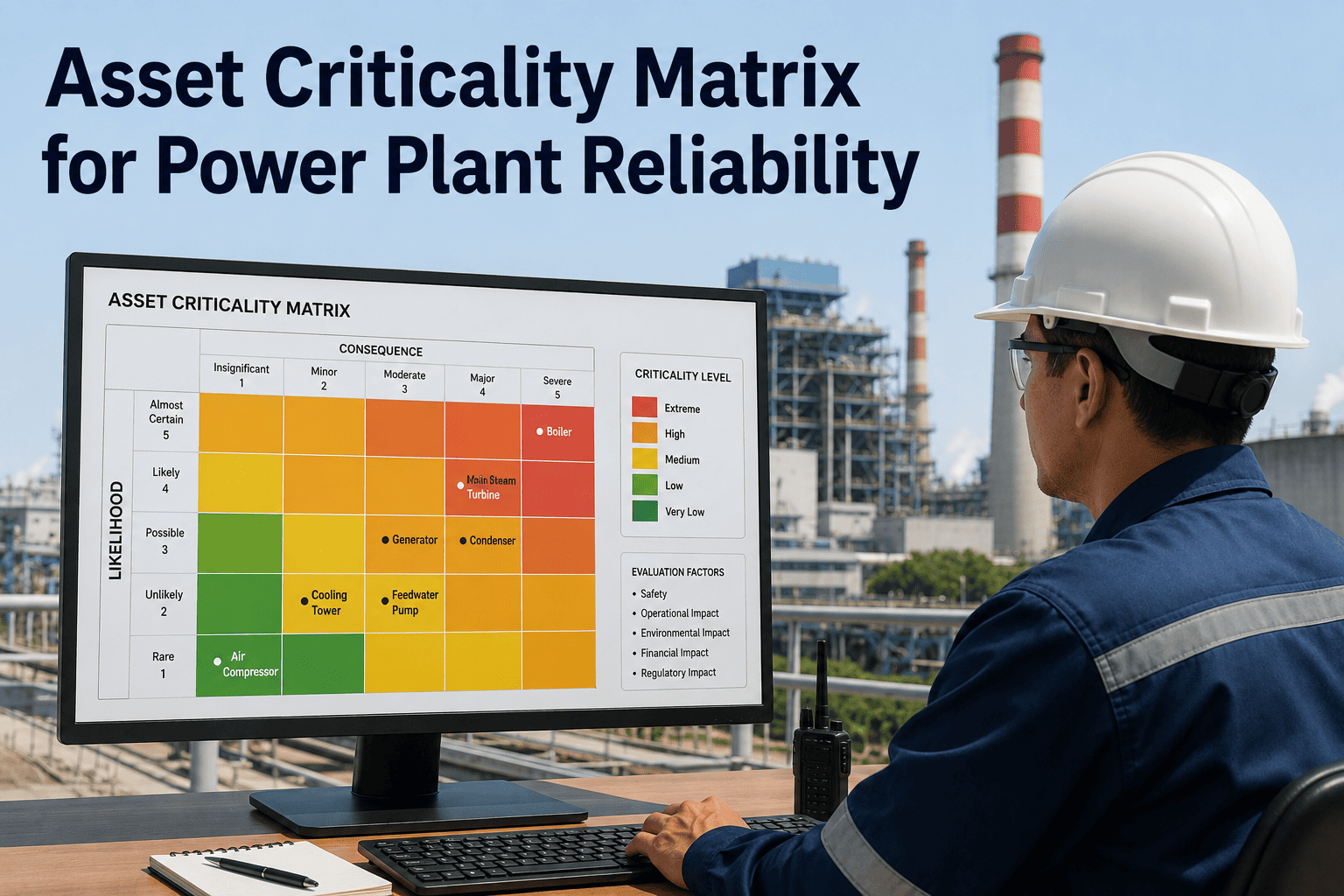
Asset Criticality Scoring
Before applying any framework above, reliability engineers score assets across these five dimensions to decide where the analytical effort actually belongs.
| Dimension |
Low Score (1) |
High Score (5) |
| Safety Consequence |
No credible safety impact if the asset fails |
Failure could cause serious injury or fatality |
| Production Impact |
Fully redundant, no output loss |
Single point of failure for the entire unit |
| Repair Cost |
Minor, low-cost repair |
Major capital repair or full replacement |
| Parts Lead Time |
Spares on the shelf, available same day |
Custom-fabricated, multi-month lead time |
| Redundancy Availability |
Multiple backup units online |
Zero backup — the only unit in service |
Career Path
From Technician to Reliability Manager
Reliability engineering is rarely an entry-level title — it is a destination most people reach after time on the tools.
01
Maintenance Technician
Hands-on equipment experience — the foundation every reliability engineer needs before moving into analysis.
02
Reliability Engineer
Owns FMEA, RCA, and RCM for an asset group — the core analytical role this handbook focuses on.
03
Senior / Lead Reliability Engineer
Owns reliability strategy across multiple asset classes or sites, often holding a CMRP or CRE certification.
04
Reliability Manager
Sets reliability KPIs and budget at the plant or fleet level, translating technical improvements into results leadership cares about.
“
The plants that get the most value from a reliability engineer are the ones that protect the role from the maintenance department's daily fires. The moment a reliability engineer starts spending their week chasing parts or covering a planner's schedule, the FMEAs stop getting written, the RCAs stop getting closed out, and the role quietly turns back into another maintenance coordinator. Protecting that scope is a management decision, not an engineering one — but it is the single biggest factor in whether a reliability program ever actually pays for itself.
Reliability Engineering Practice Lead
CMRP-Certified · 18+ Years Building Reliability Functions in Power Generation · RCM & FMEA Program Design Specialist
Frequently Asked Questions
What's the actual difference between a maintenance engineer and a reliability engineer?
A maintenance engineer is typically focused on keeping the current maintenance program running — scheduling, planning, and execution. A reliability engineer is focused specifically on why assets fail and how to eliminate the cause, using frameworks like FMEA, RCA, and RCM, which is a narrower and more analytical scope than general maintenance engineering.
See how OxMaint separates reliability analytics from day-to-day maintenance scheduling.
Do I need a CMRP or CRE certification to work as a reliability engineer?
It isn't strictly required to enter the field, but certifications like the Certified Maintenance & Reliability Professional (CMRP) or Certified Reliability Engineer (CRE) are widely recognized by employers and are frequently used to fast-track candidates during hiring, particularly for senior or lead-level roles.
Which framework should a new reliability engineer learn first — RCM, FMEA, or RCA?
Most practitioners start with FMEA, since it builds the failure-mode thinking that underpins both RCM and RCA, and it can be applied to a single critical asset without needing a full program in place first. RCA tends to come naturally on the job once a significant failure demands investigation, while RCM is usually adopted once a broader asset care strategy needs to be formalized.
Book a demo to see how OxMaint structures FMEA data for new reliability programs.
What does a "good" OEE or MTBF number actually look like in practice?
OEE above roughly 85% is generally considered world-class, while a "good" MTBF is asset-specific and is best judged by its trend over time rather than an absolute number — a steadily rising MTBF on a previously troublesome asset class is a stronger signal of program health than any single snapshot figure.
How does a CMMS like OxMaint actually support a reliability engineer's day-to-day work?
Reliability Analytics · OxMaint · Reliability Engineering
Give Your Reliability Engineers the Data Their Job Actually Requires.
OxMaint's Reliability Analytics centralizes failure history, FMEA rankings, condition data, and KPI tracking — so your reliability engineers can spend their time eliminating failures instead of assembling spreadsheets.