At 2:47 AM on a Tuesday, a bearing in your gas turbine fails. By the time your operations team diagnoses the problem and coordinates emergency repairs, eighteen hours have passed. The direct repair costs: $85,000. But the real damage happened while you were scrambling. Lost generation revenue during peak pricing: $540,000. Emergency parts expedited overnight: $32,000 premium. Grid penalty for failing to meet capacity commitment: $175,000. Customer compensation claims: still being calculated. One bearing. One failure that vibration monitoring would have caught three weeks earlier. Total impact exceeding $800,000—and that's before calculating the ripple effects on your quarterly performance metrics and regulatory standing.
Siemens' 2024 True Cost of Downtime report revealed that unplanned downtime costs the world's 500 largest companies $1.4 trillion annually—11% of their total revenues. For power generation facilities specifically, the numbers are even more devastating. One hour of downtime at an electric utility costs over $300,000. A typical 5.8-hour outage translates to $1.7 million in direct losses. And that's before accounting for the hidden costs that don't show up until the quarterly review.
The Four Layers of Downtime Costs
Most plant managers understand lost production. Fewer recognize the full cascade of financial damage that extends far beyond the megawatt-hours not generated. Understanding these four distinct cost layers is essential for building a business case for reliability investments. Power plants that sign up for modern CMMS platforms gain visibility into all four layers, transforming vague cost estimates into actionable intelligence.
What's Actually Causing Your Downtime?
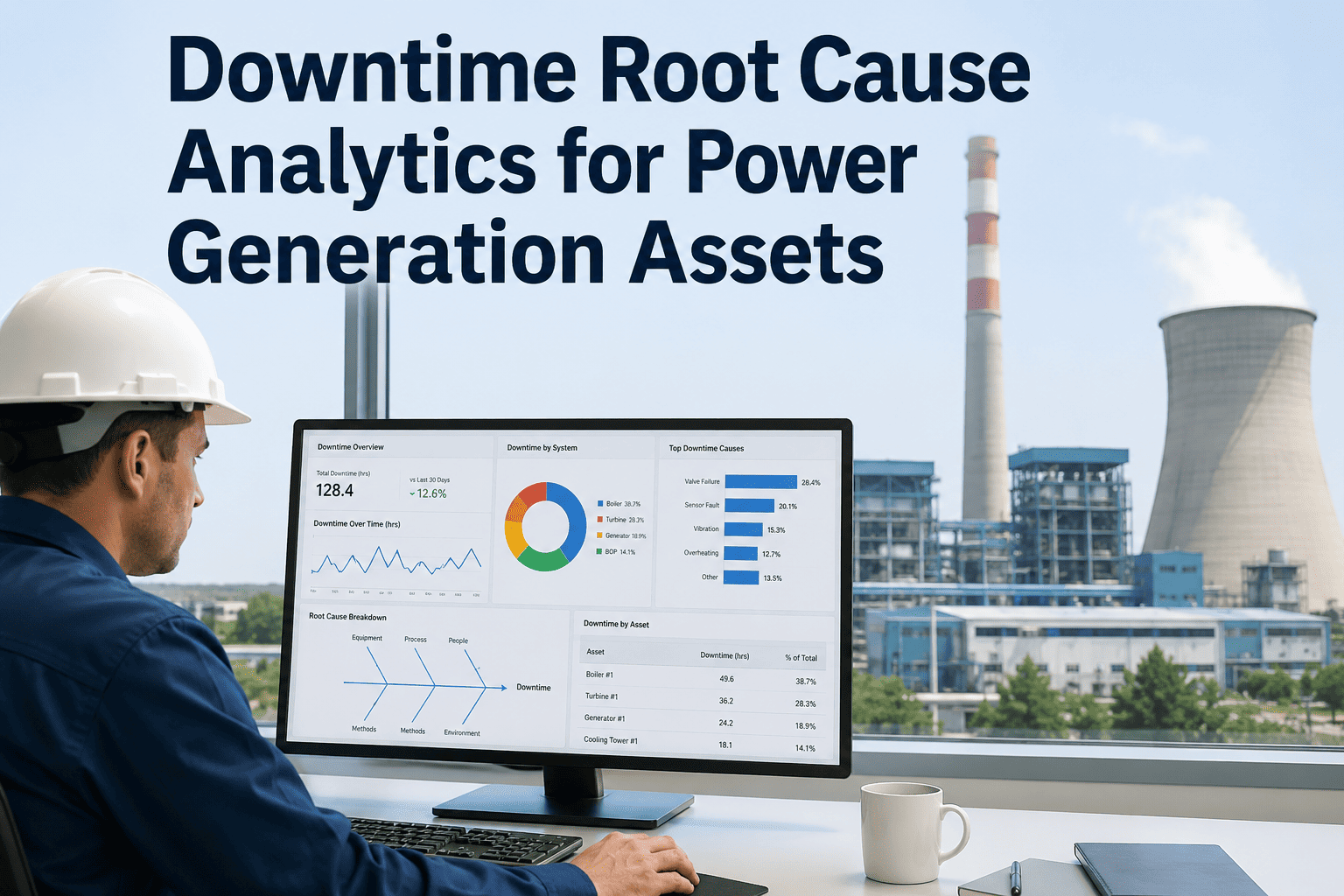
Data from the National Energy Technology Laboratory and FM Global insurance claims reveals a clear pattern: the same equipment categories fail repeatedly across the fleet. Turbines account for 43% of all power plant equipment failures, followed by generators at 14% and transformers at 11%. More than half of forced outages at coal plants stem from boiler tube leaks. These aren't random events—they're predictable failures that announce themselves weeks in advance through vibration signatures, thermal anomalies and performance degradation patterns.
The mechanical failures that drive these statistics—bearing wear, blade fatigue, tube corrosion, insulation breakdown—all produce detectable warning signs well before catastrophic failure. Plants that book a demo to see predictive monitoring in action discover that most of their "unexpected" failures were actually preventable with the right data visibility.
The Compounding Effect: Why Costs Keep Rising
Despite improvements in technology, the average cost of downtime has nearly doubled since 2019. The reasons are structural: goods cost more, so the value of production lost during downtime is greater. Plants operate at higher capacity utilization, leaving less slack to make up for lost time. Energy prices are more volatile, meaning outages during peak demand periods carry exponentially higher costs. And supply chain disruptions have extended lead times for critical replacement parts from weeks to months.
Expert Perspective: Shifting from Reactive to Predictive
The math is straightforward: corrective maintenance after equipment fails costs $17-18 per horsepower annually. Predictive and preventive maintenance together costs $7-13 per horsepower. For facilities with hundreds of thousands of horsepower in rotating equipment, that's millions in annual savings. But the real value isn't just cost reduction—it's the elimination of those catastrophic, reputation-damaging failures that cascade through your operations and your quarterly results.
The power plants succeeding with reliability-centered maintenance share common characteristics: they've moved beyond run-to-failure strategies, connected their monitoring systems to CMMS platforms that automate response workflows, and built data-driven visibility into equipment health. They're not analyzing spreadsheets after failures—they're receiving actionable alerts before problems become outages. Plants ready to explore this transition can sign up for a free platform trial to experience the difference firsthand.
The Path Forward: Converting Cost Centers to Competitive Advantage
The facilities that thrive in the coming decade will be those that treat downtime prevention as a strategic investment rather than an operational expense. NextEra Energy's gas-turbine program delivered a 23% outage reduction and $25 million in annual savings. IBM documented $7.5 million in savings at a single power generation facility through predictive analytics. These aren't pilot projects—they're proven, scaled implementations that demonstrate the ROI available to plants willing to invest in reliability.
The technology exists. The business case is clear. The question is whether your facility will capture these benefits or continue paying the premium for reactive maintenance. Schedule a free consultation to discuss how predictive maintenance could impact your specific operational and financial metrics.