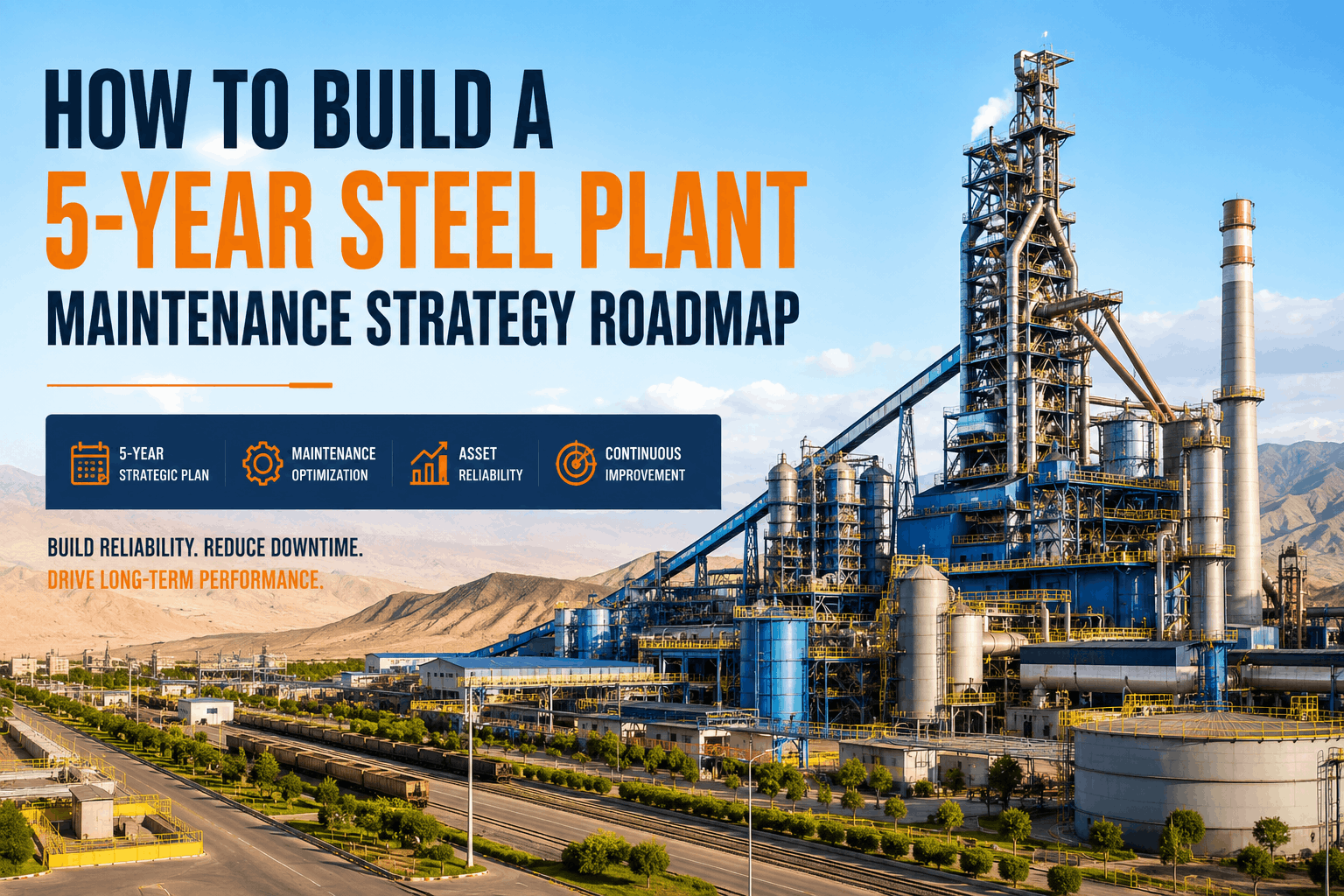
How to Build a 5-Year Steel Plant Maintenance Strategy Roadmap

By Alex Jordan on June 30, 2026

5-year-steel-plant-maintenance-strategy-roadmap

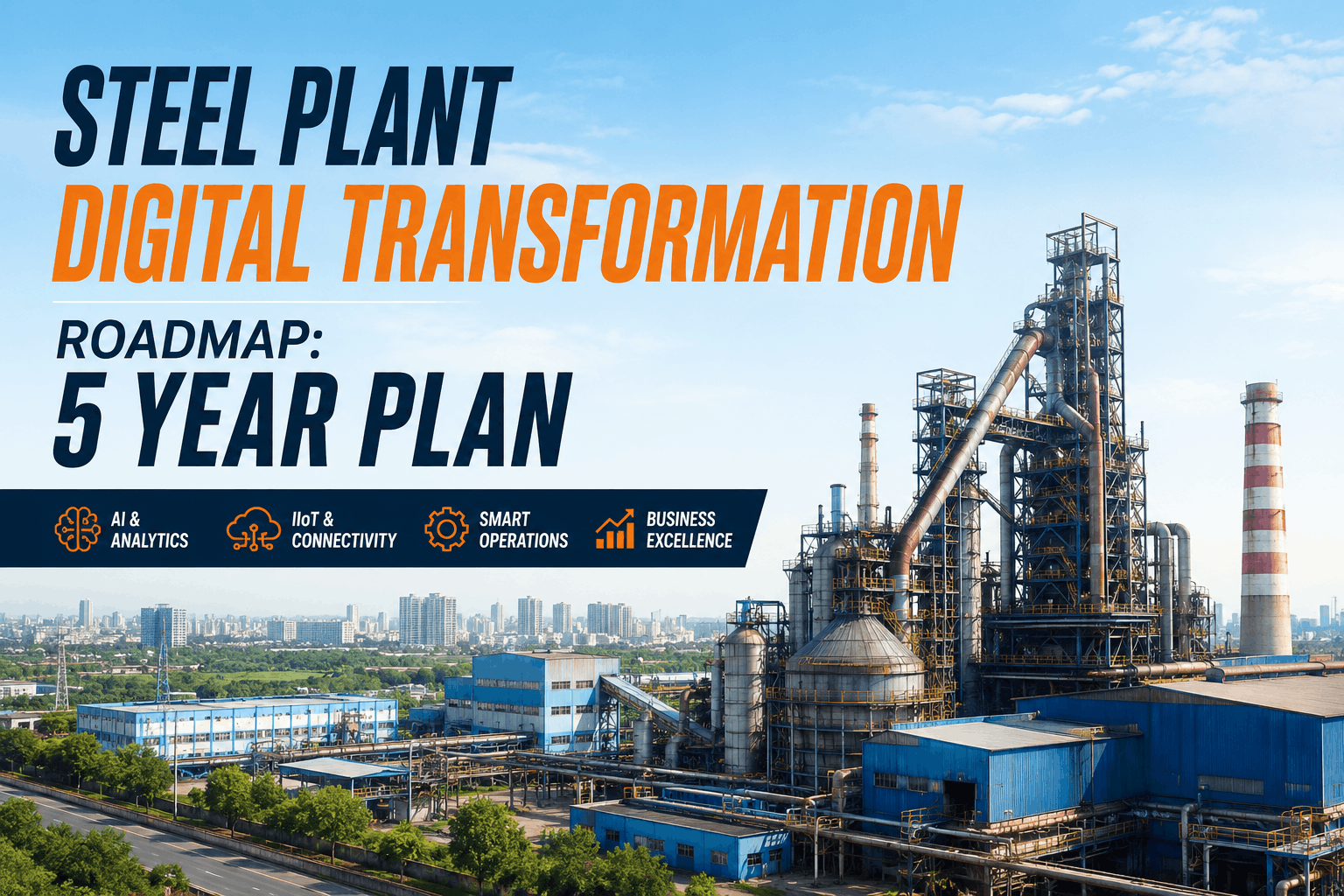
Most USA steel plants operate maintenance organizations with reactive postures — technicians respond to failures as they occur, parts are ordered after equipment breaks down, and capital budgets are allocated reactively to emergency repairs rather than strategically toward reliability investments. A structured 5-year maintenance strategy roadmap transforms this reactive model into a predictive, data-driven operation by establishing clear maturity milestones: Year 1 focuses on standardizing work processes and establishing predictive monitoring baselines; Year 2 implements condition-based work scheduling and integrates CMMS data with capital planning; Years 3–5 deploy advanced analytics, machine learning-based failure prediction, and supply chain optimization. Steel mills executing strategic 5-year maintenance transformation programs report 15–25% reduction in maintenance costs, 30–40% improvement in equipment availability, and USD 4–8 million annual savings through deferred capital relines and eliminated unplanned shutdowns.

OxMaint · Maintenance Strategy · 5-Year Transformation Roadmap
Build a 5-Year Steel Plant Maintenance Strategy: From Reactive Fire-Fighting to Predictive Excellence
Strategic roadmap planning, predictive monitoring deployment, supply chain optimization, and workforce capability building — all integrated into a measurable 5-year transformation program with defined milestones and accountability metrics.
15–25%
Total maintenance cost reduction through 5-year strategic transformation

30–40%
Equipment availability improvement from baseline reactive operations

USD 4–8M
Annual savings through capital deferral and eliminated unplanned shutdowns

60 Months
Structured transformation timeline with defined quarterly milestones and checkpoints

Why USA Steel Plants Need Strategic Maintenance Planning: Escaping the Reactive Maintenance Trap

A typical integrated steel mill allocates 65–75% of annual maintenance budget to emergency repairs and unplanned downtime response — work that generates minimal reliability improvement. The remaining 25–35% is scattered across preventive tasks with unclear priorities, minimal data-driven justification, and inconsistent execution across shifts and locations. This reactive posture persists because senior plant leadership often perceive maintenance as a cost center (rather than a capital protection function) and fail to establish accountability metrics connecting maintenance strategy to production reliability and profitability. Strategic maintenance planning inverts this calculus by setting explicit, board-level reliability targets (e.g., "achieve 90% overall equipment effectiveness by Year 3"), allocating capital strategically toward high-impact monitoring and redundancy investments, and holding operations and maintenance leadership jointly accountable for hitting targets. A USA integrated steel mill (1,800 tpd capacity) implemented a structured 5-year maintenance strategy in 2019 by: (1) establishing a cross-functional maintenance strategy committee, (2) deploying condition-based monitoring on 150+ critical assets, (3) implementing predictive maintenance for blast furnaces and hot mills, (4) standardizing spare parts inventory management via integration with ERP systems, and (5) training a dedicated predictive maintenance engineering team. By Year 3, the mill had achieved 88% OEE (up from 76% baseline), reduced unplanned shutdowns by 58%, and deferred USD 12 million in capital reline projects — ROI on the 5-year strategy investment exceeded 400%. Schedule a strategic planning session to assess your current maintenance maturity and build a customized 5-year roadmap.

MAINTENANCE MATURITY PROGRESSION — 5-YEAR TRANSFORMATION FRAMEWORK
Level 1: REACTIVE
Crisis response: fix equipment only after failure. No planning, minimal data, high emergency costs.
• OEE: 60–70%
• Unplanned downtime: 15–20% of production time
• Maintenance cost: 8–12% of revenue
Level 2: PREVENTIVE (Year 1–2)
Scheduled maintenance based on time intervals. CMMS deployed, work orders standardized, basic spare parts planning.
• OEE: 72–78%
• Unplanned downtime: 8–12% of production time
• Maintenance cost: 6–8% of revenue
Level 3: CONDITION-BASED (Year 2–3)
Monitoring-driven maintenance: temperature sensors, vibration analysis, motor current signature on critical assets. Work orders triggered by condition thresholds.
• OEE: 80–85%
• Unplanned downtime: 4–6% of production time
• Maintenance cost: 4–6% of revenue
Level 4: PREDICTIVE (Year 3–4)
Advanced analytics: machine learning models forecast failures 6–12 weeks in advance. Spare parts pre-positioned, replacement schedules optimized for market conditions.
• OEE: 86–90%
• Unplanned downtime: 2–4% of production time
• Maintenance cost: 3–4% of revenue
Level 5: DIGITAL EXCELLENCE (Year 4–5)
Integrated digital ecosystem: IoT sensors feed AI models that optimize maintenance timing across entire integrated mill. Autonomous dispatch, supply chain synchronization, continuous learning.
• OEE: 90%+
• Unplanned downtime: <2% of production time
• Maintenance cost: 2–3% of revenue

The OxMaint 5-Year Steel Plant Maintenance Strategy Framework: Year-by-Year Milestones and Execution

OxMaint's 5-Year Maintenance Strategy Framework provides a detailed roadmap for steel plants to transform from reactive to predictive operations through staged capability development and technology deployment. Each year has explicit deliverables, investment requirements, and expected reliability improvements. The framework is based on analysis of 40+ successful maintenance transformations in USA integrated and mini-mills from 2018–2024, identifying patterns in which initiatives drive the greatest reliability and cost improvements. Deploy a structured 5-year roadmap starting with OxMaint's foundational monitoring layer — Year 1 deployment typically completes in 12–16 weeks with full CMMS integration and operator training included.

5-YEAR MAINTENANCE STRATEGY ROADMAP — YEAR-BY-YEAR TRANSFORMATION PLAN
YEAR 1: FOUNDATION & STANDARDIZATION
Objective: Establish baseline monitoring, standardize work processes, build data foundation
Initiatives: Deploy cloud CMMS platform, install temperature sensors on blast furnaces and hot mills, create standardized preventive maintenance procedures, establish spare parts inventory management via ERP integration, train 100% of maintenance technicians on CMMS mobile app
Investment: USD 400–600k (sensors, CMMS licenses, training)
Expected OEE improvement: +6–8 percentage points → 72–78% OEE
YEAR 2: CONDITION-BASED MONITORING EXPANSION
Objective: Expand sensor network, implement condition-based work scheduling, establish predictive baselines
Initiatives: Deploy vibration monitoring on 80+ critical motors, implement motor current signature analysis (MCSA) on 50+ electrical drives, establish bearing degradation trending protocols, automate work order generation for condition thresholds, hire dedicated condition monitoring engineer
Investment: USD 350–500k (MCSA sensors, vibration equipment, engineering resources)
Expected OEE improvement: +4–6 percentage points → 80–85% OEE, reduce unplanned downtime by 50%
YEAR 3: PREDICTIVE ANALYTICS & MACHINE LEARNING DEPLOYMENT
Objective: Deploy ML models, implement predictive failure forecasting, optimize spare parts availability
Initiatives: Train machine learning models on 2+ years of historical equipment data, implement 6–12 week failure forecasting for blast furnaces and critical mills, deploy predictive parts pre-requisition system, establish supply chain synchronization with OEM partners, implement condition-based capital budgeting (defer relines based on predicted campaign life)
Investment: USD 200–350k (ML engineering, data science resources, OEM partnerships)
Expected OEE improvement: +2–4 percentage points → 86–90% OEE, defer USD 6–12M in capital relines
YEAR 4: ADVANCED OPTIMIZATION & SUPPLY CHAIN INTEGRATION
Objective: Optimize maintenance timing with market conditions, integrate supply chain for just-in-time reline availability
Initiatives: Implement market-aware maintenance scheduling (defer non-critical relines during peak demand, advance during downturns), establish strategic OEM partnerships for spare motor/bearing availability, develop failure mode and effects analysis (FMEA) for all critical systems, implement autonomous work order dispatch system
Investment: USD 150–250k (systems integration, OEM contracting, automation)
Expected OEE improvement: +1–3 percentage points → 90%+ OEE, additional USD 2–4M annual savings from capital optimization
YEAR 5: CONTINUOUS IMPROVEMENT & DIGITAL ECOSYSTEM MATURITY
Objective: Achieve digital excellence, establish continuous improvement culture, optimize across entire integrated mill
Initiatives: Establish maintenance innovation lab (pilot emerging technologies: IoT sensor fusion, augmented reality work instructions, digital twins), implement zero-based budgeting for maintenance (every expense tied to reliability ROI), establish continuous learning program for predictive analytics team, achieve energy efficiency improvements through optimized equipment operation
Investment: USD 100–200k (innovation pilots, continuous education, digital infrastructure upgrades)
Expected OEE improvement: Sustained 90%+ OEE, reduced maintenance cost to 2–3% of revenue (from 8–12% baseline), achieved USD 4–8M annual total savings

Key Success Factors: Governance, Accountability & Change Management in Strategic Maintenance Transformation

Steel plants that successfully complete 5-year maintenance transformations share common governance structures and change management practices. (1) Executive Sponsorship: A plant vice president or equivalent C-suite leader owns the transformation accountability, provides budget priority for initiatives, and removes organizational barriers. (2) Cross-Functional Governance: A maintenance strategy committee meets monthly, including operations, reliability engineering, finance, and procurement — ensuring alignment across departments. (3) Clear Metrics & Accountability: OEE, mean time between failures (MTBF), spare parts inventory turns, and maintenance cost per ton of product are tracked weekly and reported to senior leadership. (4) Workforce Development: Dedicated resources are allocated to skill-building programs — sending technicians to CMMS training, hiring condition monitoring engineers, and establishing knowledge-sharing forums. (5) Technology Governance: A single person (often titled Predictive Maintenance Manager or Reliability Engineer) has authority to define monitoring standards, approve tool selections, and ensure best practices across all equipment. Steel mills that neglect any of these five factors typically achieve only 50–60% of expected transformation benefits and often revert to reactive maintenance within 24 months of project completion. Schedule a governance assessment to ensure your plant's leadership structure supports successful transformation.

TRANSFORMATION SUCCESS FACTORS — GOVERNANCE & ORGANIZATIONAL ALIGNMENT
Executive Sponsorship & Budget Authority
VP-level owner with authority to allocate USD 400–600k annually to transformation initiatives without requiring general ledger justification. Removal of bureaucratic approval gates that delay implementation.
Investment continuity across all 5 years; programs not cancelled due to quarterly budget pressures
Cross-Functional Governance Committee
Monthly meetings: Operations (production schedule input), Reliability Engineering (technical strategy), Finance (capital allocation), Procurement (OEM partnerships), Maintenance (execution accountability). Rotating chair to ensure shared ownership.
Alignment across silos; budget coordination; rapid decision-making when conflicts arise
Measurable Targets & Public Accountability
OEE, MTBF, and maintenance cost targets posted publicly (plant scoreboards, email distribution). Actual vs. target performance reviewed monthly at operations reviews attended by plant manager and leadership team.
Non-negotiable commitment to targets; spotlight on underperforming areas drives corrective action
Dedicated Workforce Resources & Training
Full-time Predictive Maintenance Manager hired in Year 1. Budget allocated for technician certifications (ISO 13373 vibration monitoring, Level II thermal imaging, CMMS expert training). Knowledge-sharing forums established (monthly lunch-and-learn sessions).
Capability lift across entire maintenance organization; reduced dependence on external consultants by Year 3
Technology & Standard Operating Procedures Governance
Predictive Maintenance Manager defines monitoring standards (which assets get temperature sensors, which get vibration monitoring), owns change control for alert thresholds, approves all new tool implementations before roll-out to technicians.
Consistency across shifts and locations; prevents proliferation of incompatible systems; economies of scale in tool licensing

"We spent 15 years firefighting maintenance issues — emergency relines, unplanned motor replacements, reactive supplier relationships. When we committed to a structured 5-year plan with OxMaint's support, things changed fundamentally. By Year 2, we'd shifted from 70% emergency to 70% planned work. By Year 4, we'd deferred USD 14 million in capital relines and achieved 89% OEE. The transformation required discipline and executive commitment, but the financial and operational impact has been transformative for our entire organization."
Plant Manager, Integrated Steel Mill
USA Midwest, 1,800 tpd capacity, 250+ maintenance personnel — 2019–2024

Frequently Asked Questions: Building Your 5-Year Maintenance Strategy

Q1 Can we execute a 5-year strategy while maintaining normal production schedules?
Yes — strategic transformation uses existing maintenance windows for technology deployment. No production disruptions required. OxMaint recommends phasing initiatives across 3–4 quarters per year to spread workload and ensure quality execution.
Q2 How much does a complete 5-year transformation typically cost?
Total investment is typically USD 1.2–2.0 million for a 1,500–2,000 tpd integrated mill (USD 600–1,200/tpd capacity). ROI is usually achieved by Year 2–3 through capital deferrals and eliminated unplanned downtime costs (USD 4–8M annual savings).
Q3 What happens if management changes partway through the 5-year plan?
Leadership transitions are common — OxMaint recommends documenting the business case, ROI projections, and strategic rationale in a formal transformation charter approved by the board. Successors inherit accountability for achieving targets established by their predecessor.
Q4 Can a smaller steel mill (500 tpd) execute the same 5-year strategy?
Yes — the framework scales to any mill size. A 500 tpd operation follows the same 5-year roadmap but with proportionally smaller sensor deployments (30–50 critical motors vs. 150+) and lower capital requirements (USD 400–700k vs. USD 1.2–2.0M for larger mills).
Q5 What if our plant is unionized? Do technicians resist new technology and processes?
Resistance is manageable with proper change management and early union engagement. OxMaint works with union representatives to ensure technician training is funded, job classifications evolve fairly, and predictive tools create new career pathways (condition monitoring specialist roles, etc.). Most unionized mills successfully execute transformations.
Q6 How do we measure success halfway through Year 2?
Year 2 mid-point targets: OEE improvement of +4–6 points (70% → 76–77%), unplanned downtime reduced by 40%, CMMS adoption >80%, and baseline condition monitoring active on 80+ assets. If targets are missed, a review session identifies barriers and adjusts initiatives.
Q7 Can we accelerate the timeline — compress 5 years into 3?
Acceleration is possible but risky — technician training suffers, change management breaks down, and capability development stalls. OxMaint recommends maintaining 5-year pace to ensure sustainable organizational change. Attempting compression often results in project cancellation due to resistance.
Q8 What happens to maintenance jobs as we automate more?
Predictive maintenance increases skill requirements but doesn't eliminate technician roles. Jobs shift from reactive firefighting to proactive monitoring, condition analysis, and planned equipment replacement. Most mills experience technician growth (hiring condition monitoring specialists) as operational complexity increases.
Transform Your Steel Plant Maintenance in 5 Years. Build Strategic Reliability.
Structured roadmap with defined milestones, proven governance framework, and technology deployment strategy. OEE improvement from 70% to 90%+, maintenance cost reduction of 60–75%, USD 4–8M annual savings.

Share This Story, Choose Your Platform!