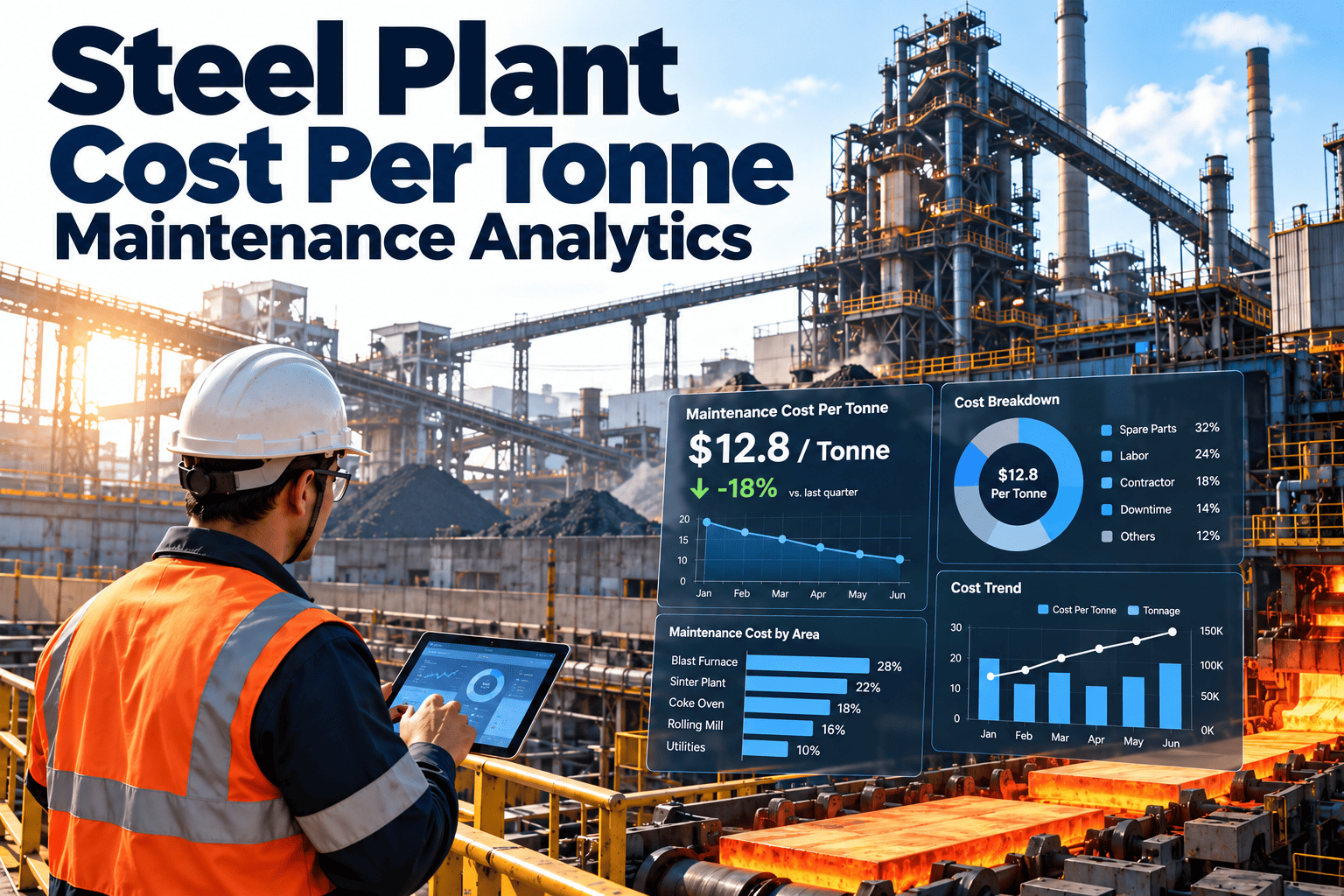
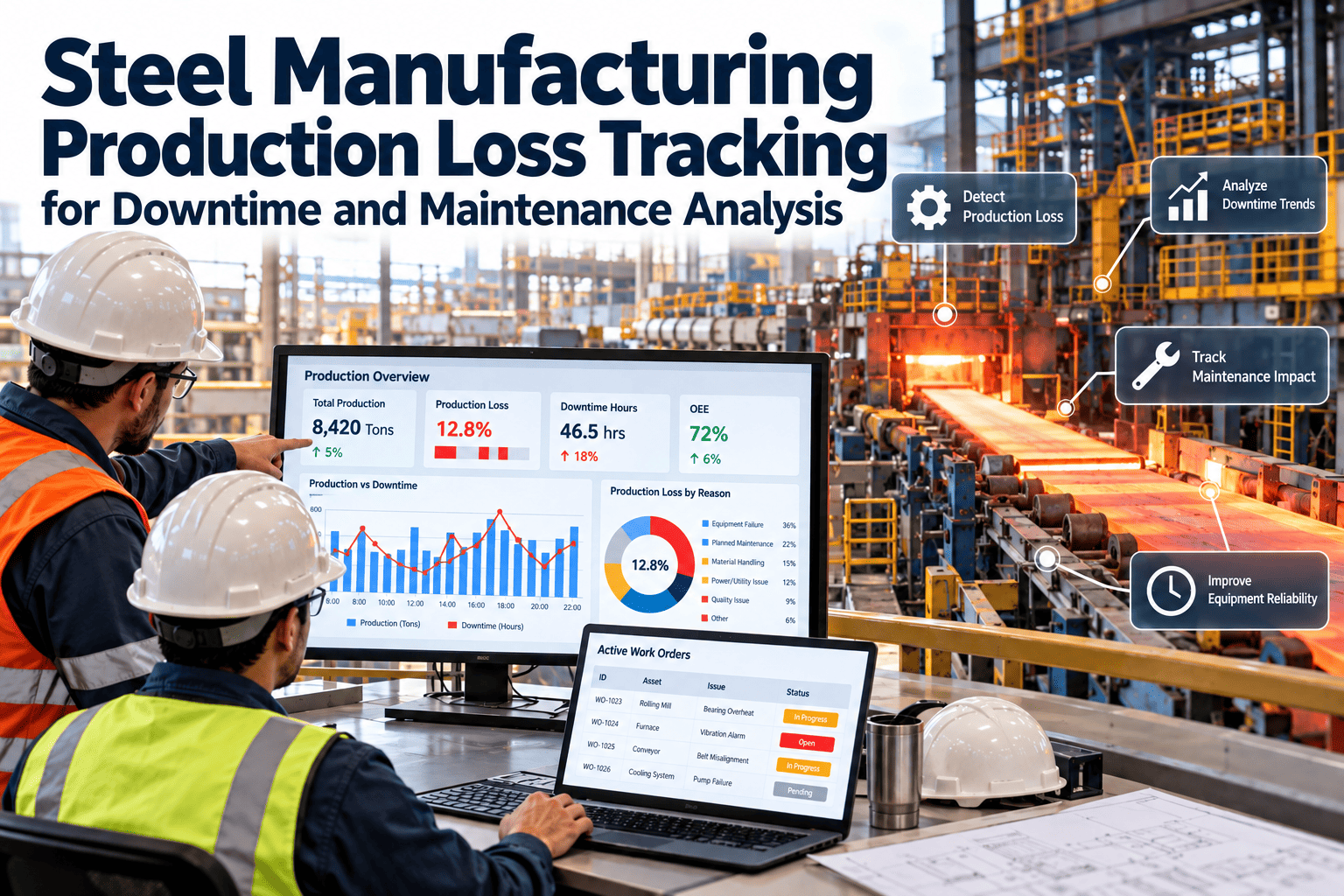
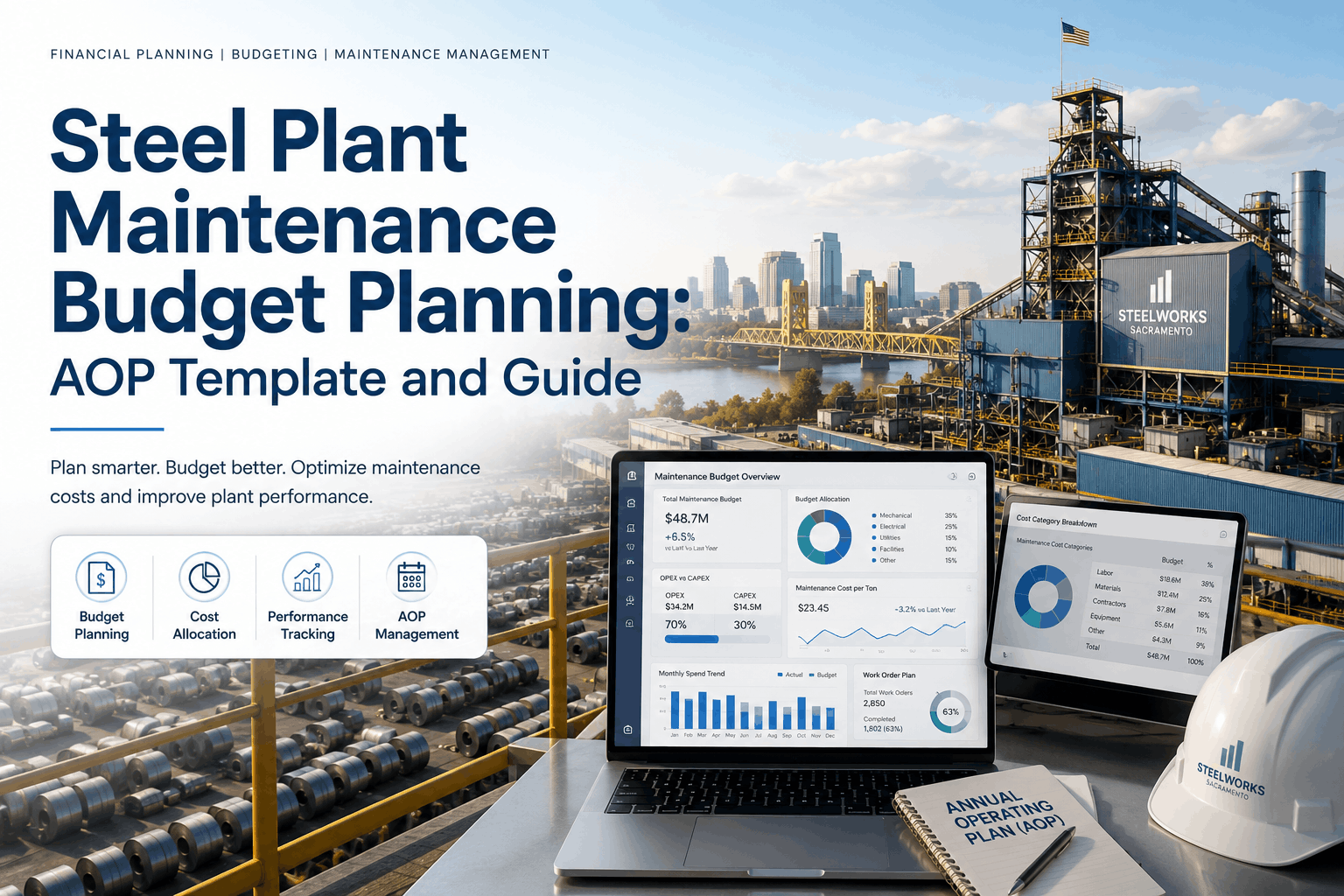
Steel plant maintenance budgets that are built from historical spend alone — without cost-per-failure data, PM compliance rates, or asset lifecycle context — are not budgets. They are guesses that get revised upward every quarter when emergency repairs arrive unforecasted. OxMaint's Budget Tracking and Cost Analytics module turns work order data into defensible budget inputs — cost per tonne, budget vs actual by area, and variance analysis linked to specific failure events. Book a 15-minute demo to see maintenance cost tracking in OxMaint.
Steel Plant Maintenance Budget Planning: Cost Estimation, Allocation & ROI
Build maintenance budgets from real cost data — per area, per asset, and per failure mode — with variance tracking and ROI evidence that survives board-level scrutiny.
How to Build a Steel Plant Maintenance Budget from CMMS Data
OPEX vs CAPEX — Steel Plant Maintenance Classification Guide
| Maintenance Activity | OPEX (Revenue) | CAPEX (Capital) | Decision Basis |
|---|---|---|---|
| Routine PM — lubrication, inspection, filter changes | OPEX | — | Maintains existing capability — no life extension |
| Like-for-like component replacement (bearing, seal) | OPEX | — | Restores to original specification — no improvement |
| Emergency breakdown repair | OPEX | — | Corrective maintenance — restores to pre-failure state |
| Full compressor or motor overhaul | OPEX | Review | OPEX if restoring; CAPEX if extending life beyond original design |
| Rolling mill roll change (consumable campaign) | OPEX | — | Consumable — expensed per campaign |
| Upgrade to higher-rated motor or drive | — | CAPEX | Enhances capability beyond original — must capitalise |
| Blast furnace reline | — | CAPEX | Extends asset life — capitalise and depreciate over campaign life |
| Automation and control system upgrade | — | CAPEX | New capability — capitalise |
| New conveyor installation or major extension | — | CAPEX | New asset — capitalise at cost |
| Major structural repair to existing asset | OPEX | Review | OPEX if restoring condition; CAPEX if extending useful life significantly |
Sign in to OxMaint — work orders can be tagged OPEX or CAPEX at creation, enabling accurate cost classification reporting at period end without manual reclassification.
Book a Demo — See Maintenance Cost Tracking and Budget Variance in OxMaint.
Cost per area · Budget vs actual · OPEX/CAPEX classification · Cost per tonne · Failure cost Pareto · Monthly variance reports. Build budgets from facts, not guesses.
The single most damaging financial fiction in steel plant maintenance is the contingency reserve built as a percentage of the prior year's budget — typically 10–15% — without any connection to actual failure probability data. On a $50M maintenance budget that is a $5–7M line item built entirely on guesswork. Plants that use MTBF data, failure cost history, and lifecycle age of critical equipment to calculate contingency go into the budget year with a defensible reserve that finance directors can understand and approve. Plants that use percentages go into the year with a number that was negotiated downward in the budget process and then exhausted in the first major emergency.
How OxMaint Supports Maintenance Budget Planning and Control
Book a Demo — See OxMaint Managing Steel Plant Maintenance Budgets.
Cost per area · Budget vs actual by WO · OPEX/CAPEX classification · Failure cost Pareto · Cost per tonne trending · Monthly variance reports. From guesswork to defensible data.
Maintenance Budget Planning — Common Questions
How do you separate planned maintenance costs from emergency repair costs in budget forecasting?
Tag every work order in OxMaint as planned PM, scheduled repair, reactive repair, or emergency callout at creation. After 12 months, planned vs reactive cost split per area is calculable with precision. This allows the planned portion to be budgeted with high confidence, while the reactive portion is sized using MTBF-based failure probability — not a percentage guess. Sign in to configure WO type tagging in OxMaint.
What is the correct benchmark for maintenance cost per tonne in an integrated BF-BOF steel plant?
AIST benchmarking data shows top-quartile BF-BOF operations at $3–4 per tonne of crude steel in total maintenance spend. Median performers are $5–7 per tonne. Plants operating reactively commonly exceed $8–12 per tonne. The gap between $4/t and $8/t on a 5-million-tonne plant is $20 million annually — making this the highest-value metric in the maintenance budget discussion. Book a demo to see cost per tonne tracking in OxMaint.
When should a steel plant maintenance cost be capitalised rather than expensed?
The test is whether the work extends asset life beyond its original design specification or adds new capability. A like-for-like bearing replacement is OPEX. A motor upgrade to a higher-rated unit is CAPEX. A blast furnace reline is CAPEX — capitalised and depreciated over the campaign life. OxMaint flags work orders for CAPEX review when cost thresholds or upgrade descriptors are present, supporting consistent classification. Sign in to configure CAPEX flagging rules in OxMaint.
How can we calculate ROI on preventive maintenance investment?
ROI on PM is calculated from three data streams: reduction in emergency repair cost (planned vs reactive rate differential × frequency reduction), reduction in unplanned downtime cost (hours avoided × tonne/hour production rate × steel margin), and equipment life extension (deferred capital replacement value). OxMaint provides all three inputs from work order data — the ROI calculation is built from plant-specific actuals, not industry averages. Book a demo to walk through PM ROI calculation using your OxMaint data.