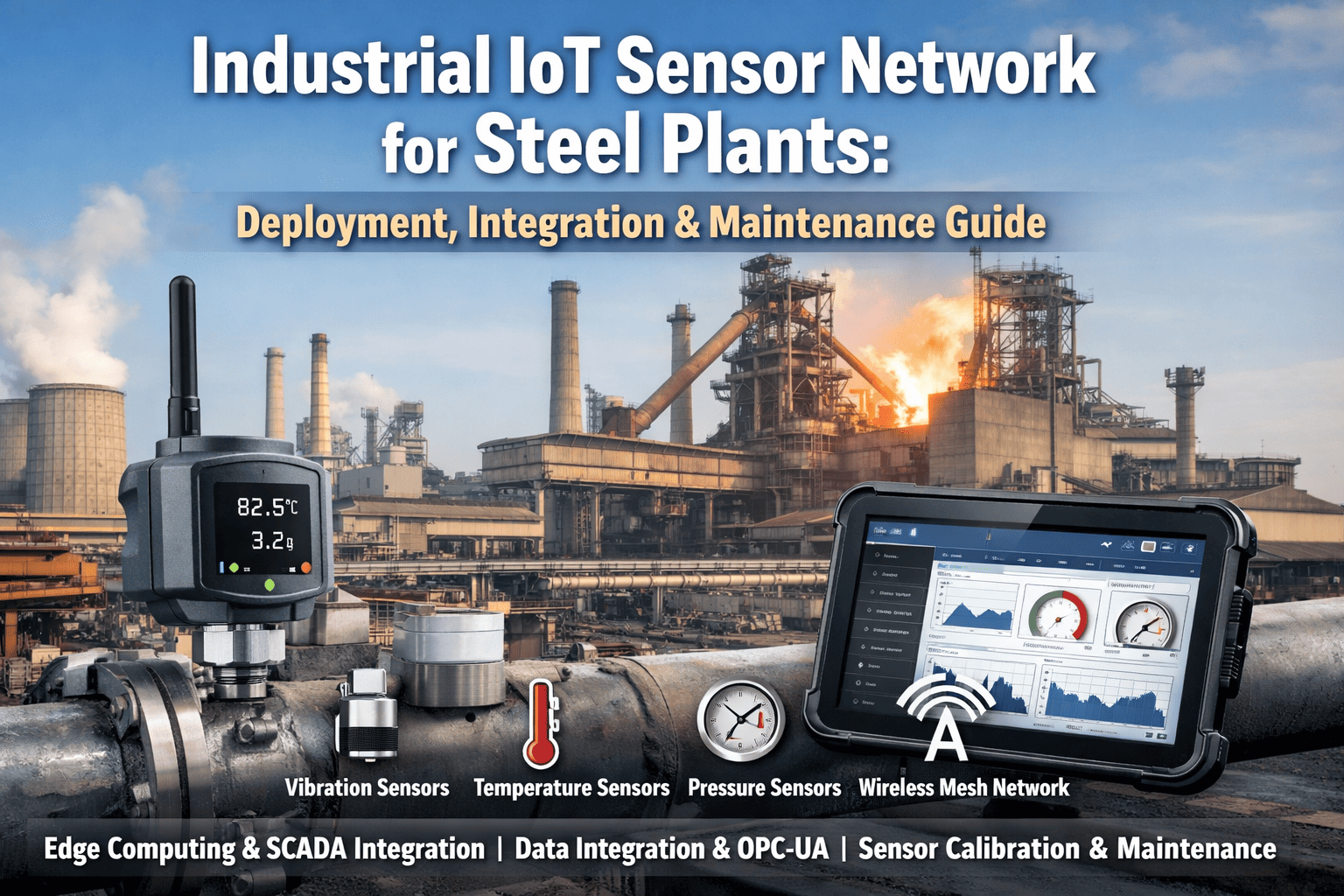
Steel plants generate more real-time equipment data than almost any other industrial environment — vibration signatures, thermal images, motor current readings, and process parameters measured in milliseconds. Yet most steel plants are wired to 1990s architecture: field devices connected to PLCs, PLCs to Level 2 systems, and nowhere else. A 5G private network removes the cabling constraint. Vibration sensors on 500 rolling mill bearings can transmit continuous data without trenching a single meter of new cable. A 4K thermal camera can stream real-time slag detection to a predictive model running anywhere in the plant — not just the control room. OxMaint's IoT sensor integration platform ingests 5G-connected sensor data, applies predictive analytics, and auto-generates maintenance work orders from the same network that runs your production systems. Book a demo to see how private 5G + CMMS transforms steel plant maintenance.
Industry 4.0 · Private 5G · Predictive Maintenance
5G Private Networks for Steel Plant Maintenance and Safety
Real-time equipment monitoring, connected sensors, and faster predictive maintenance — the complete guide to private 5G in steel manufacturing.
100xFaster data transmission than 4G for real-time monitoring
1msUltra-low latency for critical control applications
1,000+Sensors per square kilometer — true industrial density
Stop letting wired infrastructure limit your data coverage. OxMaint ingests 5G-connected sensor data — vibration, thermal, current, and process parameters — applying predictive analytics and auto-generating maintenance work orders from anywhere in the plant.
5G Capabilities
What Private 5G Delivers That WiFi and 4G Cannot
01
Ultra-Reliable Low Latency
1ms latency for closed-loop control applications — remote crane operation, automated guided vehicles, and real-time safety interlocks that cannot tolerate delay.
02
Massive Device Density
1 million+ devices per square kilometer — enough to instrument every bearing, motor, and hydraulic cylinder across an entire melt shop.
03
Deterministic Performance
Guaranteed bandwidth and latency for critical sensor streams — no "best-effort" packet delivery that drops data during interference.
04
Network Slicing
Isolated virtual networks for different use cases: safety systems on one slice, predictive maintenance on another, video surveillance on a third — each with its own performance guarantee.
05
High Bandwidth
1-10 Gbps throughput for 4K thermal imaging, LiDAR mapping, and AI inference at the edge — data that wired networks cannot cost-effectively support at scale.
06
Edge Computing Integration
Process sensor data locally at the 5G edge node — sending only alerts and aggregated trends to the cloud, not raw streams.
Industrial Applications
Steel Plant Maintenance and Safety Use Cases
← Swipe to see full table →
| Use Case |
Sensor / Device Type |
Data Volume |
Latency Requirement |
Legacy Alternative |
| Vibration Monitoring | Wireless accelerometers | 50-200 KB/s per sensor | <50ms | Monthly route-based readings |
| Thermal Imaging (Slag/Caster) | 4K thermal cameras | 15-50 Mbps per camera | <100ms | Manual periodic inspection |
| AR Remote Maintenance | AR glasses / HoloLens | 10-25 Mbps | <30ms | Phone call + email photos |
| Worker Safety Wearables | Gas sensors, location tags, biometric | 1-10 KB/s per device | <20ms for alerts | None — no real-time monitoring |
| Automated Overhead Crane | LiDAR, cameras, remote control | 20-100 Mbps | <10ms | Operator in cab; manual control |
| Predictive Maintenance Edge AI | Vibration + current + thermal | Variable — processed locally | <1ms to edge node | Cloud batch processing (minutes to hours) |
"The steel plants that will lead the industry in 2030 are the ones deploying private 5G today. Not because 5G is new — but because it removes the last infrastructure barrier to comprehensive equipment monitoring. Every bearing, every hydraulic cylinder, every drive motor can be on the network. The data has always been valuable. The cost of pulling cable to 5,000 sensing points has been prohibitive. Private 5G changes that equation. The plants that adopt early will have 2-3 years of failure pattern data before their competitors begin installing sensors."
Klaus-Dieter Schmidt, PhD Industrial IoT
Former CTO, Industrial Connectivity Division · Lead architect for three greenfield 5G steel plant deployments
How does a steel plant deploy a private 5G network?
Private 5G spectrum is licensed by national regulators for industrial use. In the US, the CBRS band (3.5 GHz) is available for private LTE/5G networks under a Priority Access License (PAL) or General Authorized Access (GAA). Many steel plants deploy using system integrators who manage spectrum licensing, infrastructure installation, and network operation as a managed service — avoiding the need for in-house telecom expertise.
Book a demo to discuss private 5G deployment options for your plant.How does private 5G reduce steel plant maintenance costs?
Three primary mechanisms: (1) Expanded sensor coverage — 5G makes it economically feasible to instrument equipment that was previously too expensive or difficult to wire, catching failures earlier. (2) Real-time streaming — continuous sensor data enables predictive models that batch or periodic sampling cannot support. (3) Faster response — 1ms latency alerts reach maintenance teams before equipment status changes, converting emergency repairs to planned interventions. Leading adopters report 30–50% reduction in unplanned downtime within 12 months.
Start a free trial to integrate 5G sensor data.Can 5G replace wired fieldbus networks in steel plants?
Not entirely — and it should not. 5G is complementary to wired networks, not a replacement. Hardwired PROFINET, EtherNet/IP, and fieldbus remain appropriate for control loops requiring microsecond synchronization. 5G excels at data that is not safety-critical but is currently unwired because cable runs are cost-prohibitive: vibration sensors, thermal cameras, mobile equipment telemetry, and worker-worn safety devices.
Book a demo to see hybrid architectures.What is the typical ROI timeline for a private 5G deployment?
Steel plants typically achieve full ROI within 12–24 months. Primary drivers: reduced unplanned downtime (30–50% reduction), lower sensor installation cost (50–70% less than wired), and predictive maintenance enabling earlier failure detection. Plants with downtime costs over $50,000/hour often recover network investment in the first 12 months.
Start a free trial to model ROI for your plant.
From Sensor to Work Order in Milliseconds
OxMaint's IoT integration platform ingests 5G-connected sensor data — vibration, thermal, current, and process parameters — applying predictive analytics and auto-generating maintenance work orders from anywhere in your plant. Transform your 5G investment into measurable downtime reduction.