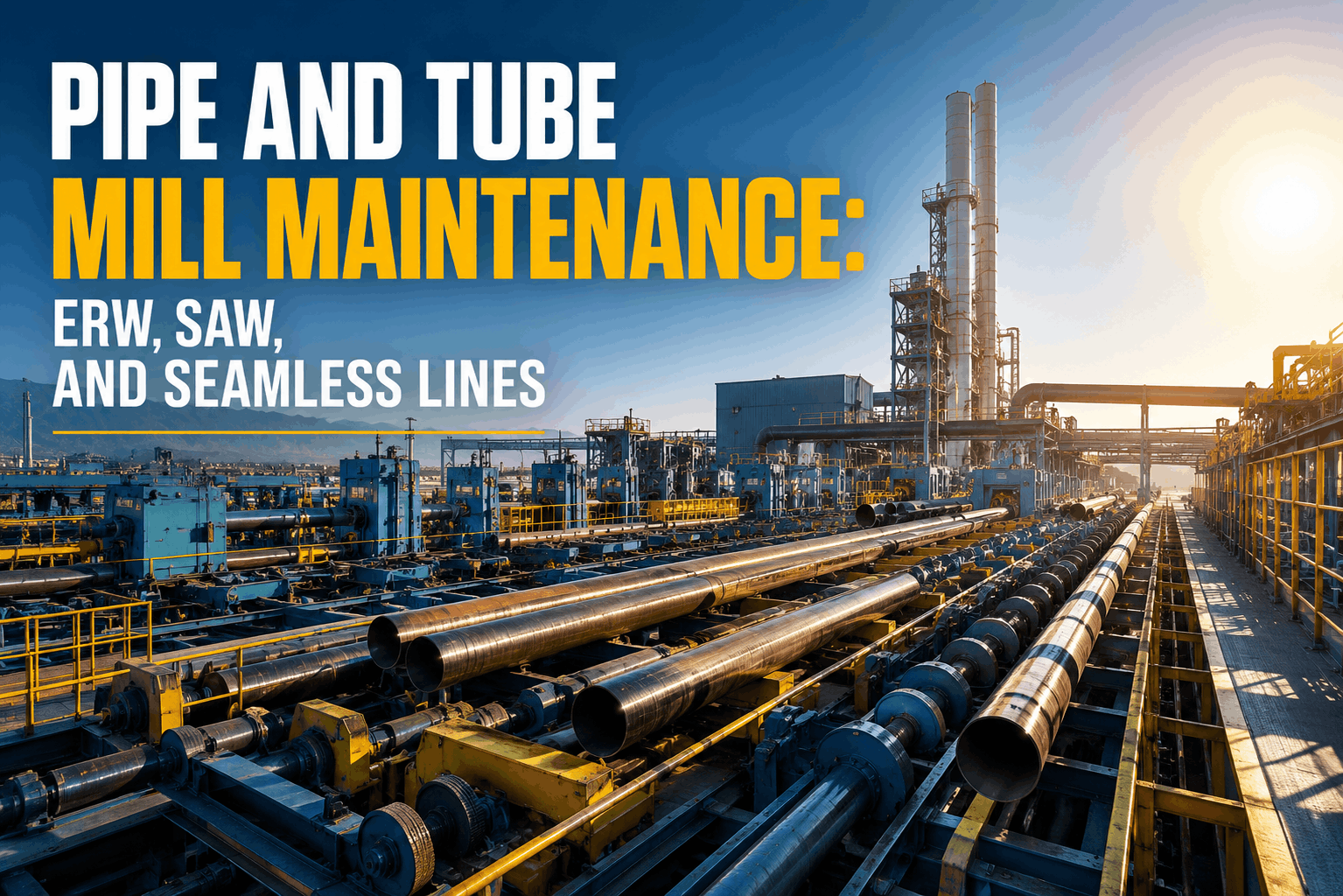
Tube and pipe mills operate at the intersection of forming precision and weld metallurgy — and the maintenance failure modes that shut them down are different from those in flat-product rolling because every defect in the process produces a reject that cannot be reworked by re-rolling. A misaligned forming roll that introduces a weld seam offset on ERW pipe creates scrap, not rework. A submerged arc welding flux feeding problem on SAW pipe that produces a subsurface inclusion requires cut-out and re-inspection, not adjustment. A piercing plug worn past tolerance on a seamless mill produces pipe that fails hydrostatic test at final inspection rather than at the point of cause. The maintenance programme in a tube and pipe mill is not primarily about uptime — it is primarily about first-time quality, because tube and pipe failure modes almost always express themselves as product defects rather than equipment breakdowns. Book a demo to see how OxMaint's Predictive Maintenance AI manages forming roll wear, weld system condition monitoring, and process-coupled maintenance triggers across ERW, SAW, and seamless pipe production lines.
Steel Plant Operations · Tube & Pipe Mill · Predictive Maintenance AI
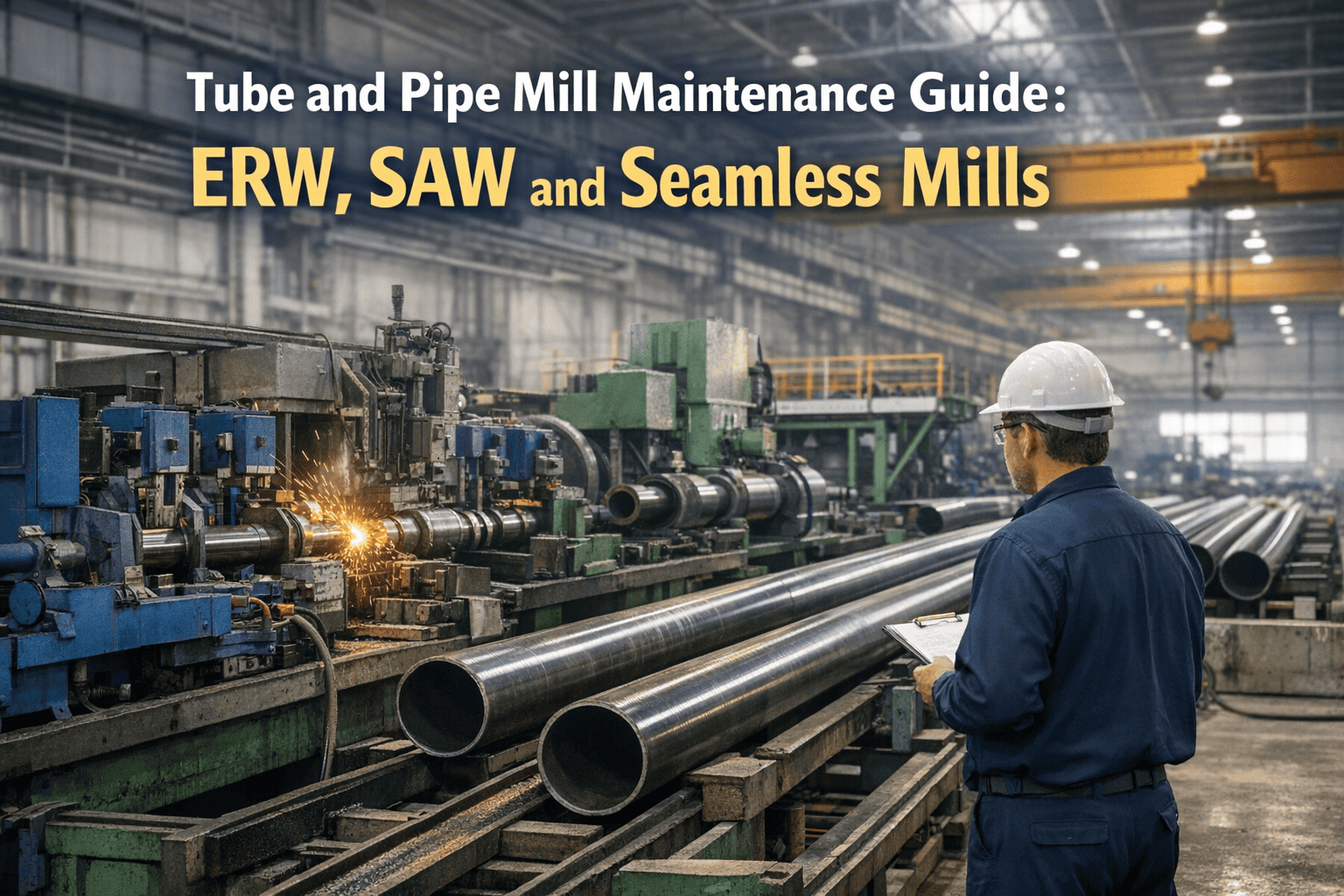
Tube and Pipe Mill Maintenance Guide: ERW, SAW & Seamless Mills
Roll forming alignment, HF weld system condition, flux management, seamless piercing tooling, NDT system calibration, and process-correlated maintenance triggers for electric resistance welded, submerged arc welded, and seamless tube and pipe production.
ERW
Electric Resistance Welding — HF induction or contact welding; forming roll alignment critical for weld seam quality
SAW
Submerged Arc Welding — spiral or longitudinal; wire feed, flux system, and weld head positioning govern weld quality
Seamless
Rotary piercing and mandrel rolling — piercing plug and guide shoe wear directly determine wall thickness tolerance and surface quality
01 — ERW Roll Forming & Weld
02 — SAW Pipe Production
03 — Seamless Piercing & Rolling
04 — NDT & Hydrostatic Testing
05 — Predictive Maintenance AI
Section 01
ERW Tube Mill Maintenance: Roll Forming, HF Weld System & Sizing
Electric resistance welded tube mill quality is governed by two independent but interdependent systems: the roll forming section that converts strip into a cylindrical form with consistent edge geometry, and the HF welding system that joins those edges with a combination of heat input and upset force. Both must be maintained to tolerance simultaneously — a correctly functioning weld system cannot produce a sound weld on a tube with misaligned forming rolls, and correctly aligned forming rolls cannot compensate for an HF coil that is producing inconsistent heat patterns.
Forming Roll Section
Per Size Change
Roll alignment verified with gauge for each fin pass stand — fin angle, fin gap, and edge form profile checked against setup card; misalignment of >0.1mm in fin gap produces weld upset defects that manifest as cold weld or hook crack in subsequent NDT
Weekly
Roll surface condition inspection — scoring, pitting, or edge chipping on any forming roll documented and assessed for replacement; roll bearing condition check (temperature and vibration per stand); side roll guide wear measurement
Monthly
Full roll profile measurement across all breakdown, fin pass, and sizing stands — compare against new roll profile to determine wear pattern; replace rolls with >0.5mm profile deviation at critical points; bearing inspection and relubrication per OEM interval
Quarterly
Drive shaft coupling inspection, gearbox oil sampling per stand, mill alignment survey with laser alignment equipment — cumulative alignment drift from individual stand adjustments can introduce camber and steering that is not visible in per-stand checks
HF Weld System
Daily
HF coil condition inspection — coil turns for cracks, burn marks, or mechanical damage; coil-to-tube gap verified at setup for each tube size (typically 3–6mm); impedance core condition — broken or saturated cores reduce current concentration and produce cold welds
Weekly
Weld squeeze roll condition — surface damage, bearing temperature, and squeeze force verification (spring-loaded or hydraulic); squeeze roll position relative to weld point confirmed; cooling water flow rate to coil and squeeze rolls measured
Monthly
HF power unit output calibration — verify actual output power against control panel setpoint using independent power analyser; oscillator tube or IGBT inverter condition inspection (thermal camera scan); bus bar connections and coil connections torque check
Annually
Full HF power unit PM — capacitor bank inspection and capacitance measurement, transformer insulation resistance test, cooling water circuit flush and biocide treatment, complete electrical safety inspection per local electrical regulations
OxMaint AI correlation: HF power unit output trending connected to weld quality data (NDT rejection rate, destructive test results) enables the AI model to detect the characteristic pattern of coil degradation — a gradual increase in power required to maintain weld temperature, followed by increasing NDT rejection rate — typically 3–5 days before weld quality becomes commercially unacceptable. The PM work order fires before the quality escape, not after it.
Section 02
SAW Pipe Mill Maintenance: Spiral and Longitudinal Weld Systems
Submerged arc welded pipe — whether spiral (SAWH) or longitudinal (SAWL) — is produced for high-pressure applications including oil and gas linepipe, structural piling, and offshore applications where weld integrity is verified against API 5L, ISO 3183, or equivalent standards. Weld defects in SAW pipe do not manifest as surface-visible indications — they are subsurface inclusions, porosity clusters, and fusion deficiencies that are detected only by ultrasonic testing or radiography. The maintenance programme for SAW weld systems must treat weld quality as a maintenance output, not just a production output.
| System / Component |
PM Task |
Interval / Trigger |
Quality Impact if Neglected |
OxMaint AI Trigger |
| Wire feed system |
Wire feed roller wear, wire straightener condition, contact tip inspection |
Weekly inspection; contact tip replacement on arc instability |
Wire feed variation produces arc instability — porosity clusters and spatter inclusions in weld |
Wire feed rate variance monitoring; arc voltage stability trending triggers contact tip inspection |
| Flux hopper & recovery |
Flux moisture content measurement, hopper level monitoring, flux crusher condition, recovery system filter |
Moisture check daily; full system inspection weekly |
Wet flux or contaminated flux causes hydrogen-induced cracking (HIC) — delayed failure mode in high-pressure service |
Flux moisture sensor trending; recovery system motor current monitoring for crusher blockage |
| Weld head positioning |
Weld head lateral and angular position verification; seam tracking system calibration |
Verified at setup; seam tracking calibration monthly |
Weld offset from seam centreline produces one-sided fusion deficiency and uneven reinforcement |
Seam tracking deviation log; systematic offset trend triggers weld head positioning PM work order |
| ID weld head (SAWL/spiral) |
ID weld head torch condition, contact tip, nozzle; internal flux recovery system |
Inspection every 50 joints; replacement on condition |
ID weld deficiency is harder to detect by UT and is the failure-critical surface in pressure service |
ID arc current stability monitoring; current spike pattern indicates contact tip deterioration |
| Forming mandrel (spiral) |
Mandrel roll condition, spiral angle adjustment mechanism, edge preparation roll wear |
Roll profile measurement monthly; mechanism inspection quarterly |
Mandrel roll wear changes pipe diameter and wall thickness uniformity — fails dimensional inspection |
Dimensional trending from dimensional inspection station; drift triggers mandrel roll measurement |
| Power source & control |
Welding rectifier/inverter output stability, cooling system, cable connections |
Monthly output calibration; quarterly full inspection |
Power instability produces uneven heat input — variable fusion and microstructure across joint |
Output voltage and current waveform quality monitoring; deviation from stable envelope triggers inspection |
Section 03
Seamless Pipe Mill Maintenance: Rotary Piercing, Mandrel Rolling & Sizing
Seamless pipe manufacturing involves a sequence of hot deformation operations — billet heating, rotary piercing, mandrel or plug rolling, and sizing — in which every tooling wear mechanism directly translates into a dimensional or surface quality defect in the finished pipe. Unlike flat-rolled products where a roll surface defect appears as a mark on one face of the strip, a worn piercing plug or guide shoe in a seamless mill produces a helical defect pattern that runs the entire length of every pipe produced until the tooling is changed.
Rotary Piercer
Piercing plug wear
Plug profile measured after each billet or on rejection — nose diameter loss >2mm and body wear pattern indicates rotation or lubrication failure; plug change interval set per grade (shorter for stainless and alloy grades)
Guide shoe / disc condition
Guide shoe groove profile measured every 50 billets — worn guide shoes allow billet wander during piercing, producing wall thickness eccentricity that propagates through the entire mill; replacement threshold 0.8mm groove wear
Roll gap and angle setting
Feed angle and roll gap verified with reference gauge at each plug change and grade change — feed angle deviation of >0.3° changes the helical pitch of the piercing and produces a predictable wall thickness helix pattern in the finished pipe
Mandrel Mill / Plug Mill
Mandrel bar condition
Mandrel bar diameter and surface condition checked before each campaign — surface scoring or diameter loss >0.5mm changes the internal diameter tolerance of finished pipe; mandrel bars rotated in service to distribute wear
Roller pass line alignment
All stands aligned to pass line reference with laser alignment tool at each roll change and monthly during campaigns — cumulative misalignment across stands produces camber and eccentric wall thickness not visible in per-stand gauging
Drive train condition
Gearbox vibration, spindle universal joint condition, and drive coupling wear monitored quarterly — torque imbalance between stands from drive train wear produces thickness variation that correlates poorly with the roll wear explanation
Stretch Reducing & Sizing Mill
Roll pass profile
Roll pass profile measured at each roll change with profile gauge — deviation from calibrated profile changes wall thickness distribution and diameter in the finished pipe; final diameter control is most sensitive to wear in the last 3 stands
Tension control
Interstand tension verified against grade-specific tension table — excessive tension produces wall thinning; insufficient tension produces wall thickening; load cell calibration quarterly
Cooling system uniformity
Cooling water distribution across all stands verified — uneven cooling produces diameter ovality and residual stress that can affect straightness and dimensional tolerance at ambient temperature
Tooling wear triggers, weld system condition monitoring, and NDT rejection rate correlation — managed in one predictive maintenance platform for ERW, SAW, and seamless mills.
Section 04
NDT & Hydrostatic Testing System Maintenance
Non-destructive testing and hydrostatic test equipment in a tube and pipe mill are quality assurance assets, not production assets — their function is to prevent defective product from shipping, and their maintenance programme must be treated with the same rigour as the production equipment whose output they evaluate. An ultrasonic testing system that is not calibrated, a hydrostatic test system with a pressure gauge out of tolerance, or a flux leakage inspection unit with degraded magnetisation is not just a compliance gap: it is a mechanism by which defective pipe reaches the customer while passing final inspection.
Ultrasonic Testing System
Daily calibrationFull calibration with reference notch standard before each production run; sensitivity verified against API 5L or relevant standard notch depth; gain settings documented per product grade
Transducer conditionTransducer wear face inspection and coupling check weekly; transducer replacement on >3dB sensitivity loss vs reference; water coupling flow rate and pressure verified per shift
Scanner mechanismRotary scanner bearing condition, encoder accuracy, and probe positioning monthly; position deviation >0.5mm from nominal produces coverage gaps
Hydrostatic Test System
Pressure gauge calibrationAll test pressure gauges calibrated against traceable reference quarterly; calibration certificate retained; test gauge replaced if >1% deviation from reference at test pressure
End seal conditionTest head seals inspected after each 500 test cycles; seal replacement before visible extrusion or leakage; seal material compatibility verified with test fluid and pressure rating
Pump and intensifierHigh-pressure pump and intensifier seal inspection monthly; pressure decay rate test on each unit monthly — decay >5% in 30 seconds indicates seal or valve leakage requiring repair before testing resumes
Section 05
Predictive Maintenance AI for Tube & Pipe Mill Operations
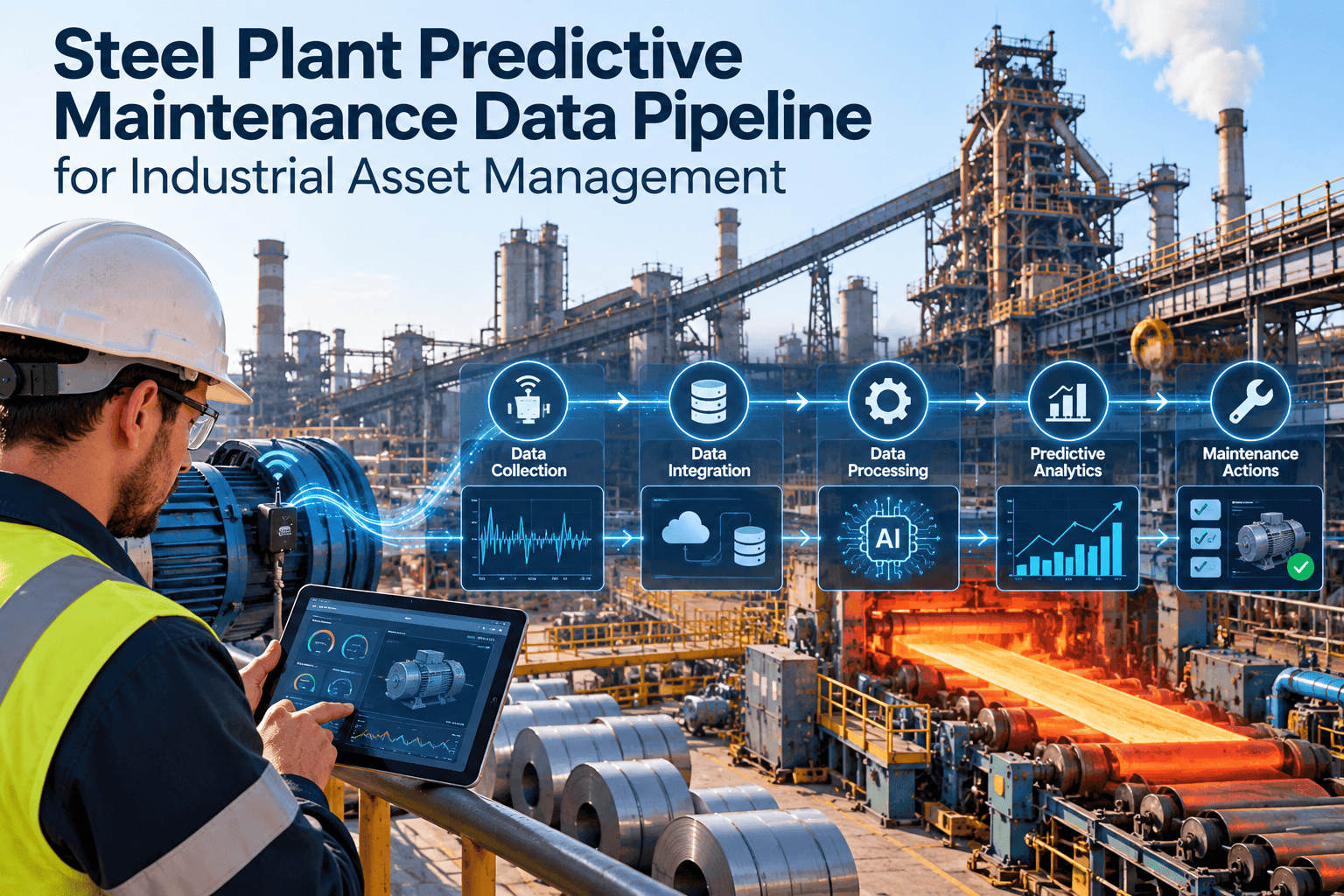
Tube and pipe mill maintenance complexity arises from three sources that predictive maintenance AI addresses directly: the coupling between process variables and tooling wear (so that the correct trigger for a forming roll change is not a fixed interval but a measured wear rate on the rolls in service); the correlation between equipment condition and product quality (so that an increasing NDT rejection rate triggers a maintenance investigation of the most probable equipment cause, not a quality investigation that runs separately from the maintenance programme); and the diversity of trigger types required across a multi-process plant (heat-based for furnace tooling, cycle-count-based for HF coil and hydrostatic seals, condition-based for bearings and drives, quality-based for forming rolls and weld system components).
01
Tooling Wear Rate Modelling — Grade-Sensitive
OxMaint AI maintains separate wear rate models for forming rolls, piercing plugs, and guide shoes per product grade and size range. High-strength grades (X70, X80 API linepipe) wear piercing tooling faster than standard grades; large-diameter SAW pipe wears forming rolls at a different rate than small-diameter ERW. Maintenance trigger intervals that are correct for one product mix become either over-conservative or under-conservative when the grade mix changes. The AI model adjusts predicted tooling life dynamically as actual production data accumulates, rather than applying a fixed interval that was calibrated for a different product mix.
02
NDT Rejection Rate Correlation with Equipment Condition
When NDT rejection rate on any product type begins trending upward, OxMaint queries the maintenance history of the equipment most likely to be the cause — for ERW tube, the HF coil condition and last weld squeeze roll change; for SAW pipe, the wire feed stability log and flux moisture history; for seamless pipe, the piercing plug wear measurement and guide shoe profile. This correlation converts a quality signal into an equipment investigation target, reducing the time from rejection rate increase to root cause identification from days to hours.
03
Multi-Trigger PM Scheduling Across Mill Types
A tube and pipe plant running ERW, SAW, and seamless lines simultaneously requires PM triggers of at least five types: length-based (ERW forming roll change by metres of product), cycle-count (HF coil by power-on hours, hydrostatic seal by test cycles), condition-based (bearing fault frequency detection), quality-correlated (forming roll replacement when dimensional rejection rate crosses threshold), and calendar-based (electrical safety inspections, flux system annual maintenance). OxMaint manages all five trigger types per asset without requiring the maintenance planner to track them in separate systems.
Expert Review
What Tube & Pipe Mill Maintenance Engineers Say
01
The most consistent ERW weld quality problem I have investigated in 20 years of tube mill engineering is not a weld system problem — it is a forming roll problem. A worn fin pass roll that is producing inconsistent edge geometry puts the HF system in an impossible position: it is trying to weld an inconsistent vee angle with a power setting optimised for the nominal geometry. Connecting roll profile measurement data to HF power control logs in OxMaint allowed us to see this pattern for the first time — the HF power variance that was being attributed to power unit instability was actually the weld system responding correctly to the roll-driven geometry variation.
Gerhard Schöttler, Dipl.-Ing., TÜV-Certified · Tube Mill Process & Reliability Engineering, ThyssenKrupp · 26 Years ERW and Seamless Tube Manufacturing
02
Flux moisture management in SAW pipe production is treated as a production responsibility in most plants — the process operator monitors moisture and adjusts. It should be treated as a maintenance responsibility because the failure mode is not gradual process degradation; it is sudden hydrogen-induced cracking that appears in the pipe weeks after it has been shipped, under service stress. The drying system, the recovery system, and the flux handling chain from storage to weld head are all assets that require structured PM. We had a HIC-related customer return that was traced to a flux dryer thermocouple that had drifted 18°C from calibration — a quarterly thermocouple calibration check in OxMaint would have found it before the batch was made.
Olusegun Adeyemi, MSc, CEng MIChemE · Linepipe Quality & Process Engineering, ArcelorMittal · 17 Years SAW Pipe Production and API 5L Quality Management
03
Piercing plug management in a seamless mill is the clearest example of predictive maintenance returning direct financial value. A plug that is changed 10 billets too late produces a wall thickness helix defect on every pipe in those 10 billets — typically 3 to 5 pipes per billet, so 30 to 50 pipes with a latent defect that may not be caught until hydrostatic test or, worse, by the customer's incoming inspection. The cost of 50 rejected pipes versus the cost of a plug that could have been refurbished or replaced at the scheduled change point is not marginal. OxMaint's grade-weighted plug wear model gives us accurate remaining-life estimates rather than fixed-interval changes that are either too conservative or too late depending on what grade we have been running.
Kenji Watanabe, Dr.Eng · Seamless Pipe Process & Maintenance Engineering, POSCO Technical Research · 24 Years Seamless Tube & Pipe Production
FAQs
Frequently Asked Questions
How should ERW forming roll change intervals be determined for a mill running multiple sizes and grades?
Fixed calendar or tonnage intervals for ERW forming rolls are almost always wrong for at least part of the product mix. The correct approach is to track actual roll profile deviation by size and grade using regular profile measurement data and set the change trigger at the wear point where the fin pass geometry begins to affect weld quality — typically observed as increasing HF power variation or rising NDT rejection rate. For a multi-size mill, OxMaint maintains separate wear rate models per roll set per size range, with grade weighting for high-strength grades that accelerate roll wear. The change trigger fires when the predicted deviation reaches the tolerance threshold for the current size and grade, not at a fixed interval.
See OxMaint's forming roll wear model configuration for ERW mills.
What are the most critical SAW weld system maintenance tasks for maintaining API 5L qualification?
API 5L qualification for SAW pipe requires documented evidence of weld procedure qualification, welder (or welding operator) qualification, and in-process process parameter monitoring. The maintenance tasks most directly connected to maintaining API 5L compliance are: flux moisture control (hydrogen-induced cracking is an API 5L non-conformance that can result in product recall); wire feed stability (feed rate variance produces arc instability that correlates with porosity in the weld); weld head positioning calibration (seam offset beyond tolerance is an automatic rejection under UT); and power source output stability (voltage and current stability records are part of the process monitoring requirements). OxMaint generates the process parameter maintenance records that form part of the API 5L documentation package alongside weld procedure records.
Book a demo to see OxMaint's API 5L maintenance documentation package.
How does OxMaint handle the coupling between NDT calibration and production scheduling in a tube mill?
OxMaint treats NDT equipment as maintenance-critical assets with PM schedules that are linked to production scheduling, not run independently. Daily calibration work orders for UT and flux leakage systems are generated automatically before each production shift, with a gate function that prevents the production schedule from releasing pipe to final inspection without a completed calibration record for that shift. If a calibration work order is overdue or incomplete, the system flags the downstream production for hold pending calibration completion. This prevents the scenario where pipe is inspected on a system that has not been calibrated for the current shift — a compliance gap that appears in API monogram audits and customer qualification assessments.
ERW Forming Roll Wear. SAW Flux Moisture. Seamless Plug Life. One Predictive Maintenance Platform.
OxMaint's Predictive Maintenance AI manages every trigger type in a tube and pipe mill — tooling wear rate models, weld quality correlation, NDT calibration gates, and condition-based monitoring — without requiring a separate system for each process technology on your floor.