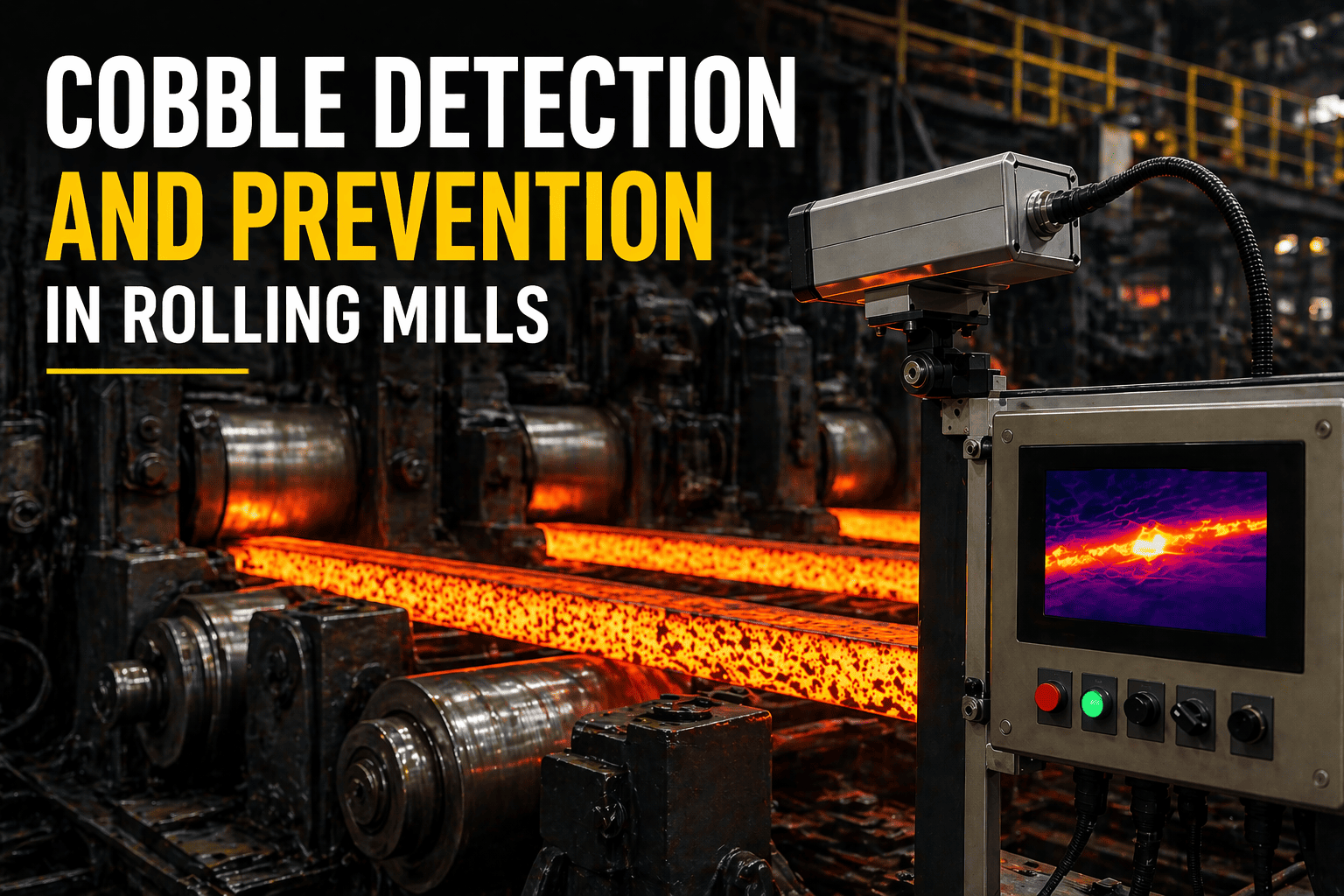
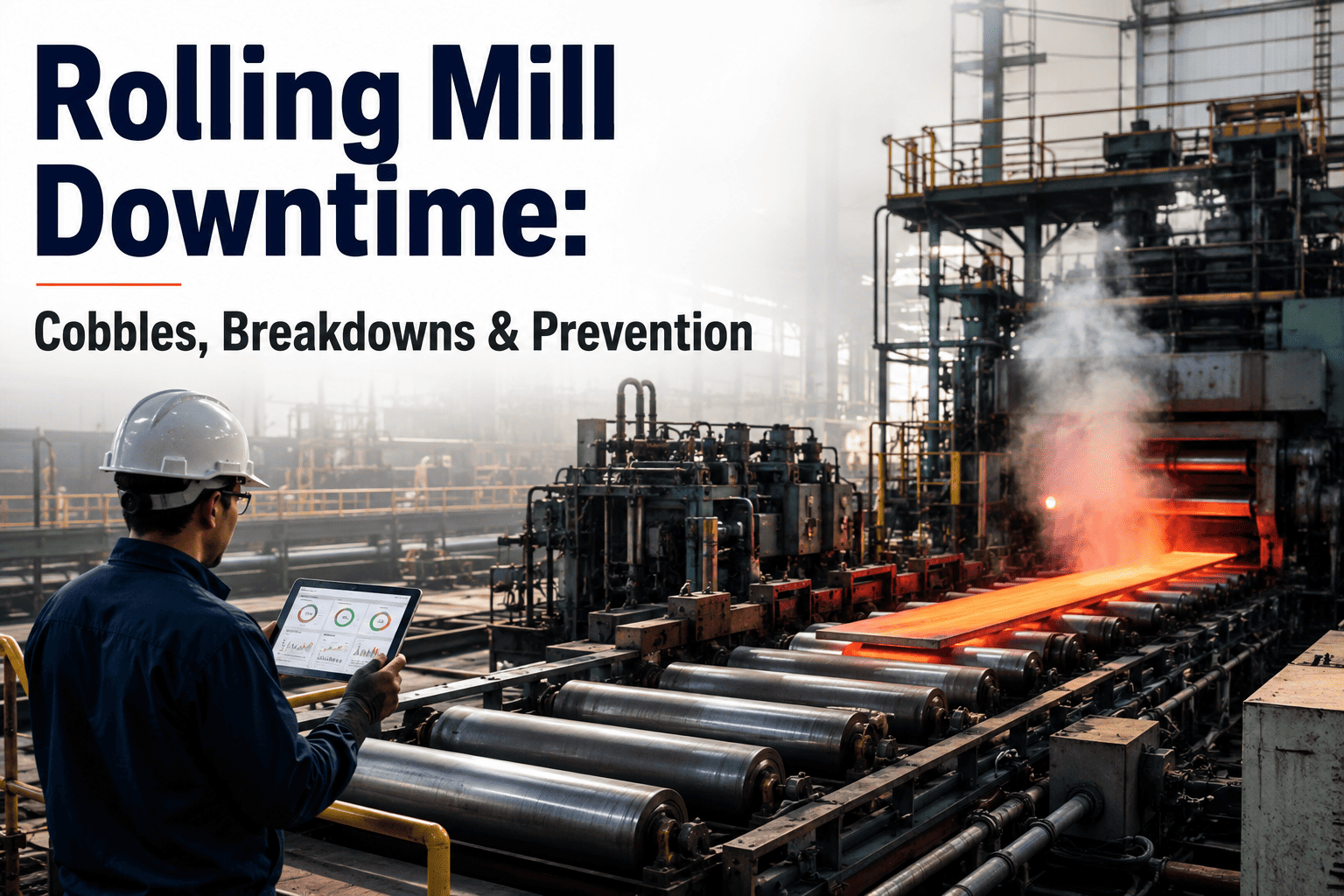
According to a single cobble event in a hot rolling mill causes $150,000–$500,000 in direct damage (rolls, guides, entry tables, hydraulic lines) plus 2–8 hours of downtime costing $30,000–$120,000 per hour in lost production. However, 63% of rolling mills rely on operator reaction as the primary cobble prevention method — catching the event only after the cobble has begun, when damage is already occurring. Modern cobble prevention systems using real-time thermal imaging, crop shear optimization, and looper control can detect anomaly conditions 0.3–2.0 seconds before cobble initiation — enough time for automatic emergency shutdown. Unlike traditional methods where detection = damage, predictive cobble detection integrates thermal, force, and position monitoring with automated roll gap adjustment and mill stop sequencing. OxMaint's Cobble Prevention Module connects real-time rolling mill sensors to emergency work order generation and root cause analysis — closing the loop between cobble events and corrective maintenance on entry guides, loopers, crop shears, and roll cooling systems. Book a demo to see how integrated steel plants are reducing cobble frequency by 40–65% and cobble-related downtime by 70–85%.
01
Cobble Detection and Prevention in Rolling Mills
Thermal monitoring · Crop shear optimization · Looper control · Automatic shutdown · CMMS integration
$150K–500KDirect damage per cobble event in hot rolling mill
63%Of rolling mills rely on operator reaction as primary cobble prevention
40–65%Cobble frequency reduction with automated detection systems
The Cost of Cobbles — Root Cause Distribution
35%
Entry guide misalignment
Most common root cause
22%
Roll wear or spalling
Uneven surface condition
18%
Looper control failure
PID gain / position sensor drift
15%
Crop shear mistiming
Leader or tail end cut incorrectly
10%
Roll cooling system failure
Overheating causing strip buckling
Five Cobble Prevention Technologies — How They Work
01
Thermal Imaging — Strip Profile & Edge Crack Detection
Thermal cameras positioned after each finishing stand detect edge cracks, centerline temperature differentials, and strip steering deviations. A strip edge temperature drop exceeding 80°C indicates edge cracking — precursor to cobble. Detection lead time: 0.5–1.5 seconds before cobble. Integrated system triggers automatic speed reduction and work order for guide inspection.
02
Entry Guide Position Monitoring
LVDT sensors on entry guides detect misalignment, wear, or gap deviation from centerline. A 2mm guide offset from pass line increases cobble probability by 8x. Real-time position monitoring triggers alert at 1.5mm deviation, automatic shutdown at 2.5mm deviation. Work order auto-generated for guide change or alignment — preventing cobbles during next bar entry.
03
Looper Control — Backward & Forward Tension Stability
Loopers maintain interstand tension. Looper angle oscillation exceeding ±3° from setpoint indicates PID gain issues or sensor drift — predecessor to cobble. Advanced systems use machine learning on looper angle, motor current, and tension data to predict cobble 1–3 seconds before unstable loop forms. Prediction triggers speed correction and work order for looper maintenance.
04
Crop Shear Optimization — Leader & Tail End Control
PLC-controlled crop shears cut non-uniform leader and tail ends. Mistimed cuts (too early or late) leave irregular shapes that jam entry guides. Predictive crop shear uses laser-based end detection and roll speed feedback to optimize cut timing. Deviation from optimal cut window triggers alert and maintenance work order for shear blade condition or position sensor calibration.
05
Vibration Monitoring — Roll Bearing & Spindle Health
Roll bearing BPFO frequency amplitude rising 0.2 in/s/s over baseline indicates spalling progression. Advanced systems correlate vibration with cobble events and automatically increase vibration sampling frequency after each cobble — building a preventive database.
Cobble Prevention Checklist — Weekly & Per-Campaign Tasks
01
Entry & Exit Guide Alignment Verification
Measure guide gap relative to pass line center using laser alignment tool. Gap >1.5mm on roughing stands or >1.0mm on finishing stands triggers alignment work order before next campaign.
Reduces cobble risk 8x
02
Roll Surface Inspection — Spalling & Thermal Cracks
Inspect roll body and neck for spalling, thermal cracks, or localized wear marks. Any spalling >3mm triggers roll replacement before next scheduled campaign. Cobble risk increases 12x with visible spalling.
Prevents strip buckling
03
Looper Sensor Calibration & PID Check
Verify looper angle sensor reading against physical measurement. Drift >1° triggers calibration. Test looper response to step change — oscillation >2 cycles indicates PID tuning required.
Stabilizes tension
04
Crop Shear Blade Gap & Timing Verification
Measure blade gap and overlap. Gap>0.5mm or overlap<2mm triggers blade replacement. Verify cut length accuracy against PLC target — deviation >2% triggers position sensor work order.
Clean leader/tail ends
05
Roll Cooling System Flow & Pressure
Measure coolant flow rate at each header, pressure at each stand. Flow <90% of design triggers pump or nozzle inspection. Uneven flow across roll face causes thermal crown — leads to strip edge wave and cobble.
Maintains uniform temperature
06
Cobble Data Review & Root Cause Analysis
After any cobble, review high-speed video, thermal images, looper traces, guide position logs, and roll cooling. Assign root cause using standard taxonomy. Update cobble prevention work orders and inspection checklists.
Prevents recurrence
Cobble Detection Technology Comparison
| Detection Method | Lead Time Before Cobble | Automated Shutdown? | Maintenance Workflow Link | Cobble Prevention Rate |
| Operator visual / audible |
0 seconds (post-cobble)Manual onlyNone — phone call to maintenance<5% Guide position limit switches0.1–0.3 secondsYes — emergency stopAuto WO for guide change55% Thermal imaging (edge crack)0.5–1.5 secondsYes — speed reduction + stopAuto WO for entry guide70% Looper oscillation detection1–3 secondsYes — PID correction + stopAuto WO for looper maintenance65% AI multi-sensor fusion2–5 secondsYes — predictive + emergencyAuto WO with root cause code85%
Source: OxMaint steel plant deployment data 2023–2025. Prevention rate = cobbles avoided relative to baseline pre-implementation.
ROI Impact at a Glance — Cobble Prevention System
40–65%
Cobble frequency reduction after automated detection deployment
OxMaint steel mill data
70–85%
Cobble-related downtime reduction
Faster detection + auto shutdown
4–10 mo.
Payback period for cobble prevention sensors + software
Single cobble avoidance often pays for system
"For 30 years, cobble prevention meant operator training, guide inspection, and prayer. The problem is that operators cannot see what's about to happen at 15 m/s. By the time the operator sees the strip folding, the entry guide is already destroyed, the roll is already damaged, and the hydraulic line is already severed. The mills that have broken the cobble cycle are the ones that instrumented the conditions preceding the fold — thermal cameras seeing edge cracks before they catch, LVDTs on entry guides detecting misalignment before the bar arrives, vibration sensors on loopers detecting instability before oscillation diverges. I've worked with mills that reduced cobbles from 22 per month to 3 per month — not by training operators better, but by giving operators a 2-second advanced warning display and automatic slowdown triggers. The technology exists. The integration with maintenance systems — auto-creating guide change work orders when misalignment is detected, auto-scheduling roll grinding when vibration signatures match spalling patterns — that's where the 85% reduction comes from."
— Kenji Tanaka, PE · Rolling Mill Process Specialist — Global Steel Consulting · 31 Years Hot Strip and Bar Mill Operations · Author, "Cobble Reduction Through Automation"
Every cobble is preceded by detectable signs — edge cracks, guide drift, tension instability. Start detecting them 1–5 seconds before disaster.
Frequently Asked Questions
What is the typical cost of a cobble event in a hot rolling mill?
The total cost of a cobble event includes both direct damage and production loss. Direct damage averages $150,000–500,000 for a hot strip mill cobble: damaged work rolls ($40,000–120,000 per pair), damaged backup rolls ($50,000–150,000), destroyed entry guides ($8,000–25,000), severed hydraulic lines ($5,000–15,000 plus fluid loss), damaged loopers or crop shear components ($30,000–80,000), and instrumentation damage ($5,000–20,000). Production loss adds $30,000–120,000 per hour of downtime, typically 2–8 hours total. Total event cost = $250,000–1,500,000. For bar and rod mills, costs are lower due to smaller equipment but still significant: $75,000–300,000 per cobble. A mill experiencing 12 cobbles per year faces annual loss of $3–18 million from cobbles alone.
Book a demo to calculate cobble cost for your specific mill configuration.
What sensors are required to implement automated cobble detection in existing rolling mills?
The minimum viable cobble detection system requires three sensor types installed on each finishing stand. Entry guide LVDTs (4–6 per mill) — measure guide position relative to pass line centerline, detect misalignment before bar entry. Thermal cameras (2–4 per mill) — positioned after exit guides to detect edge cracks and strip steering; FLIR or InfraTec models with 50mm+ lenses for 2–5m stand distances. Looper angle encoders (existing on most mills) — angle feedback from existing PLC can be used for oscillation detection; additional high-resolution encoders available if needed. For advanced prediction (Lead time 2–5 seconds), add vibration sensors on roll chocks (accelerometers monitoring BPFO frequencies) and mill stand load cells (existing on most modern mills). Total sensor hardware cost for a 7-stand finishing mill: $60,000–150,000 depending on camera count and resolution.
Sign in to see sensor mapping for your mill configuration.
How does entry guide misalignment cause cobbles, and how much misalignment is tolerable?
Entry guides center the bar into the roll bite. A guide offset from pass line centerline forces the bar to bend entering the roll gap. The bending stress concentrates at the edge of the bar, causing edge cracking or folding. At 15 m/s rolling speed, a 2mm guide offset increases cobble probability by 8x. At 4mm offset, cobble probability approaches 80% for thin gauge products. Tolerance limits: roughing stands (1&2) — 2.5mm max offset for slabs; intermediate stands (3–5) — 1.5mm max offset; finishing stands (6–7) — 1.0mm max offset for thin gauge. OxMaint's cobble detection module monitors LVDT feedback at each stand; offsets exceeding 50% of tolerance generate advisory alerts; exceeding tolerance triggers automatic emergency slowdown then stop before next bar enters.
Book a demo to see real-time guide monitoring dashboard.
Can OxMaint automatically generate maintenance work orders from cobble root cause analysis?
Yes. After each cobble, the operator selects root cause from a categorized list (guide misalignment, roll wear/spalling, looper instability, crop shear timing, cooling issue, electrical/control, operator error). OxMaint auto-generates one or more corrective work orders based on root cause: guide misalignment → alignment WO with priority P2, completed before next scheduled production; roll spalling → roll grinding WO with priority P1; looper instability → PID tuning or position sensor calibration WO; crop shear timing → blade replacement or sensor calibration WO. The system also aggregates cobble data across shifts and campaigns, identifying patterns: guide misalignment on the same stand every 6–8 weeks suggests mechanical wear pattern, triggering proactive guide assembly rebuild schedule. Digital root cause logs provide audit trail for safety investigations and insurance claims.
Start a free trial to configure cobble RCA-to-WO rules.
COBBLE PREVENTION AI — OXMAINT
The 2 Seconds Between Strip Entry and Cobble Is Enough Time to Prevent the Damage — If Your System Is Watching
Real-time guide monitoring · thermal edge crack detection · looper oscillation prediction · roll spalling vibration analysis · auto emergency stop · work order generation for every detected risk — integrated with your mill automation PLC.