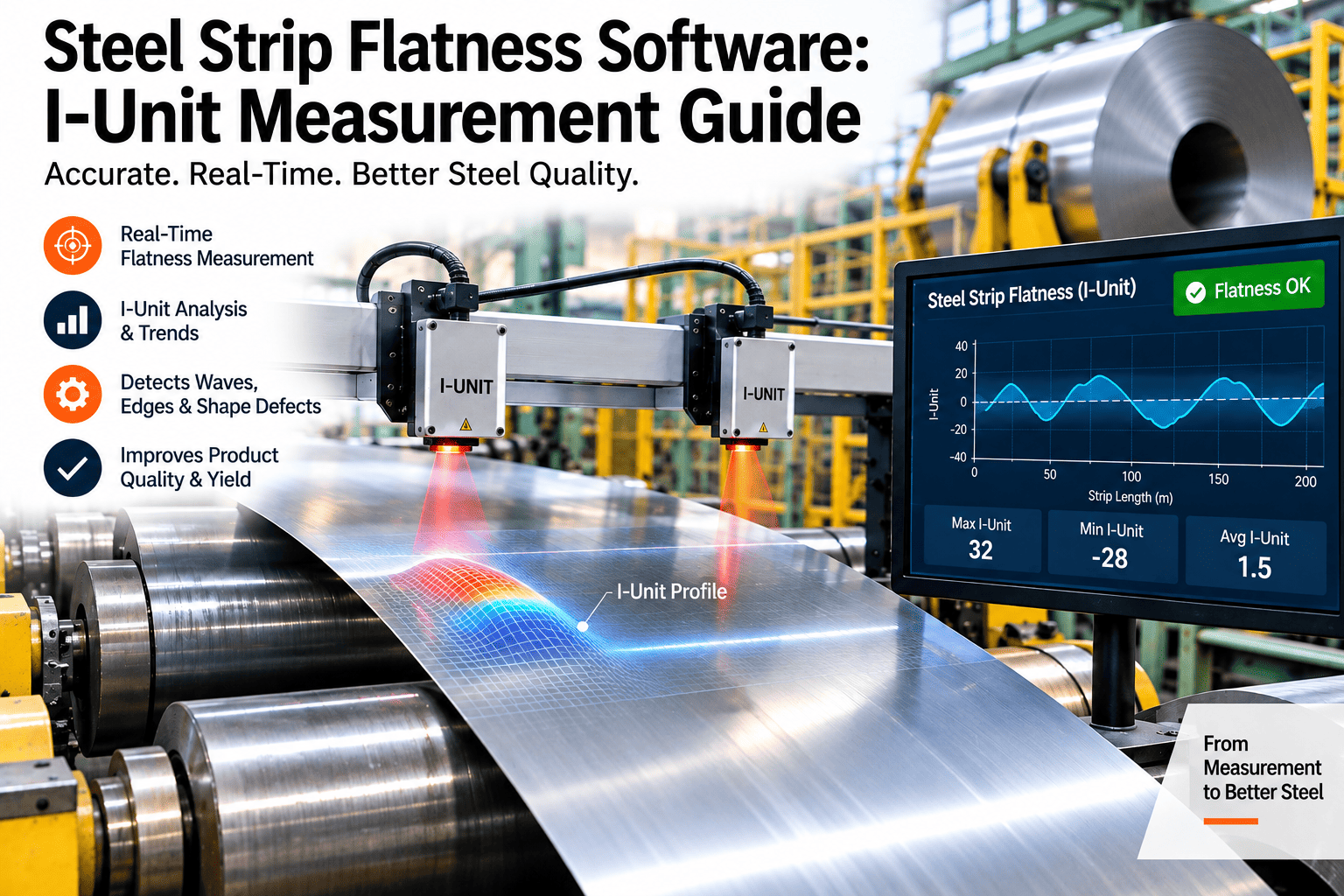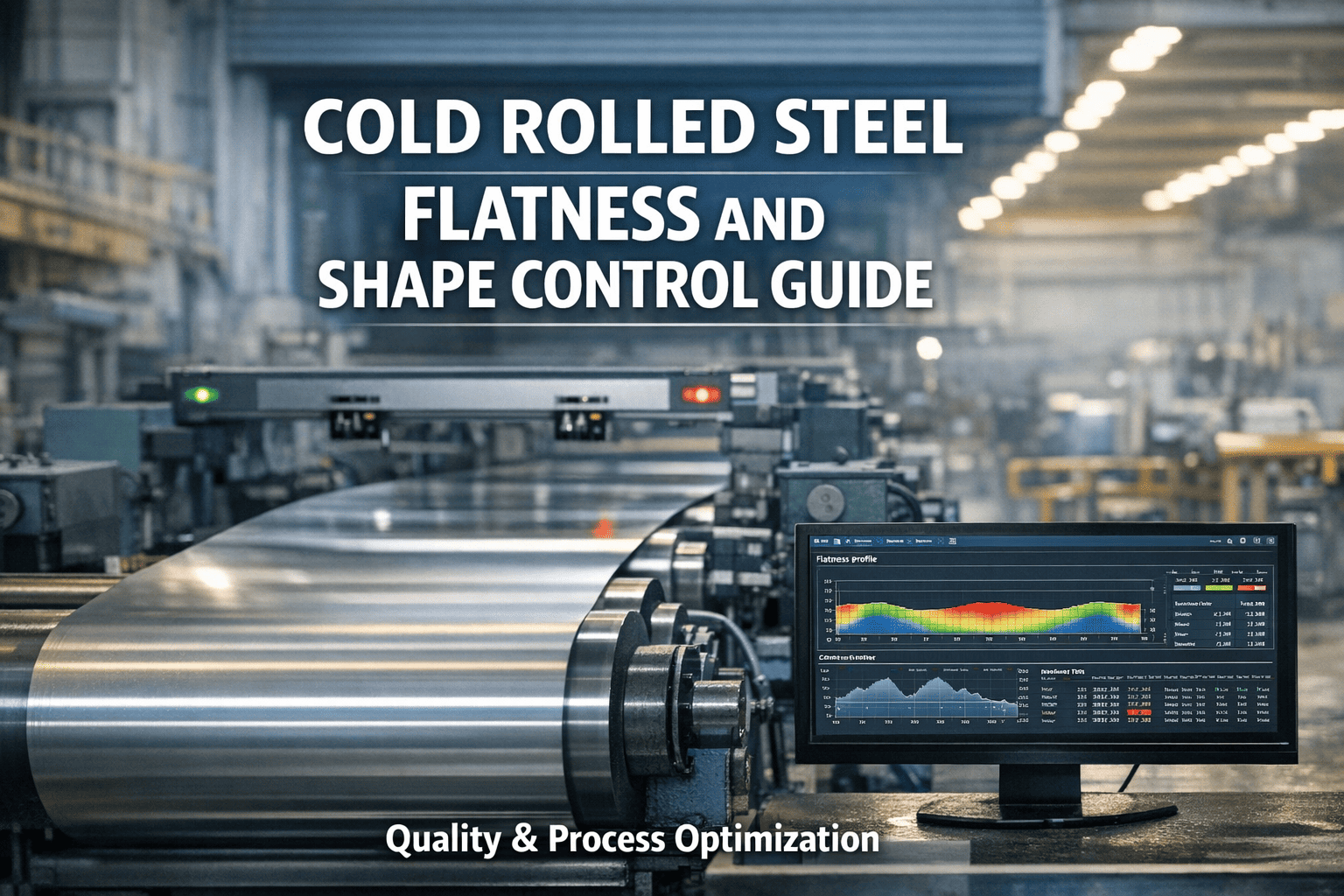
Flatness defects are the silent rejection mechanism of cold rolled steel. A coil that passes thickness tolerance and surface inspection can still be rejected at the automotive stamping press if wavy edge or center buckle pushes I-unit values above the customer specification — and automotive exposed grades now routinely require less than 5 I-units. Most mills measure flatness at the exit of the last stand with a single shapemeter roll, react to defects coil-by-coil, and never correlate repeated shape issues back to work roll wear campaigns, coolant header imbalance, or actuator drift. Oxmaint's Analytics & Reporting platform ingests shapemeter data, correlates flatness deviation with process and equipment parameters, and triggers maintenance work orders when actuator response signatures show degradation — turning flatness from a reactive quality problem into a predictable, measurable process.
The Six Flatness Defect Families — What They Look Like and What Causes Them
Flatness defects are not random — they are the geometric signature of specific process or equipment conditions. Reading a shapemeter trace is reading a fingerprint of what is happening inside the mill. The six families below cover virtually all flatness defects encountered on tandem and reversing cold rolling mills. Rolling mill flatness monitoring maps each family to its upstream actuator and equipment condition.
Wavy Edge (Edge Buckle)
Edges elongate more than center — strip edges appear wavy on both sides. Caused by work roll concave wear, excessive bending, or edge thickness under-reduction. Most common defect on tandem mills with aged roll campaigns.
Center Buckle (Full Shape)
Center of strip longer than edges — wavy pattern down the middle. Caused by excessive center thickness reduction, work roll crown mismatch, or center-heavy coolant header flow causing thermal crown loss.
Quarter Buckle
Waviness between edge and center (quarter-width zones). Complex defect requiring multi-zone actuator correction. Traces to uneven thermal crown, work roll thermal profile, or coolant header imbalance at specific zones.
Asymmetric Edge Wave
One edge longer than the other. Points to drive-side/operator-side imbalance — uneven work roll bending force, stand tilt, or differential coolant spray. Diagnostic signature of mechanical drift on one side.
Camber
One edge of strip elongates more than the other, causing lateral curve along length. Caused by misaligned work rolls, uneven pressure distribution, or worn slitter knives during coil processing. Measured by straight-edge deviation.
Coil Set & Cross Bow
Coil set: longitudinal bow from coil memory. Cross bow: edges bow up or down across width (smiley/frowning face). Corrected through tension leveling or stretch leveling post-rolling rather than at mill stand.
Shapemeter Technologies — Three Sensor Principles That Measure the Same Thing Differently
The flatness sensor is the heart of the Automatic Flatness Control (AFC) system. Three sensor technologies dominate modern installations, each measuring strip tension distribution or geometric deviation through a different physical principle. Selection depends on mill speed, strip gauge, and measurement resolution required.
BFI Principle Shapemeter Roll
Solid roll body with quartz piezoelectric force sensors distributed across the width. Measures tensile force distribution — differences in strip length tensions. Signals amplified in the roll, digitised, and transferred via optical wear-free rotary transmitter.
Air Bearing Shapemeter
Array of jets supplies each rotor with air from central arbor chamber. Differential pressure between top and bottom of each rotor is proportional to applied load — calculating tension at each rotor position across width. Rotor widths 25–120 mm for resolution tuning.
FBG Optical Sensing
Latest generation. Pressure-induced strain sensing on segmented blades using fiber optic sensors. Spatial resolution down to 5 mm, operating range 0.1–1.0 mm strip thickness. Synchronous profile measurement rejects tension disturbances.
IP-4 Electro-Optical Shapemeter
Illuminator + TV camera on opposite sides of roller conveyor after finishing stand. Directly measures geometric buckle as distribution of elongations. No strip contact — no scratching risk on thin gauge, no vibration influence. Costs 3–7× less than contact systems.
Live Shape Control Dashboard — What AFC + CMMS Integration Looks Like
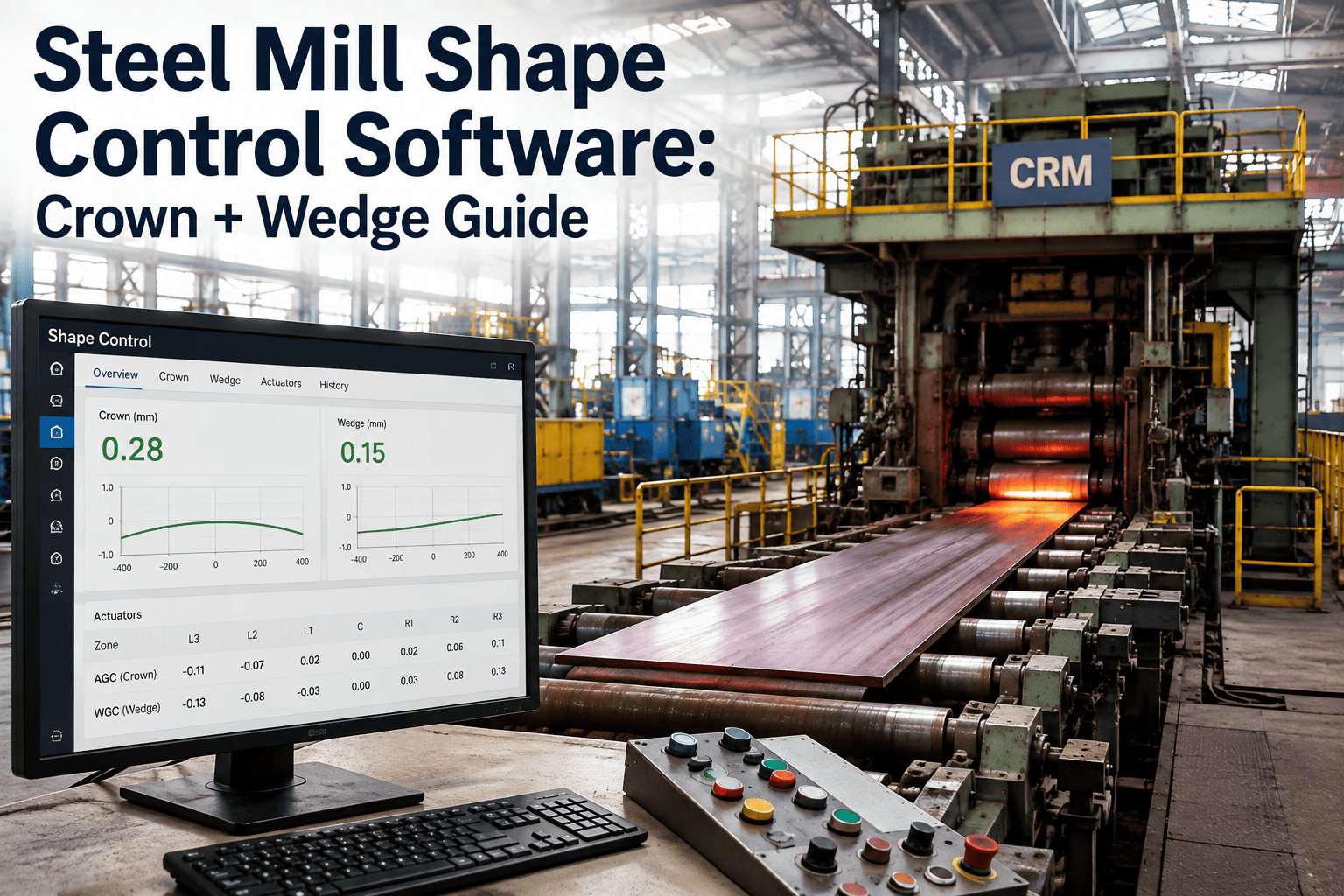
When shapemeter data flows into both the AFC control loop and the CMMS, deviations trigger not just actuator corrections but maintenance work orders when the correction pattern itself indicates equipment drift. The feed below shows what closed-loop shape control looks like on a 6-stand tandem mill.
Stop Treating Flatness as a Black Box. Treat It as the Process Signal It Is.
Oxmaint connects shapemeter data to process parameters and equipment condition so actuator drift, coolant imbalance, and roll wear are caught before they become rejected coils.
Shape Actuators — The Tools the AFC System Uses to Correct Defects
The shapemeter measures. The actuators correct. Each actuator has a specific influence zone and defect type it can address — and each has a failure signature that shows up in the AFC response log before it shows up in the coil quality data.
| Actuator | Defect Addressed | Response Time | Failure Signature |
|---|---|---|---|
| Work roll bending (positive) | Wavy edge | Fast (< 200 ms) | Saturation at max — bending circuit leak |
| Work roll bending (negative) | Center buckle | Fast (< 200 ms) | Response lag — hydraulic valve drift |
| Intermediate roll shifting (6-hi) | Quarter buckle / asymmetric | Medium (1–3 s) | Position feedback error — encoder fault |
| Work roll shifting (CVC) | Edge drop / contour | Medium (2–5 s) | Shift mechanism binding — lubrication |
| Selective coolant spray (ISV) | Thermal crown / buckle | Slow (5–30 s) | Nozzle blockage — flow sensor alert |
| Stand tilt (differential screw-down) | Camber / asymmetric | Slow (3–10 s) | Differential drift — screw calibration |
| Inter-stand tension trim | Cross-stand shape transfer | Fast (< 500 ms) | Tension measurement drift — load cell |
Maintenance-Driven Shape Stability — The PM Practices That Keep Flatness in Spec
Work Roll Profile Verification
Measure ground roll crown against campaign plan before installation. Verify thermal crown predictions against previous campaign data. Roll campaign ageing is the #1 cause of progressive edge wave.
Bending Cylinder & Hydraulic Circuit
Check bending force response curves against baseline. Pressure drop in the bending circuit causes actuator lag — visible in AFC log before flatness drifts out of spec.
Coolant Header Flow Audit
Verify flow from each nozzle header using in-line flow meters. Partial blockage changes thermal crown asymmetrically — the most common cause of quarter buckle.
Shapemeter Calibration
Validate sensor readings against known reference load. IMS and IHI shape rolls support in-line calibration without removal. FBG and ABSM require different procedures per OEM manual.
Actuator Response Baseline
Step-test each actuator and log response time and position accuracy. Drift from baseline precedes visible flatness degradation by 2–4 weeks — critical predictive window.
Stand Tilt & Mill Alignment
Full stand alignment audit during major roll change. Differential screw-down drift produces camber that cannot be corrected by any other actuator — catches the defect at its root.
"The mills that hit 5 I-unit automotive exposed consistently are not the ones with the newest shapemeter rolls. They are the ones that treat the AFC system as a diagnostic tool rather than a correction tool. When a shapemeter trace shows actuator saturation on stand F5 three coils before the defect appears at F6 exit, that is a maintenance signal — not a process signal. Plants that catch these early signatures in the CMMS and trigger preventive action on work rolls, bending circuits, and coolant headers operate in a different quality league than plants that only see flatness at the exit coiler. The difference is not technology; it is whether your shape data flows into your maintenance system or dies in the Level 2 log."