AI Demand Forecasting for Steel: Smarter Production Planning
By Lebron on February 23, 2026
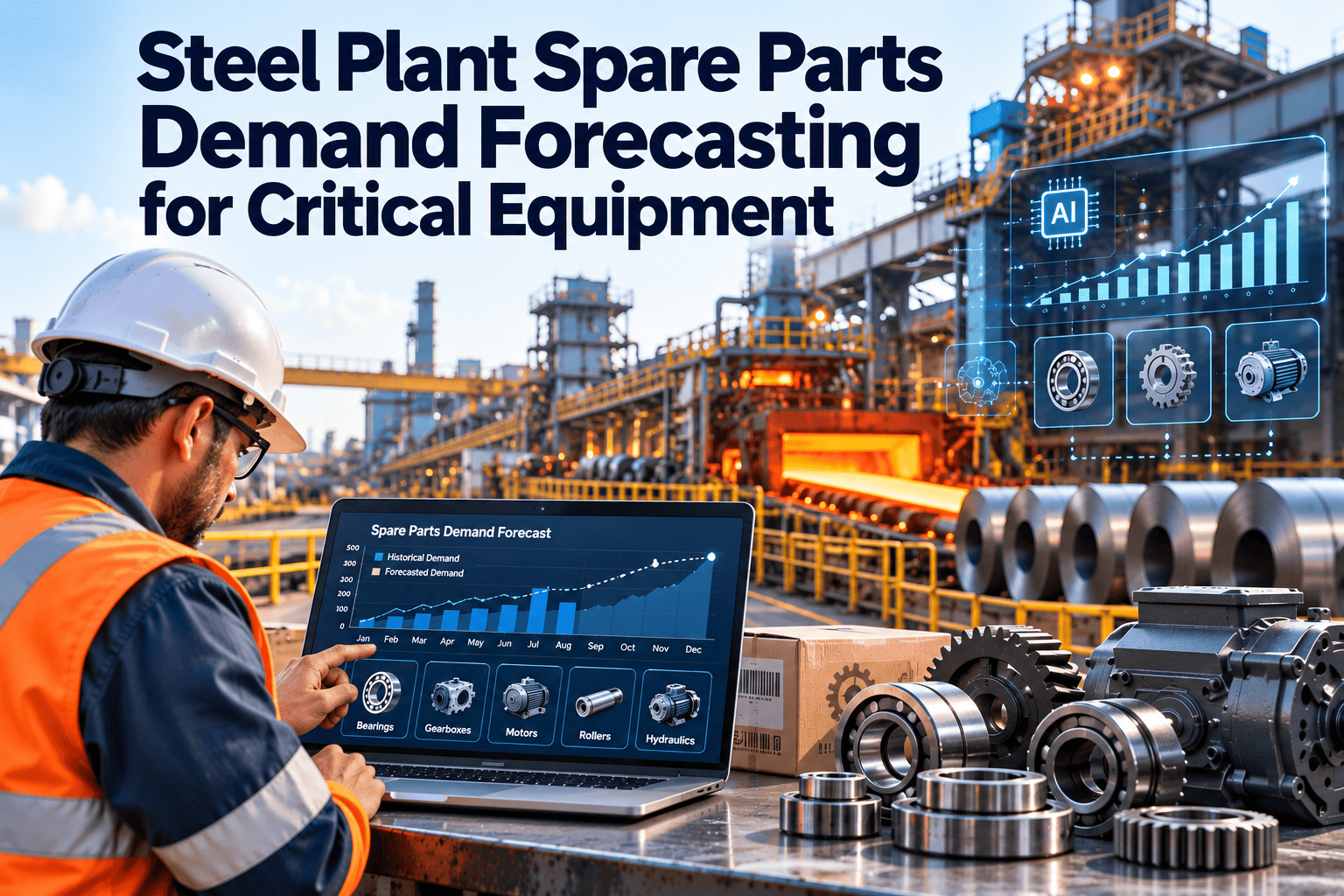
Your sales team just booked a 12,000-ton order for structural steel beams with a 6-week delivery window. Your production planner opens the schedule and sees the hot strip mill is already committed at 94% capacity for the next four weeks, the plate mill has a planned reline starting in week three, and the raw material pipeline has a 3-week lead time on the specific slab grade this order requires. He calls the sales director: "We can't make the delivery date." The sales director calls the customer: "We need eight weeks, not six." The customer calls a competitor. This scenario plays out in some form every week at steel companies that plan production based on what's already been ordered rather than what's about to be ordered. Traditional production planning is reactive — it responds to confirmed orders and adjusts capacity after commitments are made. AI demand forecasting is predictive — it analyzes historical order patterns, market signals, customer behavior, seasonal trends, macroeconomic indicators, and supply chain conditions to project demand 4–12 weeks before orders arrive. The difference is the difference between scrambling to meet deadlines you didn't see coming and pre-positioning capacity, raw materials, and production schedules for demand that hasn't materialized yet but almost certainly will. Steel companies using AI demand forecasting don't produce faster — they produce smarter. They start slab procurement three weeks earlier because the model projected a structural beam surge. They shift rolling schedules before bottlenecks form. They quote delivery dates they can actually meet because the capacity was already allocated before the customer called.
Traditional Forecasting
Spreadsheet-based, human judgment, monthly updates, historical averages
Demand Signals: What the AI Reads That Humans Can't
A human planner can track a handful of demand indicators — confirmed orders, seasonal patterns, and maybe one or two market reports. An AI forecasting model ingests dozens of demand signals simultaneously, weighting them dynamically based on which signals have been most predictive for each product, customer, and time horizon.
Internal Signals
Order Book & Pipeline
Confirmed order backlog by gradeQuote-to-order conversion ratesCustomer reorder cycle patternsOrder cancellation / modification trends
Signal weight: High — most predictive at 0–4 week horizon
Signal weight: Medium — influences order timing and volume
External Signals
Macroeconomic Indicators
PMI manufacturing indexInterest rate trajectoryGDP growth forecastsIndustrial production indices
Signal weight: Medium — most predictive at 8–12 week horizon
External Signals
Supply Chain & Logistics
Port congestion / shipping ratesRaw material lead time changesSupplier capacity constraintsTransportation availability indices
Signal weight: Low-Medium — affects timing more than volume
Steel operations that sign up for AI-integrated demand forecasting connect these signal streams to their production planning system — so forecast updates flow directly into capacity allocation, raw material procurement, and rolling schedule optimization.
Forecast Horizons: Different Decisions Need Different Windows
Not all planning decisions operate on the same time horizon. Raw material procurement needs a 12-week view. Rolling schedule optimization needs a 4-week view. Daily melt shop sequencing needs a 1-week view. The AI forecasting system produces layered forecasts at multiple time horizons, each calibrated for the decisions it supports.
Forecast Horizons — Layered Planning Windows
1–2 Weeks
Operational Forecast
Accuracy: 92–96%
Near-term demand by specific grade, width, gauge, and customer. Drives daily melt shop sequencing, rolling mill scheduling, and logistics planning.
Aggregate demand by market segment, product line, and geography. Drives capital planning, workforce planning, contract negotiations, and inventory strategy.
See Demand Before It Arrives. Plan Production Before It's Urgent.
OXmaint's AI demand forecasting integrates with your production planning system — layered forecasts at 1-week, 6-week, and 12-week horizons driving raw material procurement, capacity allocation, rolling schedules, and delivery commitments. Predict demand. Pre-position capacity. Deliver on time.
Every AI forecast is measured against actual demand when the forecast window closes. The deviation between forecast and actual is the model's learning signal — telling it which demand signals were overweighted, which were underweighted, and where the model's assumptions about customer behavior or market conditions were wrong. Teams evaluating forecasting solutions can book a free demo to see how forecast accuracy is tracked and improved continuously.
Forecast vs. Actual — Weekly Accuracy Tracking (Hot Rolled Coil)
Wk 1
28.4K
29.8K
−4.7%
Wk 2
31.0K
30.2K
+2.6%
Wk 3
32.8K
33.1K
−0.9%
Wk 4
26.2K
24.8K
+5.6%
Wk 5
32.1K
31.4K
+2.2%
AI ForecastActual DemandMean Absolute Percentage Error (MAPE): 3.2% — within best-practice threshold of 5%
Scenario Planning: What If Demand Shifts?
Demand doesn't follow a single path. Tariff announcements change order timing. Construction slowdowns shift product mix. A competitor's mill outage redirects volume. AI scenario planning models multiple demand futures simultaneously — so production planning can prepare for the most likely outcome while having contingencies ready for alternatives.
Scenario Planning — Q2 Demand Outlook
BASE CASE
65% probability
Steady Growth
Construction permits +4% YoY, auto production flat, no trade disruptions. Demand continues on current trajectory.
Volume142K tons
Mix60% HRC / 25% CRC / 15% Plate
Capacity need91%
Action: Proceed with standard procurement and scheduling
UPSIDE
20% probability
Infrastructure Acceleration
Federal infrastructure spending releases earlier than expected. Structural and plate demand surges. Competitor capacity constrained by planned outage.
Production Alignment: From Forecast to Floor Schedule
A forecast is only valuable if it changes production decisions. The AI demand forecasting system doesn't produce reports that sit in email — it feeds directly into production planning, triggering procurement actions, capacity adjustments, and schedule changes automatically as forecasts update. Operations connecting forecasting to production planning should sign up to see how forecast-driven scheduling works.
Forecast-to-Production Alignment Matrix
Forecast Signal
Production Response
Lead Time
Auto/Manual
Demand increase >10% in Grade X
Trigger slab procurement for Grade X feedstock
3 weeks
Auto
Product mix shift toward plate
Reallocate rolling mill capacity — increase plate, reduce coil
2 weeks
Review
Customer reorder probability >85%
Pre-position slab inventory for anticipated order
4 weeks
Auto
Aggregate demand exceeds capacity 95%
Flag delivery risk — recommend outage deferral or overtime
6 weeks
Escalate
Seasonal cooling demand pattern detected
Reduce procurement, schedule planned maintenance
8 weeks
Review
Expert Perspective: The Forecast Isn't a Number — It's a Decision Engine
I've implemented demand forecasting at six steel companies, and the biggest mistake every one of them made initially was treating the forecast as a report. They'd generate a weekly demand forecast, email it to production planning, and expect someone to translate the numbers into procurement orders, schedule changes, and capacity decisions. It didn't work. A forecast that requires a human to read it, interpret it, and manually adjust production plans is a forecast that's always three days behind reality. The companies that got value from AI forecasting were the ones that connected the model's output directly to their production planning system — so when the forecast for structural beam demand increased by 12%, the slab procurement order was automatically adjusted, the rolling schedule was flagged for rebalancing, and the delivery commitment system updated available-to-promise dates in real time. The forecast didn't generate a report. It generated actions. That's the difference between a forecasting project and a forecasting system. The project produces interesting charts. The system produces better production decisions.
Forecast in Tons, Not Dollars
Production planning needs volume by grade, width, and gauge — not revenue projections. Build the forecast in the units your melt shop and rolling mills consume. Translate to revenue for management reporting, but plan in physical units.
Measure MAPE Religiously
Mean Absolute Percentage Error is your single most important forecast quality metric. Track it by product, by horizon, by customer segment. Below 5% MAPE at the 4-week horizon is world-class. Above 10% means the model needs retraining or new signals.
Let Humans Override — Then Learn
Planners know things the model doesn't — a customer hint about a big order, a rumored tariff change, an equipment issue at a competitor. Let them adjust the forecast manually, but track every override and measure whether the human or the model was more accurate.
Predict Demand. Pre-Position Capacity. Deliver Every Promise.
OXmaint's AI demand forecasting reads market signals, customer patterns, and macroeconomic indicators to project demand 4–12 weeks ahead — then feeds those forecasts directly into procurement, scheduling, and capacity planning. Stop reacting to orders. Start anticipating them.
What is AI demand forecasting for steel production?
AI demand forecasting for steel production uses machine learning models to predict future demand for steel products by grade, specification, and time period. Unlike traditional forecasting methods that rely on historical averages and human judgment, AI models ingest multiple demand signal streams simultaneously — confirmed order backlog, customer reorder patterns, construction permit data, automotive production schedules, commodity price movements, macroeconomic indicators, and seasonal patterns. The models identify complex relationships between these signals and actual demand outcomes, learning which combinations of signals best predict demand for each product type at each time horizon. The output is a probabilistic forecast that tells production planners not just "we expect 32,000 tons of HRC next month" but "we expect 32,000 tons with 85% confidence, with a range of 29,000–35,000 tons, driven primarily by construction sector strength and stable auto production." This enables production planning decisions that account for both the most likely outcome and the range of plausible alternatives.
How accurate is AI demand forecasting compared to traditional methods?
Traditional steel demand forecasting — typically based on spreadsheet models, moving averages, and planner judgment — achieves forecast accuracy (measured by Mean Absolute Percentage Error or MAPE) of 45–60% at a 4-week horizon for product-level forecasts. AI-based forecasting typically achieves 82–92% accuracy at the same horizon, representing a 30–40 percentage point improvement. The accuracy advantage comes from three capabilities that human forecasters cannot replicate: the ability to process dozens of demand signals simultaneously and weight them dynamically, the ability to detect non-linear relationships between signals and demand (such as the interaction between interest rates, construction permits, and structural steel demand), and the ability to learn continuously from forecast errors, automatically adjusting the model as market conditions change. Accuracy varies by forecast horizon — near-term forecasts (1–2 weeks) typically achieve 92–96% accuracy, while longer-term strategic forecasts (8–12 weeks) achieve 78–85%. The model is most accurate for products and customers with stable, repeatable ordering patterns and least accurate for new products or customers with volatile ordering behavior.
What data does the AI forecasting model require?
The model requires two categories of data. Internal data includes historical order data (minimum 2–3 years, ideally 5+) with order date, product specification, tonnage, customer, and delivery date; current order backlog and quote pipeline; production records showing actual output by product; and inventory levels for finished goods and work-in-process. External data includes macroeconomic indicators (PMI, GDP, industrial production index), downstream industry metrics (construction permits, auto production schedules, appliance manufacturing), commodity prices (scrap, iron ore, HRC/CRC spot and futures), and trade data (import/export volumes, tariff changes). The model operates on whatever data is available — more signals generally produce better forecasts, but a model built on just historical orders and basic macro indicators will still significantly outperform spreadsheet-based forecasting. The system automatically handles missing data, irregular time series, and data quality issues that would break traditional statistical models.
How does scenario planning work in AI demand forecasting?
Scenario planning extends the single-point forecast into a range of plausible demand futures, each associated with a probability and a set of triggering conditions. The AI model generates scenarios by varying the key demand drivers — what happens if construction starts accelerate by 8% instead of the expected 3%? What if auto production cuts are announced? What if a competitor's mill goes down for an unplanned outage? Each scenario produces a complete demand forecast by product, volume, and timing, along with the production planning implications. Typically, the system maintains three active scenarios: a base case (highest probability), an upside case (demand acceleration), and a downside case (demand contraction). Production planners use the base case for primary scheduling while maintaining contingency plans aligned with the alternative scenarios. As new data arrives — a construction report, an economic indicator, a customer order pattern — the probabilities shift in real time, and the system alerts planners when an alternative scenario becomes more likely than the base case.
How does the demand forecast integrate with production planning?
The demand forecast integrates with production planning through automated decision rules that translate forecast signals into planning actions. When the forecast for a specific grade increases beyond a threshold, the system automatically adjusts slab procurement orders to ensure feedstock arrives in time for the projected demand. When product mix shifts are detected, the system flags rolling mill capacity reallocation needs for planner review. When aggregate demand approaches capacity limits, the system escalates to management with options — defer maintenance, authorize overtime, or adjust delivery commitments. Customer-level forecasts update the available-to-promise system so sales can quote delivery dates based on actual projected capacity, not estimates. The integration ensures that forecast improvements translate directly into better production decisions without requiring manual interpretation or re-entry. The planner's role shifts from translating forecast numbers into production plans to reviewing and refining the system's recommendations — overriding when human judgment adds value and confirming when the model's logic is sound.