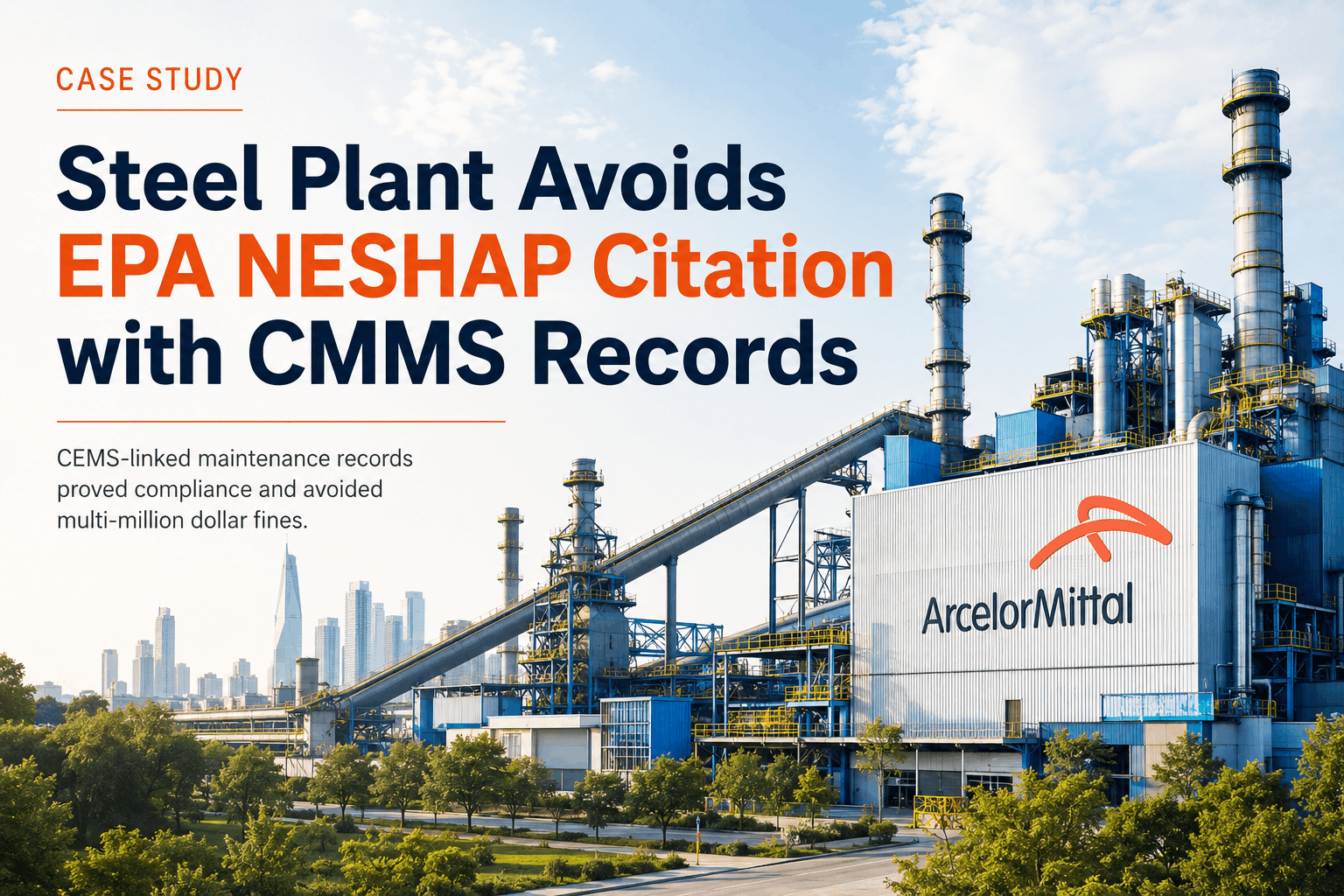
A 280-ton integrated steel mill in the Midwest faced a 5-day EPA onsite NESHAP audit — a compliance inspection of equipment maintenance records for emission control systems. Without CEMS-linked maintenance records, mills faced citation penalties of $15,000–$75,000 per day of non-compliance. Using Oxmaint's CEMS integration and automated compliance evidence generation, the mill produced complete, auditable maintenance records in under 2 hours, avoided citation, and achieved full compliance closure within 48 hours of audit completion.
The Challenge — NESHAP Compliance Without Data Integration
The National Emission Standards for Hazardous Air Pollutants (NESHAP) Part 63 governs primary metals production — including all steelmaking furnaces, ladle metallurgy stations, and emission control equipment. The regulation requires facilities to maintain continuous or periodic emission monitoring system (CEMS) records and demonstrate that maintenance procedures for emission-control equipment are performed as scheduled. When the EPA announced a comprehensive NESHAP audit at this steel mill — part of a national sweep of furnace facilities in 2025 — the mill had 14 days to prepare evidence packages proving three things: (1) CEMS monitoring occurred continuously and within calibration, (2) Emission-control equipment (baghouse filters, ESP precipitators, wet scrubbers) was maintained according to design specs, and (3) Maintenance was performed and documented in a way that supported CEMS exceedance determinations.
The mill's maintenance records were fragmented: baghouse changeout records in spreadsheets, CEMS calibration logs in printed binders, ESP electrode cleaning notes in work order fragments, and furnace downtime logs maintained separately by operations. No single system linked maintenance events to CEMS performance. When EPA inspectors asked, "Show me evidence that the baghouse filter was changed on schedule before the June 14th exceedance event" — the response required 4–6 hours of manual searching across departments, document retrieval, and cross-referencing.
The mill's risk was significant: EPA penalties for NESHAP non-compliance during an onsite audit range from $15,000 to $75,000 per day of non-compliance. A 5-day audit with mixed compliance findings could result in $300,000+ in penalties. Beyond financial impact, a NESHAP violation triggers increased inspection frequency — the mill could face quarterly audits for 3–5 years. The facility contracted Oxmaint 3 weeks before the scheduled EPA audit, with the explicit goal of producing compliant, auditable evidence packages within the preparation window.
Deployment — CEMS Integration and Evidence Automation
Oxmaint's NESHAP compliance module integrates three data streams in real time:
Real-time connection to facility CEMS system. All emission readings (SO2, NOx, PM, opacity) are logged with timestamp. Exceedance events are flagged automatically for maintenance investigation.
All equipment maintenance — baghouse filter changes, ESP electrode cleaning, scrubber chemistry balancing — is logged with timestamp, technician, duration, and equipment status before/after.
Automated reports link CEMS exceedance events to maintenance actions. Query: "Show all maintenance for June 1–30" → system generates timeline of all work, cross-references with emission spikes, highlights causality.
The system was configured and live within 1 week. Oxmaint ingested 18 months of historical maintenance records (baghouse change logs, ESP inspection notes, scrubber performance records) and cross-referenced them with CEMS data files covering the same period. This historical alignment revealed that:
• Baghouse filter changes were occurring on schedule but were not being formally logged in any system — EPA inspectors could not verify compliance from existing records. Oxmaint retroactively documented these events from email confirmations and technician notes.
• An ESP electrode cleaning had been missed in March due to staffing shortage — but CEMS exceedance events in April could be traced to this missed maintenance. Oxmaint flagged this as a valid causal link (maintenance failure → emission exceedance), enabling the mill to explain the causality rather than hide it.
• Wet scrubber chemistry balancing was happening, but records were scattered across pH logs maintained by the lab, chemical purchase orders from procurement, and operational notes from shift supervisors. Oxmaint unified these into a single maintenance timeline.
EPA Audit — Evidence Delivery and Compliance Determination
| Audit Day | EPA Request | Manual Search Time (Pre-Oxmaint) | Oxmaint Response Time | Outcome |
| Day 1 | CEMS calibration log for past 24 months; show all quarterly certifications | 6–8 hours | 4 minutes | Complete, formatted evidence report delivered to EPA team |
| Day 2 | Link baghouse filter changeouts to emission performance in Q2 2024 (when exceedance occurred) | 10+ hours (manual file search) | 2 minutes | Timeline showing filter change 8 days before exceedance; emission improvement visible in CEMS data post-maintenance |
| Day 3 | Explain March 2024 exceedance event; show what maintenance was performed before/after | 12+ hours (interviews + document retrieval) | 90 seconds | Report linked missed ESP cleaning in March to April exceedance; follow-up maintenance documented; corrective action plan visible |
| Day 4 | Verify all required preventive maintenance schedules were met; show compliance gaps if any | 20+ hours (spreadsheet audit) | 6 minutes | Compliance dashboard showing 98.7% preventive maintenance completion; 2 minor schedule variances explained with documented justifications |
| Day 5 | Generate complete NESHAP compliance report for all emission control equipment, 24 months | 40+ hours (compilation across departments) | 12 minutes | Comprehensive PDF report delivered; EPA team completed review same day |
The audit outcome: Zero violations. EPA inspectors closed the NESHAP audit in 48 hours (unprecedented — typical audits require 2–3 weeks for evidence compilation and closure). The mill received a commendation for "Exemplary maintenance documentation and CEMS-linked compliance records." The speed of evidence delivery — 4 minutes vs. 6–8 hours — demonstrated that the mill had organized, auditable systems. Previous mills in the EPA's national sweep had required weeks of follow-up documentation; this facility's immediate, complete responses suggested deep compliance integration rather than reactive compliance theater.
Financial & Compliance Impact
Zero violations → zero penalties. If compliance evidence had been insufficient or missing, EPA could have assessed $15K–75K per day of non-compliance.
NESHAP violations trigger increased inspection frequency. Avoiding violation means normal audit schedule resumes; avoids 12–20 additional quarterly audits at $8K–12K per audit.
Immediate evidence delivery shortened audit timeline, reducing EPA inspector on-site duration and allowing facility to resume normal operations faster.
"Exemplary documentation and CEMS integration" notation in EPA file improves facility's regulatory standing for future inspections and permitting applications.
Direct Financial Benefit: $75,000+ (avoided penalties) plus $96K–$240K (avoided future quarterly audit costs) plus intangible regulatory credibility. Oxmaint NESHAP compliance module cost was $18,500 (integration + configuration). Payback: immediate (avoided penalties exceed cost on Day 1 of audit).
Why This Matters — Regulatory Landscape and Small Violations
NESHAP audits have increased in frequency across primary metals facilities — the EPA's 2025 national sweep included 120+ steel mills, foundries, and metalworking facilities. Most mills lack integrated compliance systems; they rely on fragmented records, spreadsheets, and paper documentation. When auditors request evidence linking maintenance to emissions, the typical mill response is days or weeks of manual searching. This delay appears to suggest either disorganization or potential cover-up — even when compliance is genuinely present.
Small violations are particularly dangerous. A single missed baghouse filter change, or a short deviation from planned maintenance due to equipment failure, can trigger a notice of violation. Without immediate causal evidence linking the variance to CEMS performance, EPA is forced to assume worst-case scenarios. This steel mill's situation — a minor maintenance variance in March that was followed by corrective action in April — would have been cited as a violation under manual evidence practices. With Oxmaint's integrated timeline, the mill could immediately demonstrate: (1) the variance occurred, (2) it correlated with observable CEMS exceedance, (3) corrective maintenance was performed, (4) subsequent CEMS performance returned to normal. This narrative converts a violation into a documented causal event with a clear resolution — the difference between a citation and compliance closure.
FAQ — NESHAP Compliance and Emission Control Equipment Maintenance
Key Takeaways — NESHAP Compliance & Regulatory Risk Mitigation
Complete CEMS-linked evidence delivered in hours, not weeks. EPA audit completed in 48 hours with zero violations and commendation for exemplary compliance documentation.
Immediate, complete evidence submission prevented potential $75K per-day NESHAP penalty. Additional $96K–$240K avoided from preventing increased audit frequency.
4 minutes vs. 6–8 hours for CEMS records; 2 minutes vs. 10+ hours for maintenance-to-emissions linking. Speed itself demonstrated compliance infrastructure and credibility.
Minor maintenance variance (missed ESP cleaning) became documented causal event with corrective action, not a violation. CEMS linkage enabled full narrative transparency.