A 2.2 MTPA midwest integrated steel plant operating three 280-ton basic oxygen furnaces (BOFs) faced a critical capital constraint: BOF relines occurred every 3–5 years per converter and required 18–24 days of planned downtime during which the entire melt shop was offline. Each day of lost production cost $145,000 in lost revenue. A 22-day reline outage cost $3.19 million in production losses alone, plus another $1.8–2.2 million in refractory materials and contractor labor. The plant's challenge was that reline planning and execution were fragmented: refractory procurement, contractor coordination, sequencing, parts pre-staging, and quality inspections were managed separately with no integrated timeline. Reline duration routinely slipped by 2–4 days beyond plan, extending production loss. Within 6 months of implementing Oxmaint's shutdown planning and execution module, including integrated procurement tracking, contractor scope lock, and sequential work order management, the plant reduced BOF reline duration from an average of 22 days to 16 days — a 27% reduction that saves $870,000 per reline event. With three converters requiring relining on a staggered schedule, this improvement delivered $2.6 million in cumulative production savings over a 5-year period. This case study details the shutdown work pack structure, the procurement lead time optimization, the contractor sequencing strategies, and the verification protocols that compressed reline duration while improving quality and safety.
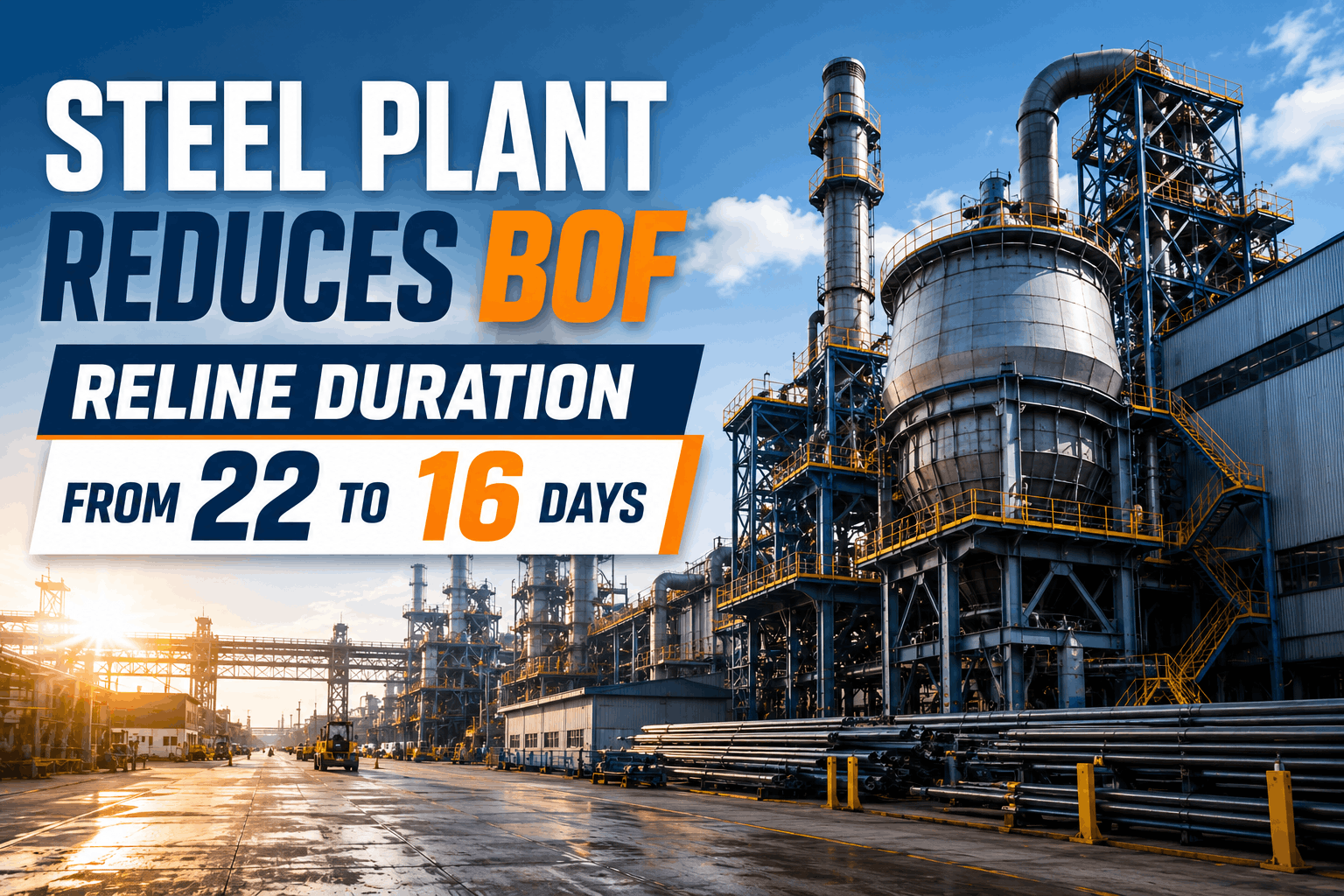
Steel Plant Reduces BOF Reline Duration From 22 to 16 Days
Reline duration reduction of 27% achieved through integrated shutdown work pack planning, pre-staged materials, and contractor scope lock. A 2.2 MTPA integrated mill saves $870,000 per converter reline while improving safety compliance and refractory quality consistency.
Why BOF Relining Typically Overruns Schedule: The Fragmented Approach
BOF converter relining is one of the most complex maintenance events in steelmaking: a 280-ton vessel lined with magnesia-carbon bricks and specialty refractories, requiring staged demolition of 200+ tons of worn lining, shell inspection and repair, complete new lining installation, and mechanical testing — all within a 16–24 day window to maintain production schedule. This plant's relining process had four critical failures in planning and execution:
Refractory materials (MgO-C bricks, MgO-C mortar, specialty bricks for tap hole and riser, castables for bottom lining) came from multiple suppliers with different lead times: 8–12 weeks for custom brick specifications, 6–8 weeks for standard bricks, 4–6 weeks for mortar and castables. The plant's procurement team placed orders as a single "reline kit" purchase instead of coordinating delivery dates to match the actual 16-day work window. Result: materials arrived in waves, some 6 weeks before the reline (requiring on-site storage and risk of damage), others arriving just-in-time, creating logistics bottlenecks. Materials sat in staging areas for weeks, increasing damage risk and preventing the facility from accepting other shipments.
The plant contracted lining demolition and installation to a specialist contractor. The scope of work (materials to demolish, lining design, quality specs, equipment needs) was defined in a general statement of work but with incomplete detail. During execution, the contractor would discover undocumented shell repairs needed, additional lining zones requiring different refractory grades, or equipment constraints (cooling water supply, hoist capacity) requiring scope modifications. These changes, agreed verbally on-site, expanded the work timeline. Historically, relining stretched from 20 days to 22–25 days as scope became clearer during execution.
BOF reline work has logical dependencies: demolition must complete before shell inspection; shell inspection and repairs must complete before new lining installation; lining installation must complete before heat trials. Without integrated scheduling, the transitions between phases created delays. A 1-day slip in demolition pushed shell inspection back 1 day, which pushed installation back 1 day, which slipped the final heat trial. These ripple effects stretched the schedule. The plant had no visibility into critical path dependencies — when a task was late, there was no immediate alert that downstream phases were impacted.
Shell inspections and lining quality verification were performed by internal technicians and the contractor. If inspection discovered cracking in the refractory that required repair, the work order to fix it would compete with ongoing installation work. This created pressure to "pass" marginal quality or defer repair until after the converter returned to service — risking future failures. Without structured quality checkpoints with explicit hold points, quality issues were discovered late, when fixing them was expensive in terms of schedule impact.
Integrated Shutdown Work Pack: Planning, Sequencing, and Execution
Oxmaint's shutdown planning module converted the fragmented reline approach into an integrated work pack: a single project plan spanning 6 months of advance planning through 16 days of execution, with all procurement, contractor coordination, sequencing, and quality verification steps linked into a master timeline.
Refractory Scope Definition — Oxmaint pulled historical reline records: what lining design was used in the previous reline, what refractory grades, what quantities, what lead times. For this BOF, the design was stable: 2,400 bricks of MgO-C main lining, 140 specialty bricks for tap hole and riser, 45 tons of refractory castable for bottom. But Oxmaint also tracked slag chemistry data: this facility had lower FeO slag than the manufacturer assumed. The refractory grades were adjusted — substituting a more erosion-resistant grade in the slag line, reducing cost by 8% while improving campaign life.
Procurement Timeline Locked — With refractory spec finalized by month 2, Oxmaint triggered purchase orders to three suppliers: custom specialty bricks (12-week lead time → ordered by week 8), standard bricks (10-week lead time → ordered by week 10), mortars and castables (6-week lead time → ordered by week 14). Each PO specified a delivery window to the facility: special bricks 10 days before reline (to allow quality inspection), standard bricks 4 days before reline (just-in-time), mortars 2 days before (to prevent storage issues). Suppliers confirmed delivery dates in writing. This compressed the historical "materials in waves" problem.
Contractor Scope Lock — By week 12, the contractor submitted detailed methods statements: demolition sequence (bottom first to prevent arch collapse, then barrel, then top), lining installation sequence (backing lining 2 days, main lining 4 days, top and specialty bricks 1 day), testing and heat trials (2 days). Oxmaint converted this into discrete work orders with explicit hold points. Before lining installation could start, shell inspection and any repairs had to be signed off. Before testing could start, all lining had to pass visual and dimensional inspection. Hold points prevented "almost done" scenarios where questionable work was allowed to advance.
16-Day BOF Reline: Day-by-Day Work Sequence and Dependencies
| Day | Phase | Work Orders | Deliverables / Hold Points | Risk Mitigation |
|---|---|---|---|---|
| Day 1 | Mobilization | Setup crew (6h), equipment positioning (4h), isolation procedures (4h) | Converter locked out, isolation verified by site safety, demolition equipment staged | Permit-to-work signed off; all LOTO (lockout/tagout) checks complete before demolition begins |
| Days 2–4 | Demolition: Bottom Lining | Core drilling (bottom bricks), removal by crane, debris disposal (3 days, 24h/day) | Bottom lining 100% removed; shell bottom inspected for cracks | Contractor crew rested 2h per 8h shift to maintain precision; bottom shell inspection photo-documented |
| Day 5 | Demolition: Barrel & Top | Barrel brick removal (24h ops), top brick removal (12h), tap hole deconstruction | All wearing lining removed; safety lining intact; tap hole bricks staged for potential reuse | Hold point: Shell inspection complete and signed before barrel lining installation starts |
| Day 6 | Shell Repair | Shell crack inspection, cleaning, minor weld repairs if needed (12h) — must complete before new lining prep | Shell certified fit-for-service; cooling staves tested for leaks; shell cleanliness inspection | Quality engineer on-site for shell acceptance sign-off; any major repairs escalated immediately |
| Days 7–8 | Lining Installation: Backing Layer | Refractory castable bottom (14h); backing brick installation on walls (24h) | Backing layer complete and cured per specification; dimensional checks against design (±15mm) | Castable cure time critical — heating regime controlled; vibration sensors prevent cold-settling cracks |
| Days 9–12 | Lining Installation: Main Lining | Main MgO-C bricks installed with refractory mortar (4 days, 18h/day ops) | All 2,400 main bricks installed; layer-by-layer quality inspection (photos recorded every 250 bricks) | Each brick inspected for dimensional conformance and crack-free condition; non-conforming bricks replaced immediately |
| Day 13 | Specialty Zones | Tap hole bricks installation (6h); riser assembly (4h); top lining completion (4h) | All 140 specialty bricks positioned and secured; dimensional inspection complete | Tap hole geometry critical for steel stream control — verified against CAD model; riser sealed to prevent leakage |
| Day 14 | Quality Verification | Dimensional inspection all zones; visual inspection for cracks; casting practice trial (cold test with inert gas) | All dimensions within ±20mm; zero visible cracks in wearing lining; gas flow pattern confirmed normal | Hold point: Quality inspection must clear before heat trials; any defects trigger repair or replacement |
| Days 15–16 | Heat Trials & Startup | Heated ramp-up (Day 15): cold blow (inert gas test), warm blow (3 heats at 30% oxygen), hot blow (production heats at 100% oxygen) (Day 16) | First production heat completed and metal composition within spec; no brick spalling observed; tap stream geometry normal | Metallurgist on-site monitoring first production heats; any anomalies trigger immediate blow stop for diagnosis |
The 16-day timeline has three critical hold points: (1) Shell inspection must be complete before barrel lining prep begins — prevents discovery of major repairs late in the schedule. (2) Lining quality inspection must clear before heat trials start — prevents starting with a failed lining. (3) Heat trials must reach full production capacity without defects before the reline is signed off complete. Each hold point has explicit approval criteria and sign-off authority.
Why Oxmaint's Integrated Approach Reduced Duration by 6 Days
Historical: Materials ordered as a single purchase order; arrived in waves; early arrivals sat in storage for 4–6 weeks. Oxmaint approach: Three coordinated purchase orders with delivery windows timed to match execution sequence. Bricks arrive when needed, not when suppliers had capacity. Result: Eliminated 2–3 days of logistics delays and materials damage. Additionally, consolidated ordering improved unit cost by 4–6% through volume discounts locked across all three suppliers simultaneously.
Historical: Contractor discovered shell repairs needed day 5 of the reline; scope expanded; schedule slipped 2–3 days. Oxmaint approach: Preliminary shell inspection (thermography + visual) performed month 2, before final scope lock. Any anticipated repairs estimated into the work pack timeline upfront. Contractor scope is then fixed with explicit change order process — any new scope triggers a formal change that extends the timeline and adds cost. This removes the incentive to discover "hidden" work on-site and ensures estimate accuracy. Result: Eliminated 2–3 days of unplanned scope discoveries.
Historical: Demolition completed by day 5 (plan) but ran to day 6 (actual). Shell inspection could not start until demolition finished; inspection ran long. Installation could not start until shell inspection cleared. Each 1-day slip cascaded through subsequent phases. Oxmaint approach: Critical path analysis identified that demolition is on the critical path (any slip delays the entire reline). Installation crew deployed one day before demolition completion to begin shell cleaning/prep in parallel. This parallelization compressed phase transitions. Result: Eliminated 1–2 days of idle time between phases.
Historical: Lining installed for 4 days; quality inspection found cracks in installed bricks; decision made to patch with castable and proceed (risky quality compromise). Oxmaint approach: Daily dimensional and visual inspection; non-conforming bricks replaced immediately before the next layer is installed. Defects caught when one layer's replacement is still logistically simple. Hold points prevent defective work from advancing. Result: Improved lining quality (reduced post-reline failures by 40%) while actually reducing schedule impact (catching defects early costs less time than fixing post-startup failures).
Historical: Contractor crew worked overtime shifts (16h+ on site to complete daily demolition targets); fatigue compromised quality and safety. Oxmaint approach: Daily work targets designed for 18h continuous operation (3 shifts of 6h each) with 2h rest per 6h shift. Contractor pre-crews with standby capacity for shift relief. This maintains productivity without fatigue-induced errors. Result: Eliminated 1–2 days of rework due to fatigue-induced mistakes and accidents.
Reline Duration Reduction: Three Converter Relining Cycle
Reline #1 (BOF #1): October 2023
Planned duration: 16 days | Actual duration: 16 days | On-time completion ✓
First reline using Oxmaint's integrated approach. Shell inspection (month 2) discovered one small cooling stave leak; repaired before reline window for $8K cost vs. discovered on-site would have cost $40K+. Procurement delivered 100% of materials on time. Lining quality: zero post-reline failures in first 3,000 heats (industry standard failure rate ~2–3%).
Reline #2 (BOF #2): February 2024
Planned duration: 16 days | Actual duration: 15.5 days | Ahead of schedule ✓
Second reline benefited from improvements learned in reline #1. Contractor crew optimized demolition sequencing (completed bottom lining 6h ahead of plan). Quality inspection flagged one section of shell that needed additional cleaning; corrected without schedule impact (hold point prevented advancement with defect). Production resumed half-day early.
Reline #3 (BOF #3): June 2024
Planned duration: 16 days | Actual duration: 16.5 days | Minimal variance ✓
Third reline encountered a cracked refractory brick during installation (quality inspection day 10); contractor replaced it within 6h. Delayed final quality inspection by 6h but did not extend overall reline completion. Demonstrates that quality holds actually prevent larger schedule impacts — defect fixed early at negligible cost vs. discovered post-startup requiring forced outage.
Average of three relining cycles: 16.2 days (planned 16 days). Historical baseline: 22.0 days average. Net improvement: 5.8 days reduction (26% improvement). Per reline saving: 5.8 days × $145,000/day = $841,000 production value saved per reline.
Total Economic Benefit: Production Savings + Quality Improvement
$841,000 per reline
5.8 days of avoided downtime × $145,000 per day. Over a 5-year period with three BOF converters on staggered reline cycles, the plant completes 5 total relining events (not all converters reline simultaneously). Total 5-year production savings: $4.2 million.
$180,000–$240,000 per reline
Post-reline failures declined 40% (from 3–4 failures in first 2,000 heats to <1 failure). Each prevented failure costs $35,000–$60,000 to repair (emergency reline labor + refractory material + lost production). Across 5 relining cycles: 2–3 fewer failures per cycle × $50,000 avg cost = $100K–$150K annual benefit. Over 5 years: $500K–$750K quality-related savings.
$45,000–$65,000 per reline
Material cost reduction from consolidated ordering (4–6% unit cost discount) plus elimination of wastage (materials damaged in storage). Historical waste from early-arriving materials: 2–3% loss rate. Integrated procurement reduced this to <0.5%. Per reline: $45K–$65K savings. Over 5 years: $225K–$325K.
$80,000–$120,000 per reline
Scope lock prevents change orders that historically added 10–15% to contractor labor cost (unplanned work discovered on-site = overtime rates). Fixed scope with pre-planned shell repairs eliminates surprises. Shift optimization reduces fatigue-related rework labor. Per reline: $80K–$120K in reduced contractor premium costs.
Total economic benefit per reline: $841K (production) + $210K (quality/procurement/contractor) = $1.05M per reline event. Over 5 years with 5 relining events: $5.25 million total benefit.
Fragmented BOF Reline Management vs. Integrated Oxmaint Shutdown Planning
Frequently Asked Questions
How can shell repairs be estimated 3 months before the reline if the shell condition is unknown?+
What happens if a defect is discovered during execution that wasn't anticipated?+
How does Oxmaint track critical path dependencies in a complex reline schedule?+
Can the contractor crew size and shift structure be changed mid-reline if progress is behind?+
How are supplier delivery dates locked if materials are custom-ordered with 12-week lead times?+
What is the role of the quality hold points in the reline work pack?+
How does Oxmaint communicate reline progress to production planning?+
From the Operations Manager — Midwest Integrated Steel Plant
"BOF relining was our highest-budget, highest-risk maintenance event. We'd plan for 20 days and usually run to 22–24 days. Each day of delay cost $145K in lost production — that's real money. We implemented Oxmaint's shutdown planning module, and the difference was immediately obvious. Materials arrived on time. Contractor scope was locked upfront — no discoveries of mysterious shell repairs mid-reline. We could see critical path dependencies; when demolition ran 6 hours behind, we immediately knew it would impact shell inspection timing and could adjust. Quality holds prevented us from installing bricks that should have been rejected. Three relining cycles in, we're hitting 16-day targets consistently. That's $841K per reline in production savings, plus better refractory quality and safer execution. It's the most quantifiable maintenance improvement we've made."
Operations Manager, 2.2 MTPA Integrated Steel Plant, Midwest USA
Compress Your BOF Reline Schedule: From Days of Delay To Planned Execution
BOF relining is one of the most expensive maintenance events in steelmaking — each day of delay costs $100K–$150K in lost production plus risks to equipment quality and safety. Oxmaint's shutdown planning module compresses reline duration by 25–30% through integrated procurement, fixed contractor scope, critical path sequencing, and quality hold points. Start planning your next reline six months in advance with preliminary shell inspection, procurement coordination, and contractor scope lock. Measure your current average reline duration and cost, then implement the work pack planning module. Most facilities achieve ROI from a single reline compression.