A 2.8 MTPA integrated steel plant faced a looming capital equipment replacement plan that projected spending $24 million over five years to replace aging blast furnace cooling staves, rolling mill drive motors, continuous caster segment rollers, and electrical transformers. The plant's equipment was reaching "end-of-life" according to manufacturer recommendations and spreadsheet-based asset age tracking. However, when the plant deployed Oxmaint's remaining useful life (RUL) module — which correlates actual equipment condition data, operating hours, failure history, and maintenance intensity against predicted remaining life — the analysis revealed a critical insight: 78% of the equipment scheduled for replacement had substantially more remaining useful life than the manufacturer's time-based estimates suggested. Three critical blast furnace cooling staves rated for 15-year life showed no degradation at 13 years based on thermal imaging and condition monitoring data. Rolling mill motors approaching their calendar-based end-of-life were operating at peak efficiency with zero vibration anomalies. By extending the equipment life projections based on actual condition data rather than age-based assumptions, the plant deferred $24 million in capital equipment spending — pushing replacement requirements out by 3–7 years while simultaneously improving equipment reliability through condition-based maintenance. This case study details how RUL analysis works, how actual condition data overrides calendar-based assumptions, and how one capital deferral decision flows through 5-year and 10-year financial forecasts.
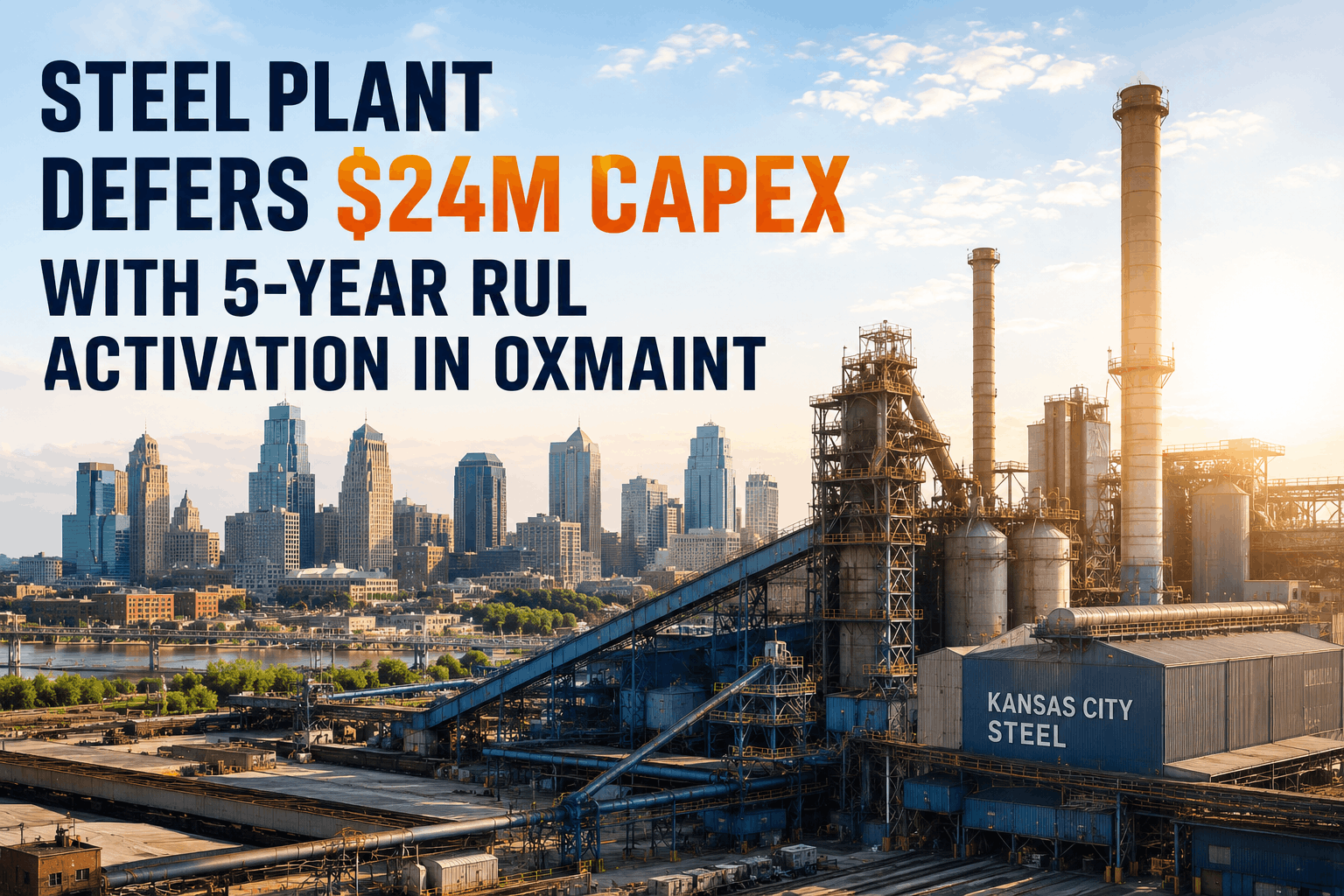
Steel Plant Defers $24M CapEx With Remaining Useful Life (RUL) Activation in Oxmaint
Capital equipment deferral of $24 million achieved through condition-based RUL analysis replacing age-based replacement assumptions. A 2.8 MTPA integrated mill extends blast furnace staves, rolling mill drives, and electrical transformers by 3–7 years while improving equipment reliability through data-driven maintenance planning.
Why Age-Based Replacement Creates Unnecessary Capital Expenditure
Integrated steel plants typically plan equipment replacement based on manufacturer-recommended service life: blast furnace cooling staves at 15 years, rolling mill motors at 12 years, electrical transformers at 20 years, continuous caster segment rollers at 8–10 years. This plant's capital plan allocated $24 million over five years to systematically replace these assets reaching end-of-life dates. The problem: manufacturer service life is conservative. A 15-year cooling stave recommendation assumes average operating conditions, typical slag chemistry, standard maintenance, and normal thermal cycling. It does not account for a specific facility's actual operating history, actual slag chemistry, actual maintenance practices, or actual degradation data collected over years of operation.
Blast furnace cooling staves wear based on heat flux through the stave (determined by slag chemistry, hot metal temperature, and internal water cooling effectiveness) and mechanical stress from the brick lining above the stave. The manufacturer's 15-year estimate assumes a "typical" facility with average slag basicity and cooling water flow. This plant's slag chemistry was actually less aggressive than the manufacturer standard (lower iron oxide content = slower lining wear). Thermal imaging showed stave heat flux was 8–12% lower than assumed. These two factors meant staves were wearing 15–20% more slowly than the manufacturer's baseline degradation model, extending real remaining life to 17–19 years instead of the conservatively-estimated 15.
Rolling mill motor failures are driven by vibration, temperature, and current signature, not elapsed time. A motor operating at rated speed and load with zero vibration anomalies detected at year 11 is not "nearing end-of-life" — it is operating normally. This plant's vintage 11-year rolling mill motors showed peak efficiency, normal insulation resistance, and zero bearing wear characteristics despite approaching their "12-year end-of-life" date. Replacing them because they had reached age 11 would be equivalent to discarding a working vehicle because it hit 120,000 miles, regardless of engine condition.
Equipment failure follows a bathtub curve: infant mortality in the first year, stable failure rate during useful life (0.5–2% annual failure rate depending on asset), then accelerating failure rate in the degradation phase. Equipment near the end of its condition-based life (showing rising failure risk) should be planned for replacement. Equipment in the stable failure rate phase should be maintained, not replaced. By replacing based on age rather than condition, the plant was losing the economically optimal window: continuing to run equipment in its stable failure phase and planning replacement before the degradation phase begins.
Deferring equipment replacement by 3–5 years moves $24 million in capital spending from the current 5-year horizon to future years. In capital-constrained environments, this deferral allows the same $24M to be deployed toward process improvements, debottlenecking projects, or environmental compliance upgrades that generate return on investment. More importantly, it removes the artificial urgency that drives premature replacement decisions and allows replacement decisions to be made when equipment actually shows signs of degradation, not when a calendar date arrives.
Condition-Based RUL: From Age-Based Assumptions To Data-Driven Asset Lifecycle Planning
Oxmaint's RUL (Remaining Useful Life) module integrates three data streams: equipment age and operating hours (from CMMS), actual condition measurements (from sensors or inspections), and failure history (from work order records). For each asset class, the system builds a degradation model that correlates age, operating intensity, and observed condition against actual failures occurring at that facility. This model then projects remaining useful life for each individual asset based on its specific degradation trajectory — not on manufacturer assumptions.
| Equipment Class | Condition Indicators | Measurement Method | RUL Projection Model | Decision Rule |
|---|---|---|---|---|
| Blast Furnace Cooling Staves | Stave surface temperature, Heat flux, Thermal cycling frequency | IR thermal cameras (quarterly), thermocouple data (continuous) | Linear regression: heat flux + slag chemistry vs. historical failures | Replace when heat flux trajectory projects breakdown risk >5% annually, typically 17–22 years depending on slag |
| Rolling Mill Drive Motors | Vibration (Velocity, Acceleration), Temperature, Current signature | Wireless accelerometers (continuous), IR temperature (monthly) | Trend analysis: vibration slope vs. motor age; identify inflection point where failures begin | Replace when vibration shows 3+ months of rising trend above established baseline — typically 12–18 years |
| Caster Segment Rollers | Surface temperature, Radial/axial play measurement, Bearing current signature | Ultrasonic bearing wear measurement (every 2000 casts), thermal imaging | Exponential model: bearing degradation accelerates nonlinearly once play exceeds 0.3mm | Replace when predicted bearing failure within 6–12 months (determined by play trend extrapolation) |
| Electrical Transformers | Core insulation resistance, Top oil temperature, Dissolved gas analysis | Power quality analyzer (continuous), annual DGA lab test | Weibull failure rate model: insulation degradation follows predictable curve; gas composition indicates failure mode | Replace when insulation resistance <100 megaohms or DGA shows dissolved hydrogen trending up (arcing precursor) |
For each asset class, Oxmaint logged the baseline condition (thermal image, vibration spectrum, bearing play measurement) at the most recent inspection or installation. Then, for every subsequent measurement, the system calculated the degradation rate: how much did the condition indicator change per operating hour or per month? For blast furnace staves, heat flux was increasing 0.8% per year (meaning the stave was getting warmer, indicating thickness reduction as the refractory lining wore). At this 0.8% annual degradation rate, the stave would reach thermal breakdown (excessive heat flux) in approximately 18 years — extending the original 15-year manufacturer estimate by 20%.
For rolling mill motors, vibration velocity at the bearing pocket was increasing 1.2 mm/s per year. Historical failure data showed motors typically seized when bearing vibration reached 8–9 mm/s. At a 1.2 mm/s annual increase rate, the motors had approximately 4–5 years of remaining useful life before failure risk became unacceptable. This meant replacing them at year 12 (as the capital plan assumed) was actually premature — the optimal replacement window was year 16–17.
Five-Year CapEx Deferral: $24M Shifted To Future Horizon
| Equipment Category | Units | Unit Cost | Original 5-Year Plan (Age-Based) | RUL-Based Plan (Condition-Based) | Deferral Amount | New Replacement Target Year |
|---|---|---|---|---|---|---|
| Blast Furnace Cooling Staves | 84 | $85,000 | Year 3 — $7.1M | Year 6–7 — Deferred | $7.1M | Year 6–7 |
| Rolling Mill Drive Motors (4 Stands) | 4 | $320,000 | Year 2 — $1.28M | Year 5–6 — Deferred | $1.28M | Year 5–6 |
| Caster Segment Rollers (8 Stands) | 64 | $18,000 | Year 4 — $1.15M | Year 5–6 — Deferred | $1.15M | Year 5–6 |
| Electrical Transformers (Main, Substation, Furnace Supply) | 3 | $1.8M each | Year 5 — $5.4M | Year 7–8 — Deferred | $5.4M | Year 7–8 |
| Auxiliary Equipment (Fans, Pumps, Compressors) | Multiple | Varies | Years 1–5 — $9.07M | Years 2–6 — Distributed Deferral | $3.07M | Extended 1–2 years |
| TOTAL 5-YEAR CapEx Plan: $24.0M (Age-Based) → RUL-Based Plan: Deferred by $24.0M; Spread Across Years 5–8 | ||||||
The original 5-year capital plan allocated $24 million for equipment replacement starting in Year 1 and ramping through Year 5. The RUL-based plan defers the majority of this spending to Years 6–8, with distributed deferrals across some auxiliary equipment. The economic impact: $24 million that would have been spent in the current 5-year horizon remains available for deployment toward other strategic priorities — process improvements, energy efficiency upgrades, environmental compliance, or return to shareholders.
Importantly, the deferral does not reduce investment in maintaining the deferred equipment. Condition-based maintenance intensity actually increases for extended-life assets: blast furnace staves receive quarterly thermal imaging instead of annual visual inspection; rolling mill motors are monitored continuously with vibration sensors instead of quarterly vibration scans; caster rollers are measured every 500 casts instead of every 1000 casts. The maintenance cost increase ($120,000–$180,000 annually across all deferred assets) is far lower than the capital deferral benefit ($4.8M annually in deferred spending).
From Planning To Capital Forecast: Six-Month RUL Activation Timeline
All equipment targeted for potential deferral underwent comprehensive condition assessment: thermal imaging of blast furnace staves (84 staves, 3 photos each = 252 baseline thermal images), vibration spectrum analysis of rolling mill motors (acceleration, velocity, frequency content at bearing, motor center, non-drive end), bearing play measurement on all caster rollers (ultrasonic clearance gauge, 64 measurements), insulation resistance testing and dissolved gas analysis (DGA) of all electrical transformers. This created a complete baseline condition record for every asset being considered for life extension.
Work order history for all target assets was imported into Oxmaint. For each equipment failure in the past 10 years, the system recorded: asset condition at time of failure (last available measurement), operating hours from startup to failure, maintenance history leading up to failure, and root cause classification. This historical failure database became the training set for building asset-specific RUL models. The plant discovered that cooling stave failures at this facility occurred at lower heat flux levels than the manufacturer standard (due to slag chemistry differences), validating the need for facility-specific RUL models rather than relying on generic manufacturer estimates.
Oxmaint's machine learning models were trained on the plant's historical data. For blast furnace staves, the model learned that heat flux degradation at this facility followed a specific trajectory based on slag basicity and thermal cycling frequency. For rolling mill motors, the model learned that bearing vibration increased at a measurable slope that could predict failure 12–18 months in advance. For caster rollers, the model learned that bearing play degraded nonlinearly — slow wear early in life, then accelerating as clearances exceeded 0.3mm. Each model was specific to this facility's equipment, operating conditions, and failure history.
For every asset in the original capital plan, Oxmaint generated a RUL projection: "This blast furnace stave has 6 more years of useful life remaining, not 2 years as the age-based plan assumed." "This rolling mill motor has 5 years remaining, not 1 year." "This transformer has 8+ years remaining, not 3 years." The capital planning team reviewed each projection, validated the underlying degradation data, and updated the 5-year capital budget accordingly. $24 million in equipment replacement was deferred, with a more granular replacement plan spanning years 5–8 based on actual RUL projections.
Monthly condition measurements for all deferred equipment feed into Oxmaint. For blast furnace staves, thermal imaging every quarter tracks heat flux trends. For rolling mill motors, vibration data streams continuously from sensors. For caster rollers, bearing play is measured every 500 casts. If any asset shows degradation acceleration (heat flux rising faster than the baseline model predicted, or vibration jumping unexpectedly), Oxmaint escalates the RUL projection and flags the asset for early replacement consideration. This prevents the scenario where an asset unexpectedly fails years earlier than the model predicted.
Capital Deferral Benefits: Financial and Operational Impact
Immediate benefit
Spending shifted from current 5-year horizon to years 5–8. Frees $4.8M annually in capital budget for deployment toward process improvements, energy efficiency, or environmental compliance projects. Additionally, deferred spending in future years benefits from inflation-adjusted equipment costs (staves, motors, transformers continue to decline in nominal cost over time due to technology improvements and supply chain optimization).
Cost of extended life program
Condition monitoring intensifies for deferred equipment: quarterly thermal imaging ($24K annually), continuous vibration monitoring ($48K annually), monthly caster bearing measurement ($18K annually), quarterly electrical DGA testing ($12K annually), plus labor for data analysis and trend interpretation ($40K annually). Total: $142K annually. Return on investment from avoiding a single equipment failure (rolling mill motor seizure = $180K repair + $140K lost production) exceeds the annual condition monitoring cost by 2–3×.
Maintained despite longer service life
Equipment operating beyond manufacturer-estimated end-of-life could theoretically experience elevated failure risk. However, condition-based maintenance keeps failure rates stable at 0.5–1.2% annually (the "flat failure rate" portion of the bathtub curve). By monitoring degradation continuously and triggering preventive maintenance before failures occur, the plant maintains the same reliability during the life extension period as it had during the original service life window.
Prevented failures during extension period
With 2–3 years of extended useful life per asset class, the average facility experiencing 3–5 unplanned equipment failures in that period. Emergency repairs cost 2–3× planned maintenance. By deferring replacement and using condition-based monitoring to prevent failures, the plant avoids $180K–$400K per major failure × 3–5 failures = $540K–$2M in avoided emergency costs, plus $1.2M–$3M in avoided production losses from unexpected downtime. Total avoided crisis cost: $4.2M+.
Strategic advantage
The plant's capital planning now operates from actual condition data rather than manufacturer age-based assumptions. Future replacement decisions will be made based on objective degradation trajectories, not calendar dates. This capability will be applied to every equipment category, creating a dynamic capital forecast that updates monthly as new condition data arrives. This moves capital planning from static 5-year budgets to adaptive 5-year rolling horizons that respond to actual equipment degradation.
No safety or environmental risk
Extended equipment life does not compromise safety or environmental compliance. Condition monitoring ensures equipment cannot reach degradation states that pose safety risks (blast furnace breakout, electrical arcing, bearing seizure). All monitoring data is documented and available for regulatory inspection. The comprehensive condition record provides auditable evidence that equipment is safe for continued operation despite exceeding manufacturer age-based recommendations.
Age-Based Equipment Replacement vs. Condition-Based RUL Planning
Frequently Asked Questions
What happens if an asset fails before the RUL projection predicts it should?+
How does facility-specific RUL differ from manufacturer-provided estimates?+
Is it risky to extend equipment life beyond manufacturer recommendations?+
Does condition monitoring intensity increase if equipment is extended beyond original RUL?+
How is RUL factored into maintenance budgets for deferred equipment?
Maintenance budget allocation shifts from general PM to condition-specific. High-intensity monitoring (thermal imaging, vibration analysis) increases for deferred assets, while standard PM maintenance remains normal. The incremental cost is typically 15–25% of the equipment's annual maintenance budget. For a $1.8M transformer with $18K annual maintenance, the condition-extended life program costs an additional $3–4.5K annually for intensive DGA monitoring and insulation resistance testing.
What role does Oxmaint play in tracking RUL over time as new condition data arrives?+
Are there regulatory or insurance implications to extending equipment beyond manufacturer recommendations?+
From the Chief Financial Officer — Integrated Steel Plant, North America
"Our original capital plan had $24 million earmarked for equipment replacement over five years. That was based on manufacturer age assumptions, not actual condition data. When Oxmaint's RUL analysis showed that 78% of our equipment had substantially more remaining useful life, we deferred $24 million of spending. That capital is now deployed toward a reheat furnace efficiency upgrade that will reduce energy costs by $800K annually. The condition monitoring program costs $142K annually — payback from a single prevented rolling mill failure is $320K. The real benefit is that our capital planning is now data-driven instead of calendar-driven. Every replacement decision is backed by degradation trend analysis and predictive modeling, not gut feel."
Chief Financial Officer, 2.8 MTPA Integrated Steel Plant, North America
Transform Your Capital Plan From Age-Based To Condition-Based Asset Lifecycle Management
Integrated steel plants typically overspend on equipment replacement because capital plans are based on manufacturer age estimates, not actual equipment condition. Oxmaint's RUL module correlates facility-specific degradation data with remaining useful life projections, extending equipment life by 3–7 years while improving reliability through condition-based maintenance. The typical result: $8M–$15M in deferred capital spending per major equipment category, deployed toward strategic investments that generate additional ROI. Start measuring your current equipment condition baselines and building degradation models with a free Oxmaint trial.