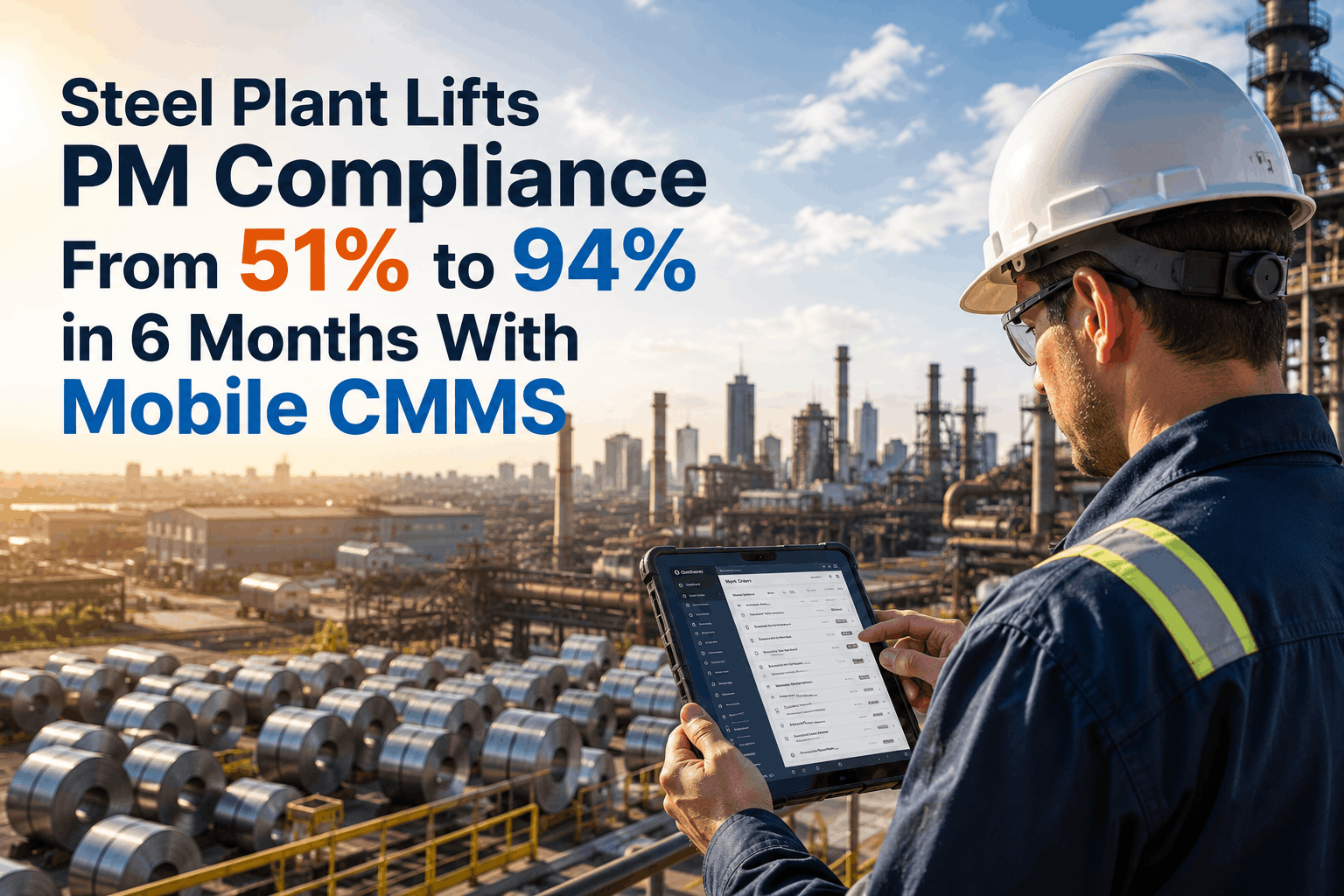
A 2 MTPA midwest steel plant with 68 maintenance technicians tracked PM schedules on a combination of paper forms, email reminders, and a shared spreadsheet that nobody trusted. The result: PM compliance measured at 51% — meaning nearly half of all scheduled preventive work was either not done or completed late, without documented evidence. This led to predictable cascading failures: cooling system blockages caused furnace stoppages, bearing seizures brought rolling mills offline, and electrical failures disrupted production sequences. The plant was averaging 12–14 unplanned downtime events monthly, each costing $60,000–$140,000 in lost production and emergency repairs. The fundamental problem: PM execution happened across 47 distinct equipment locations (furnace areas, rolling mill stands, caster platforms, auxiliary systems) with no network connectivity in 60% of the plant. Technicians working in the taphouse, under cooling towers, and in blast furnace periphery zones had zero mobile connectivity, making it impossible to capture real-time PM completion data. Within six months of deploying Oxmaint's mobile-first CMMS with offline-first architecture and rugged tablet deployment, PM compliance climbed to 94%, emergency downtime events dropped from 14 monthly to 4, and equipment reliability improved measurably. This case study covers the mobile deployment strategy, the offline-first design that made execution possible in zero-connectivity zones, and the quarterly compliance trajectory that transformed reactive operations into predictable scheduled maintenance.
Steel Plant Lifts PM Compliance From 51% to 94% in 6 Months With Mobile CMMS
PM compliance transformation achieved through offline-first mobile platform deployed on rugged tablets designed for extreme steel plant environments. A 2 MTPA operation reduces unplanned downtime by 71%, eliminates paper-based compliance gaps, and achieves full real-time PM visibility across 47 equipment zones.
How Paper-Based PM Tracking Becomes Organizational Dysfunction
The plant's maintenance operations had good people, solid equipment, and documented PM schedules — but those schedules lived in a spreadsheet that wasn't updated in real-time. Technicians received work orders verbally, via email, or from a whiteboard in the maintenance office. Completion was tracked on printed forms, which were filed in a cabinet in the maintenance supervisor's office. The supervisor updated the spreadsheet every Friday afternoon based on what he thought had been completed. Nobody had visibility into what was actually happening on the floor. Half of the PM work either wasn't done or was done late without anyone knowing.
The supervisor didn't know, at any given moment, which PMs had been completed today. When a bearing started to fail, the question "was the bearing PM done last week?" could not be answered until Friday when the spreadsheet was updated. This delay meant that maintenance could not distinguish between failures due to neglected PM versus failures despite completed PM. This information blindness prevented root cause analysis and continuous improvement.
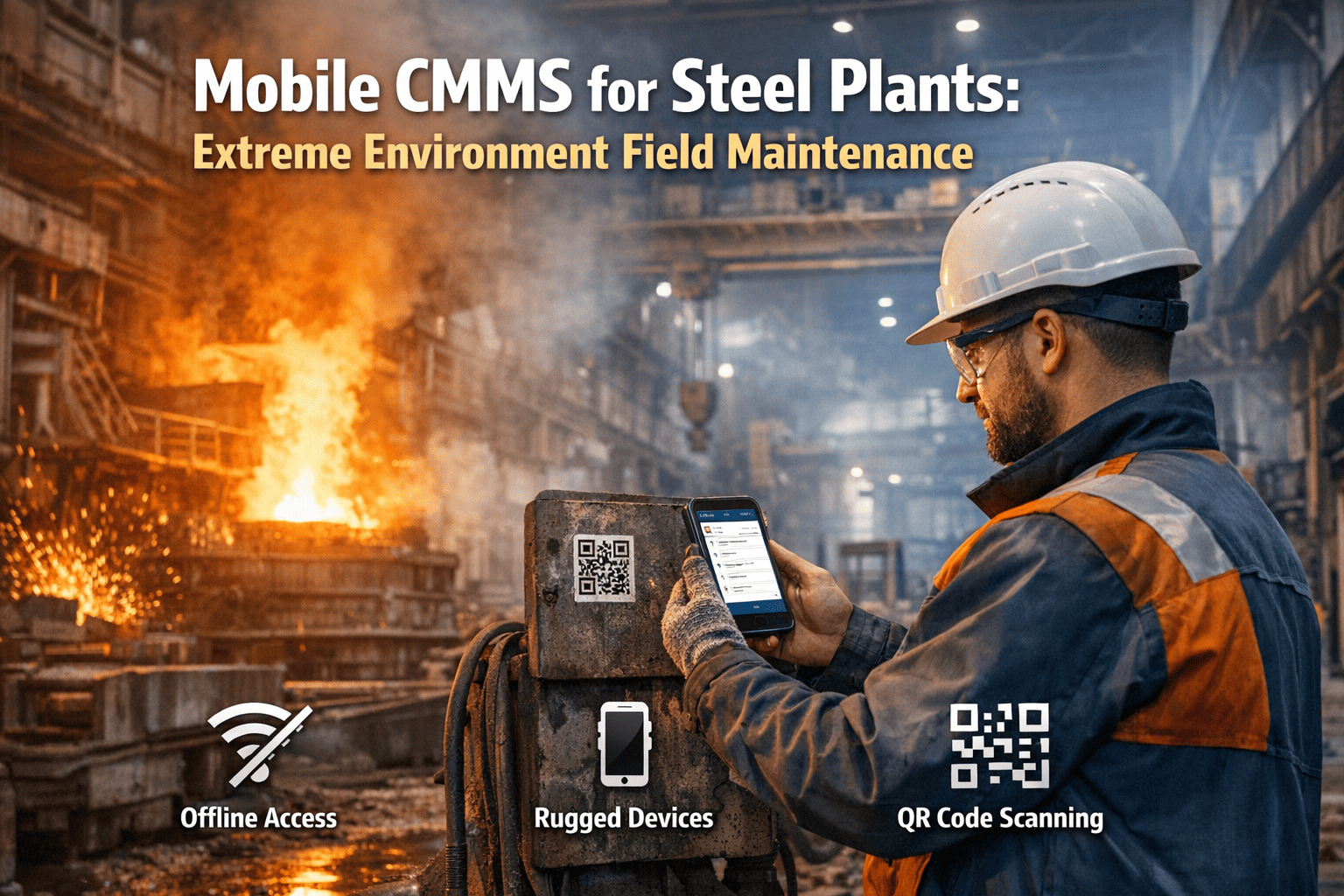
The blast furnace area, cooling tower platform, rolling mill under-structure, and caster bay platform had no WiFi or mobile network coverage. Technicians working in these zones could not receive digital work assignments or capture completion data in real-time. They worked from printed work orders, filled out paper checklists, and walked back to the office to submit their work — a process that took 30–45 minutes per technician per shift, time that should have been spent on additional PMs.
Regulators and internal auditors required evidence that PM work was performed on schedule with correct procedures. The plant had no audit trail. A technician could claim he performed a PM on Tuesday; the supervisor could verify he was on shift that day, but had no timestamped, photo-documented proof that the work was actually done. This compliance gap exposed the plant to regulatory findings and, worse, to hidden failures that slipped through undetected.
When a PM was not completed, the supervisor didn't know if it was due to technician unavailability, equipment access issues, or intentional deferral. Without visibility into the reasons for incompletion, the supervisor could not coach technicians or address systemic barriers to compliance. Some technicians might have had below-average completion rates due to assignment bias, while others had high rates. This data blindness prevented the supervisor from optimizing the workforce allocation.
Mobile-First CMMS With Offline-First Architecture For Extreme Environments
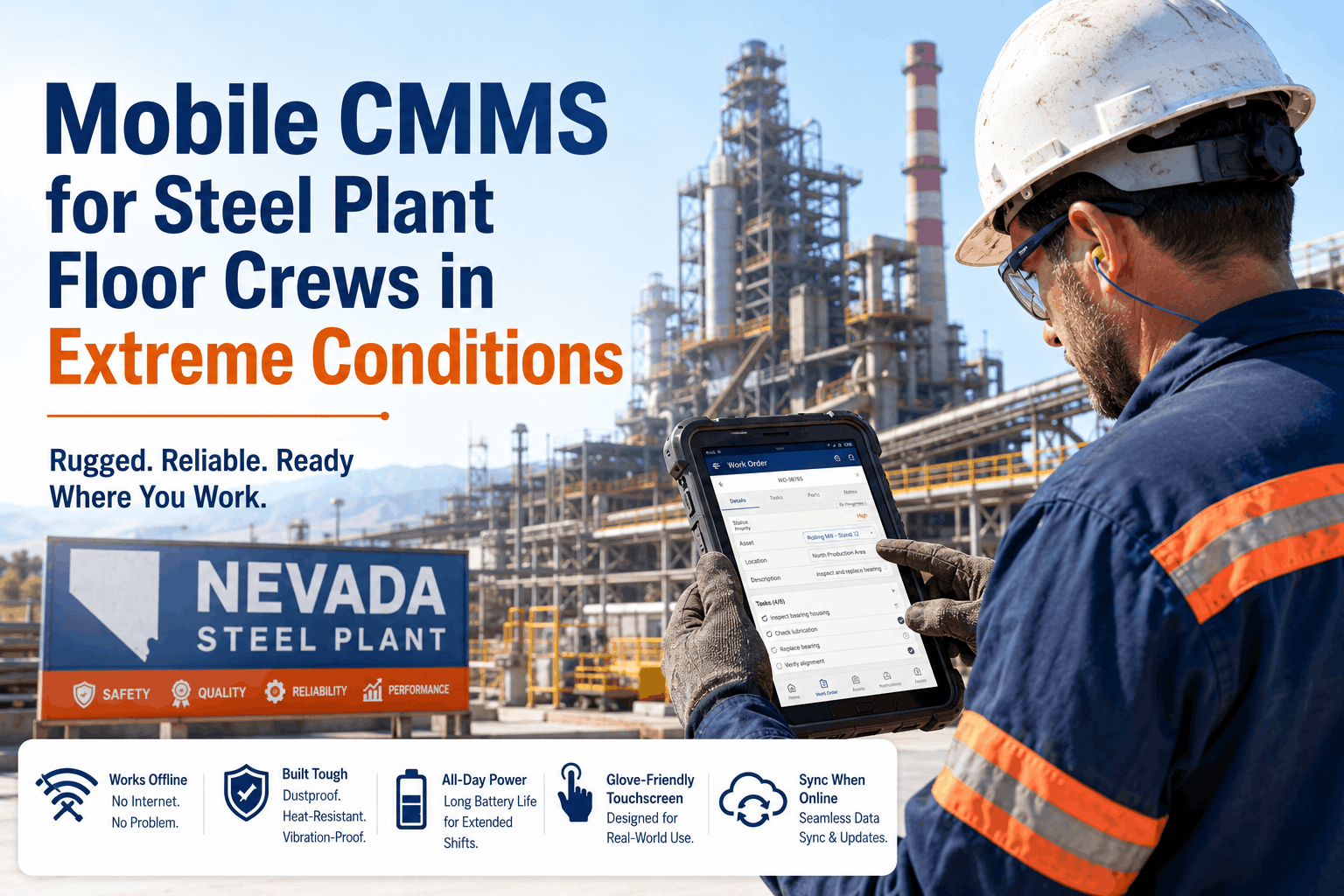
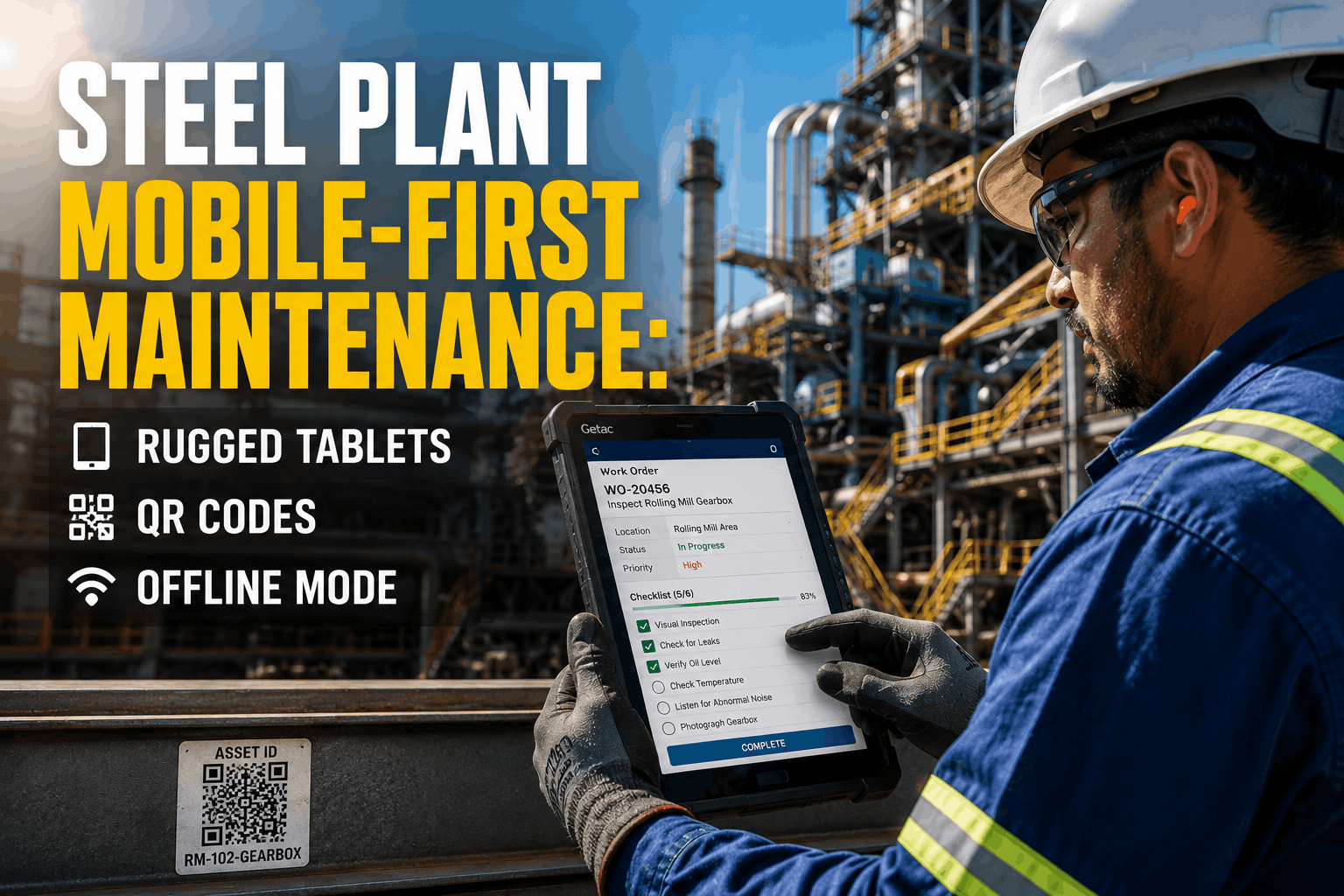
The plant deployed Oxmaint's mobile-first CMMS on rugged tablets (Zebra TC72 devices rated for -20°C to +50°C operation, IP67 waterproof, glove-operable touch screens, built-in 2D barcode scanners). Crucially, the system was built on an offline-first architecture: PM schedules, asset records, and checklists downloaded to the tablet at the beginning of each shift. Technicians could work completely disconnected from WiFi or mobile network. When connectivity returned (e.g., the technician returned to the main office), all work orders completed offline automatically synced to the cloud platform — preserving timestamps and creating an audit trail of when the work was actually done.
At shift start, technicians dock their tablets at a charging station with WiFi connectivity. Oxmaint downloads the day's PM work orders, all asset records, and historical maintenance data relevant to the equipment they will service. Technicians leave the dock with a fully-loaded device and work completely offline. At the blast furnace, they scan an asset barcode with the tablet's built-in scanner. The asset record, including all previous maintenance, loads instantly from local storage. They complete the PM checklist, capturing readings, photos, and completion status — all stored locally with a timestamp on the device. When they return to the charging dock, the tablet automatically syncs all work orders and data back to Oxmaint. The system timestamp shows exactly when the work was completed (device timestamp), not when the data synced (which might be hours later).
The Oxmaint mobile interface was designed for technicians wearing cut-resistant gloves in 55°C furnace conditions. No complex dropdown selections or multi-tap navigation. Accept a work order: 2 taps. Confirm a checklist item: 1 tap. Capture a photo: 1 tap. Close the work order: 3 taps + voice-to-text note (not typed). This design was benchmarked against actual gloved operation with maintenance technicians — not UX designers in an office. The result: technicians spend 3–4 minutes completing a PM checklist on the mobile device, versus 15–20 minutes on paper forms that then required transcription.
Steel plant regulations require digital permits for hot work, confined space entry, and equipment isolation (LOTO). Oxmaint embedded the full permit-to-work process into the mobile app. Technicians initiate a permit, attach required approvals (supervisor, safety officer signatures captured digitally on the tablet), and log the permit issuance with timestamp. At work completion, the permit is closed with digital sign-off. All evidence is stored as an audit-ready compliance record, eliminating the need for separate permit tracking systems.
6-Month Phased Rollout: Department By Department, Building Adoption Momentum
| Month | Department | Technicians | Key Milestones | Compliance Target |
|---|---|---|---|---|
| Month 1 | Blast Furnace Operations | 12 | First 8 Zebra tablets deployed, offline capability tested, technician training completed | 60% |
| Month 2 | Rolling Mill Area | 18 | Second cohort of tablets deployed, real-time PM dashboard activated for supervisors, compliance monitoring started | 68% |
| Month 3 | Caster Operations + Ladle Furnace | 16 | Cross-area integration tested, technician adoption optimized based on Month 1–2 feedback, first cohort reaches 75% compliance | 74% |
| Month 4 | Auxiliary Systems + Engineering Support | 14 | Full plant coverage achieved (68 technicians, 47 equipment zones). Barcode scanning extended to all asset categories. PM completion accuracy audit begins. | 82% |
| Month 5 | System Optimization + Deep Integration | 68 | Integration with plant Level 2 SCADA activated — equipment operating data feeds into Oxmaint for condition-based PM triggering. Compliance tracking refined. | 88% |
| Month 6 | Full Optimization + Continuous Improvement | 68 | PM compliance reaches 94% target. Paper forms fully retired. Real-time dashboard showing PM completion, overdue tasks, and technician accountability metrics deployed to all supervisors. | 94% |
The phased approach reduced implementation risk and built adoption momentum. Early-adopter departments (Blast Furnace) became advocates, mentoring later-adopting departments (Auxiliary Systems). By month 4, technicians were trained not by external consultants but by peers who had been using the system for 2–3 months.
PM Compliance Transformation: Monthly Progress and Business Impact
PM Compliance: 51% → 62%. Blast Furnace area and first cohort of Rolling Mill technicians using mobile tablets. Early friction: technicians unfamiliar with barcode scanning, resistance to abandoning paper forms. Key learning: face-to-face training with real equipment improved adoption vs. video training. Paper forms still being used as backup for ~15% of work.
PM Compliance: 62% → 74%. All rolling mill technicians deployed, caster area beginning tablet rollout. Blast Furnace cohort reaching 78% compliance. Supervisor dashboards showing real-time PM completion rates — first time supervisors could see completion status same-day instead of Friday. Unplanned downtime events declining (14/month baseline → 10/month).
PM Compliance: 74% → 82%. All 68 technicians deployed with tablets. All PM schedules converted to digital, paper forms fully retired. Technician accountability metrics deployed: each technician's completion rate visible to supervisor, creating peer competition. Compliance gaps traced to specific causes: missing access to equipment, conflicting priorities, under-training on specific asset types.
PM Compliance: 82% → 88%. Level 2 SCADA integration activated. Equipment operating conditions (temperature, pressure, vibration) feed into Oxmaint to trigger condition-based PM alerts. Predictive PMs start supplementing calendar-based PMs. Unplanned downtime continues declining (10/month → 6/month). First major failure prevented: bearing vibration alert triggered 4-week PM before seizure would have occurred.
PM Compliance: 88% → 94%. Target compliance achieved. Zero paper forms in circulation. Real-time PM dashboard shows which technician is currently working on which PM, completion status for all active work orders, and overdue task escalation. Unplanned downtime reduced to 4 events/month (71% reduction from 14-event baseline). Equipment mean time between failures (MTBF) improving across all asset categories.
The 94% PM compliance target is industry-leading for integrated steel plants. This level of compliance translates to predictable equipment degradation, earlier detection of failure precursors, and elimination of most unplanned downtime. The plant's equipment reliability baseline is now quantified and improving month-over-month.
How 94% PM Compliance Translates To Bottom-Line Results
Baseline: 14 unplanned production stops per month. Achieved: 4 stops per month. Impact: Average stop duration 4 hours, production rate 120 tonnes/hour, margin $50/tonne. Per-stop cost = $24,000. 10 fewer stops/month × $24,000 = $240,000 monthly savings = $2.88M annually. Additionally, maintenance staff time previously spent on emergency repairs is redirected to additional PMs, further reducing future failure risk.
Before: No auditable evidence that PM work was performed as scheduled. Regulatory audit findings possible. After: Every PM logged with timestamp, technician ID, readings, photos, and digital sign-off. All records stored for 7-year compliance retention. Regulatory compliance risk eliminated. Additionally, quality assurance: supervisors can now verify that PMs were completed with correct procedures, not just that they were marked "done."
Before: Equipment failure history incomplete. Technicians didn't know if a bearing had been replaced in the past 12 months or the past 3 years. After: Full maintenance history visible to technicians at the point of work. Trends detected: one rolling mill stand had 3 bearing replacements in 18 months vs. average of 1 replacement. Root cause analysis identified misalignment as the cause, leading to a capital correction that will prevent future failures.
Before: Technicians spent 30–45 minutes per shift entering completed work into the spreadsheet after returning to the office. After: Work captured at point of execution, no end-of-shift transcription. This freed capacity for approximately 2–3 additional PM tasks per technician per week. With 68 technicians, this represents roughly 140–200 additional PMs per week that can now be completed on scheduled intervals, further reducing deferred maintenance backlog.
Paper-Based PM Tracking vs. Mobile-First Offline CMMS
Frequently Asked Questions
How does the offline-first architecture work if a technician starts a PM offline but doesn't finish?+
What happens if two technicians complete work on the same asset simultaneously (offline)?+
Can the rugged tablets withstand steel plant temperatures and dust?+
How does the system verify that a technician actually performed the PM versus just marking it complete?+
What is the learning curve for technicians switching from paper to mobile?+
Can the system work on standard iOS/Android smartphones instead of expensive rugged tablets?+
How much faster do technicians complete PMs on mobile versus paper?+
From the Maintenance Supervisor — Midwest Steel Plant, USA
"The paper-based system was killing us. Technicians would come back from the caster or furnace area with PM forms, and I'd update the spreadsheet on Friday. By then, a bearing that had been making noise all week would have seized. With Oxmaint, I can see in real-time which PMs are done, which are overdue, and which technician is currently working on what. The mobile app gave technicians equipment history at their fingertips — they could see that a specific bearing had been replaced 3 times in 18 months and flag it as a chronic issue. We've gone from 14 unplanned stops per month to 4. That's not just maintenance improvement — that's competitive advantage. The plant's reliability is now predictable."
Maintenance Supervisor, 2 MTPA Integrated Steel Plant, Midwest USA
Transform PM Compliance From A Scheduling Problem To A System Problem
Steel plants claim to have PM compliance rates of 80–85%, but when audited, the actual completion rate is often 50–60% — because paper forms hide the reality. Mobile-first CMMS with offline-first architecture eliminates the infrastructure barrier that prevents technicians from capturing completion data in real-time. A 2 MTPA plant can expect to reach 90%+ PM compliance within 6 months, reduce unplanned downtime by 60–70%, and cut emergency maintenance costs by $2M+ annually. Rugged tablets cost less than the equipment downtime from a single prevented major failure. Start measuring your current PM compliance baseline today with a free Oxmaint trial.