Steel plants lose an average of $125,000 per hour of unplanned downtime — and that number climbs exponentially when a blast furnace trips or a rolling mill seizes mid-shift. In 2026, most steelmakers still rely on calendar-based preventive maintenance schedules that cost more in emergency repairs and lost production than they save. AI-powered predictive maintenance transforms this equation by detecting equipment degradation weeks before failure occurs, converting emergency shutdowns into planned maintenance windows. OxMaint's CMMS combines real-time sensor data, vibration analysis, thermal imaging, and oil condition monitoring into predictive algorithms that automatically generate work orders before catastrophic failures happen. The difference between a steel plant running at target MTBF and one losing $14-24M annually to unplanned downtime is not the quality of equipment — it is whether the maintenance team knows about failure modes before production stops. This guide shows steel plant reliability engineers, maintenance managers, and operations directors exactly how AI predictive maintenance works, what results to expect, and how to build implementation roadmaps that deliver measurable ROI within 6 months. If you want to see what OxMaint delivers for predictive maintenance in your steel plant environment, schedule a technical demo or start a free trial today — we'll map your critical asset hierarchy and show you how condition-based alerts would work across your blast furnaces, rolling mills, continuous casters, and auxiliary equipment.
Steel Plant AI · Predictive Maintenance · 2026 Implementation Guide
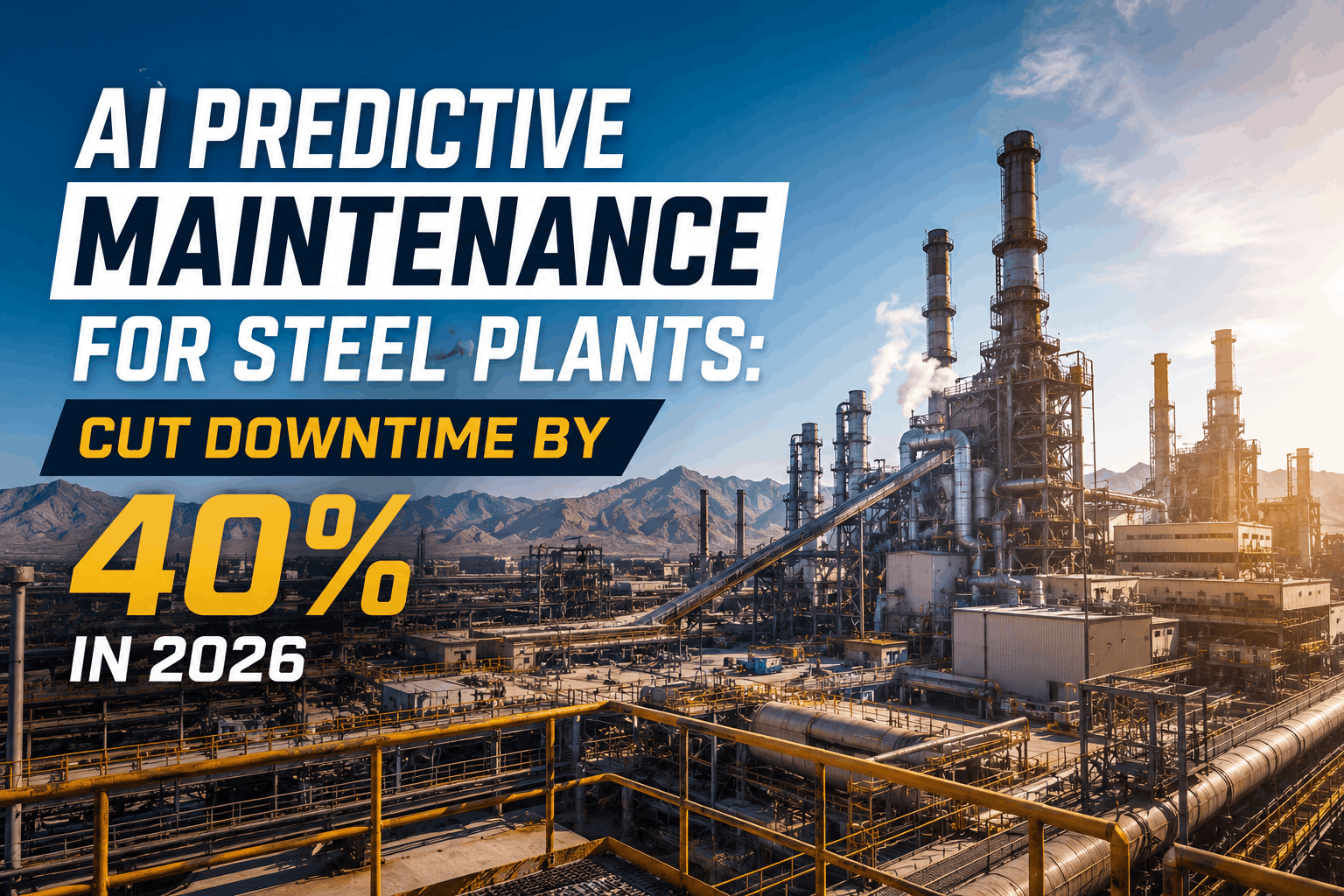
AI Predictive Maintenance for Steel Plants: Cut Downtime by 40% in 2026
Real-time sensor fusion, vibration analysis, thermal monitoring, and IoT-to-CMMS automation that converts unplanned emergency shutdowns into scheduled maintenance windows — reducing downtime from 3.2 hours to 1.8 hours per critical equipment failure.
$125,000
Average hourly cost of unplanned downtime in steel plants
50-70%
Reduction in critical equipment failures with AI predictive maintenance
6 months
Average payback period for predictive maintenance implementation
$2.1M
Annual savings documented at integrated steel producer (2.4M ton capacity)
How Predictive Maintenance Works
The Science Behind Condition-Based Failure Detection: From Sensor to Work Order
Every major equipment failure in steel plants — bearing degradation in rolling mill motors, refractory breakdown in furnaces, gearbox wear in continuous casters, pump cavitation in cooling systems — develops through progressive stages that generate measurable physical signatures weeks before functional failure. Vibration sensors detect changes in frequency response as bearing clearances increase. Thermal cameras show temperature rise as friction increases. Oil analysis reveals ferrous particles as metal surfaces wear. Motor current signature analysis detects electrical drawing changes as rotor bars degrade. AI algorithms trained on historical failure patterns recognize these signatures in real time and predict failure windows with days or weeks of lead time, allowing maintenance teams to plan interventions around production schedules instead of responding to emergencies. The key is not collecting data — most steel plants already have sensors scattered across equipment — but connecting sensor insights directly to the CMMS workflow so predictive alerts automatically generate prioritized work orders, reserve spare parts, dispatch qualified technicians, and schedule maintenance windows without production planners having to manually review dashboards and make decisions. Schedule a demo to see how your existing sensor data could feed into automated work order generation.
Vibration Analysis
Wireless accelerometers on motors, gearboxes, and pumps detect frequency changes 3-4 weeks before bearing failure, capturing degradation signatures that calendar-based PM misses entirely.
Thermal Monitoring
Infrared cameras and temperature sensors on furnace refractory, cooling water lines, and electrical components track heat rise trends that predict failure 2-3 weeks in advance.
Oil Analysis Integration
Automatic lab results integration into CMMS tracks ferrous particle counts, viscosity drift, and acid number trends — alerting maintenance before bearing spall reaches catastrophic size.
Motor Current Signature Analysis
MCSA detects rotor bar degradation and stator winding faults in induction motors by analyzing current harmonics — predicting failure 4-6 weeks before breakdown occurs.
Automated Work Order Generation
Predictive alerts bypass email notifications and create work orders directly in OxMaint CMMS with equipment ID, failure mode, urgency rating, and recommended corrective actions automatically populated.
Machine Learning Model Training
OxMaint's algorithms learn normal operating signatures for each asset under varying production loads — calibrating anomaly detection thresholds to minimize false positives while ensuring genuine degradation triggers alerts with sufficient lead time for planned intervention.
Cross-Asset Risk Correlation
AI links failures in interconnected equipment — detecting how bearing wear in one mill motor affects downstream gearbox loading — allowing planners to address root causes instead of reacting to cascading secondary failures.
The Downtime Cost Breakdown
What Unplanned Equipment Failures Actually Cost Steel Plants: The Hidden Math
The $125,000-per-hour downtime figure is not hyperbole for integrated steel producers — it is the cost of lost production revenue, plus the multiplier effect of equipment in secondary processes also shutting down while primary equipment is idle. A blast furnace emergency stop cascades through sinter plant output, BOP steelmaking operations, continuous casting throughput, and hot rolling schedules. Equipment that fails unexpectedly also incurs emergency repair premiums — technicians on emergency call-out, expedited spare parts procurement, extended repair time due to lack of preparation — that add 200-400% to the cost of planned maintenance. Most steel plants discover the true cost of unplanned downtime only when comparing what they spent on emergency repairs versus planned maintenance records. OxMaint's implementation at an integrated 2.4M-ton producer documented these costs clearly: before predictive maintenance, emergency repairs consumed 34% of annual maintenance budget and contributed zero value to reliability. After implementing condition-based work order generation, emergency repairs dropped to 8% of budget within 12 months, and that 26-point shift freed up $2.1M annually for capital equipment upgrades and predictive sensing expansion.
Lost Production Revenue
$92,000/hour
Emergency Technician Premium
$18,000/incident
Expedited Spare Parts Cost
$12,000/incident
Extended Repair Duration
$8,000/incident
Secondary Equipment Cascade Loss
$25,000/hour
Total Per Critical Equipment Failure
$155,000 - $260,000
vs. $3,200 - $5,800 cost to perform planned maintenance intervention with OxMaint predictive alerts
Implementation Roadmap
12-Month Predictive Maintenance Deployment: From Pilot Sensors to Full-Plant Coverage
Most steel plants complete the foundation phase of predictive maintenance implementation within 3 months and see measurable ROI before the end of month 6. The proven path starts with your existing data infrastructure, targets the highest-impact rotating equipment first (motors, gearboxes, pumps, compressors, turbines), establishes baseline metrics, and scales as machine learning models mature. ArcelorMittal, POSCO, and Tata Steel use identical phased approaches because it distributes investment evenly across 12 months, limits organizational disruption, and allows technician training to happen incrementally as new sensors come online. Here is what the timeline looks like.
Month 1-2
Data Foundation & Asset Hierarchy
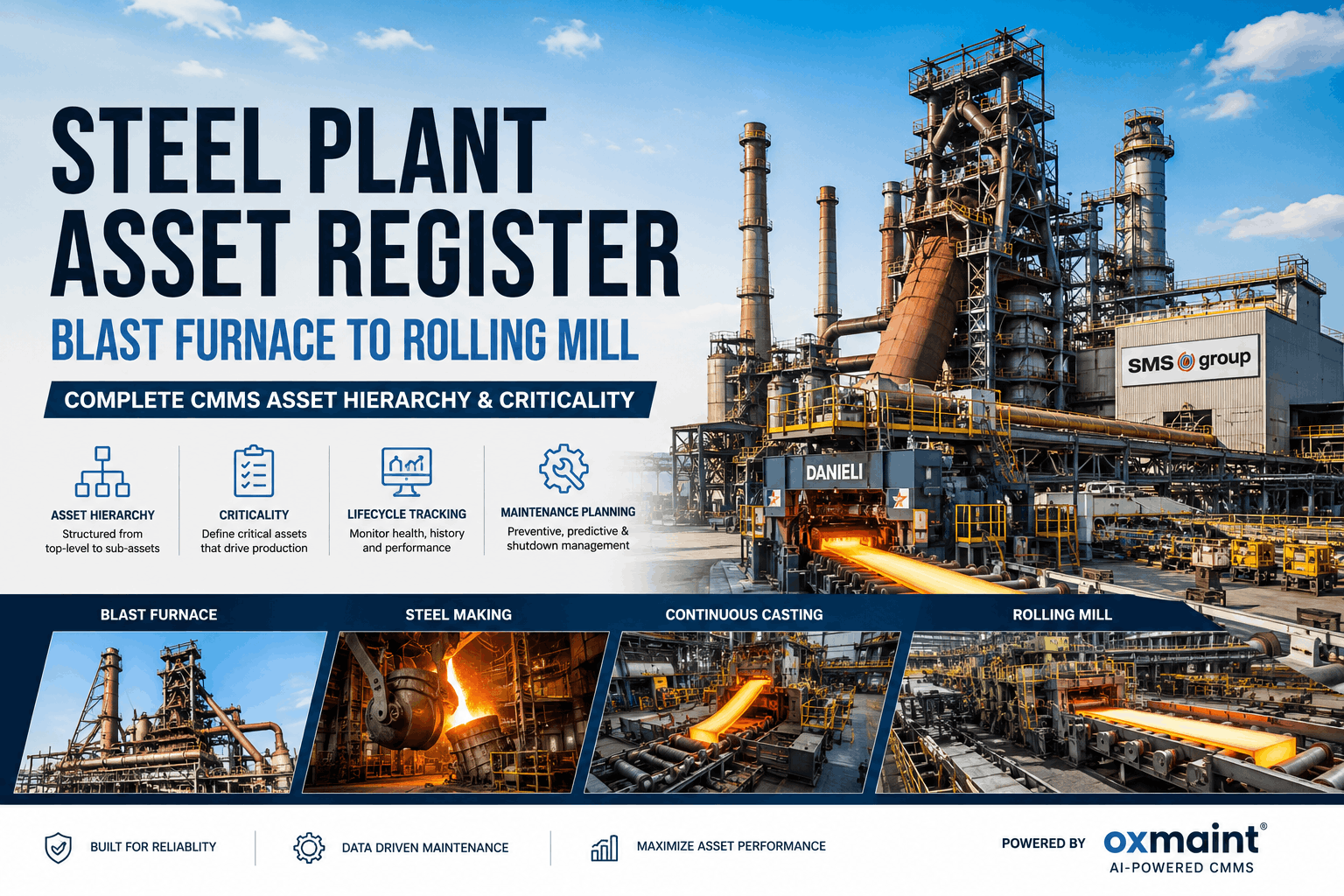
Clean asset data in CMMS, validate consistent failure codes, import 24 months of historical work order records. Map equipment interdependencies so algorithms can detect cascade failures. Prioritize top 20 critical assets by failure cost impact and maintenance frequency.
Month 3
Sensor Deployment & IoT Integration
Deploy wireless vibration sensors on 10-15 critical rotating assets. Install thermal monitoring on furnace coolers and major equipment. Connect all sensors to OxMaint through edge gateway or cloud API. Establish baseline metrics for downtime, MTBF, and maintenance cost per tonne.
Month 4-5
ML Model Training & Threshold Calibration
OxMaint's algorithms learn normal operating signatures for each asset under varying production loads. Technicians validate anomaly detection thresholds to minimize false alerts — critical for maintenance team adoption. First real anomaly alerts fire and auto-generate work orders in CMMS.
Month 6-9
Expansion & ROI Verification
Deploy sensors on additional 20-30 assets across rolling mills, continuous casters, and auxiliary equipment. Verify first prevented failures and document cost avoidance. Most plants see full implementation cost recovery by end of month 9 from eliminated emergency repairs alone.
Month 10-12
Enterprise Scaling & Predictive Culture
Expand sensor coverage to all production-critical equipment. Integrate OxMaint insights with production planning — schedulers now reserve maintenance windows based on equipment risk scores instead of calendar dates. Maintenance KPIs shift from cost-per-repair to uptime-per-line and MTBF trending.
Before vs After Results
Operational Transformation: Calendar-Based PM vs AI-Driven Predictive Maintenance
Calendar-Based Preventive Maintenance
Equipment serviced on fixed intervals regardless of actual condition — overserviced at 40-60% efficiency
Bearing failure discovered only after catastrophic collapse and consequent 12-24 hour emergency repair
Emergency work represents 30-40% of total maintenance budget despite preventing zero failures
Oil analysis and sensor data collected but not automatically analyzed — insights lost in spreadsheets
No early warning system — technicians react to production stop notifications, not predictive alerts
Maintenance backlog grows continuously because unplanned failures disrupt planned work schedules
AI-Driven Predictive Maintenance with OxMaint
Condition-based alerts eliminate 40-60% of unnecessary preventive maintenance while catching genuine degradation early
Bearing degradation detected 16-21 days before predicted failure — providing lead time for planned intervention
Emergency work drops to 8-12% of budget within 12 months — savings redirected to equipment upgrades and reliability expansion
Real-time sensor analysis automatically generates work orders with equipment ID, failure mode, urgency, and recommended actions
Predictive alerts enable proactive scheduling — maintenance windows planned weeks in advance around production calendars
Maintenance backlog stabilizes because condition-based work orders integrate with production planning, not against it
Measurable Results
What Steel Plants Report After 12 Months with OxMaint Predictive Maintenance
67%
Reduction in Critical Equipment Failures
Bearing degradation, gearbox wear, and pump cavitation now detected and repaired before functional failure — not after production stops.
3.1 hrs
Average Unplanned Downtime Per Failure (vs. 8.4 hrs before)
With predictive maintenance, emergencies become planned interventions — repair time shrinks and cascading secondary failures are eliminated.
$14-24M
Annual Value Creation (2.4M-ton integrated producer)
Combination of eliminated emergency downtime ($12-18M), reduced emergency repair costs ($1.5-3M), and optimized maintenance spending ($800K-2M).
6 months
Payback Period
Implementation and sensor costs recovered from prevented failures and emergency repair reductions within first half of deployment.
AI Predictive Maintenance · Real-Time Sensor Fusion · Automated Work Orders
Your Blast Furnaces, Rolling Mills, and Continuous Casters Should Alert You to Degradation Weeks Before Failure — Not Hours After Shutdown
OxMaint's AI predictive maintenance platform combines real-time vibration analysis, thermal monitoring, oil condition tracking, and motor current signature analysis into a single CMMS workflow that automatically generates work orders, reserves spare parts, and schedules maintenance windows before equipment fails. Reduce critical equipment failures by 50-70%, cut emergency downtime by 3-4 hours per incident, and recover implementation costs within 6-9 months. Book a technical demo to see how OxMaint maps your critical asset hierarchy and handles sensor data from your specific equipment types.
Questions Answered
Steel Plant Predictive Maintenance — What Reliability Engineers Ask Before Implementation
How quickly does OxMaint AI learn normal equipment operating signatures?
+
ML models require 30-60 days of sensor data under varying production loads before generating anomaly alerts. After 90-120 days, predictive accuracy reaches 92-96% and algorithms begin forecasting specific failure windows with 2-3 week lead time. Early detection enables planned intervention before functional failure.
What sensor types does OxMaint integrate with, and what is typical hardware cost?
+
OxMaint integrates with wireless vibration sensors ($800-1,200/unit), thermal cameras ($2,000-5,000), oil analysis lab systems, motor current signature devices ($3,000-6,000), and ultrasonic detectors ($500-1,200). Typical 20-asset pilot deployment costs $40-60K in hardware. Integration and setup included in OxMaint platform subscription.
Does OxMaint work with existing CMMS systems like SAP PM or Oracle EAM?
+
Yes — OxMaint integrates with SAP PM, Oracle EAM, Maximo, and other ERP maintenance modules through REST APIs. Predictive alerts create work orders directly in your existing CMMS. Cost data flows to ERP for financial consolidation while OxMaint handles operational maintenance execution.
What is the minimum equipment count for predictive maintenance ROI?
+
Predictive maintenance ROI materializes at 10+ critical rotating assets. Sensor deployment on 10-15 pumps, motors, gearboxes, and compressors typically prevents 1-2 emergency failures within 12 months, generating $100-200K in avoidable downtime costs and justifying implementation investment.
How does OxMaint handle false positive alerts and maintain technician trust?
+
Anomaly detection thresholds are calibrated during month 4-5 of deployment with input from plant technicians who validate alerts against actual equipment condition. False positive rate drops below 5% after threshold tuning. Technicians grade each alert (true positive, false positive, early detection) and algorithms learn plant-specific baselines.
Can predictive maintenance detect failures in equipment without existing sensors?
+
OxMaint can deploy cost-effective sensor packages on previously unmonitored equipment. Vibration sensors ($800-1,200), thermal cameras, and ultrasonic devices cost less than the expense of a single unplanned emergency shutdown. Most plants retrofit high-impact equipment during year one of deployment.
What training is required for maintenance teams to use predictive maintenance CMMS?
+
Training focuses on interpreting OxMaint alerts and executing condition-based work orders — not on understanding ML algorithms. Most technicians become proficient in 2-3 days of hands-on training. Online training modules and certified OxMaint specialists support deployment.
Schedule a training overview with your team.
How does OxMaint handle real-time sensor data from multiple geographic locations or multiple plants?
+
OxMaint cloud architecture ingests and analyzes sensor data from unlimited geographic locations simultaneously. Multi-plant customers get enterprise dashboards showing cross-site equipment health, enabling centralized reliability management while allowing each plant to maintain operational autonomy in scheduling maintenance.
OxMaint · AI Predictive Maintenance for Steel Plants
Detect Equipment Degradation Weeks Before Failure. Plan Maintenance Around Production. Recover $2-3M Annually from Avoided Downtime.
OxMaint's AI predictive maintenance platform is built for steel plants managing blast furnaces, rolling mills, continuous casters, and auxiliary equipment under relentless production pressure. Sensor fusion, ML-based anomaly detection, and automated CMMS work order generation transform unplanned emergency shutdowns into scheduled maintenance windows. Reduce critical equipment failures by 50-70%, compress downtime from 8+ hours to 3 hours per incident, and see full ROI within 6-9 months. Start your free trial today — we'll map your critical asset hierarchy and show you how predictive alerts would work for your specific equipment types. USA-based support team available 24/5.