DRI Plant (MIDREX/HYL) Maintenance and Shaft Furnace Reliability
By Alex Jordan on June 1, 2026
Direct reduction ironmaking plants operate shaft furnaces at temperatures exceeding 900°C where reducing gas quality directly controls iron recovery rates, DRI metallurgical properties, and carbon footprint compliance. Book a demo to see how Oxmaint tracks reformer catalyst life, shaft furnace refractory condition, gas composition stability, and hydrogen blend optimization for MIDREX/HYL facilities in North America, or contact our team to learn more.
DRI Plant Maintenance and Shaft Furnace Reliability
Monitor shaft furnace refractory wear, reformer catalyst degradation, reducing gas composition (H₂/CO ratio), temperature control loops, and hydrogen injection optimization across MIDREX and HYL process designs.
MIDREX process captures majority of global direct reduction capacity across iron ore markets.
750K
Hours MTBF Target
Mean time between failures for shaft furnace campaigns with predictive maintenance.
52–56°C
H₂/CO Balance Zone
Optimal reduction gas composition and temperature control window for DRI quality.
90%
CO₂ Reduction Potential
Achievable with 100% hydrogen (MIDREX H₂™) vs. traditional blast furnace ironmaking.
MIDREX and HYL Process Technology Overview
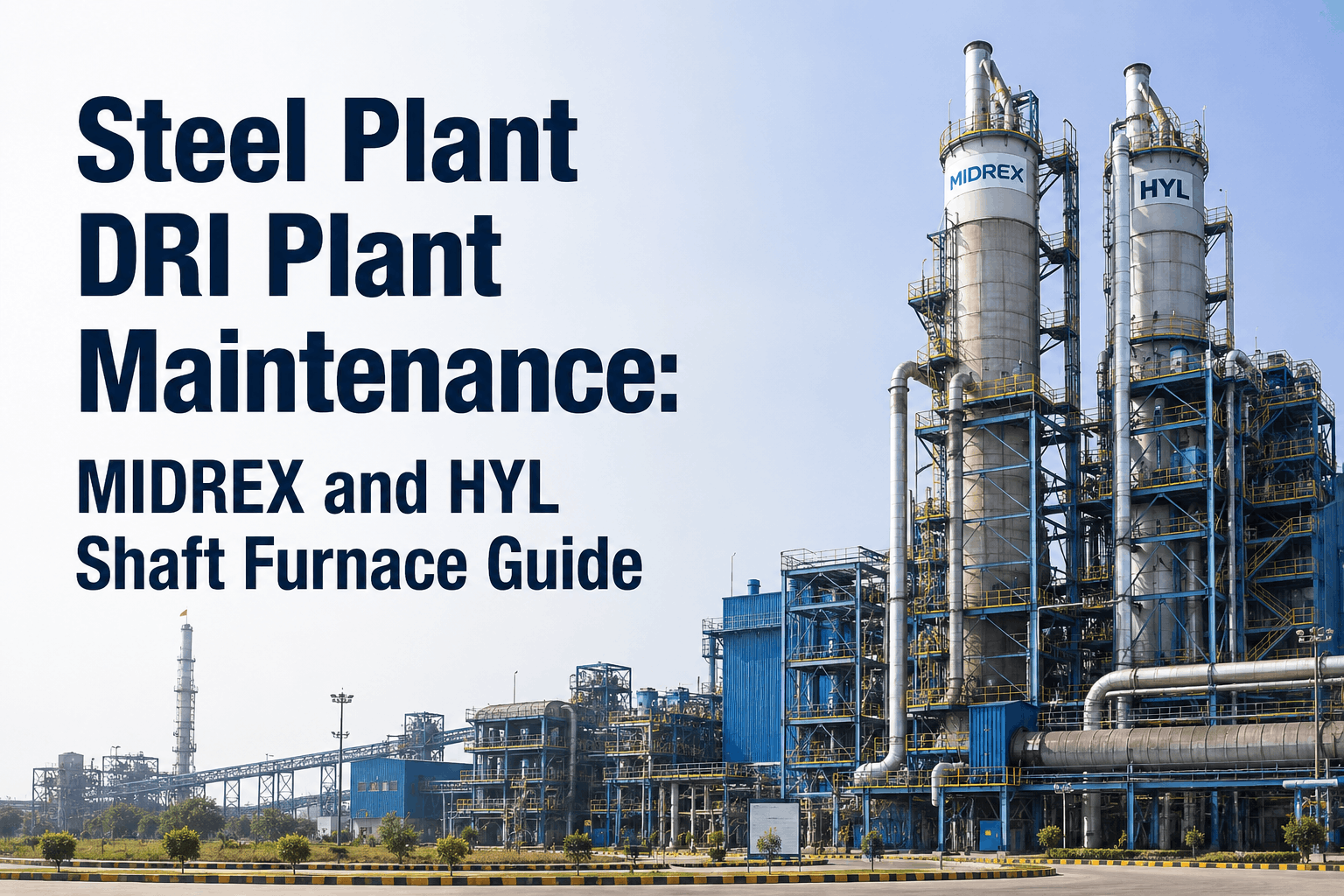
Direct reduction ironmaking converts iron ore (pellets or lump) to DRI (direct reduced iron) using hydrogen and carbon monoxide at temperatures between 800–900°C in a shaft furnace. MIDREX, the dominant technology since 1969, uses a reformer that mixes recycled furnace top gas with fresh natural gas, catalytically reforming it to 90–92% syngas (H₂ + CO), then injecting this gas into the shaft furnace where it reduces iron oxide by gravity countercurrent contact. HYL variants use steam reforming instead of dry reforming, producing slightly different gas ratios but following the same shaft furnace reduction principle. The reformer is the thermal heart—a refractory-lined chamber with catalyst-filled alloy tubes that must maintain 900–950°C to achieve complete methane decomposition. Shaft furnace refractory lining wears from thermal cycling, mechanical abrasion, and chemical attack from ore fines and carryover deposits. Modern plants are now transitioning to hydrogen blending (MIDREX Flex™, MIDREX H₂™) to reduce carbon footprint, but this requires precise gas flow balancing because hydrogen reduction is more endothermic than CO reduction, demanding higher process gas mass flow to maintain thermal balance.
Shaft Furnace and Reformer Condition Assessment
GRADE A
Excellent — Planned Campaign
Refractory lining uniform wear <3mm per campaign, lining temperature stable ±50°C, reformer catalyst activity >85%, H₂/CO ratio 1.5–1.8 maintained continuously. Furnace operating at design capacity. Expected campaign life: 36–42 months.
GRADE B
Good — Monitored Wear
Refractory wear 4–6mm per campaign, temperature fluctuations ±75°C, reformer catalyst activity 75–85%, H₂/CO ratio drifts 1.4–1.9. Production rate reduced 8–12%. Campaign life: 24–30 months with weekly monitoring.
GRADE C
Fair — Urgent Intervention
Refractory wear 7–10mm per campaign, temperature instability >100°C swings, catalyst activity <75% (poisoning likely), H₂/CO ratio erratic. Production curtailed 20–25%. Campaign life: 12–18 months; immediate refractory relining planning required.
GRADE D
Poor — Imminent Failure
Refractory penetration >10mm, lining temperature hot spots, catalyst activity <65% (severe deactivation), H₂/CO uncontrollable. Furnace producing off-spec DRI. Must be taken offline immediately for emergency rebricking.
Critical DRI Plant Maintenance Zones
Shaft Furnace Refractory Lining Management
Campaign-end lining inspections via visual assessment and temperature profiling. Measure lining thickness using ultrasonic or laser scanning at critical zones (belly, upper shaft, cooler section). Track erosion rate per ton DRI produced. Predict rebricking window 8–12 weeks in advance.
Reformer Catalyst Performance and Desulfurization
Monitor reformer outlet gas composition (H₂/CO ratio, CH₄ tail gas). Catalyst poisoning from sulfur >0.1% in ore or feedstock requires preemptive desulfurization unit. Measure catalyst activity by methane slip (target <0.5%). Replace catalyst tubes every 4–6 years or when activity drops below 70%.
Temperature Control and Thermal Balance
Continuous furnace temperature monitoring at multiple points (burden level, cooler outlet, gas inlet). Track temperature stability ±50°C zone. Hydrogen blend transitions require increased process gas flow to maintain endothermic heat balance—automate flow ramp control to prevent furnace destabilization.
DRI Quality Control and Metallurgical Properties
Track DRI carbon content (target 1.5–3.5% for EAF feed), iron recovery rate, and porosity. Hydrogen-heavy reducing gas lowers carbon; monitor DRI carbon continuously during H₂ blend ramps. Adjust oxygen injection or carburizing gas injection to maintain target metallurgical spec.
Hydrogen Injection and Gas Flow Management
For MIDREX Flex™ and MIDREX H₂™ operation, track hydrogen injection rates at reformer inlet, reformer burners, and shaft furnace feed points. Monitor total process gas flow—increasing H₂ percentage requires proportional flow increase to maintain thermal mass balance. Compressor capacity becomes limiting ~30% NG replacement.
Gas Cooler and Heat Recovery Unit Maintenance
Furnace top gas is recycled after cooling and dedusting; cooler tube fouling reduces heat recovery efficiency. Monthly inspection of cooler tubes, cleaning of dust carryover, and inspection of internal refractory protect against unplanned shutdown and maintain reformer feed temperature.
Planned Maintenance vs. Unplanned Furnace Outage Economics
Factor
Reactive Outage
Planned Campaign End
Rebricking Duration
14–21 days with emergency crews
10–12 days with scheduled crew
Refractory Material Cost
$680K–750K (rush procurement)
$520K–600K (planned inventory)
Lost Production Revenue
$4.2M–5.1M (450,000 tons × $9.50 DRI price)
$2.8M–3.2M (coordinated with market)
Catalyst Replacement Cost
$240K–280K (unplanned, expedited)
$180K–220K (planned procurement)
Startup and Ramp to Design Capacity
7–10 days (rushed, high variability)
4–6 days (controlled startup)
Total Economic Impact
$5.4M–6.2M
$3.5M–4.1M
$1.8M
Avoided Cost Annually
By extending shaft furnace campaign from 24 to 36 months through predictive condition monitoring.
Maintained via reducing gas composition control and oxygen/carburizing gas injection tuning.
8–12 Wks
Rebricking Lead Time
Visibility window to order materials and schedule crews without premium emergency pricing.
Frequently Asked Questions
How does Oxmaint predict optimal shaft furnace rebricking timing?+
Oxmaint logs refractory wear rate per ton DRI, temperature stability trends, and lining thickness measurements. System projects remaining campaign life in months and triggers rebricking planning when furnace reaches 80% of predicted campaign life, allowing 8–12 weeks for material procurement and crew scheduling.
Can the system monitor catalyst poisoning and predict replacement timing?+
Yes. Oxmaint tracks methane slip in reformer outlet gas and H₂/CO ratio. When methane tail gas exceeds 0.5% or catalyst activity drops below 70% (calculated from gas composition trends), system alerts for catalyst replacement. Desulfurization unit effectiveness is also monitored to prevent sulfur poisoning.
How are hydrogen blend transitions managed without furnace destabilization?+
Hydrogen reduction is more endothermic than CO reduction; transitioning to higher H₂ percentages requires proportional increase in process gas flowrate to maintain thermal mass balance in the furnace. Oxmaint automates flow ramp control and monitors furnace temperature stability during H₂ blend increases to prevent temperature swings >±50°C that accelerate refractory wear.
What DRI carbon content is achievable with different reducing gas compositions?+
Standard MIDREX NG (55% H₂, 36% CO) produces DRI with 2.5–3.5% carbon. Increasing H₂ percentage lowers carbon content; 100% hydrogen can achieve <1% carbon. Adjustment is made via carburizing gas injection (CO or CH₄) to maintain target 1.5–3.5% carbon window for EAF metallurgical specs. Oxmaint tracks carbon spec continuously and adjusts injection points automatically.
How is furnace temperature stability maintained across load transients?+
Temperature is balanced between endothermic reduction reactions (require heat) and exothermic oxidation reactions (release heat). Oxmaint monitors furnace temperature at multiple points and logs thermal imbalances. Process gas flow, oxygen injection, and carburizing gas injection are tuned to maintain 800–900°C within ±50°C envelope; deviations >100°C accelerate refractory failure.
What is the compressor capacity limitation when increasing hydrogen blend?+
Hydrogen reduction requires higher gas flow per unit of iron reduced. Existing plants typically reach compressor capacity limit around 30% natural gas replacement with hydrogen. Beyond this, compressor upgrade or debottlenecking is required. Oxmaint tracks process gas flow and hydrogen percentage to flag when approaching compressor limits.
How does cooler fouling impact reformer performance and feed gas temperature?+
Furnace top gas is recycled after cooling; fouled cooler tubes reduce heat recovery efficiency and push reformer feed gas above design temperature. Hot feed reduces reforming efficiency and catalyst life. Oxmaint monitors cooler tube effectiveness and triggers monthly cleaning when heat recovery degrades >5%; preventive cleaning extends catalyst life 12–24 months.
What is the CO₂ reduction potential with hydrogen-based DRI production?+
MIDREX H₂™ (100% hydrogen) achieves ~90% CO₂ reduction vs. blast furnace ironmaking (1.1–1.2 kg CO₂/kg steel vs. 2+ kg/kg for BF). Current MIDREX NG (50% hydrogen) delivers ~60% reduction. Hydrogen availability and cost remain the limiting factors; MIDREX Flex™ allows gradual transition as green hydrogen supply increases.
Maximize DRI Plant Campaign Life and Product Quality
Oxmaint's CMMS tracks shaft furnace refractory wear, reformer catalyst performance, reducing gas composition, and hydrogen blend optimization. Extend furnace campaigns 12+ months, prevent unplanned rebricking, and maintain DRI metallurgical specifications for EAF feed.
-maintenance-and-shaft-furnace-reliability.png)