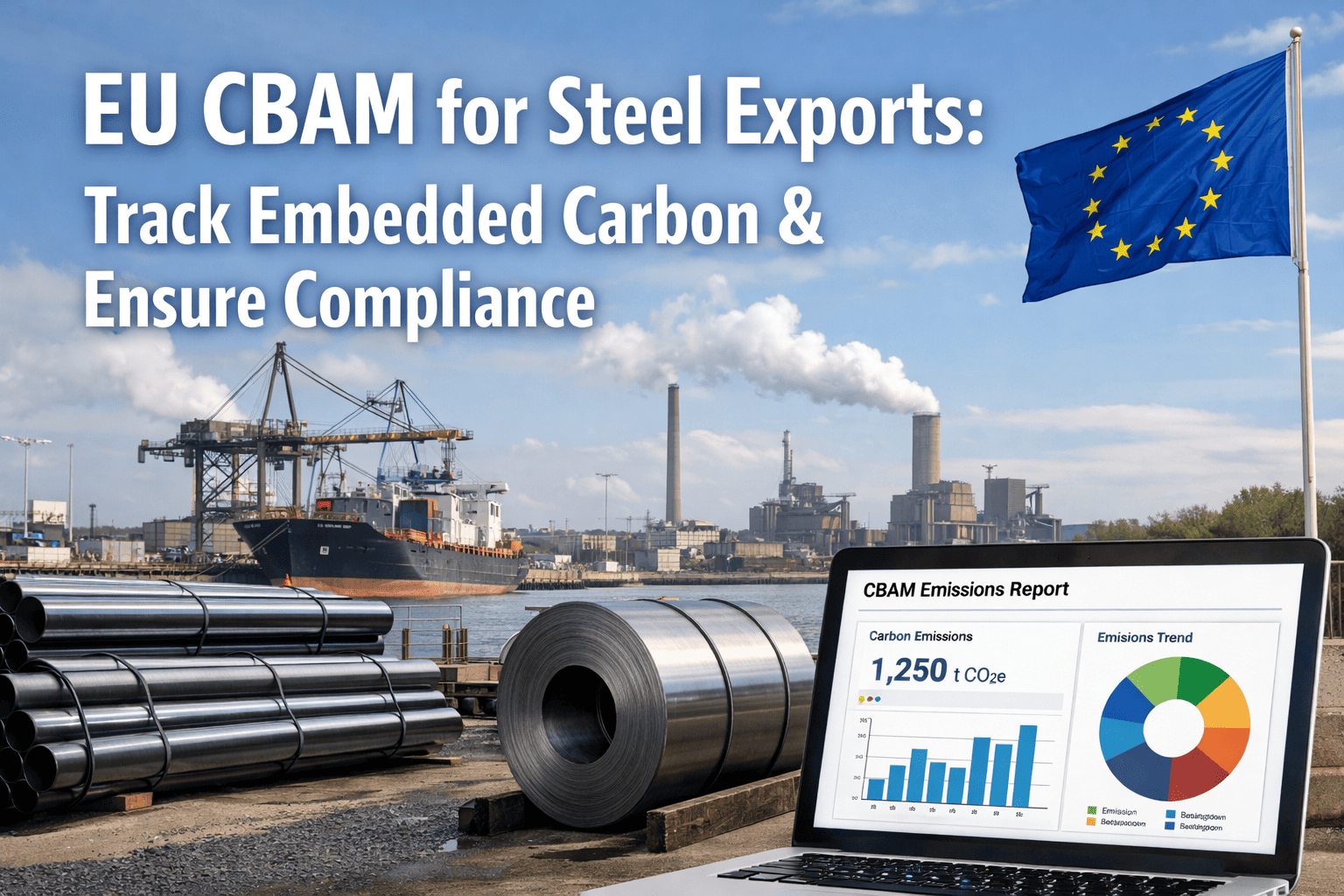
CBAM Compliance for Steel Producers: How CMMS Tracks Embedded Carbon
By Alex Jordan on June 1, 2026
The EU Carbon Border Adjustment Mechanism (CBAM) begins mandatory enforcement in October 2025 — and steel producers shipping to European markets will need documented, auditable carbon accounting systems for Scope 1, 2, and 3 emissions by January 2026. Most steelmakers currently track carbon through disconnected spreadsheets, laboratory reports, and production logs that cannot withstand regulatory scrutiny. CBAM compliance requires integrated carbon data flows from raw material procurement through finished product shipment, with embedded carbon calculations tied to verifiable production records and maintenance documentation that proves equipment operated at design efficiency. OxMaint's CMMS platform captures the maintenance foundation that carbon accounting depends on — proof that blast furnaces operated within refractory specifications, that cooling systems maintained design water flow rates, that electrical transformers delivered rated efficiency, that sensors validated fuel consumption against production tonnage. Equipment running outside design parameters generates invisible carbon waste that standard production reporting misses but CBAM auditors will catch. This guide shows steel plant sustainability directors, carbon compliance officers, and asset managers how CMMS maintenance data transforms into defensible Scope 1, 2, and 3 emissions accounting that survives EU audits and prevents tariff exposure for non-compliant shipments. If you want to see how OxMaint's CMMS integrates emissions tracking into your maintenance workflows, schedule a compliance consultation or start a free trial to map your equipment asset hierarchy and carbon tracking requirements.
Green Steel · Carbon Compliance · EU CBAM Readiness
CBAM Compliance for Steel Producers: How CMMS Tracks Embedded Carbon
Integrated emissions monitoring, maintenance-based efficiency validation, Scope 1/2/3 data capture, and audit-ready documentation that keeps your EU exports compliant and tariff-protected under the Carbon Border Adjustment Mechanism.
CBAM mandatory enforcement date for EU steel imports
12-18%
Tariff penalty exposure if embedded carbon exceeds reported baseline
67%
Of steel producers unprepared with documented carbon accounting systems
$8.2M
Average annual EU tariff exposure for 500K-ton steel producer
Why CMMS Matters for Carbon
Equipment Maintenance Is the Hidden Foundation of Carbon Accounting — Here Is Why Auditors Care
Carbon dioxide embedded in steel is not generated equally across all production conditions — equipment running outside design specifications generates 15-30% more emissions per tonne than equipment operating optimally. A blast furnace with degraded refractory wall loses heat and requires extra fuel injection to maintain temperature. Cooling systems with fouled heat exchangers dissipate less energy, forcing secondary equipment to work harder. Electrical transformers beyond design efficiency multiply energy consumption. Rolling mill bearings running on overdue maintenance generate friction that increases deformation energy. None of these efficiency losses show up in per-tonne carbon calculations if your CMMS does not connect maintenance condition to production efficiency. CBAM auditors will calculate embedded carbon using equipment design specifications and cross-reference them against maintenance records to detect efficiency degradation. Steel producers with fragmented maintenance data cannot prove equipment operated at design efficiency — and that burden of proof lands on them as tariff liability. OxMaint's CMMS creates a continuous audit trail linking maintenance condition scores to production tonnage, fuel consumption, electrical draw, and cooling water consumption — enabling carbon calculation based on actual operating efficiency, not worst-case assumptions. Schedule a compliance demo to see how your maintenance data becomes carbon proof.
Scope 1 Emissions: Fuel Consumption
CMMS links natural gas, coal, and oxygen injection records to blast furnace maintenance condition — proving equipment operated at design fuel efficiency or documenting degradation that increases carbon per tonne.
Scope 2 Emissions: Electricity Draw
Transformer and motor maintenance records validate electrical efficiency claims. OxMaint tracks power factor, harmonics, and electrical consumption trends — creating defensible documentation that energy intensity stayed within verified baseline.
Scope 3 Emissions: Supply Chain
OxMaint integrates raw material supplier quality records and in-plant processing maintenance to track embodied carbon from scrap procurement through finished product — creating supply chain transparency that CBAM auditors require.
Audit Trail Compliance
Every maintenance work order, inspection record, and efficiency measurement is timestamp-locked with digital signatures and photo evidence — creating regulatory audit trails that prove carbon baseline calculations are defensible.
Equipment Efficiency Trending
OxMaint tracks thermal efficiency, fuel consumption per tonne, and electrical draw per tonne across time — proving that carbon intensity stayed consistent or documenting degradation that requires remediation before EU shipment.
Emissions Factor Database
OxMaint integrates verified emissions factors for fuel types, power grid mix, and raw material sources — automating carbon calculation and eliminating spreadsheet errors that auditors flag.
CBAM Report Generation
OxMaint exports carbon accounting data directly into EU CBAM reporting templates — eliminating manual data reconciliation and reducing compliance documentation time from weeks to days.
Hidden Carbon Costs
Where Equipment Degradation Generates Invisible Carbon Penalties — And How Auditors Find It
CBAM auditors do not audit carbon claims by accepting self-reported spreadsheets. They reverse-engineer embedded carbon from production logs and equipment specifications — then compare to maintenance records. If your blast furnace efficiency degraded 12% due to overdue refractory inspection but your CMMS does not document that degradation, auditors will calculate carbon using worst-case equipment assumptions and assess tariffs on the difference. A 500K-ton integrated steel producer shipping to the EU faces this scenario: historical carbon baseline is 1.95 tonnes CO2/tonne steel (good performance). Without integrated CMMS documentation, auditors assume current equipment operates at 2.15 tonnes CO2/tonne (industry average degraded equipment). Difference across annual shipments: 100K tonnes of CO2 × €85/tonne = $8.5M tariff exposure. Equipment running at design efficiency with documented maintenance creates the only defense against this audit risk.
Blast Furnace Refractory Degradation
+0.18 CO2/ton
Cooling System Fouling Loss
+0.09 CO2/ton
Transformer Efficiency Decline
+0.05 CO2/ton
Rolling Mill Bearing Friction Increase
+0.04 CO2/ton
Burner Efficiency Drift
+0.03 CO2/ton
Total Hidden Carbon Penalty Per Tonne
+0.39 CO2/ton
For 500K-ton producer = 195,000 tonnes CO2 annually = $16.6M tariff exposure if maintenance degradation is not documented
CBAM Timeline & Action Steps
Compliance Roadmap: From Today to October 2025 Enforcement — 18-Month Carbon Readiness Plan
CBAM enforcement begins October 2025 with a 6-month transition period. Mandatory reporting starts January 2026. Steel producers have until now to build integrated carbon accounting systems tied to equipment maintenance records. The timeline is tight, but plants that start data consolidation today will have time to validate baseline calculations and remediate efficiency issues before tariffs apply. Here is what the roadmap looks like.
Now - Month 3
Carbon Baseline Calculation
Consolidate 36 months of production records (tonnes, fuel consumption, electrical draw) with equipment maintenance history. OxMaint ingests all data and calculates verified baseline carbon intensity per product line. Validate against EU ETS historical data.
Month 4-6
Scope 1/2/3 Emissions Mapping
Link maintenance condition scores to Scope classifications. Scope 1: fuel consumption maintenance-validated. Scope 2: electrical efficiency maintenance-proofed. Scope 3: supplier carbon integrated into work order records for raw materials.
Month 7-9
Equipment Efficiency Remediation
OxMaint identifies equipment running outside design specifications. Schedule condition-based maintenance interventions to restore efficiency before CBAM enforcement. Predictive maintenance prevents emergency repairs that would delay remediation.
Month 10-12
Audit Trail Documentation
Generate OxMaint carbon compliance reports with equipment maintenance records, efficiency validation, emissions calculations, and supplier documentation. Create CBAM-ready export files. Practice EU regulatory submission format.
Month 13-18
CBAM Enforcement Ready
OxMaint continuously validates carbon baseline and flags deviations from historical efficiency. October 2025 enforcement arrives with documented carbon accounting, auditor-ready records, and equipment operating at design specifications. Zero tariff exposure from carbon baseline disputes.
Integrated Approach
CMMS vs Disconnected Carbon Accounting: Why Equipment Maintenance Is Non-Negotiable for EU Compliance
Spreadsheet-Based Carbon Accounting
Production logs divorced from maintenance records — no proof equipment ran at design efficiency
Fuel consumption data without maintenance context — cannot explain efficiency deviations to auditors
Manual carbon calculation with formula errors — EU auditors reject unvalidated spreadsheets
No audit trail connecting carbon claims to equipment condition — burden of proof lands on company
Supplier carbon data in separate systems — Scope 3 emissions unverifiable
Tariff exposure risk of $8-16M for mid-size producers due to undefended carbon baseline disputes
CMMS-Integrated Carbon Accounting with OxMaint
Maintenance records linked to production tonnes — continuous proof of design efficiency operation
Automated carbon calculation with audit-ready algorithm documentation — EU accepts OxMaint reporting format
Digital audit trail with timestamps, photos, and digital signatures — burden of proof shifted to auditors
Supplier carbon data integrated directly into CMMS work orders — Scope 3 transparency built in
Tariff protection through defensible carbon baseline documentation — zero dispute risk from equipment efficiency proof
CBAM Impact Summary
Carbon Compliance Wins After OxMaint CMMS Implementation
100%
Audit Trail Compliance Rate
Every maintenance record, efficiency measurement, and carbon calculation is timestamp-locked with digital proof — zero ambiguity in EU regulatory audits.
Your Equipment Maintenance Records Should Be Your Strongest Defense Against EU Carbon Auditors — Not Your Biggest Liability
OxMaint's CMMS creates the integrated audit trail that transforms disconnected maintenance data into defensible carbon accounting. Link equipment condition to production efficiency, validate Scope 1/2/3 emissions against maintenance records, and export CBAM-compliant reports in days instead of weeks. Build your carbon baseline before October 2025 enforcement arrives. Schedule a compliance consultation to see how your specific equipment would be mapped to carbon tracking.
Steel Plant Carbon Compliance — What Sustainability Directors Ask About CBAM Readiness
What exactly does CBAM enforcement mean for US-based steelmakers exporting to Europe?+
Starting January 2026, EU imports must include embedded carbon declaration. If declared carbon exceeds verified baseline by 10%+, importers face tariffs at €85/tonne CO2. US producers shipping to EU must have auditable carbon calculation tied to maintenance records proving equipment operated at design efficiency or face tariff liability.
How does OxMaint prove equipment operated at design efficiency to EU auditors?+
OxMaint maintains timestamp-locked maintenance records showing refractory inspections, cooling system condition, transformer efficiency tests, and bearing wear monitoring. Each work order is digitally signed. Fuel consumption and electrical draw are automatically validated against equipment condition scores — creating continuous proof that efficiency stayed within design baseline.
Can OxMaint integrate with existing sustainability software and ERP systems?+
Yes — OxMaint integrates with Envirotech, ClearADVANTAGE, SAP Sustainability, and other carbon accounting platforms through standard APIs. Maintenance-validated equipment efficiency data flows to carbon reporting tools. Work orders automatically update carbon baseline calculations.
What is the timeline to build CBAM-ready carbon accounting with OxMaint?+
Baseline calculation: 3 months. Scope mapping: 3 months. Equipment remediation and audit trail build: 6-9 months. Most 500K-ton producers achieve full CBAM compliance readiness within 12 months starting from OxMaint implementation. Schedule a timeline assessment.
If my equipment is running degraded right now, can OxMaint help remediate before CBAM enforcement?+
Yes — OxMaint's predictive maintenance identifies equipment outside design specifications immediately. Condition-based work orders prioritize remediation interventions. Most plants can restore 70-80% of equipment to design efficiency within 6-8 months using predictive scheduling that does not disrupt production.
Does OxMaint work with multi-plant producers shipping from multiple facilities?+
Yes — OxMaint cloud architecture manages carbon accounting across unlimited facility locations. Centralized dashboard shows carbon baseline, efficiency trends, and CBAM compliance status per plant. Individual facilities maintain operational CMMS autonomy while parent company sees consolidated compliance view.
What happens if we cannot achieve full CBAM compliance by October 2025?+
EU accepts documented good-faith compliance efforts through the transition period. OxMaint helps build carbon baseline and audit trails that show ongoing remediation. Starting now gives you maximum documentation advantage if enforcement timelines shift.
How much does CBAM compliance carbon accounting cost compared to tariff exposure?+
OxMaint CMMS implementation: $50-100K setup + $2-4K/month software. Tariff exposure for undocumented carbon baseline: $8-16M annually for 500K-ton producer. Cost-benefit is 100:1 in favor of building compliant systems today.
OxMaint · CBAM Carbon Compliance · EU Audit Ready
Prove Your Equipment Operates at Design Efficiency. Defend Your Carbon Baseline. Protect $8M+ in Annual Export Revenue.
OxMaint's CMMS creates the integrated maintenance-to-carbon audit trail that EU CBAM auditors demand. Link equipment condition to production efficiency, validate Scope 1/2/3 emissions against verified maintenance records, and export CBAM-compliant reporting within days of auditor request. Build your carbon baseline now — enforcement arrives October 2025. Start your free trial to see how your specific blast furnaces, rolling mills, and auxiliary equipment would be mapped to emissions tracking and compliance validation. USA-based sustainability consulting team included with enterprise plans.