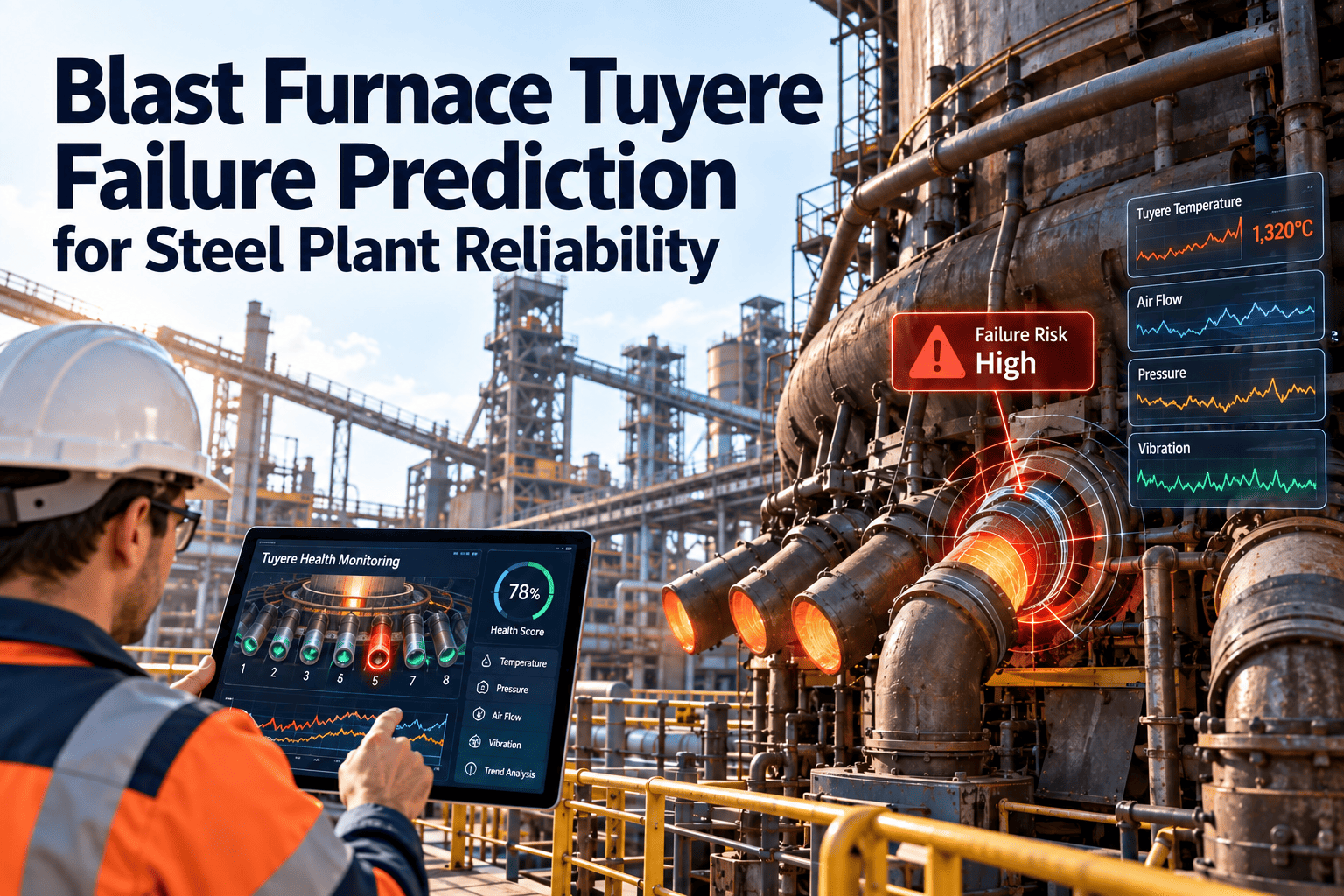
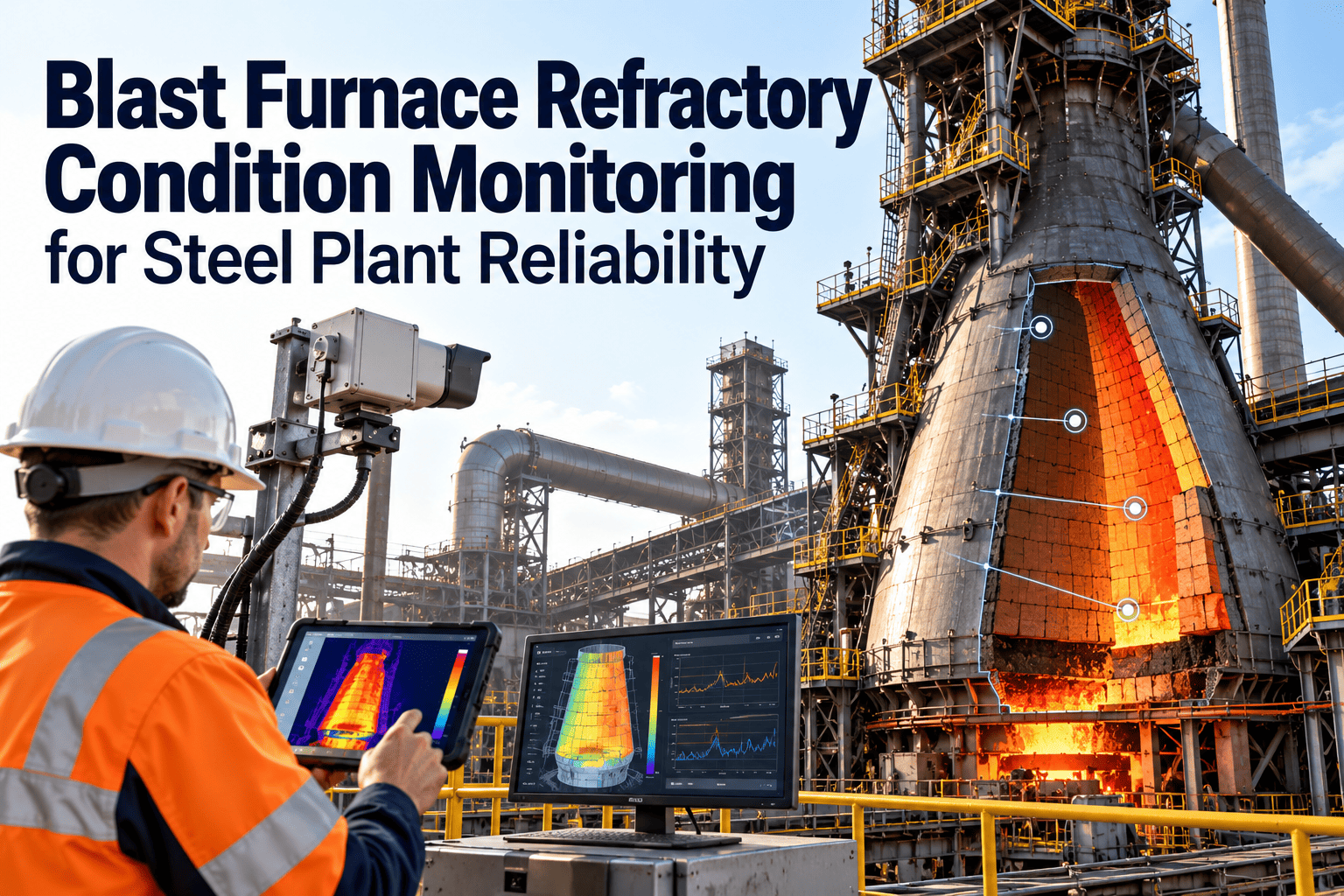
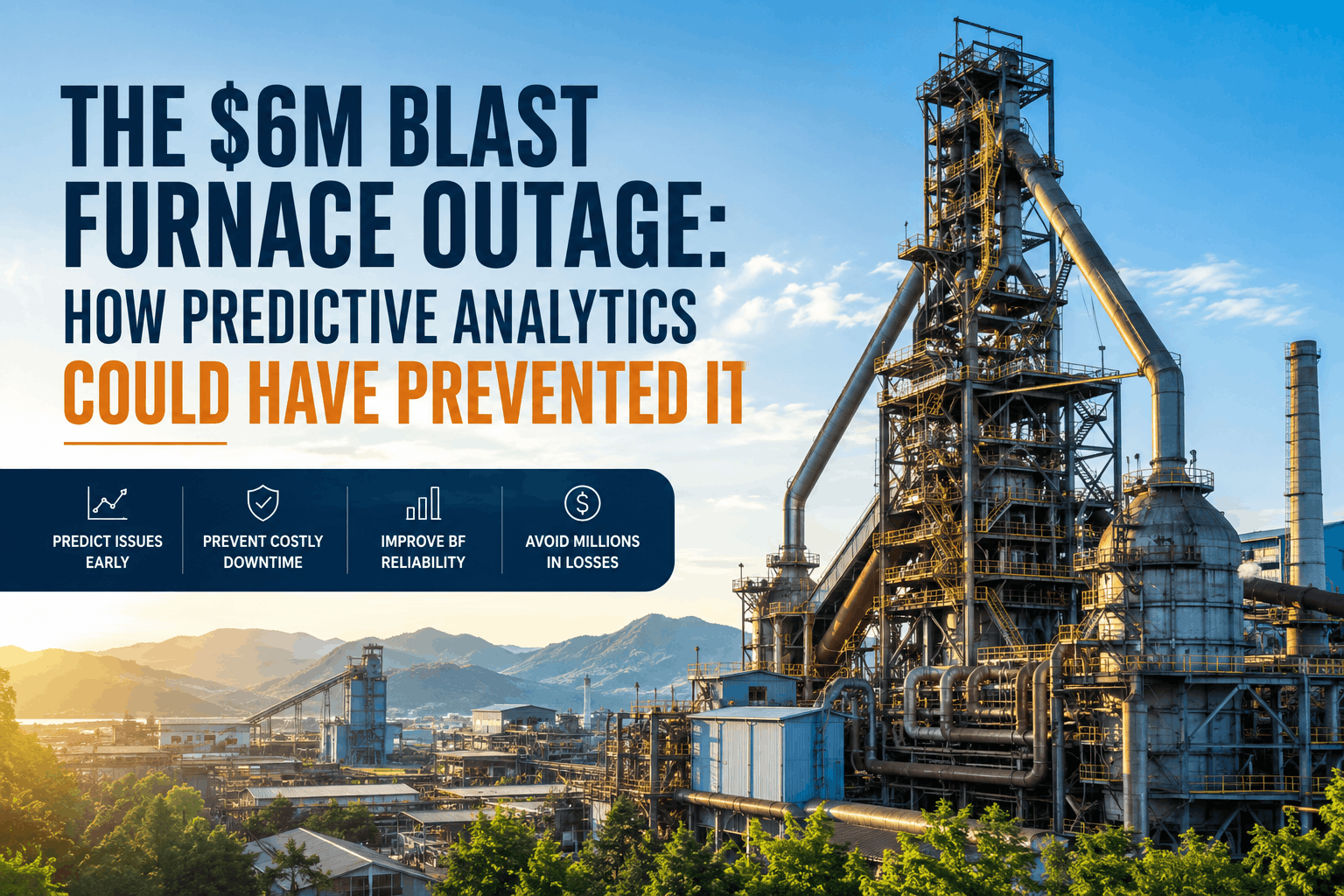
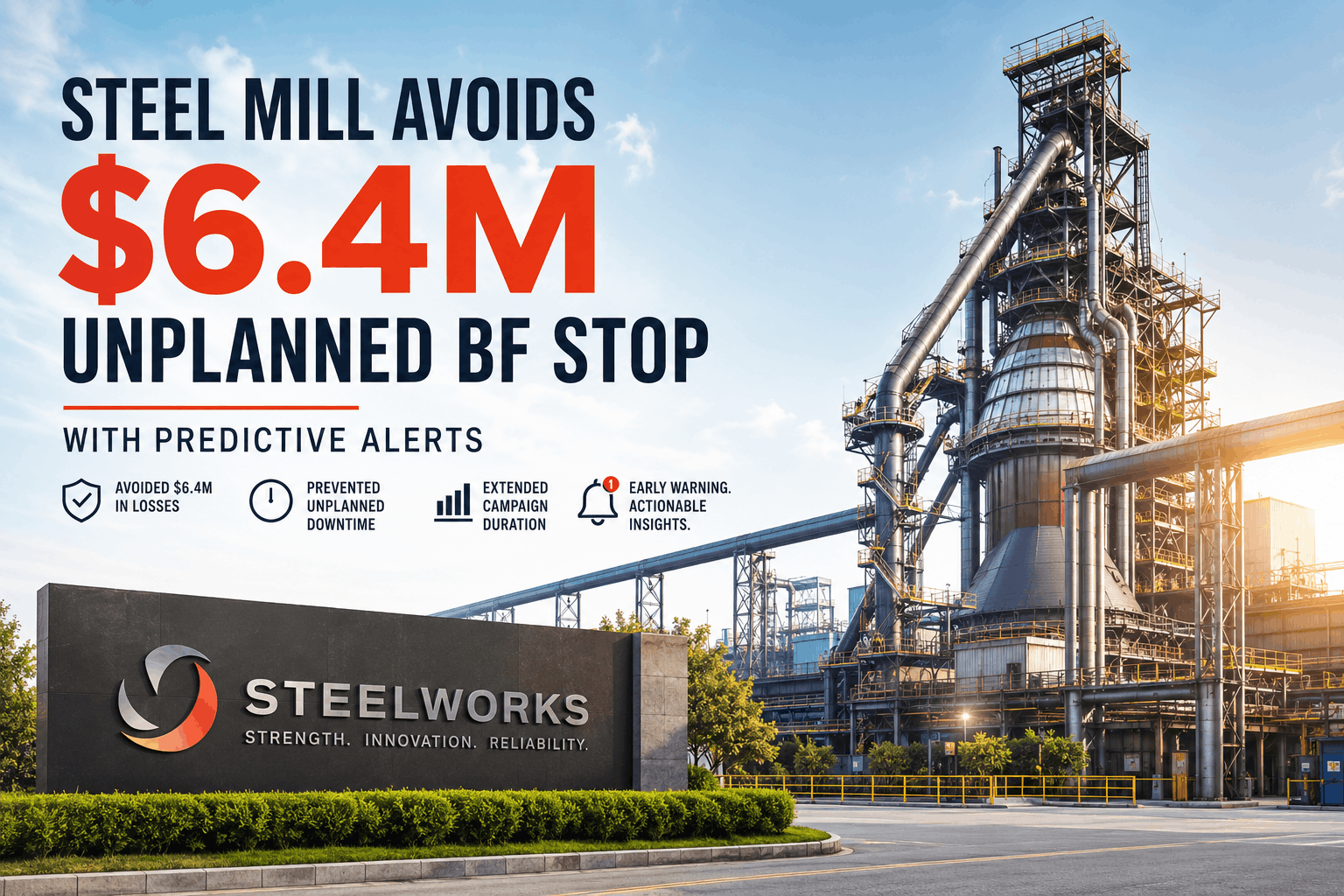
Year 11 of an 18-year campaign. Ninety-four embedded thermocouples. One spatial anomaly — 18°C above expected — that the DCS never saw. Oxmaint AI flagged it on Day 1. By Day 23, without intervention, the hearth wall would have breached: $6.2 million in emergency repairs, 22 days offline, and a campaign cut short by three years. Instead the furnace ran at 8,200 tonnes of hot metal per day while the engineering team spent $340,000 on a planned fix. This is what that looks like — day by day, decision by decision, number by number.
How AI Prevented a
$6M Blast Furnace Breakout
Steel Plant Predictive Maintenance — Real Data, Real Timeline, Real Outcome
What a Blast Furnace Breakout Costs — The Full Number
Most plant managers know breakouts are catastrophic. Few have added the full number. When molten iron contacts the furnace shell, the direct cost is only the opening line. Indirect costs — lost production, emergency crane mobilisation, secondary damage, insurance implications, and campaign life reduction from accelerated thermal cycling — make the real figure far higher than what goes on the repair invoice.
Plant and Furnace Profile at Detection
The 23-Day Timeline That Saved $6.2 Million
Every decision in this timeline was data-driven. Every data point came from sensors already wired into the furnace. Nothing new was installed. The gap was not instrumentation — it was the analytical layer that converts raw thermocouple readings into spatial anomaly detection, erosion rate velocity, and compound risk signatures.
Spatial Anomaly Flagged in Northwest Hearth Quadrant
TC at 600mm depth reads 18°C above the spatial mean for its ring position. Absolute value: 847°C — the DCS alarm threshold is 950°C. No alarm fires. Oxmaint's spatial model identifies the pattern deviation because the TC's reading is wrong relative to its eight neighbours, not because it crossed a fixed limit. Alert dispatched with spatial deviation map. Zero human detection without the AI layer.
Erosion Rate 2.3× Baseline — Breakthrough Projected in 19–24 Days
Three consecutive 4-hour inverse heat transfer model updates confirm the 1150°C isotherm migrating outward at 2.3× the campaign baseline rate in the northwest quadrant. Cooling stave heat flux in the adjacent panel rises 22% above panel mean. Wall thickness is still technically safe — but the velocity projects shell contact within three weeks. Oxmaint generates a Priority 1 work order with the projected breakthrough date, confidence interval, and erosion rate trend attached.
Alkali Attack + Cooling Degradation — Compound Risk Identified
Oxmaint's correlation engine traces the thermal anomaly to an elevated alkali loading period in the burden 9 days prior — a delayed potassium penetration signature in the carbon block. The adjacent cooling circuit shows 14% flow reduction from baseline: partial scale blockage reducing heat extraction from the zone under active erosion. Accelerating erosion plus degraded cooling is the compound signature that precedes breakthrough.
Operational Response Deployed — Full Production Maintained
Blast temperature reduced 40°C to lower hearth thermal load. Burden distribution adjusted away from the northwest quadrant. Titanium ore addition initiated at 0.4 kg/t hot metal for TiC/TiN freeze lining recovery. Cooling water flow raised to design maximum on affected circuits. Total operational adjustment cost: $85K. Production rate: unchanged at 8,200 t/day throughout.
Freeze Lining Rebuilding — Erosion Rate Below Baseline
Erosion rate drops to 0.8× campaign baseline in the affected zone. Cooling stave heat flux normalising toward panel mean. Oxmaint updates the campaign life forecast: the intervention has recovered 14 months of projected campaign life. Planned copper stave replacement is scheduled for the next maintenance window — not as an emergency callout at 2 AM.
Projected Breakthrough Date — Furnace Still Running
Without intervention, the original erosion rate projected hearth shell contact on this day. Instead, 8,200 t/day continues. Hearth stable. Campaign extended. Total cost of the entire response: $340K. Total cost avoided: $6.2M minimum. The platform that made this possible costs less than one day of the production it protected.
See What Your Thermocouple Array Is Already Telling You
Connect your existing hearth thermocouples and cooling circuits. Oxmaint builds the spatial baseline from your process historian data. First erosion model in 30 days.
Three Detection Capabilities the DCS Does Not Have
Spatial Pattern Analysis
Every DCS alarm fires when one sensor crosses a fixed value. Oxmaint calculates what each TC should read given its eight spatial neighbours and the furnace geometry. An 18°C spatial deviation at 847°C — 103°C below any DCS alarm — is a clear anomaly to the spatial model. This detection is structurally impossible for threshold systems regardless of how the thresholds are tuned.
Erosion Rate Velocity
Absolute wall thickness was safe on Day 4. But the migration velocity — 2.3× baseline — projected shell contact in 19–24 days. Rate-of-change detection converts a 23-day warning into a managed intervention. Without it, the first signal arrives when the DCS finally alarms — by which point the decision window for low-cost intervention has already closed.
Multi-Source Correlation
The 14% cooling circuit flow reduction was a separate data stream from the thermal anomaly. No engineer manually correlates 94 thermocouples against 30+ cooling circuits in real time. Oxmaint identified the compound risk signature — accelerating erosion plus degraded cooling — the combination that immediately precedes breakthrough. Sign up for Oxmaint to enable compound risk detection for your furnace today.
From Your Existing Instrumentation to Actionable Erosion Intelligence
Connect
Oxmaint ingests TC arrays, cooling water inlet/outlet temperatures, flow rates, and blast parameters via OPC-UA or process historian — OSIsoft PI, Honeywell PHD. No new sensors required in most deployments. Integration typically completes in 2–4 weeks.
Learn
Over 4–6 weeks the AI builds a 3D spatial baseline — the expected reading at every TC given its neighbours and furnace geometry. Historical historian data accelerates mid-campaign deployments. The baseline is what makes spatial anomaly detection structurally possible.
Detect
Every 4 hours, an inverse heat transfer model runs across the full TC array — calculating remaining lining thickness, erosion velocity, and isotherm position. When velocity exceeds 1.5× campaign baseline for three consecutive cycles, a Priority Alert fires with projected breakthrough date and confidence interval.
Act
Work orders include the complete evidence package: spatial deviation map, erosion rate trend, cooling circuit status, and alkali load correlation. Your metallurgical engineering team makes the intervention decision with data — not instinct. Book a demo to see this configured for your furnace geometry.
Continuous monitoring of 200+ thermal and flow parameters per furnace detects cooling anomalies 2–8 weeks before catastrophic failure — converting $4.8M emergency repairs into $340K planned interventions. The steel industry spent $4.2 billion on unplanned downtime in 2024. That number is shrinking wherever AI is deployed.
Frequently Asked Questions
Your Next Hot Spot Is Already Forming
The question is whether you have 23 days to respond — or zero. Oxmaint connects to your existing thermocouple array and gives your engineering team the advance warning that turns a $6M crisis into a $340K planned intervention.