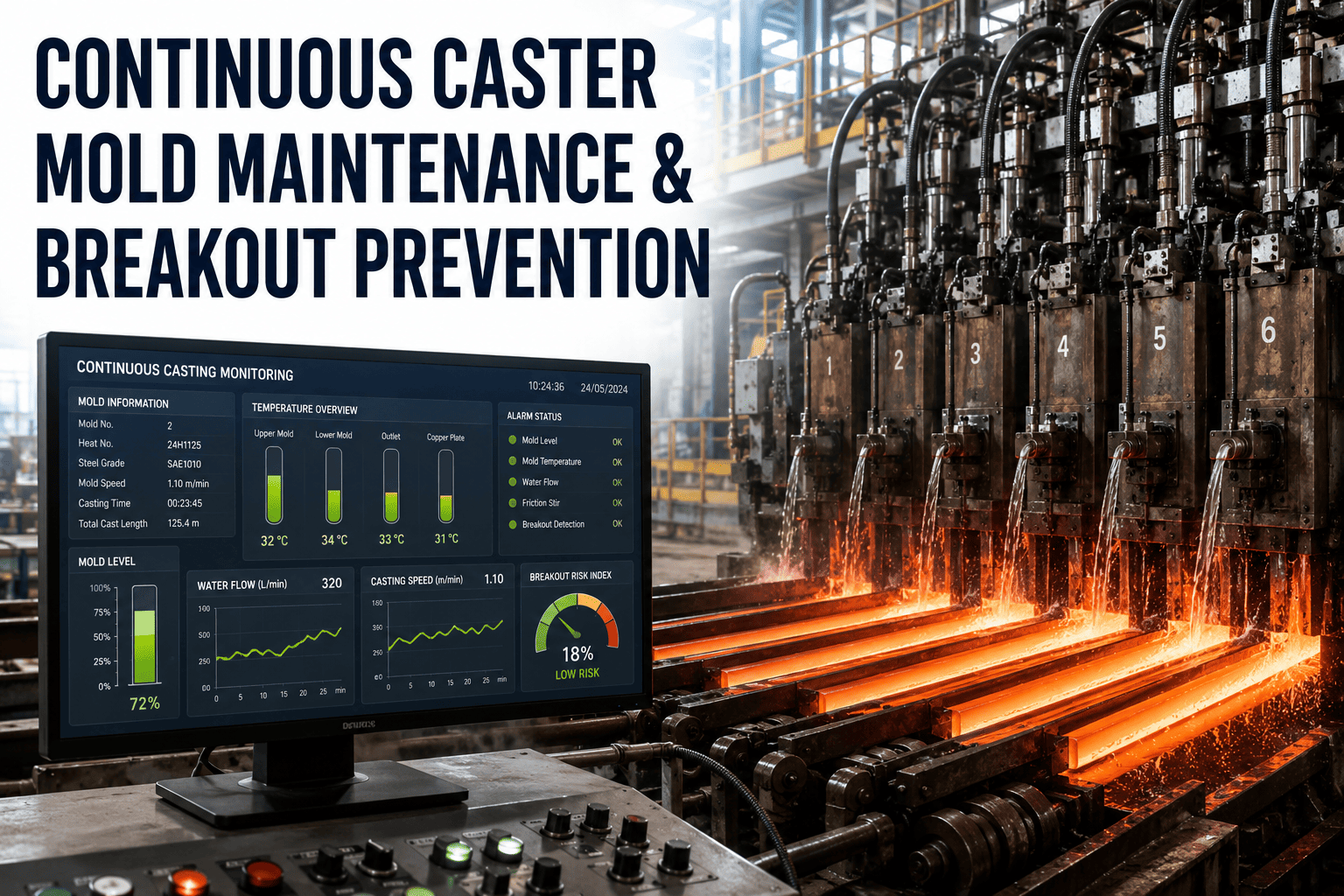
Caster Breakout Prevention: AI and CMMS Early Warning Systems
By Alex Jordan on June 2, 2026
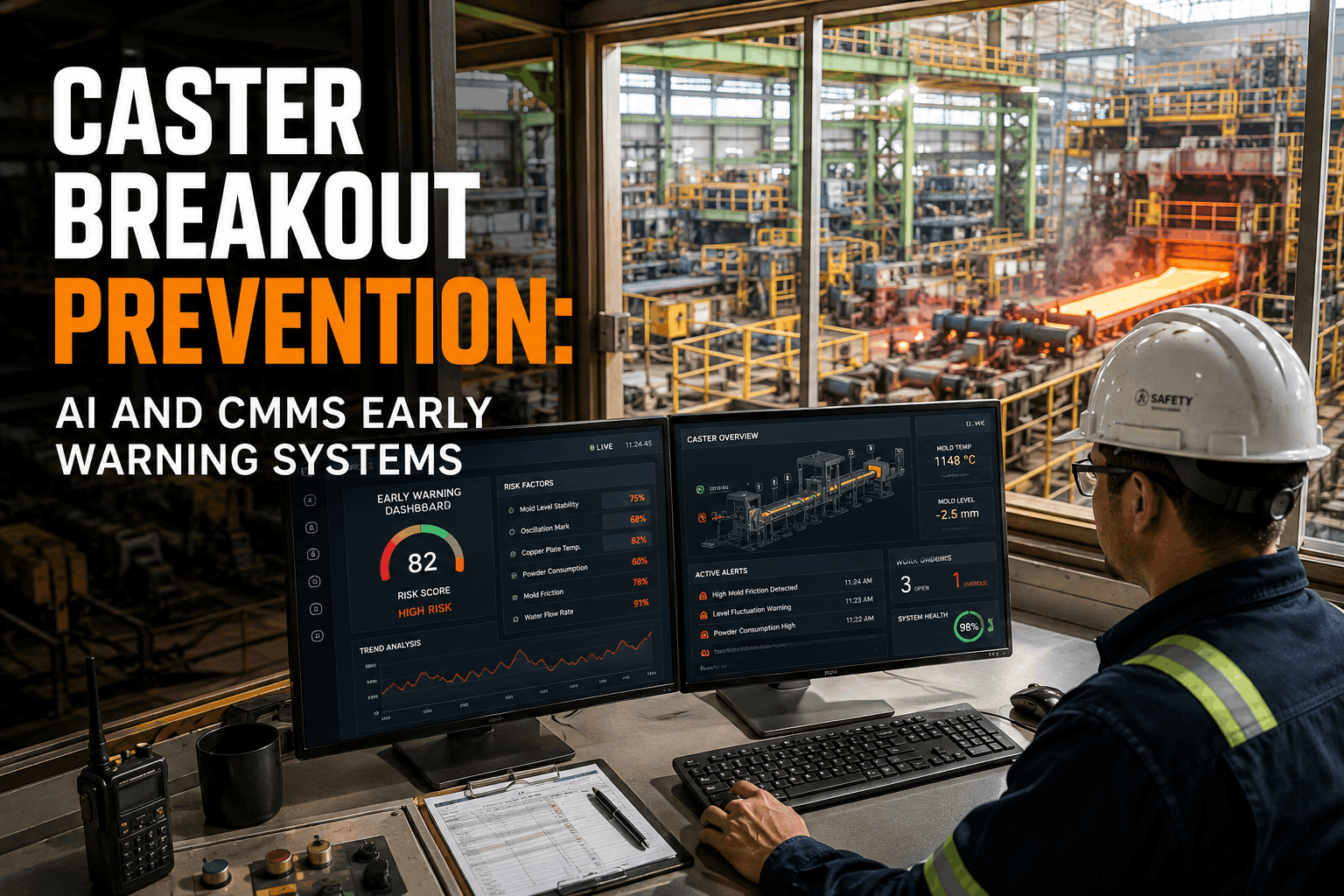
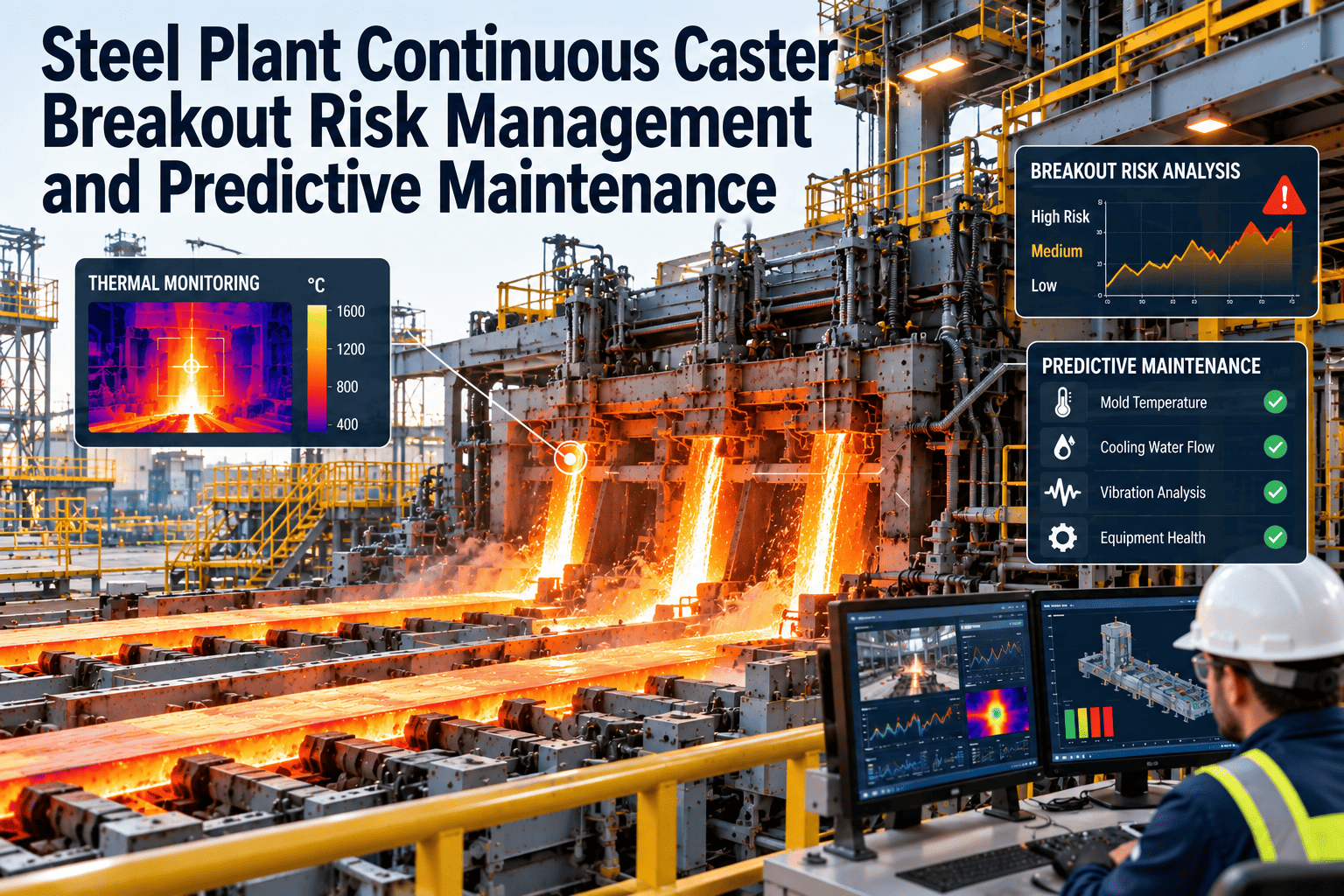
Continuous casting is the heartbeat of steel production — and breakout is its nightmare. A single sticker breakout can cost $1.5M–$4M in mold damage, lost production, and safety incidents. AI-powered early warning systems now predict sticker breakouts 8–12 minutes before they occur, reducing breakout frequency by up to 80%. Integrated CMMS captures every mold thermal event, friction anomaly, and level fluctuation — turning AI predictions into auditable maintenance records. Plant operators with comprehensive breakout prevention documentation pay 15–25% lower insurance premiums than mills without structured caster reliability records. Insurance underwriters view documented mold monitoring, AI prediction accuracy, and automated work order responses as evidence of a well-managed, lower-risk facility — and they price accordingly. Beyond premiums, incident investigation speed is directly tied to documentation quality: mills that can produce complete caster monitoring records within hours resolve safety inquiries faster with lower liability exposure. Start a free trial or book a demo to see Oxmaint's breakout prevention integration.
Caster Breakout Prevention: AI and CMMS Early Warning Systems
Reduce sticker and breakout breakouts by 80% using real-time mold monitoring with automated work orders — complete guide for steel plant casting operations.
"Our six-strand slab caster averaged 11 sticker breakouts per year — each costing over $2M in mold damage and lost tons. After deploying Oxmaint integrated with our mold thermocouple system and breakout prediction AI, we reduced breakouts to 2 in the first 12 months. The AI now gives us 9-minute average warning time. The CMMS auto-creates work orders for cooling checks and mold maintenance after every thermal event. Our insurer reduced our property premium by 18% after reviewing our documented breakout prevention records."
— Casting Operations Manager, Integrated Steel Mill, Pennsylvania, USA
Section 01
Breakout Physics
Sticker Breakout Physics — Why AI Detection Works Better Than Human Monitoring
Sticker breakouts occur when molten steel freezes to the mold copper plate, creating a "sticker" that tears away as the strand descends — ripping a hole in the solidifying shell. Molten steel escapes through the gap, causing a breakout. The physics is consistent: sticker formation creates characteristic patterns in mold thermocouple temperatures (a rapid drop followed by recovery) and increases mold friction. A human operator monitoring 50+ thermocouple signals cannot reliably detect these patterns across all strands simultaneously. AI pattern recognition, trained on thousands of historical breakout events, achieves 94-98% detection accuracy with 8-12 minutes of warning time — enough to slow casting speed, adjust mold taper, or stop the caster before breakout.
The CMMS role: every AI prediction, thermocouple anomaly, and operator response is timestamped and linked to the casting asset record. This creates an auditable chain of evidence for safety investigations, insurance claims, and continuous improvement. Explore Oxmaint's breakout prevention module on a free trial.
DETECTION SIGNATURES
Breakout Precursors — What AI Monitors in Real Time
Thermocouple Pattern
Rapid temperature drop (30-50°C in 5-10 sec) followed by recovery — sticker formation signature
Deviation from optimal depth (typically 120-150mm) disrupts flow and shell formation
Cooling Water Delta-T
Exit water temperature minus inlet water temperature — abnormal cooling pattern
Section 02
AI Architecture
AI Breakout Prediction — Neural Networks, Alert Thresholds, and CMMS Integration
Modern breakout prediction systems use neural networks (typically LSTM or Transformer architectures) trained on historical caster data — thermocouple readings, mold friction, level fluctuations, powder consumption, and operator actions. The model learns the temporal signature of an incipient breakout, distinguishing true precursors from normal process noise. When the prediction confidence exceeds a configurable threshold (typically 85-90%), the system triggers an alert: visual alarm on operator HMI, audible warning, and optionally automatic slow-down or stop logic.
The CMMS integration is critical for documentation and continuous improvement. Every AI alert generates a timestamped record in Oxmaint, including: prediction confidence score, detected precursor signals, operator response (speed reduction, mold taper adjustment, stop), and outcome (breakout avoided or occurred). This creates a closed-loop learning system where the AI model is continuously retrained on new alert outcomes. Book a demo to see the AI alert-to-work-order workflow.
AI Breakout Detection — Performance Metrics by Model Type
LSTM
Long Short-Term Memory
94%
Detection accuracy · 8 min avg warning
CNN
Convolutional Neural Net
96%
Detection accuracy · 6 min avg warning
Trans
Transformer (2026)
98%
Detection accuracy · 11 min avg warning
Connect Oxmaint to Your Caster AI — Auto-Log Every Alert, Auto-Create Work Orders
Every AI breakout prediction, every operator response, every mold inspection becomes a timestamped, auditable record. Export complete caster reliability history for insurance or safety investigation in under 10 minutes.
From AI Alert to Maintenance Action — The CMMS-Integrated Breakout Prevention Workflow
A breakout prediction without a documented response is an unclosed safety loop. Oxmaint's integration creates a complete workflow: AI alert fires → event logged in CMMS with timestamp and confidence score → operator response recorded (speed reduction, mold adjustment, stop) → outcome tracked (breakout avoided or occurred) → follow-up work orders auto-created for mold inspection, cooling system check, or thermocouple validation. This closed-loop documentation provides the evidence insurers and safety regulators require.
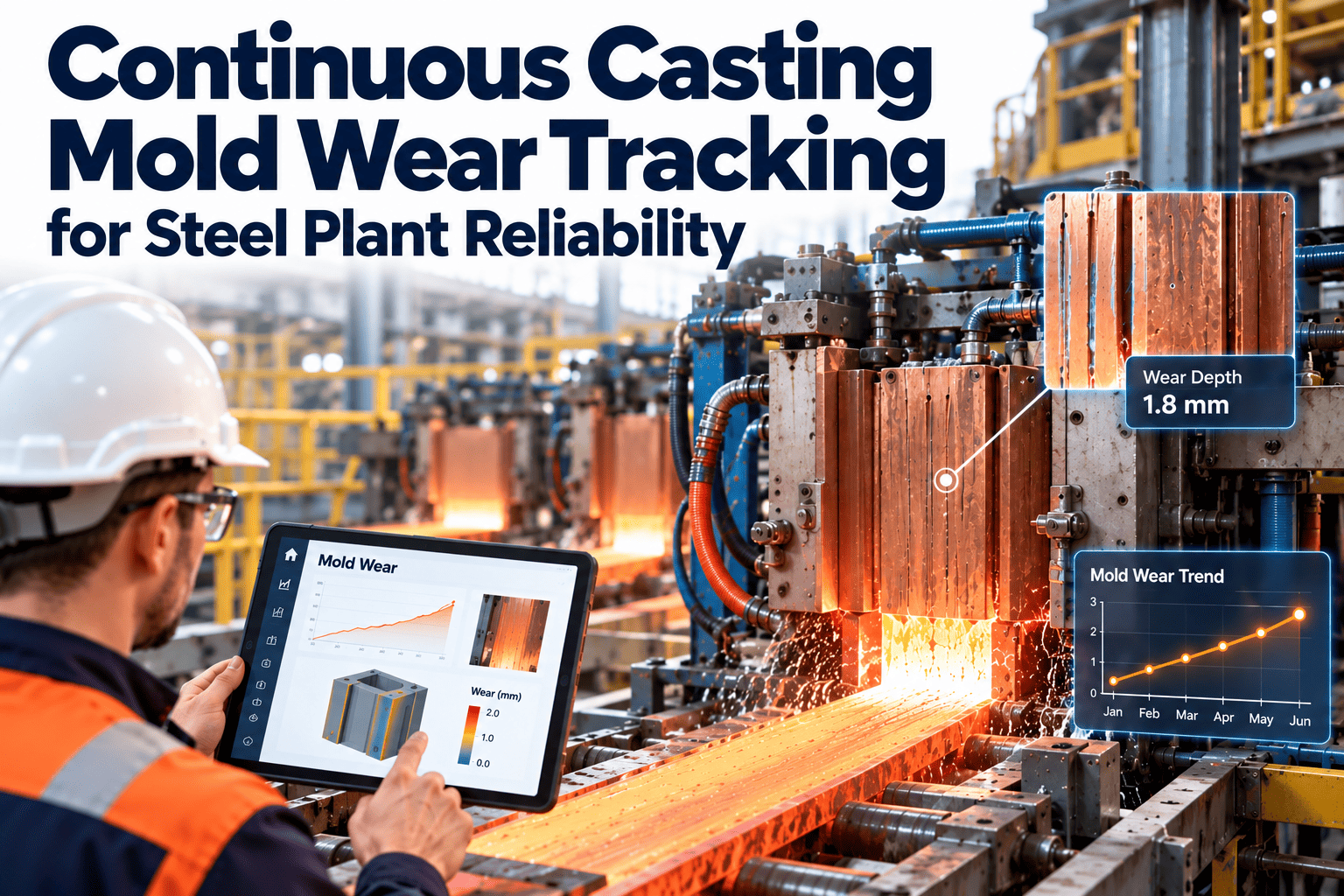
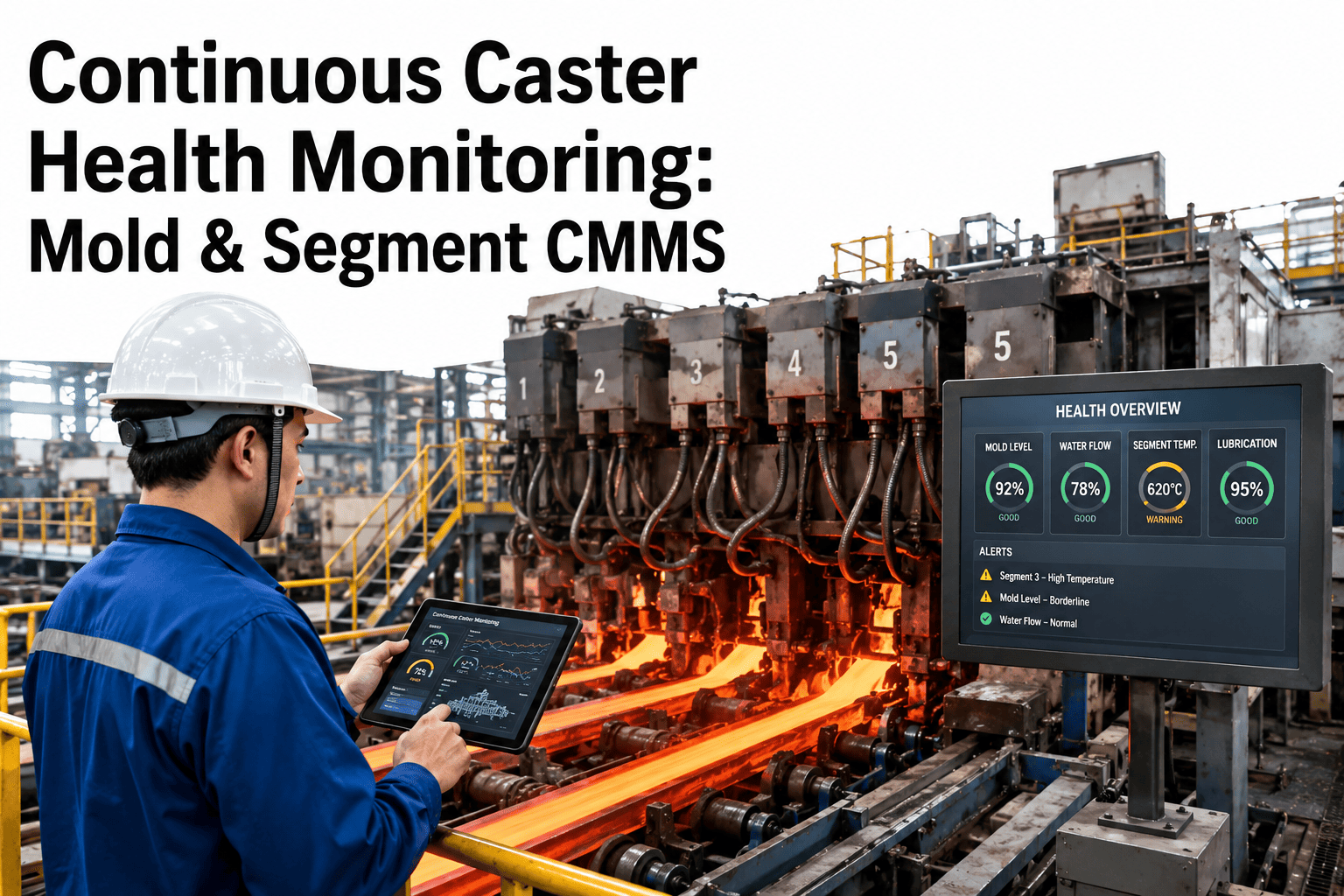
Preventive maintenance based on breakout precursor analysis is equally important. Oxmaint analyzes thermocouple trends across campaigns to identify molds with abnormal thermal patterns, triggering PM inspections before a sticker develops. See Oxmaint's closed-loop breakout prevention workflow — start free.
Alert to Action — CMMS Workflow for Breakout Prevention
1
AI Alert
Prediction confidence >85%
2
CMMS Log
Timestamped event with sensor data snapshot
3
Operator Action
Speed reduction / mold taper / stop
4
Outcome Log
Breakout avoided / occurred
5
Auto WO
Mold inspection / cooling check
IMPACT DASHBOARD
Breakout Prevention ROI — What CMMS-Documented AI Delivers
Breakout Frequency Reduction
-74%
Average across AI-deployed casters
Cost Per Breakout Avoided
$1.8M
Mold damage + lost production + cleanup
Insurance Premium Reduction
-18%
With documented breakout prevention program
Frequently Asked Questions — Caster Breakout Prevention with AI and CMMS
Breakout prediction accuracy, warning time, and CMMS integration for continuous casting
How much warning time does AI breakout prediction provide?
Modern Transformer-based models achieve 8-12 minutes average warning time for sticker breakouts — enough to reduce casting speed by 30-50% and prevent the breakout in 94% of cases.
What sensors are required for breakout prediction AI?
Minimum: mold thermocouple array (12-24 thermocouples), mold friction/oscillation monitoring, and mold level control. Enhanced systems add cooling water delta-T and mold powder sensors.
Can Oxmaint integrate with existing breakout prediction systems?
Yes — Oxmaint receives alerts via API or OPC from any breakout prediction system (VUHZ, Primetals, SMS, Danieli) and creates timestamped records with auto-generated work orders.
What is the cost of a single sticker breakout in a slab caster?
Typical cost: $1.5M–$4M including mold damage ($300K-$800K), lost production ($500K-$1.5M), safety incident investigation, and downstream impact on rolling mills.
How does CMMS documentation help with breakout safety investigations?
Complete records of AI alerts, operator responses, and follow-up inspections provide auditable evidence for OSHA/MSHA investigations, insurance claims, and legal defense.
Can the AI predict breakouts other than sticker type?
Yes — trained models also detect SEN clogging breakouts (level fluctuation patterns) and mold powder-related breakouts, though sticker breakouts remain the most common (65%+ of all cast breakouts).
How often should mold thermocouples be calibrated?
Oxmaint tracks thermocouple calibration schedules — typically every 3-6 months for copper plate TCs, with drift monitoring alerts when readings deviate from expected patterns.
What is the payback period for AI breakout prediction system?
Typical payback: 6-12 months for a 6-strand slab caster (2-3 avoided breakouts per year). Integrated CMMS documentation further reduces insurance premiums by 15-20%.
Ready to Prevent Breakouts?
Connect AI Breakout Prediction to Oxmaint CMMS — Document Every Alert, Auto-Create Work Orders
Live 30-minute demo tailored to your caster configuration — slab, bloom, or billet — and existing automation systems.