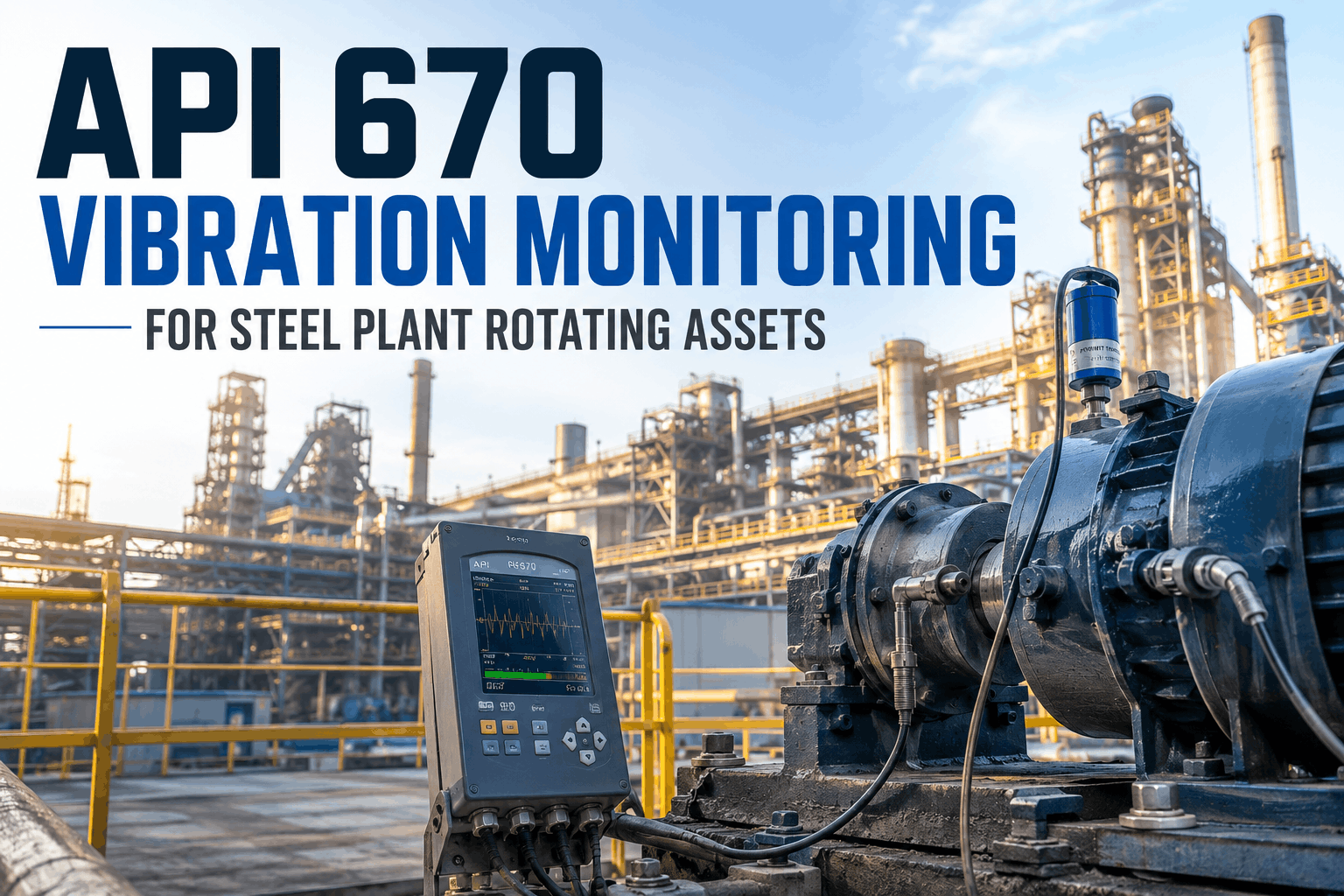
Steel plant rotating assets — blast furnace blowers, compressors, turbomachinery, and large fans — operate at high speeds under extreme loads. API 670 (American Petroleum Institute) defines the gold standard for vibration monitoring on these critical machines, providing continuous protection against catastrophic failure. Compliance with API 670 requires proximity probes, velocity sensors, redundancy (2oo2 or 2oo3 voting logic), and alarm/danger setpoints with time delays. Plant operators with comprehensive API 670-compliant CMMS vibration records pay 12–18% lower insurance premiums than mills without structured turbomachinery monitoring. Underwriters view documented proximity probe calibration, alarm history, and vibration trends as evidence of a well-managed, lower-risk facility — and they price accordingly. Beyond premiums, the speed of root cause analysis after a turbomachinery event is directly tied to documentation quality: mills that can produce complete vibration records from the event window resolve investigations faster with lower liability exposure. OxMaint integrates with API 670-compliant vibration monitoring systems — capturing every alarm, every shutdown, and every maintenance action automatically.
API 670 Vibration Monitoring for Steel Plant Rotating Assets
Comply with API 670 standards for vibration monitoring on BF blowers, compressors, and turbomachinery — complete guide for steel plant reliability engineers and rotating equipment specialists.
API 670 Overview — Protection vs. Prediction
API 670 distinguishes between protection systems (continuous monitoring that can trip the machine) and prediction systems (periodic data collection for trend analysis). Protection systems require redundancy (2oo2 or 2oo3 voting), calibrated proximity probes, and defined alarm/danger setpoints with time delays. Prediction systems can use simpler sensors but must still meet data quality standards. For steel plant critical assets — blast furnace blowers, main air compressors, turbogenerators — full API 670 protection systems are mandatory for insurance and operational safety. OxMaint captures both protection alarm data and prediction trend data — creating a complete vibration history for every rotating asset.
Sensor Types — Proximity Probes, Velocity Sensors, Accelerometers
API 670 specifies three primary sensor types for different measurement objectives. Proximity probes (eddy current) measure shaft relative vibration and position — essential for sleeve bearing machines. Velocity sensors measure casing vibration — standard for rolling element bearings and smaller machines. Accelerometers measure high-frequency vibration — ideal for gearmesh detection and bearing defect identification. Each sensor type requires specific mounting, calibration, and signal conditioning. OxMaint tracks every sensor installation, calibration date, and measurement channel — maintaining complete API 670 documentation.
| Sensor Type | Measurement | Application | API 670 Spec | Mounting |
|---|---|---|---|---|
| Proximity Probe (Eddy Current) | Shaft relative vibration · Displacement · Thrust position | Sleeve bearing machines · Blast furnace blowers · Turbines | Sec 5.1.1 — 5mm or 8mm probe | Radial or axial — bracket or housing mount |
| Velocity Sensor (Seismic) | Casing absolute velocity · Bearing housing vibration | Rolling element bearings · Medium machinery · Pumps | Sec 5.2 — 4–1000 Hz response | Stud mount or magnetic base — single axis |
| Accelerometer (Piezoelectric) | High-frequency acceleration · Gearmesh · Bearing defects | Gearboxes · High-speed compressors · Fans | Sec 5.3 — 0.5–10 kHz typical | Stud mount — single or triaxial |
| Key Phasor (1 per revolution) | Phase reference · Speed measurement · Shaft triggering | All rotating machines for orbit/bode analysis | Sec 5.4 — once-per-rev signal | Radial probe mounted to shaft keyway |
Redundancy Architecture — 2oo2 and 2oo3 Voting Logic
API 670 requires redundant monitoring channels for protection systems. 2oo2 (two out of two) means both channels must exceed the alarm setpoint to trigger — prevents single-channel false trips but requires dual failure for missed detection. 2oo3 (two out of three) is the preferred configuration: any two channels exceeding setpoint trigger the alarm, providing both false-trip immunity and missed-detection coverage. For steel plant blast furnace blowers and main compressors, API 670 specifies dual-channel minimum, with triple-channel recommended for critical assets. OxMaint logs every channel reading and voting outcome — creating an auditable protection system record.
Alarm & Danger Setpoints — Configuration Best Practices
API 670 requires distinct alarm and danger setpoints with time delays. Alarm setpoints (typically 1.0–1.5 mm/s velocity or 2–4 mils displacement) provide early warning before damage occurs. Danger setpoints (typically 1.5–2× alarm) trigger machine shutdown. Time delays (minimum 3 seconds per API 670) prevent nuisance trips from transient events. For steel plant critical assets, many operators use trend-based alerting alongside fixed setpoints — the CMMS tracks baseline vibration and alerts when any channel exceeds 2× historical baseline. OxMaint stores setpoint configurations, tracks exceedances, and records operator responses — maintaining complete API 670 compliance records.
CMMS Integration — Capturing Vibration Alarms, Trends, and Work Orders
API 670 systems generate continuous data — but that data only creates value when integrated with your CMMS. OxMaint connects directly to API 670 monitoring racks (Bently Nevada, Emerson, Meggitt, etc.) via Modbus, OPC, or digital outputs. Every alarm event (channel, timestamp, magnitude, duration) is logged automatically. Trending data feeds predictive models — vibration magnitude increases over time trigger PM inspections before setpoints are exceeded. When danger setpoints trip, OxMaint auto-creates emergency work orders and notifies reliability engineers. The complete record supports insurance audits and root cause analysis. Connect your API 670 system to OxMaint — automate alarm logging and work order generation.
Our blast furnace blower is a single point of failure — if it trips, the furnace goes down. After upgrading to API 670-compliant monitoring with 2oo3 voting and connecting to OxMaint, we captured a developing subsynchronous vibration that would have destroyed the $2.8M blower within 72 hours. The alarm triggered a planned shutdown, we replaced the bearing, and avoided catastrophic failure. Our insurer reduced our premium by 16% after reviewing our API 670 compliance records.
Frequently Asked Questions — API 670 for Steel Plants
Protect Your Critical Rotating Assets with API 670 Compliance
Alarm logging · Trend analysis · CMMS integration — all in one platform. Free to start.