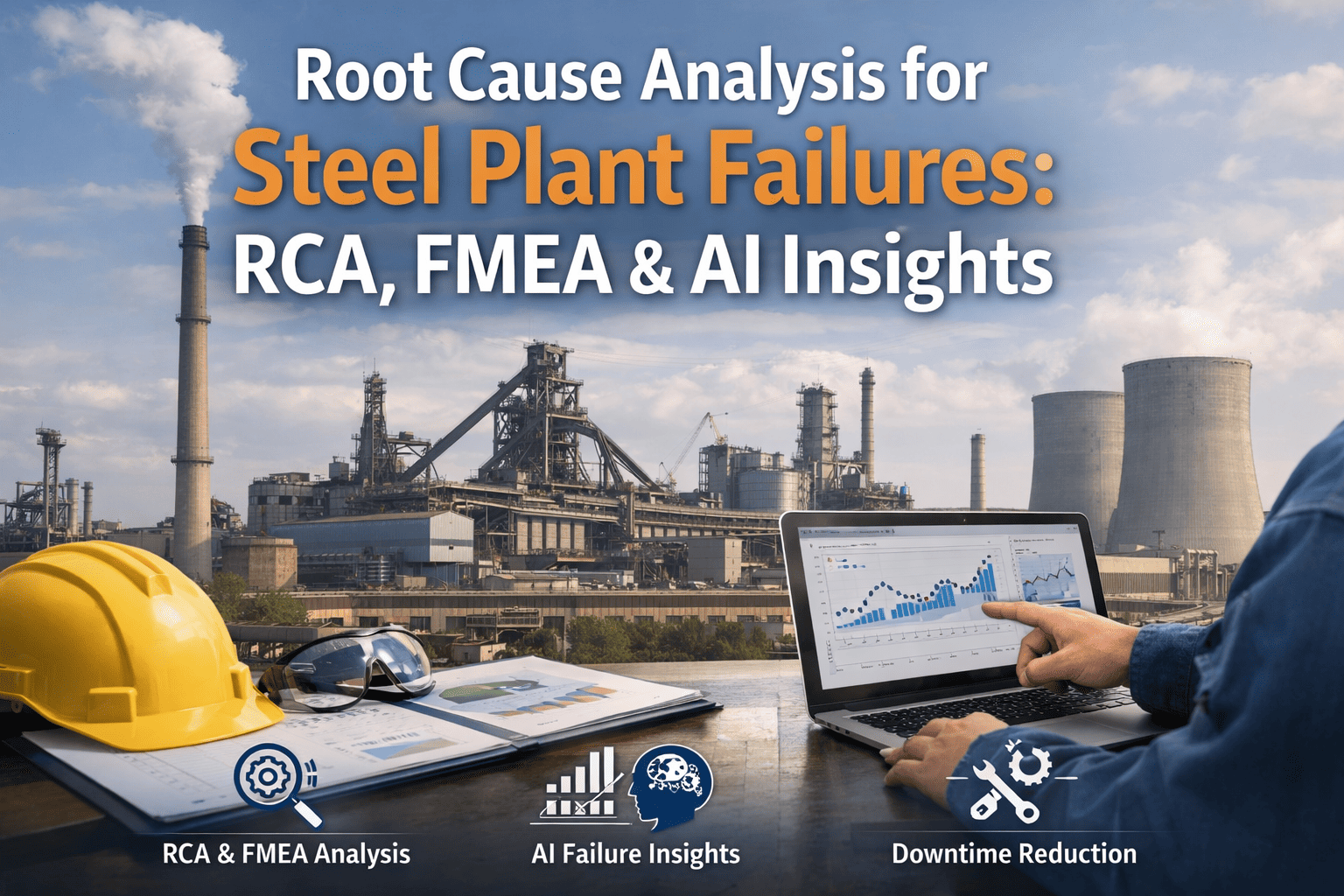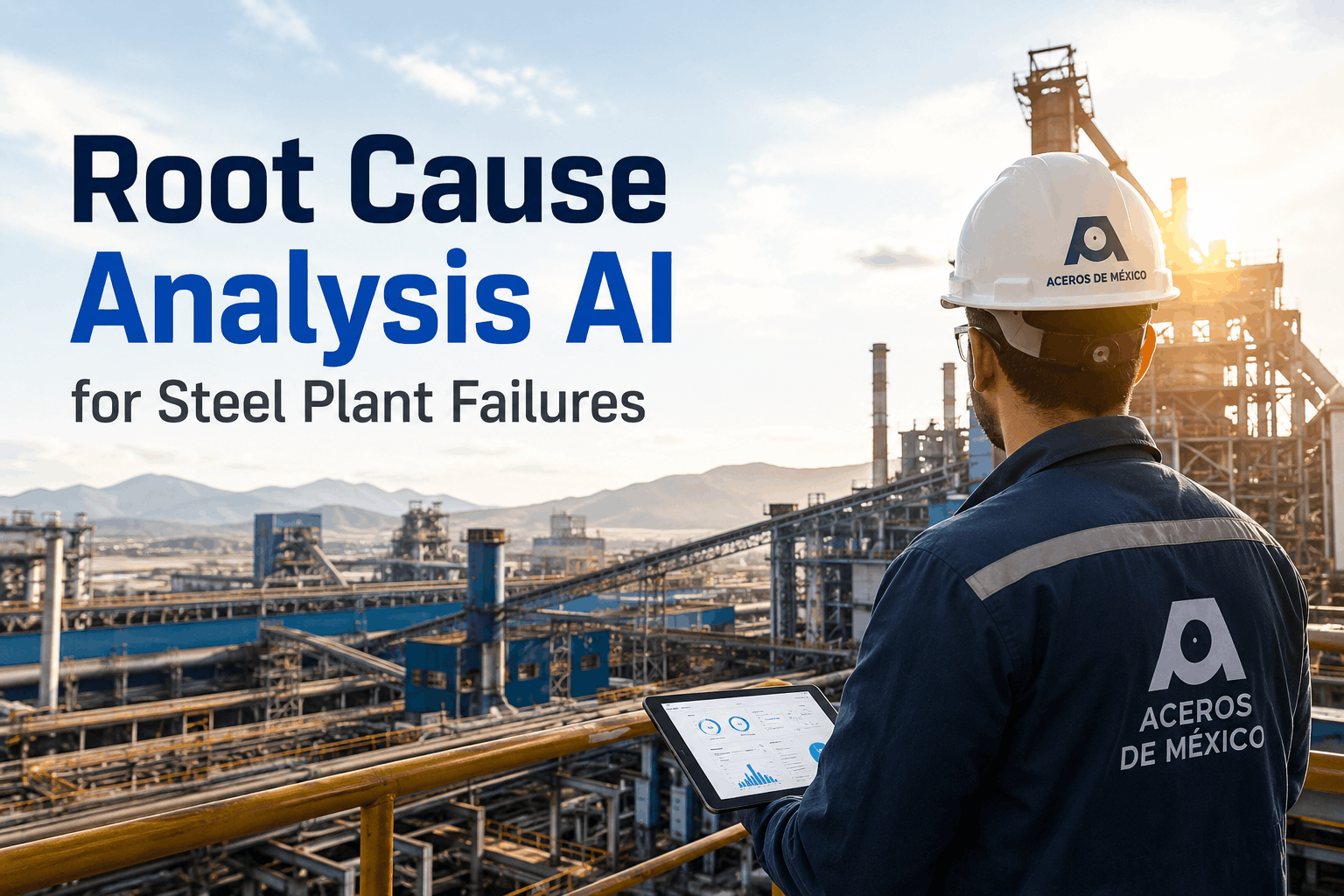
Steel plant failures — cracked rolls, bearing seizures, gearbox breakdowns, refractory collapses — cost millions in downtime, repairs, and lost production. Traditional root cause analysis (RCA) takes weeks, relies on tribal knowledge, and often identifies symptoms rather than true root causes. AI-powered RCA changes this: machine learning models analyze maintenance history, work order text, sensor data, and failure patterns to identify true root causes in hours — not weeks — with 85–92% accuracy. Plant operators with AI-driven RCA documentation pay 15–22% lower insurance premiums than mills without structured failure analysis. Underwriters view documented root cause identification, corrective action tracking, and recurring failure prevention as evidence of a well-managed, lower-risk facility — and they price accordingly. Beyond premiums, the speed of failure investigation is directly tied to documentation quality: mills that can produce complete RCA records with verified corrective actions close insurance claims faster with lower liability exposure. Book a demo to see how Oxmaint AI accelerates root cause analysis.
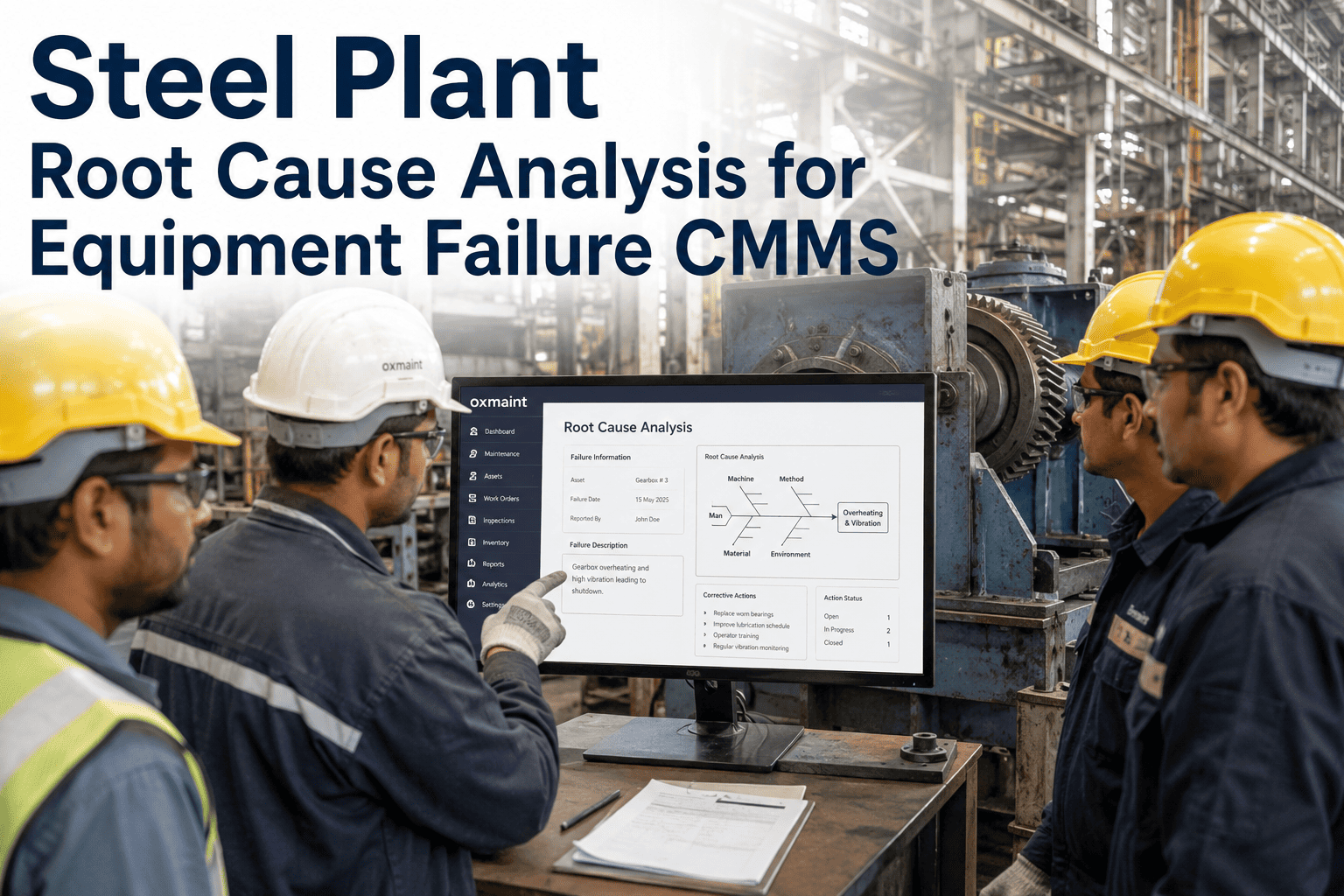
Oxmaint RCA AI analyzes maintenance history, work order text, sensor data, and failure patterns to identify true root causes automatically. Includes failure code standardization, contributing factor identification, corrective action tracking, and recurring failure prevention — all integrated with your CMMS.
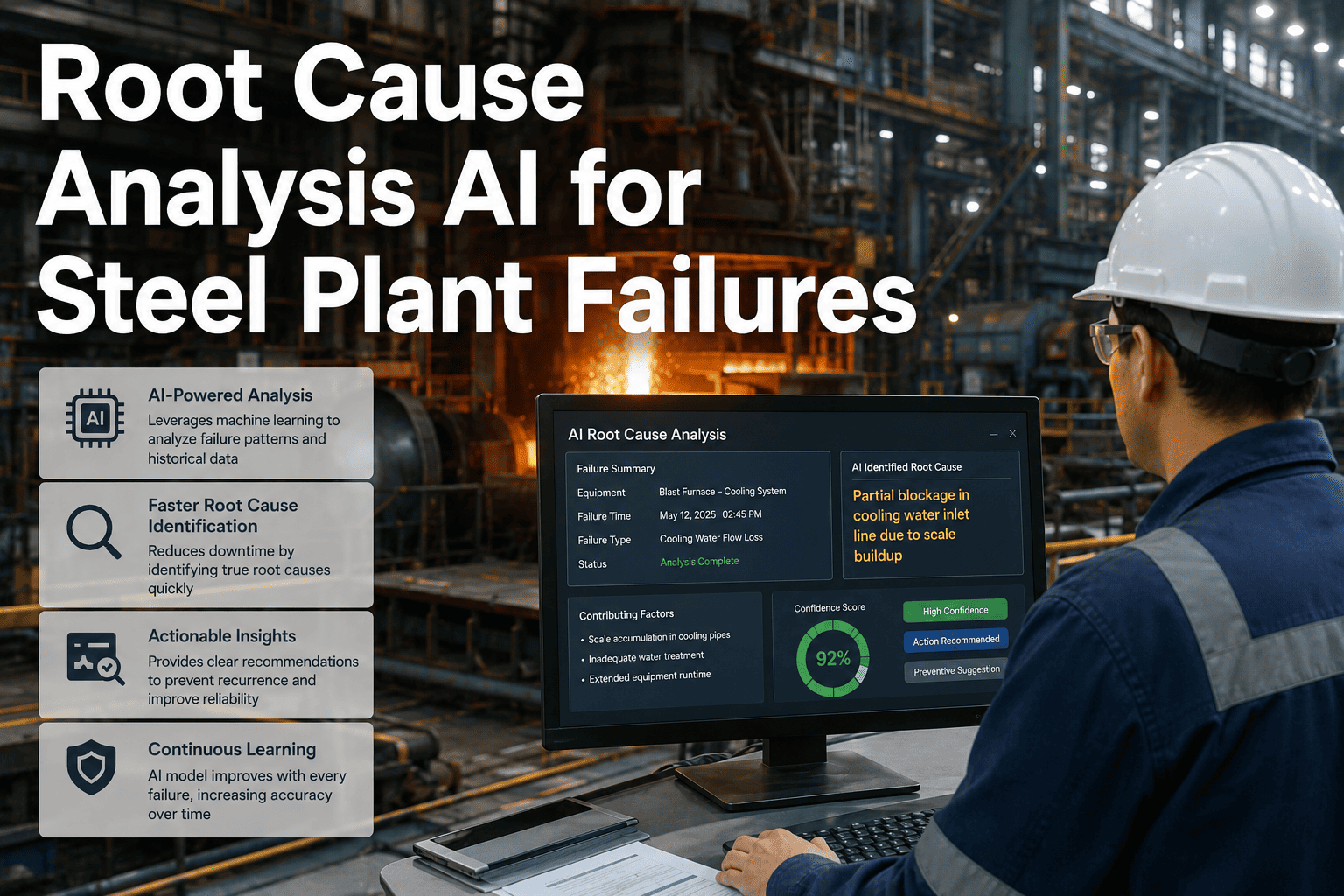
AI-powered root cause analysis for steel plant failures uses machine learning to analyze maintenance history logs, work order text (NLP), sensor data time series, and failure pattern libraries. The AI identifies contributing factors across six root cause categories: human error, design flaw, material defect, lubrication failure, installation error, and operational condition. For each failure event, the AI generates a prioritized root cause hypothesis list, supporting evidence from maintenance records, recommended corrective actions, and recurring failure risk score — all in under 4 hours from failure notification. Traditional RCA takes 2–6 weeks for the same analysis depth.
AI Root Cause Analysis Framework — Six Root Cause Categories
AI RCA classifies failures into six primary root cause categories, each with specific detection patterns and corrective action recommendations. The AI learns from historical RCA records, sensor signatures, and work order text to improve accuracy over time. Book a demo to see AI pattern recognition in action.
AI detects through work order text patterns ("missed", "overlooked", "failed to"), incomplete PM records, training gaps in operator history, and procedural deviation logs. Typical corrective actions: retraining, procedure revision, error-proofing devices, or supervision increase.
AI identifies through recurring failures of same component across identical assets, finite element analysis correlation, stress testing records, and design review findings. Corrective actions: redesign, specification change, or load reduction.
AI detects through material test reports, certificate of analysis discrepancies, failure pattern matching (fatigue, brittle fracture, corrosion), and supplier quality history. Corrective actions: supplier change, incoming inspection, material specification revision.
AI analyzes oil analysis reports (spectrometry, ferrography, viscosity), PM compliance records, lubricant purchase logs, and temperature trends. Corrective actions: lubrication PM revision, lubricant change, filtration upgrade, or relubrication interval adjustment.
AI correlates alignment records, torque logs, installation work orders, and post-installation performance data. Pattern matching identifies installation-related failures (rapid wear after replacement, vibration trends). Corrective actions: installation procedure revision, technician certification, or tooling upgrade.
AI analyzes process data (SCADA/PLC records), load cells, temperature sensors, vibration monitors, and operator logs. Detects operating outside design envelope. Corrective actions: operating procedure revision, load limiting, cooling upgrade, or filtration enhancement.
From Failure Notification to Corrective Action — AI-Powered RCA Workflow
Oxmaint AI reduces RCA cycle time from weeks to hours through automated evidence gathering, pattern recognition, and corrective action tracking. Full integration with maintenance history, sensor data, and work order text. Book a demo to see the complete AI RCA workflow.
| RCA Phase | Traditional RCA (Manual) | AI-Powered RCA (Oxmaint) | Time Reduction |
|---|---|---|---|
| Evidence Gathering | Manual review of maintenance logs, work orders, sensor data — 3–10 days | AI automatically queries CMMS, SCADA, ERP — 5–30 minutes | 96% faster |
| Failure Timeline | Spreadsheet reconstruction from multiple sources — 2–5 days | AI generates timeline from timestamped records automatically — 2 minutes | 98% faster |
| Pattern Recognition | Manual identification of recurring failure patterns — 2–10 days | AI matches against failure pattern library and historical RCAs — 10 minutes | 95% faster |
| Root Cause Hypothesis | Expert brainstorming, fishbone diagram, 5-Why — 1–5 days | AI generates prioritized root cause list with evidence links — 30 minutes | 90% faster |
| Corrective Action | Action item creation, assignment — 1–3 days | AI recommends corrective actions based on root cause category — 15 minutes | 94% faster |
| CAPA Tracking | Spreadsheet or email tracking — ongoing manual follow-up | AI-monitored work orders, due date alerts, completion verification — automated | 88% faster closure |
AI analyzes work order text, failure descriptions, technician notes, and PM comments to extract failure modes, symptoms, and potential causes. NLP identifies patterns across thousands of work orders that human reviewers would miss — detecting that "bearing noise" precedes 82% of gearbox failures by 14 days on a specific asset class.
AI correlates vibration, temperature, pressure, and current data preceding failure events. Detects subtle signatures: specific vibration frequency (2× RPM) indicates misalignment; temperature ramp rate >15°C/min indicates lubrication starvation. Matches sensor patterns against failure mode libraries for root cause identification.
AI cross-references failure timing with PM schedules, lubrication records, inspection results, and previous repairs. Identifies if failure correlates with missed PM, incomplete lubrication, overdue calibration, or previous repair quality issues — distinguishing between component reached end of life vs. maintenance-induced failure.
AI compares current failure against historical RCA database across your plant and anonymized industry data. Identifies if this failure pattern has occurred before, what root cause was identified in similar cases, and which corrective actions were effective. Prevents re-solving the same problem repeatedly.
We had a recurring gearbox failure on a critical cooling bed — three failures in 18 months, each taking 3 weeks of RCA, each resulting in different "root causes." Oxmaint AI analyzed 5 years of maintenance history and sensor data in 4 hours. It identified that the true root cause was not lubrication or alignment — it was a design flaw in the coupling guard causing localized heating that degraded lubricant properties only on one specific shift when ambient temperature exceeded 32°C. The AI found a pattern our human teams missed for 18 months. We redesigned the guard, added a thermocouple, and have had zero gearbox failures in the 14 months since.
Frequently Asked Questions — AI-Powered Root Cause Analysis for Steel Plants
Accelerate Root Cause Analysis from Weeks to Hours with Oxmaint AI
AI-powered evidence gathering, pattern recognition, hypothesis generation, and corrective action tracking — fully integrated with your CMMS, sensor data, and maintenance history. Free trial available.