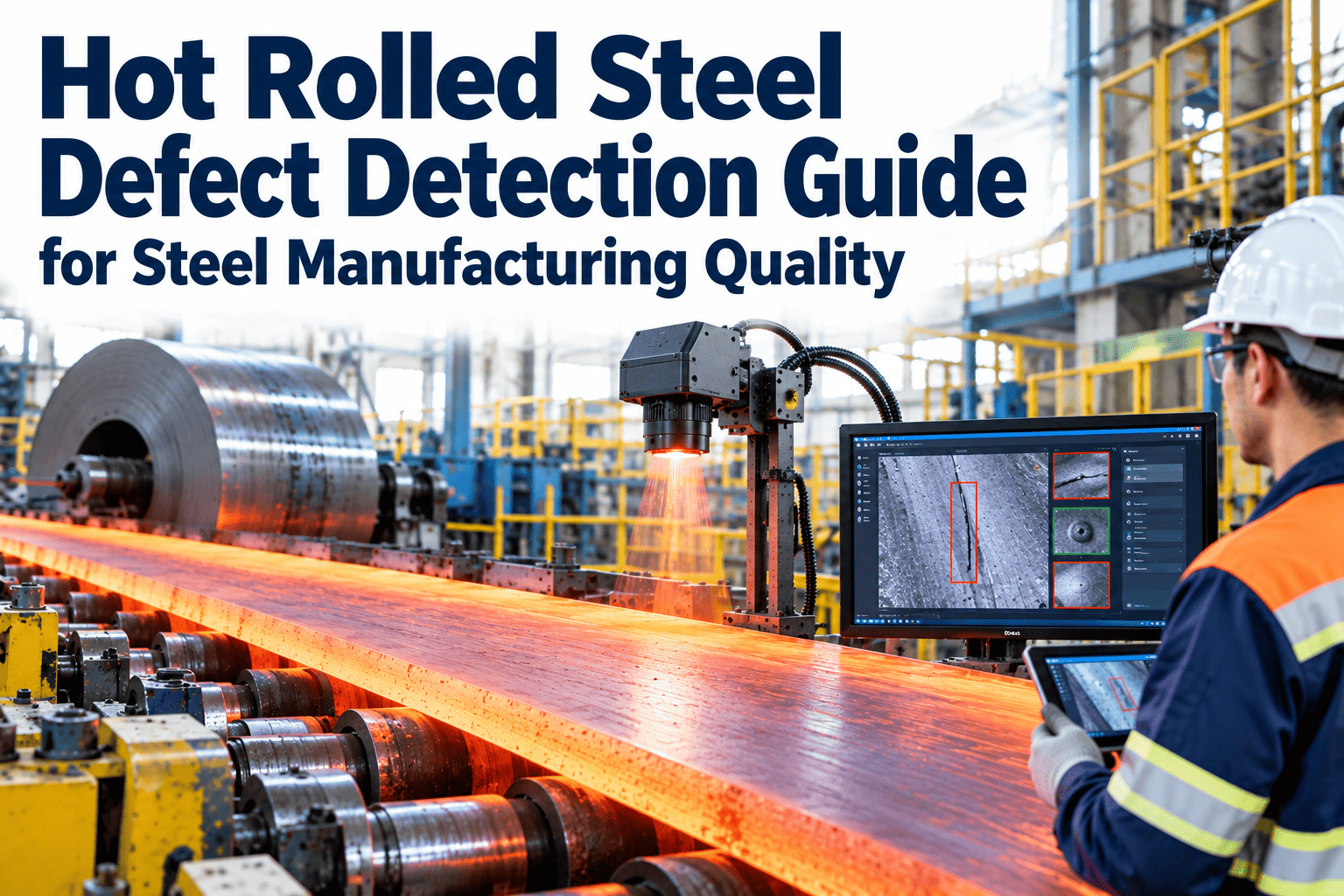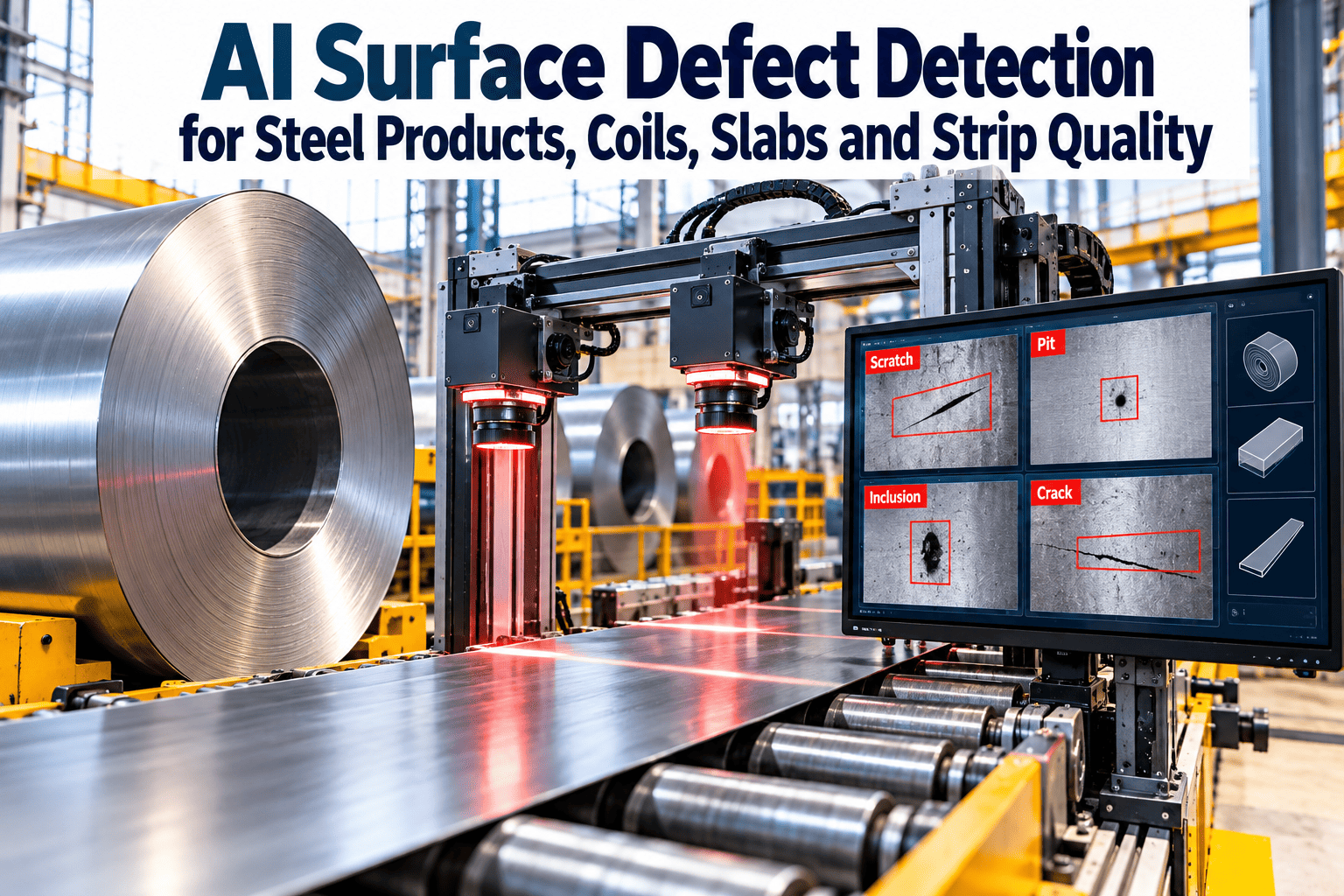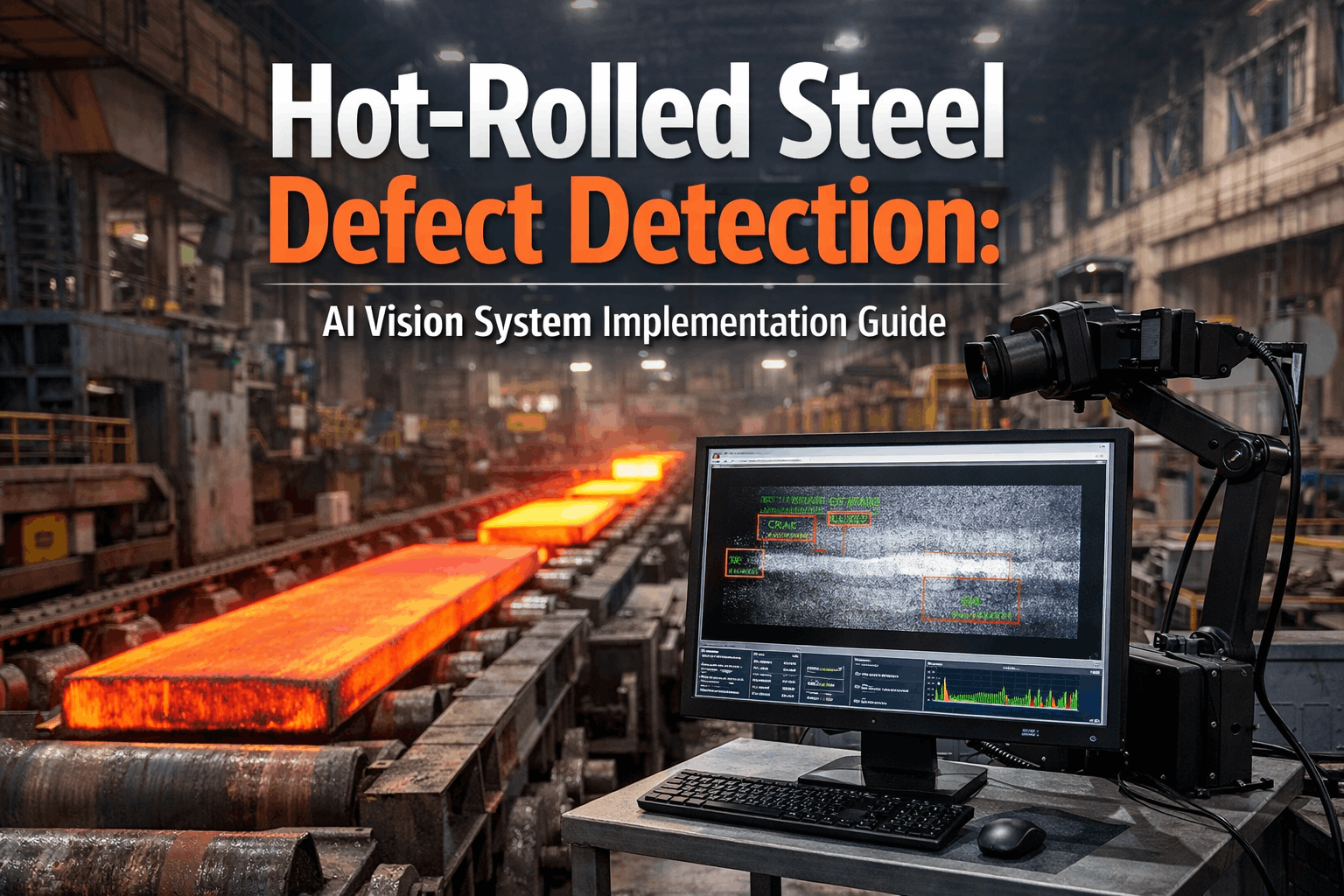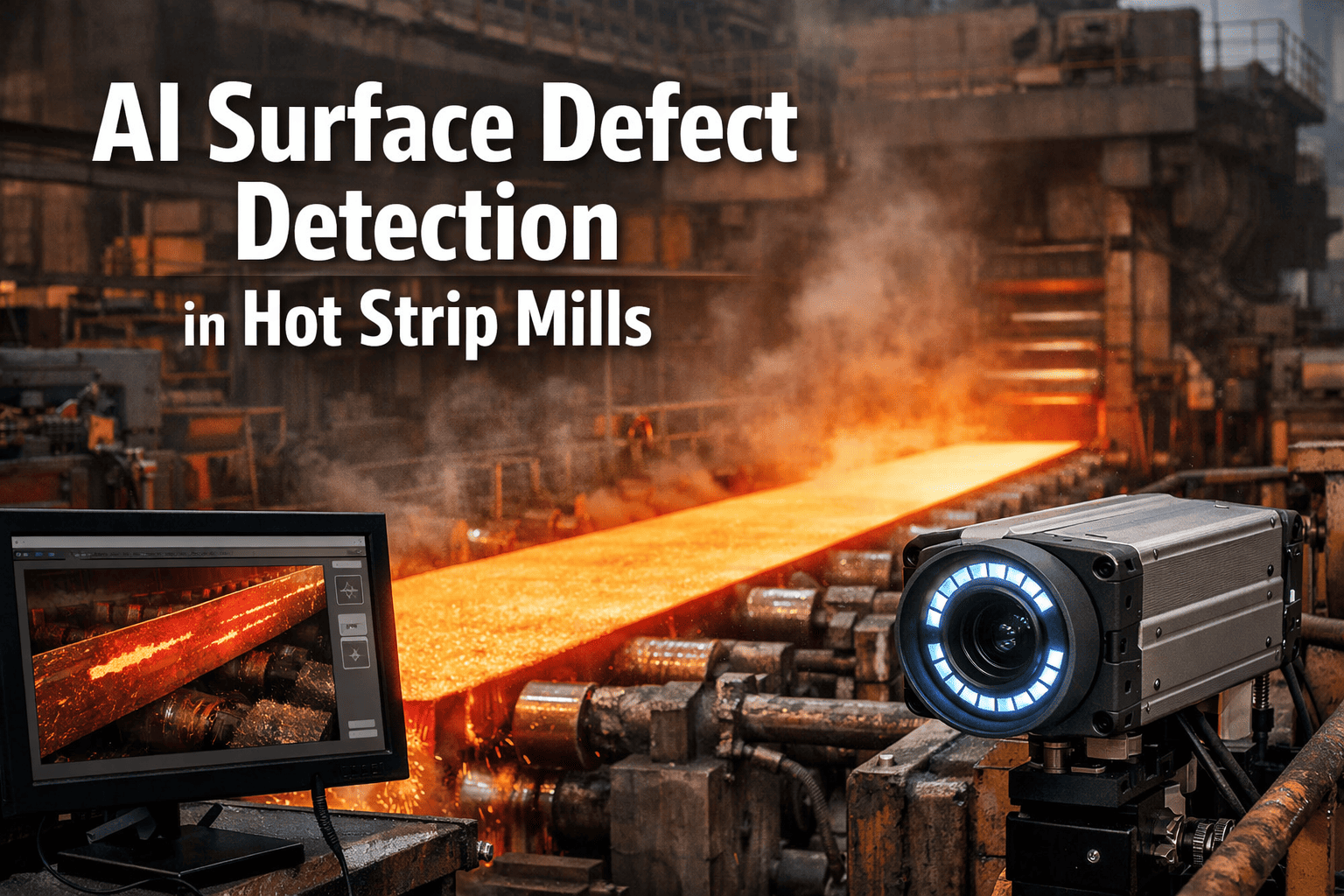
A hot strip mill producing steel at 900°C and 15 m/s generates a new metre of surface every 67 milliseconds — speeds at which human inspectors catch only 45–60% of surface defects, dropping to 40% on the last hours of a night shift. The defects that escape don't disappear; they show up six months later as automotive stamping cracks, paint adhesion failures, and customer claims worth millions. Oxmaint's AI Vision Inspection module detects and classifies 200+ defect types at line speeds up to 2,000 m/min with 95–99% accuracy, auto-generates maintenance work orders when defect patterns trace to upstream equipment, and turns every coil into a documented quality record — closing the loop from detection to root-cause maintenance action.
The Eight Defect Families Every Hot Strip Mill Produces
Steel surface defects are not one problem — they are eight visually distinct families, each with its own signature and its own upstream root cause. A defect caught at the mill exit but traced back to the caster is worth more than the coil itself, because the fix prevents the next thousand coils. CNN-based defect classification identifies the family from image data in milliseconds.
Scratches & Scuffs
Linear damage parallel to rolling direction from guide contact, roll table issues, or coiler damage. Low-angle dark-field lighting reveals them. AI detection: 96–99%.
Roll Marks & Imprints
Periodic impressions repeating at exact roll circumference intervals — a direct fingerprint of work roll damage. AI matches periodicity to specific roll IDs. Detection: 97–99%.
Scale Residue & Rolled-In Scale
Oxide scale pressed into the surface during rolling. Traces to descaler pressure drops or reheat furnace timing. AI correlates scale density with descaler PSI data. Detection: 94–97%.
Pitted Surface
Small non-periodic depressions from scale detachment, corrosion, or roll surface degradation. Often misclassified by inspectors; AI distinguishes pits from inclusions with texture analysis. Detection: 93–96%.
Inclusions & Slivers
Non-metallic particles (alumina, silicates) trapped during solidification. Appear as reddish-brown or light yellow streaks. The defect family human inspectors miss most. AI detection: 92–96%.
Lamination & Seams
Internal separations exposed at the surface, propagated from caster defects. Often invisible until downstream processing. AI detects sub-surface signatures via contrast analysis. Detection: 90–95%.
Edge Cracks & Tears
Longitudinal cracks at strip edges from thermal stress, composition issues, or improper rolling reduction. Critical for downstream forming operations. AI detection: 96–99%.
Crazing & Patches
Network of fine cracks (crazing) or discoloured regions (patches) from temperature non-uniformity or chemistry variation. Part of the six-class NEU-DET benchmark dataset. Detection: 95–98%.
The AI Vision Pipeline — Pixel to Work Order in Under 50 Milliseconds
A production-grade AI surface inspection system runs as a 5-stage pipeline. Each stage must complete before the inspected strip section leaves the imaging zone — because the next section is already arriving. The architecture below reflects current state-of-the-art deployed in world-class mills.
Line-Scan Capture
16,000–32,000 pixel line-scan cameras at 40,000+ lines/sec. Top and bottom surfaces captured simultaneously. Water-cooled, air-purged IP67+ housings rated for 900°C strip environment. Resolution: 0.1–0.5 mm/pixel.
Multi-Geometry LED Array
Bright-field, dark-field, and structured light combined in a single pass. Different defect types require different geometries — scratches need low-angle dark-field; inclusions need bright-field; roll marks need structured patterns.
GPU Pre-Processing
500–2,000 frames/sec processed on NVIDIA GPU edge servers. Image normalisation, background subtraction, feature extraction in under 10 ms per frame. 2–8 GB/sec data throughput. Redundant architecture prevents loss.
CNN / ViT Classification
Deep CNN and Vision Transformer models trained on 5–10 M labelled defect images. Classifies 200+ defect types by category, severity (1–5), and dimensions. Transfer learning adapts to plant-specific grades.
MES + CMMS Closed Loop
Defect data flows to Level 2 MES for coil grading. Patterns tied to equipment (periodic roll marks → roll change, scale clusters → descaler service) auto-generate Oxmaint work orders with defect evidence attached.
Live Defect Feed — What Closed-Loop Quality Actually Looks Like
When the AI vision system classifies a defect pattern, it does not just flag the coil — it traces the defect to the upstream equipment condition that caused it and generates a maintenance work order before the next coil enters the mill. The feed below shows what that closed loop looks like in real operation.
Every Undetected Defect Is a Claim Waiting to Happen. Catch It Before the Customer Does.
Oxmaint connects AI vision output to your CMMS so defect patterns trigger maintenance work orders automatically — turning quality inspection from a filter into a prevention system.
Defect Pattern → Root Cause Equipment Map
The highest value of AI vision is not catching defects — it is preventing them. When defect patterns are systematically traced to upstream equipment conditions, the mill stops producing the defect rather than sorting coils after the fact. The mapping below reflects the most common defect-to-equipment relationships tracked in a modern steel plant.
| Defect Pattern | Suspected Root Cause | Upstream Asset | Auto Work Order |
|---|---|---|---|
| Periodic marks at fixed interval | Work roll surface damage | Finishing roll stand | Roll change inspection |
| Rolled-in scale clusters | Descaler pressure drop / blocked nozzle | Descaler headers | Descaler nozzle PM |
| Increasing scratch density | Guide wear / roll table damage | Entry / exit guides | Guide alignment check |
| Edge cracks — drive side | Caster oscillation / tundish condition | Continuous caster | Caster mould review |
| Inclusions / slivers | Tundish nozzle erosion / ladle slag | Steelmaking / caster | Tundish inspection |
| Heat stains — asymmetric | Cooling header non-uniformity | Run-out table cooling | ROT header flow check |
| Surface roughness drift | Roll campaign ageing | Finishing roll campaign | Roll change trigger |
ROI — Where the Money Actually Is
"The steel mills that extract the most value from AI vision are the ones that stop treating it as quality control and start treating it as process intelligence. Yes, you will catch more defects and reduce downgrades — that is the baseline ROI. But the real transformation happens when your vision system tells you that rolled-in scale defects spike every time descaler pressure drops below 2,800 PSI, and that signal auto-generates a maintenance work order before the next coil enters the mill. You have just identified a maintenance trigger that prevents thousands of tons of downgrades. That is the defect-to-equipment closed loop, and it is only possible when the vision system, the process historian, and the CMMS share a single data model."